PART 2 — THE FABRIC THAT CHANGED EVERYTHING
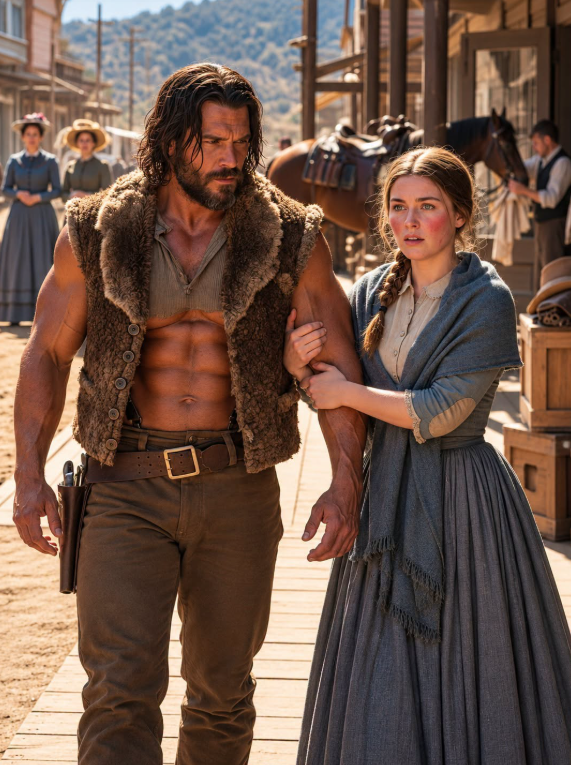
PART 2 — THE FABRIC THAT CHANGED EVERYTHING
The young woman followed Micah Montgomery into Morrison’s General Store, still uncertain whether she had just been rescued from humiliation or drawn into another kind of trouble.
The three ladies remained outside.
Mrs. Henderson watched through the window, her mouth pinched with disapproval.
Inside, the store smelled of coffee, leather, and fresh-cut pine. Bolts of fabric lined the shelves in orderly rows: calico, muslin, wool, and cotton in colors Clara had not seen in years.
Micah removed his hat.
“Name’s Micah Montgomery,” he said. “And I realized I never asked yours.”
“Clara Whitmore.”
“Well, Miss Whitmore, I need shirts that won’t fall apart after a week in the mountains. I was told you’re skilled with a needle.”
Clara glanced at him.
“Who told you that?”
Micah looked toward the window.
“Your sтιтches did.”
For the first time that morning, Clara almost smiled.
She approached the fabric shelves, running her fingers over the different materials.
“This heavy cotton would last,” she explained. “But if you want something warmer, wool is better. Though it costs more.”
“Then we’ll get what lasts.”
Clara turned toward him.
“How many shirts do you need?”
“Four.”
She began calculating the cost.
Micah watched her carefully.
She knew fabric. She knew how to compare quality, how to judge a seam, how to recognize when a merchant was charging too much.
She spoke with confidence when discussing the work.
But when the storekeeper asked how much she wanted for helping, her voice became small.
“Whatever you think is fair, sir.”
Micah frowned.
“Your work deserves a fair price. You tell me.”
Clara hesitated.
“Fifty cents?”
The storekeeper raised his eyebrows.
“For advice and sewing?”
Clara’s cheeks reddened.
“I could do more, if you’d like.”
Micah looked at the man behind the counter.
“She’s worth more than fifty cents.”
He purchased the fabric, then turned to Clara.
“Would you be willing to make the shirts? I’ll pay you for the labor.”
She stared at him.
“You’re asking me to sew for you?”
“That’s what I said.”
“Not as charity?”
 Micah’s expression softened.
“No, ma’am. As work.”
Clara looked down at the bolts of fabric.
She had spent years being told that her hands were useful only when they were serving someone else. Her father had never been cruel, but he had been poor, and poverty had a way of making every kindness feel like a debt.
“Then yes,” she said quietly. “I’ll make them.”
Micah nodded.
“Good.”
He added a small bolt of blue cotton to the purchase.
Clara noticed.
“That isn’t for your shirts.”
“No.”
“Then who is it for?”
Micah lifted the fabric.
“For the woman who knows how to make a fine dress out of scraps.”
Clara stepped back.
“Oh, I couldn’t accept that.”
“Why not?”
“Because I don’t need you to buy me a dress.”
Micah considered her words.
Then he set the fabric down.
“You’re right. You don’t.”
He turned to the storekeeper.
“Put that bolt aside. Miss Whitmore can decide what she wants to do with it after she’s finished my shirts. I’ll pay her the full price for her work, and she can purchase the cloth herself if she chooses.”
Clara looked at him.
It was a small distinction.
But it meant everything.
He was not offering to save her.
He was offering her a choice.
Outside, Mrs. Henderson had not gone far.
When Clara emerged with Micah, the older woman stepped directly into their path.
“Well, Miss Whitmore. I see you’ve found yourself a benefactor.”
Clara stiffened.
Micah remained calm.
“She’s found herself a customer.”
Mrs. Henderson gave a thin smile.
“I do hope you understand what you’re doing, Mr. Montgomery. A woman with no proper means can easily mistake kindness for something else.”
Micah looked at her.
“And a woman with plenty of means can mistake cruelty for good manners.”
The other two ladies exchanged glances.
Mrs. Henderson’s face darkened.
“You’ll regret speaking to me that way.”
Micah placed his hat back on his head.
“I doubt it.”
He turned to Clara.
“Would you like me to walk you home?”
She shook her head.
“I can manage.”
“Then I’ll see you when the shirts are ready.”
He mounted his horse and rode away.
Clara stood on the sidewalk, the small parcel of sewing supplies tucked under her arm.
For the first time in a long while, she did not feel ashamed of her dress.
She felt angry.
And the anger gave her strength.
Clara lived with her father in a small cottage on the outskirts of Petaluma.
Her mother had died when Clara was fifteen, leaving behind a sewing basket, a few dresses, and a daughter who had learned to mend before she had learned to dream.
Her father, Thomas Whitmore, worked wherever he could find employment. Lately, the work had grown scarce.
When Clara returned home that afternoon, he was sitting at the kitchen table with a stack of bills.
He looked up.
“How was town?”
Clara set down the parcel.
“I found work.”
Thomas frowned.
“With whom?”
“Micah Montgomery. He’s having me make shirts.”
Her father looked surprised.
“That mountain man?”
“Yes.”
Thomas studied her face.
“Did he treat you properly?”
Clara thought about the question.
“Yes. He did.”
She told him what had happened outside the store.
Thomas’s expression grew troubled.
“Those women have been cruel to you for years.”
“I know.”
“I should have done more.”
Clara sat across from him.
“You did what you could, Father.”
He shook his head.
“Not enough.”
Clara glanced at the bills.
“How much do we owe?”
Thomas tried to hide them.
“Nothing you need to worry about.”
But Clara saw the bank notice beneath the papers.
The cottage was at risk.
She looked at her father.
“How long?”
Thomas’s shoulders slumped.
“Thirty days.”
Clara felt the familiar weight of helplessness settle over her.
Then she looked at the sewing parcel.
For once, she had work that was hers.
And she intended to make it count.
The next week, Clara worked from dawn until late evening.
She cut the fabric carefully, measured each seam, and made sure every shirt would withstand the rough life Micah lived in the mountains.
She had just finished the third shirt when a knock sounded at the door.
Micah stood outside.
He carried a sack of flour and a small wooden box.
“I came to check on the work,” he said.
Clara stepped aside.
“The shirts are nearly finished.”
Micah glanced around the cottage.
The furniture was old but clean. A small fire burned in the stove. Clara’s sewing basket sat beside the window.
Her father was asleep in the next room.
Micah set the flour on the table.
“Your father mentioned he was short on supplies.”
Clara’s face тιԍнтened.
“I didn’t ask him to tell you that.”
“No. He didn’t.”
She looked at the sack.
“Then why bring it?”
“Because I had flour to spare.”
Clara folded her arms.
“Mr. Montgomery, I appreciate your kindness. But I don’t want you thinking I need to be rescued.”
Micah nodded slowly.
“I don’t think that.”
“Then what do you think?”
He looked at her sewing.
“I think you’re a woman who has been working hard for a long time. I think people have mistaken your poverty for a weakness. And I think you deserve to be treated with respect.”
Clara’s eyes stung.
She looked away.
Micah placed the wooden box beside the flour.
“There’s something else.”
She opened it.
Inside were several spools of thread, a pair of sharp sewing scissors, and a small measuring tape.
Clara stared.
“These are expensive.”
“Good tools should be.”
“I can’t accept them.”
Micah took a step back.
“Then consider them an advance on the next shirts.”
Clara looked at him.
“You’re planning to order more?”
“If the first four fit.”
A small laugh escaped her.
“Then I suppose I’d better make them fit.”
Micah’s mouth lifted in a faint smile.
“That’s what I was hoping.”
Two days later, Clara delivered the shirts to Micah’s cabin.
The journey took most of the afternoon.
The mountain road was steep and narrow, and the weather had begun to turn. By the time she reached the clearing, the sky was dark with clouds.
Micah was outside splitting wood.
He stopped when he saw her.
“You shouldn’t have come alone in this weather.”
“I wanted to deliver the shirts myself.”
He wiped his hands and examined the bundle.
The shirts were beautifully made.
The seams were strong, the cuffs reinforced, and the collars fitted to his measurements.
Micah held one up.
“These are excellent.”
Clara smiled.
“I’m glad.”
He paid her the agreed amount.
Then he offered her a cup of coffee.
She accepted.
They sat on the porch while the wind moved through the pines.
For a while, neither spoke.
Then Micah asked, “Why do you let those women treat you that way?”
Clara stared into her cup.
“Because they have money. Because they know people. Because if I speak up, they can make things worse for my father.”
Micah’s expression grew serious.
“That isn’t right.”
“No. But it’s the way things are.”
He looked toward the valley.
“Things can change.”
Clara turned to him.
“Can they?”
Micah nodded.
“Sometimes it takes one person refusing to accept the way things are.”
She looked at him for a long moment.
Then she said, “You did that for me in the street.”
Micah shook his head.
“You did it yourself. I only gave you a chance to speak.”
Clara felt something warm stir inside her.
Not love.
Not yet.
But the beginning of trust.
The following Sunday, Clara attended church with her father.
She wore the blue dress she had carefully mended, its patches nearly invisible beneath the fresh sтιтching.
Mrs. Henderson saw her immediately.
“Well,” she whispered to her companions. “It appears the mountain man has taken an interest in our little seamstress.”
Clara heard every word.
This time, she did not lower her head.
She turned toward the woman.
“Mr. Montgomery hired me because I do good work. If you need a dress repaired, Mrs. Henderson, I’d be pleased to give you a price.”
The older woman’s smile vanished.
A few people nearby looked startled.
Then the church doors opened.
Micah entered.
He had come into town to deliver a load of timber, and he wore a clean shirt Clara had made for him.
His eyes found hers.
He nodded.
Clara nodded back.
It was a simple exchange.
But Mrs. Henderson noticed.
And for the first time, she seemed uncertain.
That evening, Clara returned home to find a letter waiting on the table.
It was from the bank.
Her father opened it with trembling fingers.
The notice stated that the cottage would be sold unless the overdue payment was made within thirty days.
Clara sat down.
The money she had earned from Micah’s shirts was not enough.
Her father looked at her.
“I’m sorry, Clara.”
She shook her head.
“We’ll find a way.”
But as she folded the letter, she noticed something written on the back.
A name.
MONTGOMERY.
And beneath it, a short message:
Ask him what happened to the land his family lost.
Clara stared at the words.
She had thought Micah was simply a quiet mountain man who had stepped in when others were cruel.
But someone in Petaluma knew something about him.
Something they believed Clara should discover.
The next morning, she rode back into the hills.
When Micah opened his cabin door, she held the letter out.
“Who wrote this?”
He read it.
His face changed.
For the first time since she had met him, Micah Montgomery looked afraid.
He folded the paper slowly.
Then he stepped aside.
“Come in, Clara.”
She entered.
Micah closed the door behind her.
And when he finally spoke, his voice was low.
“There’s a reason I live alone in these mountains.”
He looked at her.
“And if you want to know the truth, you need to understand what my family did—and what was done to us.”
To be continued…