PART 3 — THE SECRET BENEATH THE OLD MILL
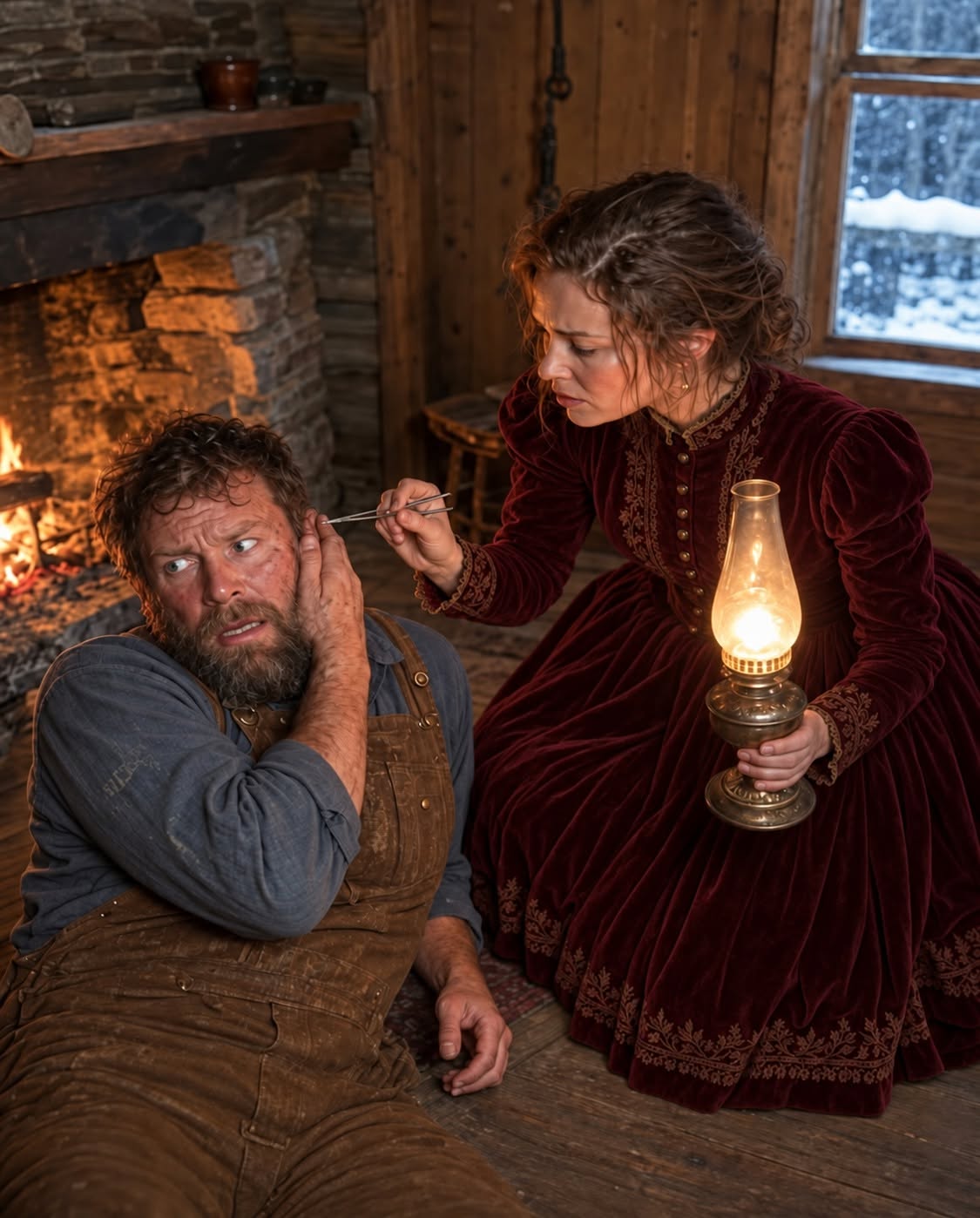
PART 3 — THE SECRET BENEATH THE OLD MILL
Clara locked the door and turned toward Elias.
He was standing beside the fireplace, his face pale.
His hands were clenched.
She picked up his fallen notebook.
“Do you know what he meant?”
Elias took the pencil.
HE IS LYING.
Then he wrote another sentence.
HE ALWAYS LIED.
Clara sat beside him.
“Then why did he come here?”
Elias stared into the fire.
After a moment, he wrote:
BECAUSE HE KNOWS WE FOUND THE MARK.
Clara looked at the medical case she had glimpsed through the doorway.
“What was that instrument?”
Elias shook his head.
He had never seen the exact device before.
But the copper symbol was familiar.
He opened his old notebook again and turned to a page near the back.
There was a drawing of a machine.
A series of delicate metal pieces connected to a narrow copper plate.
Beside it, Elias had written:
VANE’S ROOM.
Clara studied the drawing.
“Where did you see this?”
Elias wrote:
WHEN I WAS EIGHTEEN.
Then he added:
BEFORE I LOST MY HEARING.
Clara felt a terrible thought forming.
“Did he use something like that on you?”
Elias nodded.
But he didn’t write anything more.
He seemed unable to continue.
Clara reached across the table and gently covered his hand.
“You don’t have to tell me everything tonight.”
Elias looked at her.
Then he wrote:
I SHOULD HAVE WARNED YOU.
“About what?”
He turned the notebook around.
BLACKWOOD OWNS THIS VALLEY. HE CAN MAKE PEOPLE DISAPPEAR.
Clara looked toward the window.
The ranch sat miles from town, surrounded by mountains and snow-covered trees.
She had thought the greatest danger in her new marriage would be the humiliation of being unwanted.
She had been wrong.
The man everyone called a monster was a victim of something far worse.
And now she had become part of a secret that powerful men had buried for twenty years.
The next morning, Clara made a decision.
They would go to the old mill.
Elias tried to object, but she pointed to the letter.
 “Your father left those records for a reason. If they can prove what happened, we need to find them.”
He wrote:
IT IS DANGEROUS.
“So is letting Vane decide what happens next.”
Elias studied her.
Then he slowly nodded.
They left before sunrise.
The old mill stood beside a frozen creek, nearly swallowed by pine trees and drifting snow.
Its roof had partially collapsed, and one of its wooden doors hung from a single hinge.
Elias stopped outside.
He stared at the building for a long time.
Clara waited.
Finally, he took out his notebook.
MY FATHER BROUGHT ME HERE WHEN I WAS A BOY.
He looked toward the broken doorway.
HE SAID A MAN’S HONOR WAS LIKE A MILLSTONE. ONCE IT WAS BROKEN, IT COULD NEVER GRIND THE SAME WAY AGAIN.
Clara smiled faintly.
“He sounds like he was a good man.”
Elias nodded.
Then he entered.
The inside smelled of damp wood and old grain.
Dust covered the machinery. Broken boards lay scattered across the floor.
They searched the office first.
There were old receipts, a cracked ink bottle, and several empty drawers.
Nothing important.
Then Clara noticed a wooden panel behind the desk.
One corner was slightly loose.
“Elias.”
He came over.
Together, they examined it.
Behind the panel was a narrow compartment.
Inside lay a leather-bound journal and a small tin box.
Elias opened the journal.
The first pages contained ordinary farm accounts.
Then the handwriting changed.
The entries became shorter and more urgent.
October 14 — Vane visited again. He says the treatment is progressing.
October 19 — Elias complains of pain. Vane insists this is temporary.
October 23 — I have heard enough. The doctor is not treating my son. He is using him.
Clara covered her mouth.
She turned the page.
October 25 — Blackwood came to the house. He demanded the original papers. I refused.
The next entry was dated two days later.
October 27 — If I do not survive this week, let my son know that I tried to protect him.
Clara looked at Elias.
His eyes were wet.
She reached for his hand.
He held it тιԍнтly.
Then they opened the tin box.
Inside were several folded documents and a small pH๏τograph.
The pH๏τograph showed three men standing outside a medical building.
One was Dr. Vane.
Another was Judge Nathaniel Blackwood.
The third man was Elias’s father.
But someone had written a name on the back.
THE PATIENT WHO HEARD EVERYTHING: ELIAS THORNE.
Clara turned the pH๏τograph over again.
“Why would they take a picture of you?”
Elias stared at it.
Then he noticed something.
There was a second pH๏τograph underneath.
It showed the same three men, but this time a young woman stood beside them.
Clara recognized her immediately.
She had seen that face before.
It was the woman in the framed pH๏τograph above Elias’s fireplace.
His mother.
Clara’s stomach тιԍнтened.
“Your mother knew?”
Elias shook his head slowly.
He turned the pH๏τograph over.
A message had been written across the back.
She must never learn what happened to the boy.
Clara read it again.
Then she noticed a date.
The pH๏τograph had been taken three months before Elias lost his hearing.
That meant his mother had been alive when the secret began.
And she might have known more than anyone had ever told him.
A sudden sound came from outside.
A horse snorted.
Clara froze.
Elias quickly closed the journal.
Through a crack in the wooden wall, Clara saw two riders approaching.
One was Dr. Vane.
The other wore the dark coat and silver badge of a county official.
Clara recognized him from town.
It was Deputy Marshal Grady.
She whispered, “We need to hide.”
They slipped into the narrow storage room behind the mill office.
Through the gap beneath the door, they watched the two men enter.
Vane spoke first.
“Where are the papers?”
“I don’t know,” Grady answered. “The old man may have hidden them somewhere else.”
“Then find them.”
“You said the mill was empty.”
“It was. Until Thorne married that woman.”
Grady laughed.
“That girl? She looks like she couldn’t frighten a chicken.”
Vane’s voice became sharp.
“Never underestimate a woman who has nothing left to lose.”
Clara felt Elias stiffen beside her.
Then Grady asked a question that made her blood run cold.
“What do we do about the husband?”
Vane paused.
“His hearing may return.”
Grady gave a nervous laugh.
“After twenty years?”
“Not naturally. But the fragment she removed was only part of the apparatus. The rest is still inside him.”
Clara stared at Elias.
He looked as shocked as she felt.
Vane continued.
“If he remembers the original experiment, he could identify the men who financed it. We cannot allow that.”
Grady lowered his voice.
“And the wife?”
“She has seen too much.”
A heavy silence followed.
Then Vane said something Clara would never forget.
“By tomorrow morning, the Thorne ranch must be empty.”
The two men walked toward the office.
Clara held her breath.
She could hear Elias’s breathing beside her.
Then his hand found hers.
He placed a folded piece of paper in her palm.
She opened it.
Only four words were written.
MY MOTHER IS ALIVE.
Clara stared at him.
“What?”
Elias nodded urgently.
He pointed toward the second pH๏τograph.
Then toward the journal.
Clara quickly searched the final pages and found a name written in the margin.
MARGARET THORNE — SAN LUIS MISSION.
A location.
A date.
And a short message:
She knows where the original records are.
Before Clara could read further, a boot struck the storage-room door.
“Someone’s in here!”
Elias grabbed the journal.
Clara clutched the pH๏τographs.
The door began to open.
Then a voice came from the mill entrance.
“Step away from them, gentlemen.”
It was a woman’s voice.
Old.
Steady.
And unmistakably familiar to Elias.
He turned toward the doorway.
A woman stood in the snow, holding a walking stick.
Her hair was silver.
Her face was older.
But her eyes were the same as those in the pH๏τograph.
Elias dropped the journal.
The woman looked at him, tears gathering in her eyes.
“My boy,” she whispered.
Then she turned toward Dr. Vane.
“And you have finally made the mistake I knew you would.”
To be continued…