PART 2 — THE BOY WHO HAD PROOF OF EVERYTHING
PART 2 — THE BOY WHO HAD PROOF OF EVERYTHING
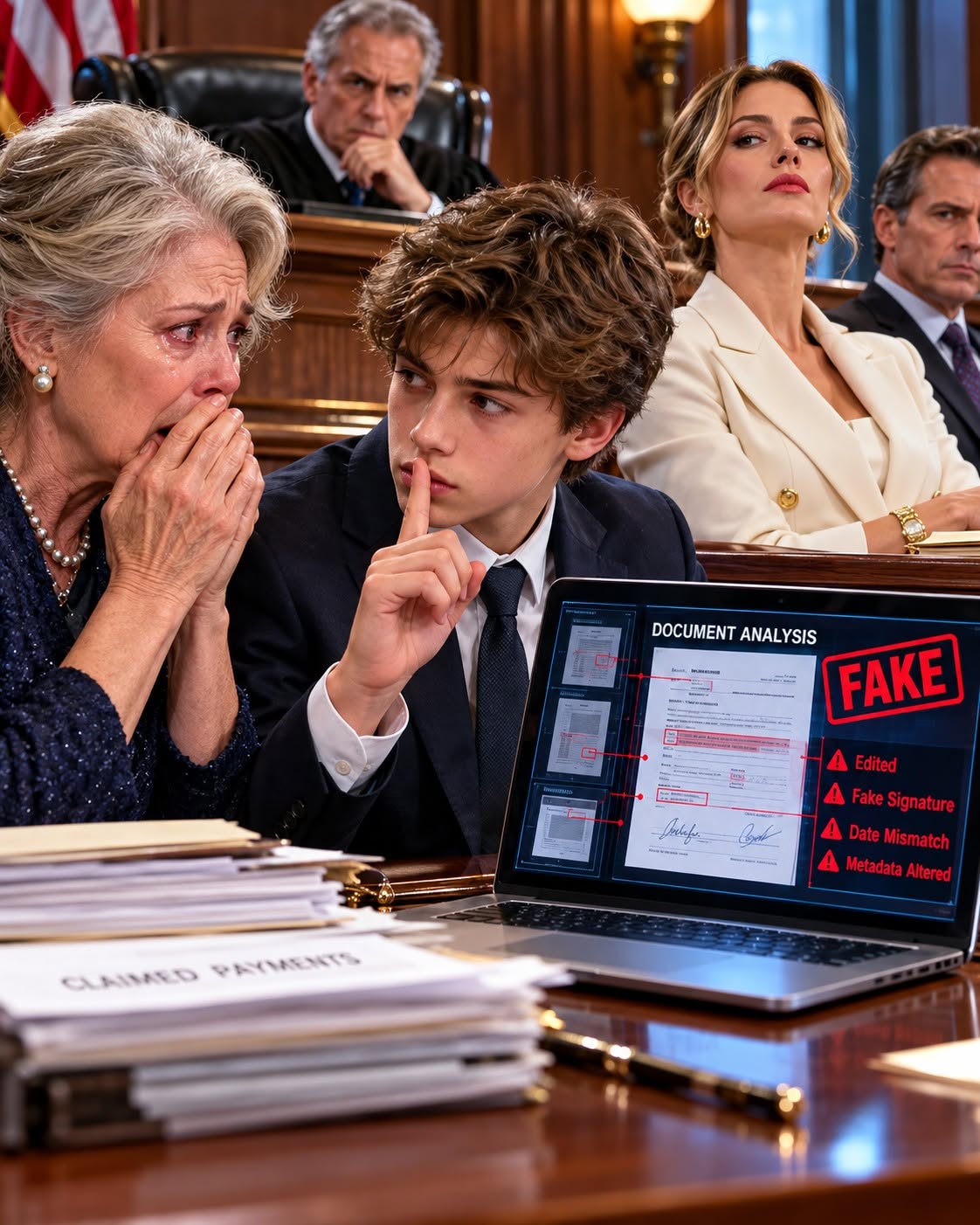
The courtroom fell silent as Ethan connected his laptop to the large screen.
Rachel smiled faintly.
“Your Honor, I don’t understand why a sixteen-year-old needs to turn this into a technology demonstration. This is a family matter.”
Ethan didn’t look at her.
He opened the first folder.
“Actually, it’s a document verification demonstration.”
His voice was quiet, almost emotionless.
The judge leaned forward.
“Go ahead, Ethan.”
The first image appeared on the screen.
It was Rachel’s supposed bank statement, showing eleven years of monthly payments to support him.
Ethan enlarged the document.
“These payments are supposed to prove my mother sent money to Grandma. But there is a problem.”
Rachel’s attorney stood.
“Objection. The minor is not qualified to interpret financial records.”
Ethan calmly turned toward him.
“I’m not interpreting them. I’m showing where they came from.”
He clicked again.
A second window appeared, displaying the original file information.
“Every document has a history. When it was created, when it was modified, and sometimes which software modified it.”
He highlighted a date.
“These statements were created nineteen days ago.”
A murmur spread across the courtroom.
Rachel’s smile disappeared.
Her attorney quickly approached the screen.
“That proves nothing. Documents can be scanned at any time.”
Ethan nodded.
“Correct. That’s why I checked the original bank records.”
Another file appeared.
This time, it was an official response from the bank.
The account numbers didn’t match.
Neither did the transaction references.
The alleged monthly payments had never existed.
Rachel shifted in her chair.
“Those records are incomplete!” she protested. “I have other evidence.”
Ethan clicked another folder.
“That’s why I brought the phone records.”
The screen filled with eleven years of call logs.
Every unanswered call from Grandma to Rachel.
Every birthday.
Every Christmas.
Every emergency.
Then came a recording.
Rachel’s voice filled the courtroom.
“Mom, I can’t keep doing this. Ethan needs too much attention. I have my own life. Please stop calling me about him.”
My stomach twisted.
I remembered that conversation.
I remembered standing in the kitchen, begging my daughter to come home.
Rachel jumped to her feet.
“That’s taken out of context!”
Ethan paused the recording.
“Then let’s hear what came before it.”
He opened the original audio file.
The recording continued.
My voice sounded exhausted.
“Rachel, he keeps asking when you’re coming back. He’s having trouble sleeping. He misses you.”
Then Rachel answered.
“Tell him I’m busy. He’ll eventually stop asking.”
Nobody moved.
Nobody spoke.
Rachel’s attorney whispered something urgently into her ear.
But Ethan wasn’t finished.
He opened another folder.
“This is the school attendance and emergency contact history.”
He displayed eleven years of records showing my name beside Ethan’s.
Medical appointments.
Therapy sessions.
Parent-teacher meetings.
Emergency authorizations.
Every document carried the same truth.
I had been there.
Rachel had not.
Then Ethan opened the final folder.
Its name was simple.
THE WEEKEND MOM LEFT.
My breath caught.
Inside was a scanned pH๏τograph of a blue backpack sitting beside my front door.
The date was visible in the corner.
Eleven years earlier.
Beneath it was a handwritten note Rachel had left that afternoon.
Mom, I’ll be back Sunday. Please take care of him.
The next document was a message Rachel had sent me three days later.
I need more time. Don’t make this difficult.
Then another.
And another.
Until, eventually, the messages stopped.
Rachel’s face had become completely pale.
“Where did you get those?” she demanded.
Ethan finally looked at her.
“Grandma kept everything.”
He turned back to the judge.
“I didn’t build this software to make money. I built it because I watched people tell Grandma things that weren’t true, then make her feel like she was imagining them.”
His voice trembled slightly.
“And I didn’t want that to happen again.”
For the first time that morning, I saw my grandson’s hands shaking.
He took a breath.
Then he opened one last file.
“There’s something else, Your Honor. My mother says Grandma prevented her from contacting me. But I found something that happened six months ago.”
Rachel froze.
On the screen appeared an email.
It was from Rachel to a financial adviser.
The subject line read:
Ethan Cooper — Inheritance and ᴀsset Access.
Ethan enlarged the message.
The first paragraph discussed his newly acquired wealth.
The second discussed obtaining parental authority over his financial accounts.
But the final sentence made the entire courtroom go silent.
Once I regain legal control, I can move the money before he turns eighteen. The boy won’t understand what happened.
I felt my heart stop.
Rachel stood abruptly.
“That’s private correspondence! You had no right to access that!”
Ethan looked at her.
“You submitted fabricated financial records claiming you supported me. I checked the documents connected to your claims.”
Her attorney demanded a recess.
But the judge raised his hand.
“Sit down, Ms. Cooper.”
Rachel slowly lowered herself into her chair.
The judge examined the email again.
Then he turned toward my grandson.
“Ethan, do you understand the seriousness of what you’ve presented?”
“Yes, Your Honor.”
“Do you have the original files?”
“Yes. With verification records and independent copies.”
“Can they be examined by a court-appointed expert?”
“Absolutely.”
The judge ordered the documents preserved and requested an independent forensic review. He also issued a temporary order preventing either side from transferring or accessing Ethan’s settlement funds until the court could determine the appropriate legal protections.
Rachel’s attorney looked furious.
But my daughter was no longer looking at him.
She was staring at Ethan.
For the first time in eleven years, she seemed to be looking at the son she had abandoned.
“Ethan,” she whispered. “I’m your mother.”
He stared at her for several seconds.
Then he said something that made my heart ache.
“I know. I’ve had eleven years to remember that.”
Rachel began crying.
“Sweetheart, I made mistakes. I was young. I was overwhelmed. I never thought you’d become—”
“Become what?”
She stopped.
Ethan closed his laptop.
“You mean successful?”
Nobody moved.
He continued.
“When I was five, you left because I was too difficult. When I was eight, I asked Grandma if you had died. When I was twelve, I stopped asking when you were coming home.”
His eyes glistened.
“And now that I have money, suddenly you remember my birthday.”
Rachel covered her mouth.
I reached for Ethan’s hand.
But he gently squeezed mine first.
The judge announced that the hearing would continue after the forensic examination and that the court would separately review the question of guardianship and parental responsibility.
We had not won everything.
Not yet.
But for the first time, Rachel’s carefully constructed story had begun to collapse.
As we walked out of the courtroom, her attorney hurried after us.
“Mr. Cooper, perhaps we can discuss a settlement.”
Ethan stopped.
“There’s nothing to settle with me.”
Then he looked at Rachel.
“I didn’t build that app to become rich.”
He paused.
“I built it because I wanted to make sure Grandma would never have to prove she loved me.”
Rachel stood frozen.
And as the courtroom doors closed behind us, Ethan whispered something I will carry for the rest of my life.
“Grandma, you spent eleven years protecting me. Now it’s my turn to protect you.”
I pulled him into my arms.
For once, he didn’t hesitate.
He hugged me тιԍнтly.
But the battle wasn’t over.
Because that evening, our lawyer called with news that changed everything.
Rachel had filed another motion.
This time, she wasn’t asking for control of Ethan’s money.
She was demanding visitation rights.
And attached to her application was a letter Ethan had supposedly written to her when he was seven years old.
A letter I had never seen.
A letter that ended with the words:
PLEASE COME HOME, MOM. I PROMISE I’LL TRY TO BE A BETTER SON.
Ethan read it twice.
Then he looked at me.
“Grandma, I never wrote this.”
Our lawyer went quiet.
Because if the letter was forged, it meant Rachel hadn’t simply fabricated eleven years of financial support.
She had manufactured an entirely different childhood for her son.
And Ethan was already reaching for his laptop.
“Let’s find out who wrote it.”