The Baby Whose Little Face Looked Different: Olivia’s Story with Pfeiffer Syndrome
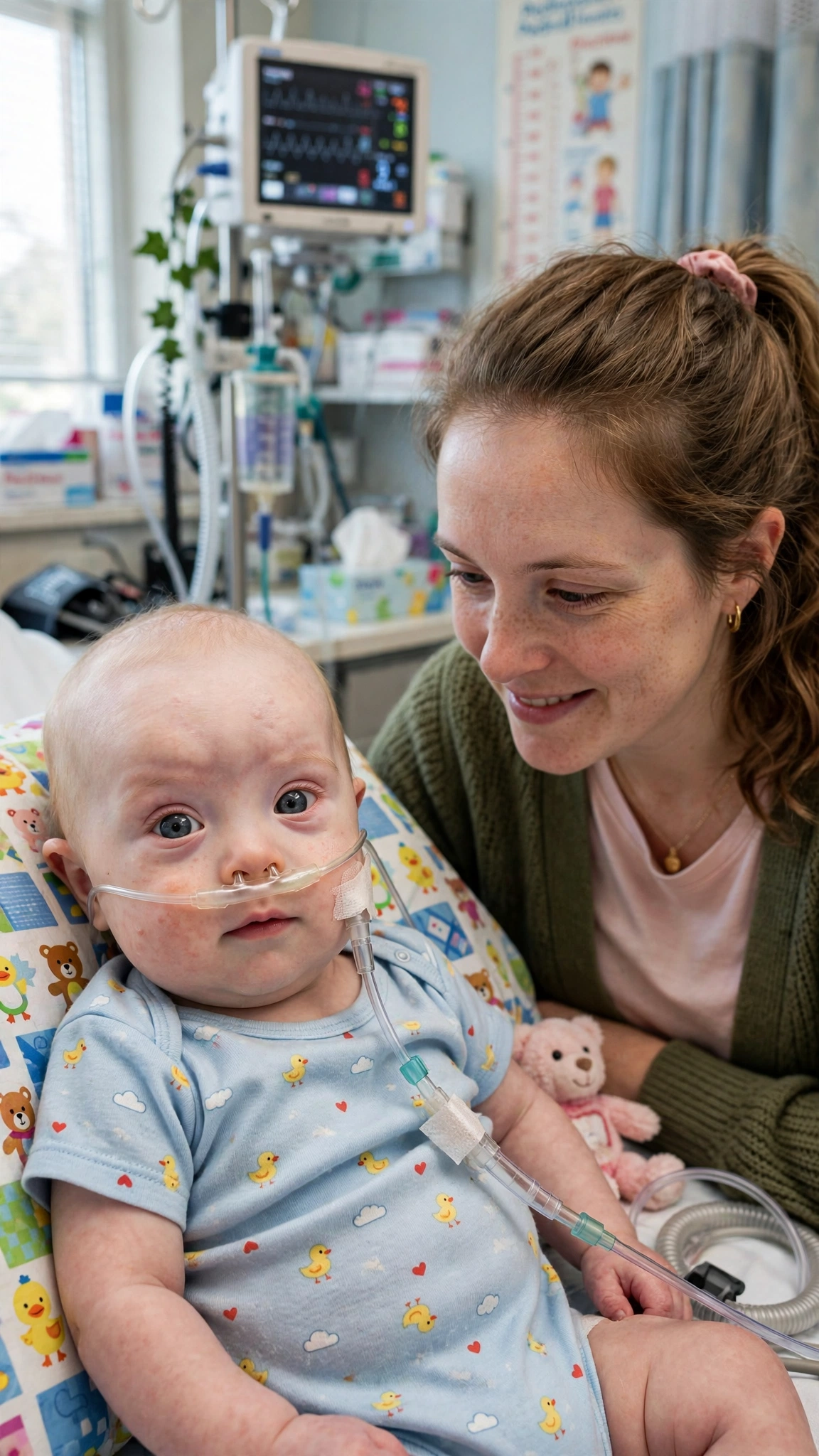
When little Olivia was born, her parents immediately noticed that something about her head and facial features looked different.
Her forehead appeared unusually prominent, her eyes were noticeably pronounced, and the middle portion of her tiny face seemed smaller and less developed than expected.
At first, her parents did not know what these differences meant. They had prepared themselves for the usual challenges of caring for a newborn, but they had never imagined that their daughter might be born with a rare genetic condition.
They wanted answers.
After several examinations and consultations with medical specialists, Olivia was diagnosed with Pfeiffer Syndrome, a rare genetic disorder that affects the development of the skull and facial bones.
The condition is ᴀssociated with the premature fusion of one or more cranial sutures, which are the natural joints connecting the bones of the skull.
During normal development, these sutures remain open during infancy, allowing the skull to expand as the brain grows. When they fuse too early, the skull cannot develop in its usual pattern, resulting in an unusual head shape and potentially affecting the surrounding facial structures.
In Olivia’s case, several cranial sutures had fused prematurely, contributing to her distinctive forehead and facial appearance.
Her eyes appeared unusually prominent because the development of the bones surrounding her eye sockets was affected. The middle portion of her face was also underdeveloped, particularly around the cheekbones and upper jaw.
These changes were not simply physical differences. Depending on their severity, they could also create challenges involving breathing, vision, and neurological development.
Her doctors explained that children with Pfeiffer Syndrome require careful ᴀssessment because the condition can affect several important functions.
From her earliest days, Olivia needed regular medical monitoring.
Her healthcare team closely evaluated the growth and shape of her skull, checked her vision, and ᴀssessed her breathing. Doctors also monitored her neurological development and watched for signs of increased pressure inside her skull.
Because the condition can affect multiple areas of the head and face, her care required collaboration between different medical specialists.
For Olivia’s parents, the first months of her life became a period filled with hospital visits, medical ᴀssessments, and difficult decisions.
They spent countless hours traveling to specialist appointments, waiting for examination results, and listening carefully as doctors explained the possible complications ᴀssociated with her diagnosis.
The possibility of future treatments and surgeries was particularly difficult to process.
They knew that some children with Pfeiffer Syndrome require craniofacial surgery to improve skull development, protect the brain, or address breathing and eye-related problems. However, the appropriate treatment depends on each child’s individual condition and medical needs.
Every new appointment brought questions about Olivia’s future.
Would she experience difficulties with her eyesight? Would her breathing become more complicated? How would her skull and facial bones develop as she grew older?
Her parents could not predict every challenge, but they were determined to give their daughter access to the medical care and support she needed.
Amid the uncertainty, there were quiet moments at home that meant more than anything else.
Sometimes, Olivia’s mother would sit beside her crib long after the baby had fallen asleep.
She would gently touch her tiny fingers, adjust her blanket, and watch the peaceful movements of her little chest as she breathed.
Her thoughts often drifted toward the future. She wondered what Olivia’s childhood would look like, whether she would need multiple procedures, and how she might experience the world as she grew older.
But then Olivia would open her eyes and look toward her mother.
Sometimes, she would respond with a tiny smile.
In those moments, the fear seemed to become a little easier to carry.
Her mother was reminded that, despite the medical challenges, Olivia was still just a baby who needed affection, comfort, and the reᴀssurance that she was safe.
Her parents knew that her journey might involve complicated medical treatments, regular specialist appointments, and possibly several surgical procedures.
They also knew that she deserved a childhood filled with warmth, encouragement, and opportunities to discover the world.
They made a promise that would guide them through every difficult moment: Olivia would never grow up believing that she was less beautiful or less deserving of love because she looked different.
Her appearance would never determine her value.
Her medical diagnosis would never become her entire idenтιтy.
She was not simply a child living with a rare genetic condition.
She was Olivia, their precious daughter, and the little girl whose presence had changed their lives forever.
She deserved to be loved, protected, celebrated, and given every opportunity to experience a beautiful childhood.
Because she was never defined by a medical diagnosis. She was their precious little girl.