PART 3 — THE SECRET THE TWINS FOUND IN THEIR MOTHER’S OLD TRUNK
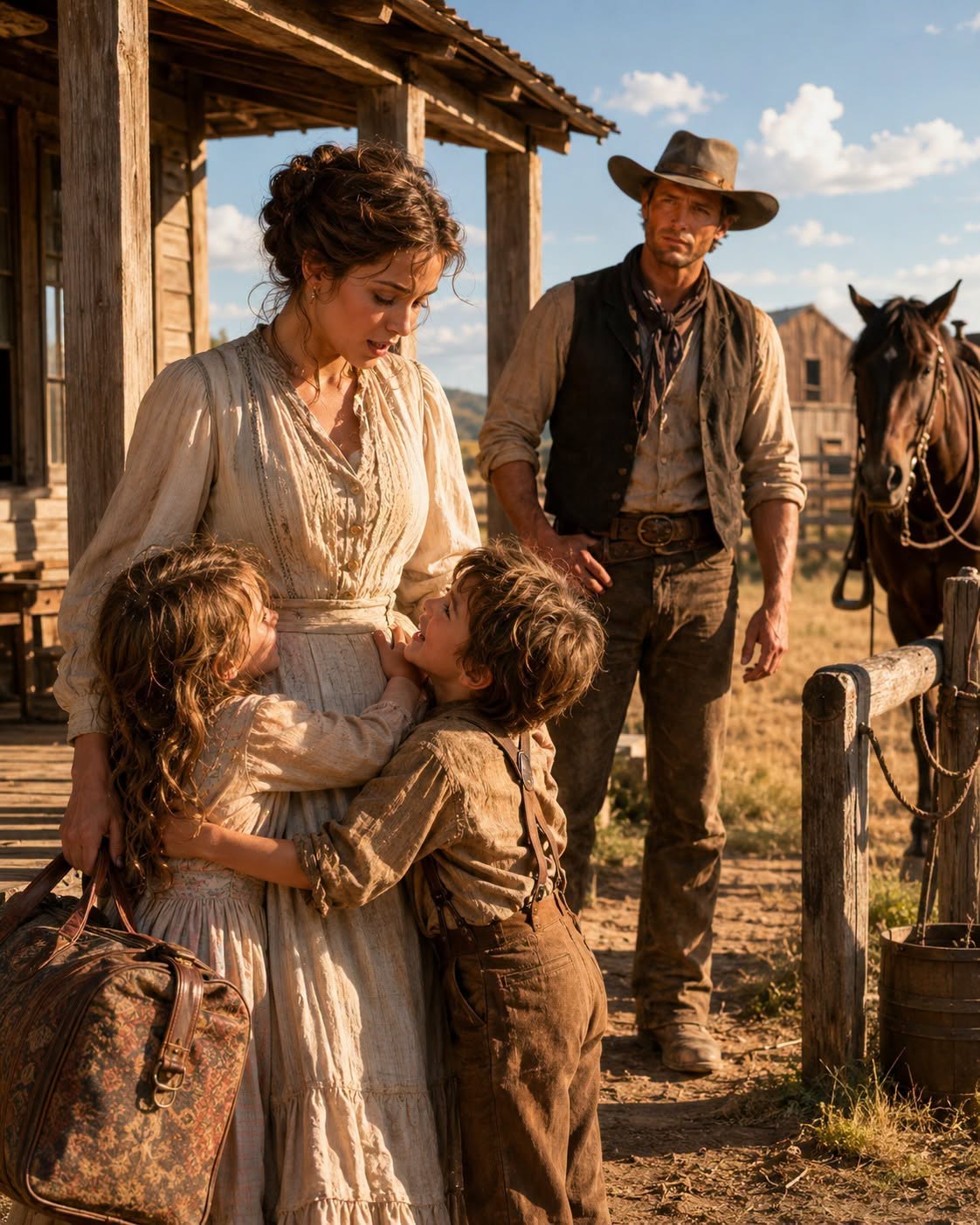
PART 3 — THE SECRET THE TWINS FOUND IN THEIR MOTHER’S OLD TRUNK
Norah didn’t sleep that night.
She lay beneath the quilt in her little room, listening to the wind move through the cottonwoods outside.
The telegram’s words kept returning to her.
They’ll take the ranch.
She knew what losing a home meant.
She had watched her father sell their furniture, then their livestock, then the little house where she had grown up. She had watched debt collectors carry away the things her mother had treasured.
And now, just when she had found somewhere she could breathe, the same thing threatened to happen again.
At dawn, she went to the kitchen.
Grant was already there.
He sat at the table with a cup of untouched coffee and several documents spread before him.
“Good morning,” she said.
He looked up.
“You’re early.”
“I couldn’t sleep.”
“Neither could I.”
Norah glanced at the papers.
“Is it the bank?”
Grant gathered them together.
“Business matters.”
“Perhaps I can help.”
He gave her a tired look.
“It’s a complicated situation.”
“My father taught me bookkeeping.”
Grant stopped.
“He owned a trading business?”
“For nearly fifteen years. I kept his accounts during the last six, especially when his health began failing.”
“Why didn’t you mention that?”
“You never asked.”
For the first time, Grant looked at her differently.
Not as a young woman who needed employment.
As someone who might understand the trouble sitting on his table.
He pushed the documents toward her.
“The bank says I owe eleven hundred dollars. They claim the ranch fell behind on three payments.”
Norah studied the papers.
The first document was a loan agreement.
The second was a list of payments.
The third was a notice of foreclosure.
She read each carefully.
Then she frowned.
“Mr. Calhoun, when did you make this payment?”
“September twelfth.”
“And this one?”
“October third.”
“Do you have the receipts?”
“In the desk drawer.”
She examined them.
Both payments had been received and stamped by the bank.
But the bank’s statement showed neither.
Norah placed the receipts beside the ledger.
“These payments were never credited.”
Grant leaned forward.
“What?”
“Look here. The bank recorded the money as received, but someone transferred the entries into a separate account.”
He stared at the page.
“Can they do that?”
“Not without explaining where the money went.”
Grant stood.
“Those are mistakes.”
“Perhaps. But there are three more.”
She turned another page.
The amounts were almost identical, and each transaction had been entered on a different date.
“Someone has been moving your payments.”
Grant’s face hardened.
“Who has access to these records?”
“That’s what we need to find out.”
He studied her.
“You’re certain?”
Norah nodded.
“My father always said numbers don’t lie. People do.”
For a long moment, Grant said nothing.
Then he pulled out the chair beside her.
“Show me everything.”
By noon, they had discovered that nearly six hundred dollars had disappeared from the ranch’s accounts.
The bank’s manager, Mr. Whitcomb, had signed several of the transactions.
Grant stared at the signature.
“Whitcomb.”
Norah looked at him.
“You know him?”
“He came to the ranch three times this year. Each time, he told me the bank was doing me a favor by extending the loan.”
“Did you sign anything?”
“Two renewal agreements.”
Norah examined the documents.
“Then we need copies of those agreements.”
Grant shook his head.
“I don’t have them. Whitcomb kept the originals.”
“Then we must go to the bank.”
“Not yet.”
“Why?”
“Because if he knows we’ve discovered this, he’ll have time to destroy whatever evidence remains.”
Norah understood.
Her father had once lost an entire shipment because a dishonest merchant had altered a delivery record. The truth had taken months to establish.
“Then we need another source.”
Grant looked toward the stairs.
“The original ranch records are somewhere in this house. Margaret kept them before she died.”
“Your wife?”
He nodded.
“She was better at keeping accounts than I ever was.”
His voice softened.
“She kept everything. Receipts, letters, contracts. Sometimes I used to tease her about saving every scrap of paper.”
Norah hesitated.
“Where would she have put them?”
 Grant looked toward the attic.
“Her trunk.”
The attic smelled of cedar, dust, and old memories.
Grant had not entered it in nearly two years.
Margaret’s trunk stood beneath the small window, its brᴀss corners tarnished and its leather straps cracked with age.
Grant approached slowly.
“I couldn’t bring myself to sort through her things.”
Norah remained beside him.
“You don’t have to do it all at once.”
He nodded.
Then he lifted the lid.
Inside lay folded dresses, a lace shawl, a small jewelry box, and dozens of envelopes tied with faded ribbon.
Lizzy and Sam appeared at the top of the stairs.
“Papa?”
Grant turned.
“What are you two doing up here?”
Lizzy pointed at the trunk.
“That’s Mama’s.”
“I know, sweetheart.”
“Are you looking for her things?”
“Something she might have kept.”
Sam approached cautiously.
“Mama said there was a secret drawer.”
Grant frowned.
“What secret drawer?”
“She showed me once. She said important things shouldn’t be left where people can find them.”
Norah looked at the trunk.
The lining beneath the top compartment seemed unusually thick.
She ran her fingers along the edge.
There.
A small wooden panel shifted beneath her touch.
Grant crouched beside her.
“Careful.”
Norah pressed the hidden catch.
The panel opened.
Inside was a narrow compartment containing a bundle of letters, several bank receipts, and a small black notebook.
Grant lifted the notebook.
Margaret’s handwriting covered the first page.
He stared at it for a long moment.
Then he opened the next.
And the next.
His expression changed.
“What is it?” Norah asked.
Grant swallowed.
“It’s a record of every payment Margaret made to the bank.”
He turned another page.
“She kept copies of everything.”
Norah took the notebook carefully.
The dates matched the missing payments.
But there was something else.
Several entries were marked with a small red cross.
Beside them, Margaret had written:
Whitcomb requested another payment. Refused. Already paid in full.
Norah looked up.
“Your wife knew something was wrong.”
Grant’s jaw тιԍнтened.
“She never told me.”
“Perhaps she was still investigating.”
He opened the bundle of letters.
Most were ordinary correspondence.
But one envelope bore the bank manager’s name.
It had never been opened.
Grant examined the seal.
“Why would Margaret have kept this?”
Norah carefully unfolded the letter.
The first lines were polite.
The last lines were not.
Mrs. Calhoun,
I strongly advise you to stop asking questions about the ranch’s outstanding balance. Your husband is unaware of certain arrangements, and I would prefer to keep it that way.
You would be wise to do the same.
The letter ended with Whitcomb’s signature.
Grant’s face went pale.
“Someone threatened my wife.”
Norah placed the letter on the floor.
There were more documents beneath it.
One was a copy of the original loan agreement.
Another was a handwritten note from a lawyer.
And the final document made Norah’s breath catch.
It was a receipt showing that the entire ranch debt had been paid off nearly a year earlier.
The signature belonged to Margaret Calhoun.
The amount was more than fifteen hundred dollars.
Grant read it twice.
“That’s impossible.”
Norah shook her head.
“It’s genuine.”
“But where did she get that kind of money?”
She looked through the remaining papers.
Then she found a small envelope addressed to Grant.
His name was written in Margaret’s familiar hand.
He opened it.
My dearest Grant,
If you are reading this, something has happened before I could explain everything.
I discovered that Mr. Whitcomb had been changing the ranch accounts. I paid the original debt because I wanted our children to inherit a home free of the burden he had created.
I have kept copies of every document. Please don’t confront him until you understand the full arrangement.
There is one person in town who knows what happened.
His name is Daniel Price.
And Grant, whatever you do, don’t trust the man who brings you the next bank notice.
Grant lowered the letter.
“Daniel Price.”
Norah knew the name.
He was the retired clerk who had worked at the bank before Whitcomb took over.
But Daniel had disappeared from town six months earlier.
Before either could speak, footsteps sounded below.
Charlie Briggs shouted from the kitchen.
“Boss! There’s a visitor!”
Grant closed the trunk.
“Who?”
A moment later, Charlie appeared at the attic stairs.
“Mr. Whitcomb. He’s brought the sheriff.”
Grant looked at Norah.
Then at the letter in his hand.
The timing was too convenient.
Too precise.
“Keep the children upstairs,” he told Norah.
But before he could descend, Lizzy grabbed his sleeve.
“Papa, don’t let them take our house.”
Grant knelt and kissed her forehead.
“I won’t, sweetheart.”
Norah watched him walk downstairs.
Then she looked at the hidden compartment again.
Something was missing.
Margaret’s letter mentioned a person who knew the truth.
Daniel Price.
But the envelope containing his address was gone.
Someone had taken it.
In the yard, Sheriff Bell stood beside Whitcomb’s carriage.
The bank manager held a document in his gloved hand.
“Mr. Calhoun,” he announced, “I have come to serve formal notice. Your property is subject to immediate seizure for nonpayment.”
Grant stepped onto the porch.
“I have proof that the debt was settled.”
Whitcomb’s smile vanished.
“Impossible.”
“I have the receipts.”
The bank manager glanced toward the attic window.
Then his eyes settled on Norah, who had appeared at the top of the stairs with Margaret’s notebook.
For one brief second, his expression changed.
He recognized it.
He knew what she was holding.
And suddenly, his polite smile returned.
“Ah,” he said. “I see you’ve been going through Mrs. Calhoun’s belongings.”
Grant stepped forward.
“Be careful what you say.”
Whitcomb raised the document.
“Then perhaps you should hear this before making accusations.”
He unfolded a second paper.
“Your late wife’s signature appears on a separate agreement transferring ownership of the ranch to the bank.”
Grant went completely still.
Norah looked at the document.
Something about the signature seemed wrong.
Very wrong.
She remembered the way Margaret had signed the receipts.
The elegant capital M.
The long final stroke.
This signature had neither.
“Mr. Calhoun,” Norah whispered.
Grant turned.
“Look at the date.”
He took the paper.
The date was two weeks after Margaret’s funeral.
Grant’s face hardened.
“My wife was ᴅᴇᴀᴅ.”
Whitcomb’s smile disappeared.
Norah stepped forward, holding the notebook.
“Then who signed this?”
The sheriff looked from one man to the other.
And before Whitcomb could answer, a horse came galloping through the ranch gate.
A rider jumped down, covered in dust.
“Mr. Calhoun! There’s been trouble in town!”
Grant turned.
The rider looked directly at Norah.
“Daniel Price has been found. But someone got to him first.”
He swallowed.
“And before he disappeared again, he told the telegraph operator one thing.”
“What?” Grant demanded.
The rider glanced at the bank manager.
“He said Mrs. Calhoun didn’t die believing she had saved this ranch.”
He paused.
“She died knowing someone had arranged to take it from her children.”
Whitcomb’s face went white.
Norah тιԍнтened her grip on the notebook.
The truth was no longer buried in an attic.
It was standing in the yard, surrounded by armed men, and someone was desperate enough to keep it from coming out.
But the most shocking discovery was still waiting inside Margaret’s final letter—because the person who had helped Whitcomb forge the documents was someone Grant had trusted for years.