PART 3 — THE MAN WHO HAD BEEN LOOKING FOR HER
PART 3 — THE MAN WHO HAD BEEN LOOKING FOR HER
Wilder stared at the letter.
The name was unmistakable.
Edmund Rusk.
For a moment, the cabin seemed to tilt around her.
She hadn’t heard that name since she was sixteen.
Edmund had been a traveling surveyor who stayed in Pincher Creek for several weeks while mapping a new trail through the western hills. He had rented a room above the mercantile and often visited her father’s property to purchase supplies.
Unlike the other men, he had spoken to Wilder as though her opinions mattered.
He had once told her she was clever.
He had even asked whether she would like to travel west with him when his work was finished.
She had refused.
Not because she didn’t want to leave, but because she had been afraid of what her father would do.
A month later, Edmund disappeared from town.
Her father told her he had gone looking for another woman.
Now his name was sitting in front of her.
“Why is he in this agreement?” she whispered.
Goss pulled out the chair opposite her.
“Because he contacted the placement service before I did.”
Wilder looked up sharply.
“What?”
“He made an offer for a wife arrangement. The service rejected it. Apparently, he wanted someone who could help him manage a property near the western pᴀss.”
“And my father?”
“Your father knew about it.”
Wilder felt a familiar anger rising in her chest.
“He never told me.”
“No.”
“Why would he hide it?”
Goss hesitated.
“Because Rusk’s offer was considerably larger than mine.”
Wilder pushed the letter away.
“So my father sold me to the highest bidder.”
“Not exactly.”
 Goss removed another sheet.
“Rusk’s offer was withdrawn after the service received a warning about him. The clerk who wrote this letter says Rusk had been accused of forging land documents.”
Wilder stared at the paper.
Edmund had always seemed so respectable. He wore clean clothes, spoke politely, and carried expensive surveying instruments.
But she remembered something now.
A conversation she had overheard outside the mercantile.
Edmund had been arguing with a rancher about a boundary line. The rancher had accused him of changing the measurements on a map.
At the time, Wilder had thought it was simply a disagreement.
“Does he know where I am?” she asked.
Goss folded the letter.
“He might.”
“Then why did you let me come here?”
“Because the service told me your father had already accepted the arrangement. I didn’t know Rusk had made an earlier offer until this letter arrived yesterday.”
Wilder studied him.
“You knew before I arrived?”
“I knew there was a question about your paperwork. I didn’t know what it meant.”
“That’s convenient.”
Goss accepted the accusation without arguing.
“Fair enough.”
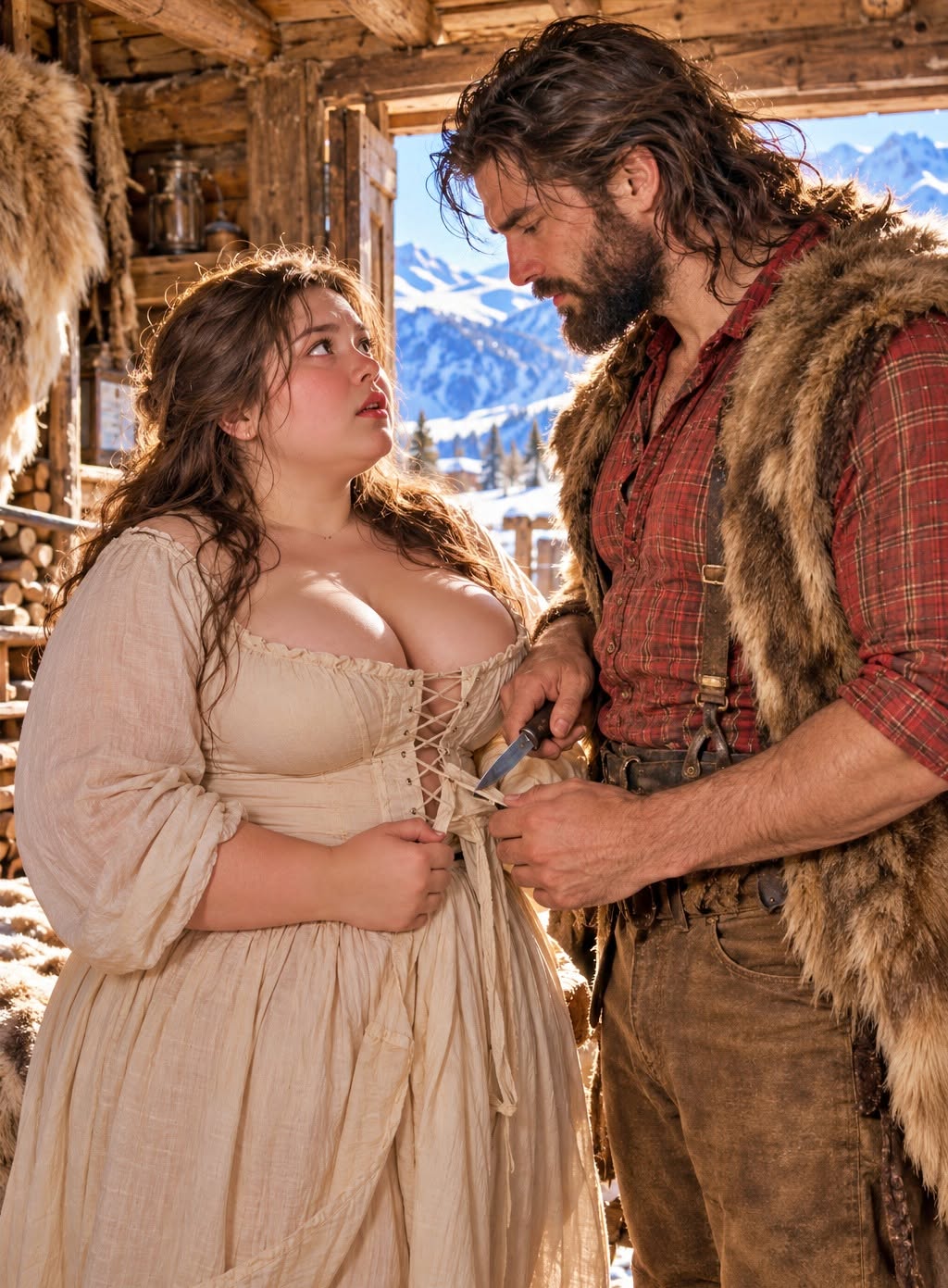
He stood and crossed to the fireplace.
“I should’ve told you as soon as you arrived. But you were half-frozen, and I wasn’t going to make you read legal papers before you could feel your fingers.”
Wilder looked down at the letter again.
For years, she had believed her father’s cruelty was simple. He disliked having a daughter who didn’t fit the picture of the family he wanted. He thought she ate too much, worked too slowly, and took up too much room.
But this was different.
He had made arrangements behind her back.
He had negotiated her future as though she were a horse being traded at market.
“Did you really need a wife?” she asked.
Goss turned.
“I needed help.”
“With the cabin?”
“With the winter stores, the animals, the trading accounts. My hands aren’t as steady as they used to be, and the mountain is getting harder to manage alone.”
“Then why not hire someone?”
“Because nobody wants to spend seven months up here for wages I can afford.”
He paused.
“And because I thought a wife might want the same things I wanted. A quiet home. Someone to share the work. Someone who wouldn’t disappear when the snow closed the pᴀss.”
Wilder almost smiled.
“You could have asked for a companion instead.”
“Would’ve saved us both a great deal of trouble.”
For the first time, she saw something softer in his expression.
Then a loud knock sounded against the cabin door.
Goss immediately straightened.
He reached for his coat and looked through the narrow window.
A horse stood outside.
Its rider was a thin man wearing a dark traveling coat and a hat dusted with snow.
Wilder’s heart began pounding.
She recognized the horse before she recognized the man.
It was the same chestnut gelding Edmund Rusk had ridden through Pincher Creek years earlier.
Goss turned toward her.
“Stay behind me.”
The knock came again.
“Goss!” the visitor called. “I know you’ve got company.”
Goss didn’t move.
The man outside laughed.
“Come on, old mountain bear. I’m not here to cause trouble.”
Wilder stood frozen.
She knew that voice.
Edmund Rusk.
Goss opened the door only a few inches.
“What do you want?”
Rusk smiled.
He was older now, with silver beginning to show at his temples, but his manner hadn’t changed.
“I’m looking for a woman.”
“Plenty of women in the valley.”
“This one came up your trail yesterday.”
Goss said nothing.
Rusk leaned slightly, trying to see past him.
“Her name is Wilder. Her father arranged a marriage for her, but there was a mistake with the paperwork.”
“There was no mistake.”
Rusk’s smile faded.
“I believe there was.”
He reached into his coat and produced a document.
“I have proof that the placement service had no authority to complete the agreement. The woman was promised to me first.”
Wilder stepped forward before Goss could stop her.
“Promised?”
Rusk looked directly at her.
For a moment, his face showed genuine surprise.
Then his old charming smile returned.
“Wilder. You’ve grown into quite a woman.”
“Don’t.”
His smile faltered.
“I’m only trying to correct a misunderstanding.”
“You disappeared.”
“I had business to attend to.”
“You told my father I wasn’t worth the trouble.”
Rusk glanced at Goss.
“Family matters can be complicated.”
“My father sold me for two horses.”
Rusk’s expression changed.
“Two geldings?” He gave a quiet laugh. “Then he received a poor price.”
Goss stepped into the doorway.
“You’ve said enough.”
But Rusk raised the document.
“Before you decide anything, perhaps you should read this. It contains the original agreement and the name of the person who authorized the transfer.”
He held it out.
Goss took the paper and examined the signature.
Then his expression went completely still.
Wilder looked at him.
“What is it?”
Goss didn’t answer immediately.
He turned the document over.
On the back was a handwritten note, dated three weeks earlier.
The handwriting was unfamiliar to Wilder, but the signature beneath it was not.
It belonged to her father.
And beside it was another signature.
Saurin Goss.
Wilder stepped backward.
“You signed something?”
Goss looked at her.
“I signed the placement request. Nothing more.”
Rusk smiled.
“That’s what he told you, is it?”
He reached into his coat again and produced a second paper.
“This one says something rather different.”
Goss took one look at it and shut the door.
The bolt slid into place.
Wilder stared at him.
“What have you done?”
He stood with the paper in his hand, his face darker than she had ever seen it.
“I think,” he said slowly, “that someone has been using both our names.”
Outside, Rusk’s horse shifted in the snow.
Then the rider called through the door.
“Ask him about the western cabin, Wilder. Ask him what happened to the woman who lived there before you.”
Goss went motionless.
Wilder looked from the door to the man standing beside the fireplace.
“What woman?”
For a long moment, Goss said nothing.
Then he placed the document on the table.
“There was no woman before you,” he said.
But his voice had changed.
And Wilder knew he was hiding something.
Because when she looked down at the second document, she noticed a date written beneath Goss’s signature—one that was almost a year before he had ever contacted the placement service.