PART 2 — THE MESSAGE BENEATH THE CABBAGE
PART 2 — THE MESSAGE BENEATH THE CABBAGE
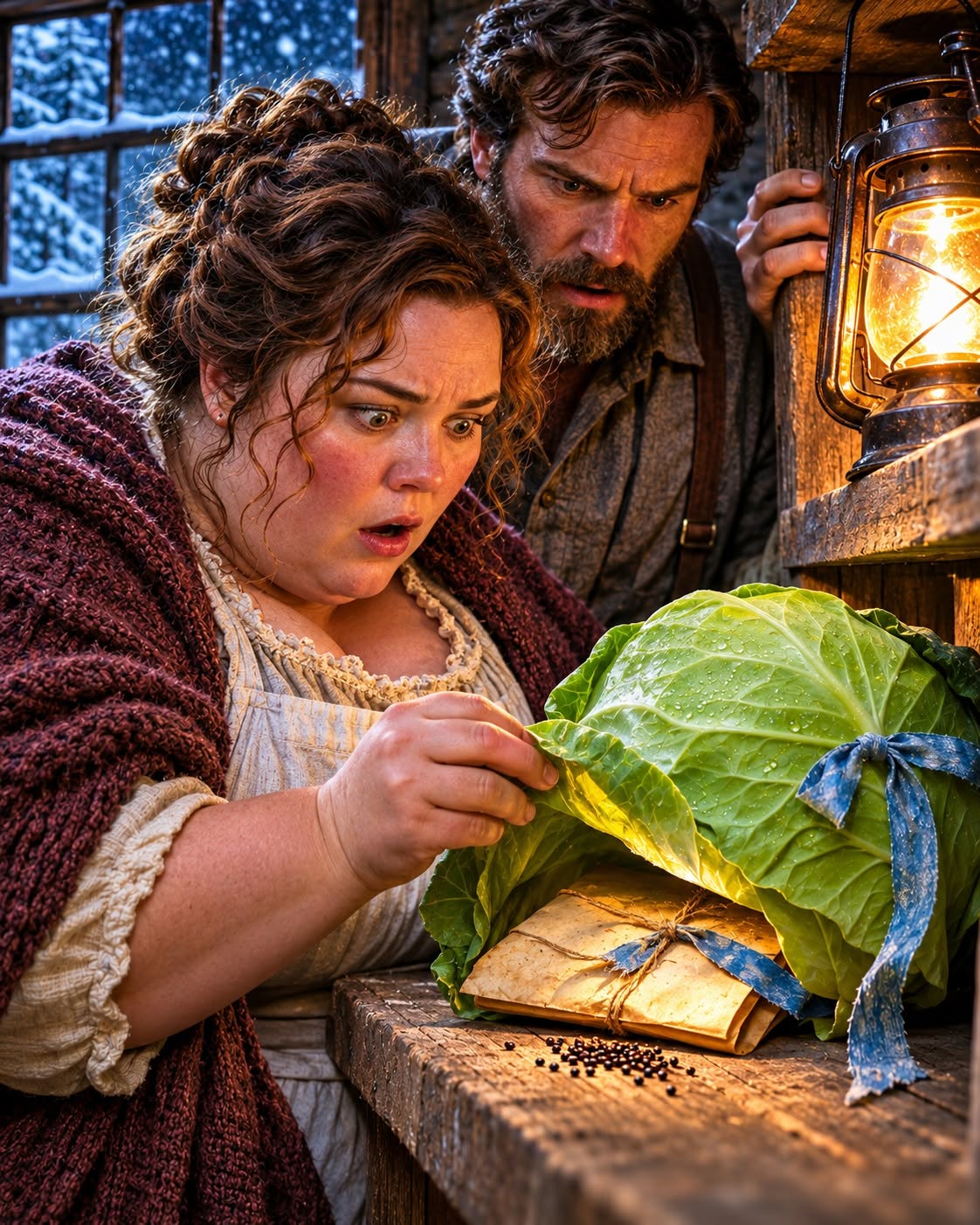
My hands began trembling as I unfolded the paper.
The handwriting was small and uneven, as though whoever had written it had been in a hurry.
Clara,
If this cabbage has reached your pantry, then someone has finally found the courage to come back. I know you may be frightened. Please don’t throw away the seeds. And whatever you do, don’t let anyone in town know you have them.
I read the words twice.
Samuel moved closer, his face growing serious.
“Who wrote it?”
“I don’t know.”
But that wasn’t entirely true.
There was something familiar about the handwriting. The letters leaned slightly to the right, and the capital C had a little curl at the bottom. I had seen writing like that before, although I couldn’t remember where.
I turned the paper over.
There was another sentence.
The woman you helped in April is not ᴅᴇᴀᴅ. She needs you now.
My breath caught.
Samuel looked at me.
“Clara?”
I slowly lowered the paper.
“It’s Margaret.”
He frowned.
“Margaret who?”
 “Margaret Bell. The woman from the creek.”
Six months earlier, I had found a woman sitting beside the old footbridge, struggling to carry a basket of vegetables. She was thin, exhausted, and wearing a coat far too light for the cold spring rain.
She had refused my offer of help three times before finally accepting a piece of bread.
I learned her name was Margaret Bell. She had once lived in a small settlement beyond the northern ridge, but after her husband died, she had lost her home and most of her belongings.
She had been trying to reach her sister in the next county.
I remembered giving her a packet of cabbage seeds from my garden.
“Plant these when you find somewhere to stay,” I had told her. “A little garden can make a difficult season easier.”
She had stared at the seeds for a long time before thanking me.
Then she disappeared down the trail.
I never saw her again.
Samuel rubbed his beard.
“Why would she leave a cabbage in our pantry?”
“I don’t know.”
“Or how did she get inside?”
That question brought back the uneasiness.
Our cabin had only two doors, both locked. Samuel checked the windows again, but found no broken latch or sign of forced entry.
Then he noticed something.
“Clara, look at the floor.”
A thin trail of melting snow marked the boards beneath the pantry shelf.
It began near the back wall and continued toward the kitchen.
Samuel knelt and examined the wooden boards. He pressed his palm against one loose plank, then looked up at me.
“There’s a space underneath.”
He fetched a small iron tool and carefully lifted the board.
Beneath it was a narrow compartment we had never known existed.
Inside lay a bundle wrapped in brown cloth.
Samuel drew it out and placed it on the table.
The bundle contained three things: a small leather notebook, a brᴀss key, and an old pH๏τograph.
I picked up the pH๏τograph first.
It showed Margaret standing beside a young girl with dark curls. The girl couldn’t have been more than eight years old. She was smiling, with one hand resting on Margaret’s shoulder.
On the back, someone had written:
Margaret and Rose — August 1885.
“Who is Rose?” Samuel asked.
I turned the pH๏τograph over again, searching for another clue.
There wasn’t one.
But when I opened the notebook, the first page explained everything.
Margaret had written about a man named Elias Crowe.
According to the notebook, Crowe owned several farms in the valley and had spent years buying land from families who could no longer afford their debts. Some had agreed willingly. Others had been pressured into signing documents they barely understood.
Margaret’s husband had refused to sell their property.
A few weeks later, he had died in an accident.
Margaret believed it hadn’t been an accident at all.
Samuel read over my shoulder.
“This is serious.”
The next pages described how Margaret had tried to prove that Crowe was taking advantage of struggling families. She had collected letters, copies of land agreements, and names of witnesses.
Then, halfway through the notebook, I found a sentence underlined three times.
The original deeds are hidden where nobody would think to look.
I turned the page.
A rough drawing showed our cabin, the creek, and a small mark beside the old stone well.
Samuel stared at the sketch.
“That’s on our property.”
“Why would she hide something here?”
“Perhaps because she trusted you.”
Before I could answer, a sound came from outside.
Three slow knocks.
Samuel immediately closed the notebook.
“Stay here,” he whispered.
He took the lantern and moved toward the front door.
“Who is it?” he called.
A man’s voice answered.
“Evening, Samuel. It’s Elias Crowe.”
My stomach тιԍнтened.
Samuel glanced back at me.
We had never invited Elias Crowe to our cabin. In fact, I had only seen him twice in town. He was a well-dressed man with silver hair, polished boots, and a habit of speaking as though every conversation belonged to him.
Samuel opened the door only a few inches.
Crowe stood on the porch wearing a fine black coat. Snow clung to his hat, and behind him stood a younger man holding the reins of a horse.
“Terrible weather,” Crowe said pleasantly. “I was pᴀssing through and thought I’d check on your supplies.”
Samuel didn’t move.
“Why?”
Crowe smiled.
“People talk. I heard you might be having a difficult winter.”
“We’re managing.”
“I’m glad to hear it.”
His eyes shifted past Samuel’s shoulder.
“Is your wife home?”
I stepped into view.
“Good evening, Mr. Crowe.”
His smile widened.
“Mrs. Samuel. Lovely to see you.”
Then his gaze dropped to the table.
The notebook was partly visible beneath Samuel’s hand.
For the briefest moment, the pleasant expression vanished from Crowe’s face.
“What have you got there?” he asked.
“An old family notebook,” Samuel answered.
Crowe stepped closer.
“I’d like to see it.”
“It’s not for sale.”
“I didn’t ask to buy it.”
Samuel’s shoulders stiffened.
“Then you have no reason to see it.”
The silence between them grew uncomfortable.
Finally, Crowe took a step backward.
“There’s something I should tell you, Clara.”
I felt Samuel tense beside me.
“Last night, a woman came to my office asking about you. She claimed she knew you from the spring.”
I gripped the edge of the table.
“Was her name Margaret?”
Crowe’s eyes narrowed.
“So you do know her.”
“Where is she?”
He adjusted his gloves.
“That depends on what she told you.”
I said nothing.
Crowe looked from me to Samuel, then gave a small, cold smile.
“People like Margaret have a habit of creating trouble. She has something that belongs to me. If she contacts you again, I suggest you send her straight to town.”
Samuel’s voice became firm.
“She isn’t welcome to your trouble, Mr. Crowe.”
Crowe ignored him.
“One more thing. That old stone well on your property? I wouldn’t go digging around it. The ground is unstable, and there are dangerous holes beneath the rocks.”
My blood ran cold.
He knew about the drawing.
He knew about the well.
Crowe tipped his hat.
“Have a peaceful evening.”
Then he walked down the porch steps and disappeared into the falling snow.
Samuel shut the door and slid the wooden bolt into place.
Neither of us spoke for several seconds.
Finally, he turned toward me.
“Clara, we need to find Margaret.”
I nodded.
But before we could move, something struck the back window.
A small object rolled across the floor.
Samuel grabbed the lantern.
It was a stone wrapped in a scrap of blue cloth.
I unfolded the cloth and found a message written inside.
DON’T GO TO THE WELL. HE’S WATCHING IT.
Below those words was a second sentence.
ROSE IS WITH ME. PLEASE COME BEFORE MORNING.
I looked at Samuel.
“Margaret’s daughter is alive.”
He reached for his coat.
Outside, the wind had begun to rise again.
But before we could leave, a distant horse whinnied.
Then another.
Samuel moved toward the window and peered through a narrow gap in the curtain.
His face changed.
“Clara,” he whispered. “We’re not alone out here.”
I joined him.
At the edge of the clearing, two riders had stopped beneath the trees. One held a lantern. The other was looking directly at our cabin.
And between them stood a little girl wearing a faded blue ribbon in her hair.
The same shade of blue as the ribbon tied beneath our mysterious cabbage.
The girl lifted one hand and pressed it against her chest.
Then she pointed toward the woods.
Samuel reached for his rifle.
But I recognized something else.
The little girl was holding a pH๏τograph.
The same pH๏τograph we had just found in Margaret’s notebook.
TO BE CONTINUED — PART 3: THE LITTLE GIRL IN THE SNOW