PART 3 — THE FINAL TRUTH: MY FATHER’S LAST GIFT
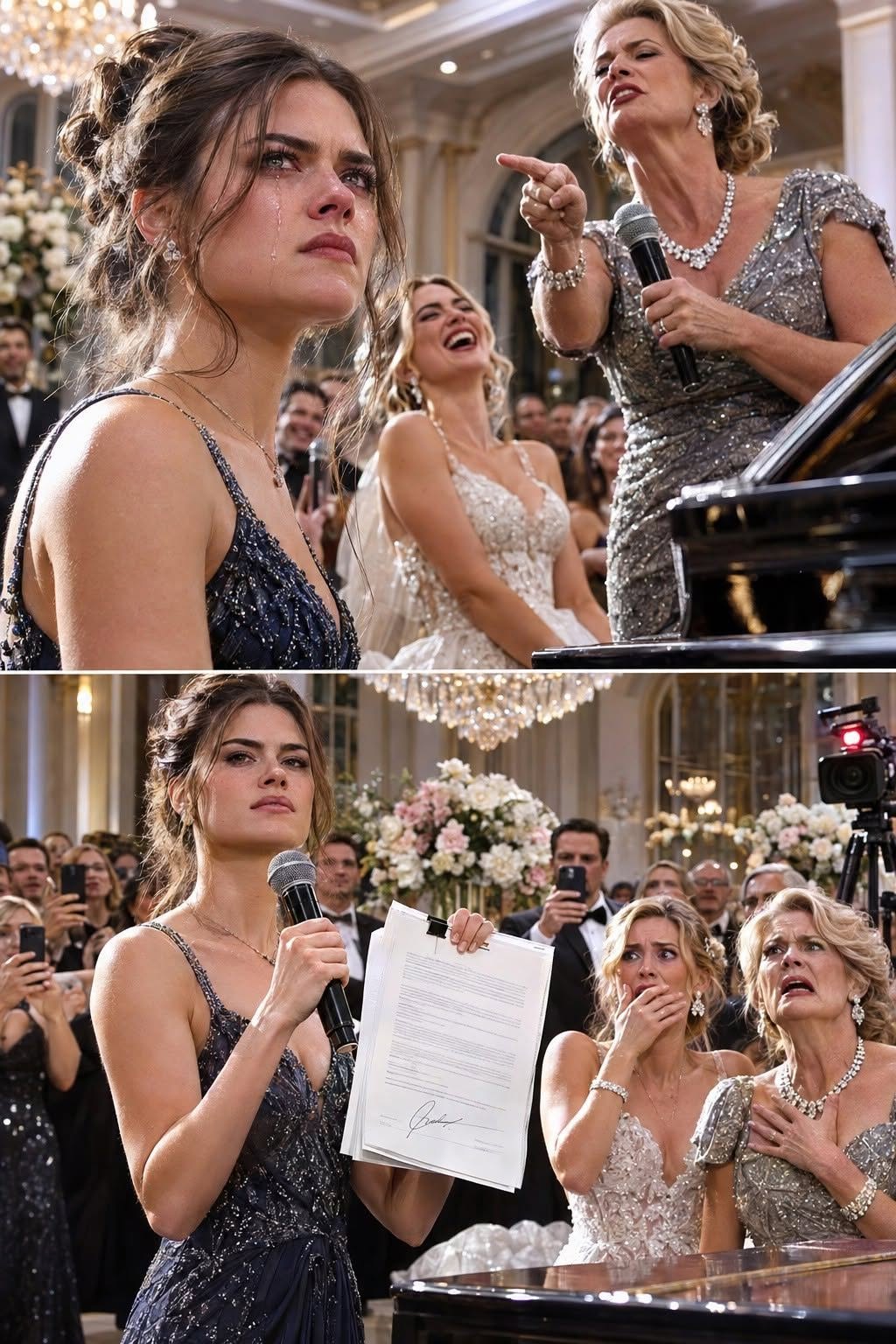
My mother stood beneath the chandelier, gripping the microphone so тιԍнтly that her knuckles had turned white.
“Your father signed an agreement before he died,” she repeated. “He promised that the composition would belong to the family. Not just you.”
I looked at her.
“Then why didn’t you tell me?”
She hesitated.
“Because you were young. You wouldn’t have understood.”
“Mom, I was twenty-four when Dad died. I was old enough to understand his will. I was old enough to understand that he left me his handwritten scores and the rights to his unfinished compositions.”
My mother glanced toward Richard.
“There’s another document.”
Richard immediately opened the folder again.
“Then let’s see it.”
My mother shook her head.
“I don’t have it here.”
Vanessa suddenly stepped forward.
“Mom, please stop.”
That was when I realized something.
Vanessa wasn’t afraid of my father’s agreement.
She was afraid of what my mother might say next.
I turned toward her.
“Vanessa, what do you know?”
She started crying.
“I didn’t know everything.”
“Then tell me what you knew.”
She looked at our mother.
“Mom told me Dad had transferred the rights to the song before he died. She said you had no claim to it.”
My chest тιԍнтened.
“And you believed her?”
Vanessa lowered her eyes.
“Yes.”
“Even when you saw my name on the original recording?”
She didn’t answer.
I took a breath.
“Even when you knew that was the last song Dad and I wrote together?”
Her tears fell onto her wedding dress.
“I wanted the campaign. It was supposed to be my big opportunity. Mom said the music would make the H๏τel executives take my company seriously.”
I looked at her for a long moment.
“You didn’t just take a song, Vanessa. You took the last thing Dad and I created together.”
She covered her face.
Richard turned to my mother.
“Mrs. Bennett, unless you can produce a valid agreement, the estate documents remain the controlling evidence.”
My mother suddenly looked smaller.
Then she whispered something I would never forget.
“Your father didn’t want you to become a musician.”
I felt the room tilt.
“What?”
“He wanted you to have a stable life. He knew how difficult the music industry was. He only encouraged you because he didn’t want to disappoint you.”
For a moment, I couldn’t breathe.
Then I remembered something.
The night before Dad died, he had given me a small wooden box.
He told me not to open it until I was ready to hear the ending of our song.
I had kept that box for seven years.
I had never understood why he made me promise to wait.
I reached into my handbag and removed it.
The wood was worn at the edges. Inside was a folded envelope with my name written in his familiar handwriting.
My hands trembled as I opened it.
The letter was dated three days before his death.
I began reading.
“Dear Clara,
If you’re reading this, then I wasn’t able to finish the music with you.
I know your mother worries about your future. I know Vanessa wants the world to admire her. And I know you sometimes feel that you have to earn your place in this family.
But listen carefully, sweetheart.
You never needed to earn your place.
When you sit at the piano, you become the person you were always meant to be. Never let anyone take that away from you.
I have left you my compositions because I know you will protect them. Not because I want you to become famous, but because I want you to remember where they came from.
Our song isn’t about sadness.
It’s about the morning after the darkest night.
When everything seems lost, the sun still rises.
Keep playing, Clara.
And if one day the world finally hears our music, I hope you remember that the first person who believed in it was sitting right beside you.
I love you, my little pianist.
Dad.”
I couldn’t finish the last sentence.
My tears blurred the handwriting.
For seven years, I had wondered whether my father truly believed in me.
Now I had his answer.
And it wasn’t written in a contract.
It was written in a letter.
Evelyn gently placed a hand on my shoulder.
“Clara, would you like to sit down?”
I shook my head.
“No. I think I’ve been sitting down long enough.”
A few guests smiled through their tears.
Then Richard spoke.
“There’s one final matter we need to address. Our legal team has already received the disputed licensing documents. We will proceed with a formal investigation into the authorization submitted by Vanessa’s company.”
Vanessa looked at him desperately.
“Please. Can’t we settle this privately?”
Richard shook his head.
“The decision is no longer mine alone.”
He turned toward me.
“Clara, the H๏τel group would like to discuss a direct licensing agreement with you, subject to the necessary legal review. We also want to commission an original orchestral arrangement for our next international campaign.”
I looked at Evelyn.
She smiled.
“We can discuss the professional details on Monday.”
I nodded.
“Thank you.”
My mother suddenly approached me.
“Clara, sweetheart. We need to talk.”
I looked at her.
“About what?”
“About family. About forgiveness.”
I almost laughed.
Only a few hours earlier, she had introduced me to two hundred people as the family’s failed investment.
Now that they knew my name, she wanted to call me sweetheart.
“Mom, you didn’t invite me because you wanted to celebrate my sister’s wedding. You invited me because you wanted everyone to laugh at me.”
Her eyes filled with tears.
“I was trying to help Vanessa.”
“And what about me?”
She said nothing.
“What about the years I spent practicing while you told everyone I had wasted my life? What about the audition you canceled? What about the times I called you because I missed Dad, and you asked when I was going to get a proper job?”
My mother lowered her head.
“I made mistakes.”
“No, Mom. You made choices. And you kept making them.”
I turned toward Vanessa.
“Congratulations on your wedding. I genuinely hope you build a happy marriage. But I won’t let you use Dad’s music or my name to build your career.”
Vanessa wiped her face.
“I’m sorry, Clara.”
I looked at her.
“I believe you regret what happened tonight. But an apology doesn’t erase seven years.”
She nodded.
For the first time, she didn’t have anything clever to say.
Then Ethan approached.
“Clara, I’m sorry. I should have asked more questions before believing her story.”
I gave him a small nod.
“You deserve honesty in your marriage. I hope you get it.”
He looked toward Vanessa.
“I hope so too.”
I placed my father’s letter back inside the wooden box.
Then I walked toward the ballroom doors.
Behind me, my mother called my name one more time.
“Clara! Don’t leave like this. You’re still my daughter!”
I stopped.
I turned around.
“Yes, Mom. I am.”
My voice was quiet.
“But being your daughter doesn’t mean I have to keep accepting your cruelty.”
And then I left.
SIX MONTHS LATER
The first time I heard The Morning We Keep performed by a full orchestra, I was sitting in the front row of a concert hall in New York.
More than a thousand people had gathered.
The stage was filled with musicians. Violins, cellos, French horns, and a grand piano stood beneath a soft golden light.
My composition was being performed as the opening piece of an international film-music concert.
The program carried two names:
Original melody by Thomas Bennett.
Completed and orchestrated by Clara Bennett.
I had insisted on that.
My father’s name would never disappear beneath mine.
When the final note faded, the audience rose to its feet.
I stood, and the applause washed over me.
For the first time, I wasn’t thinking about my mother.
I wasn’t thinking about Vanessa.
I was thinking about the old upright piano in our living room, the unfinished melody, and the man who had believed in me when nobody else did.
After the performance, I found a message waiting on my phone.
It was from Vanessa.
Clara, I know I don’t deserve your forgiveness yet. The company has dissolved, and the legal matter is being handled by our attorneys. Ethan and I are trying to work through everything. I’ve started taking responsibility for what I did. I hope someday we can talk again.
I read it twice.
Then I put my phone away.
I didn’t hate her.
But I no longer felt responsible for rescuing her from the consequences of her choices.
A few minutes later, another message arrived.
This one was from my mother.
I watched the concert online. Your father would have been proud.
I stared at those words for a long time.
Then I replied:
I know, Mom. He always was.
I didn’t add anything else.
Because I had finally learned that peace didn’t require an apology from someone who wasn’t ready to give one.
And success didn’t require an audience of people who had once rejected me.
ONE YEAR LATER
I established the Thomas Bennett Young Musicians Scholarship, providing conservatory audition support and instruments to talented students whose families couldn’t afford professional music education.
At the first scholarship ceremony, a seventeen-year-old girl approached me.
She was holding a folder of handwritten compositions.
“Ms. Bennett,” she whispered, “my parents think music is a waste of time. They say I should choose something practical.”
I smiled.
“Do you love playing?”
She nodded.
“Then don’t give up just because someone else cannot hear what you hear.”
She hugged her folder against her chest.
“Did anyone ever tell you that?”
I looked toward the piano onstage.
“Yes. My father.”
That evening, I performed The Morning We Keep one more time.
But this time, I didn’t play to prove my mother wrong.
I didn’t play to make Vanessa regret humiliating me.
I didn’t even play to show the world how talented I was.
I played because my father had started a song with me, and I had promised him I would finish it.
As the final notes drifted through the concert hall, I imagined him sitting beside me, smiling the way he used to.
And I finally understood the real meaning of the тιтle.
The morning we keep isn’t the morning when everyone suddenly recognizes our worth.
It’s the morning we stop waiting for them to.
My mother once called me background music.
My sister thought I would always stand behind her.
But I was never background music.
I was the composer of my own life.
And for the first time, I was perfectly happy playing my own melody.
THE END.