PART 2 — THE WOMAN WHO WOULD NOT TURN BACK
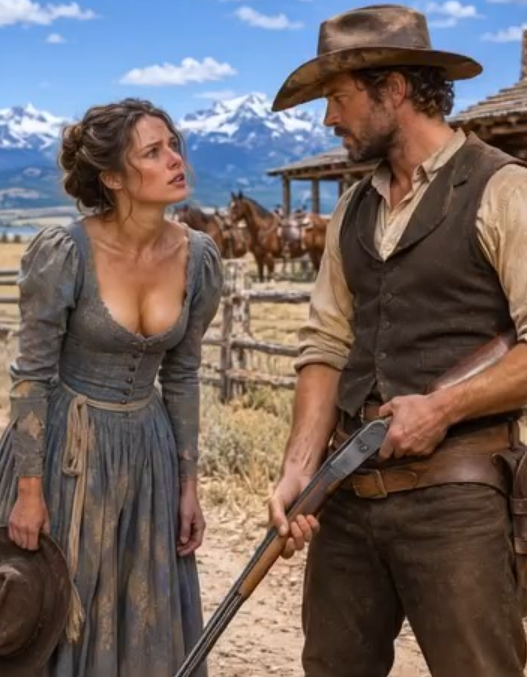
She Walked Onto a Lonely Cowboy’s Ranch With Just a Cast-Iron Skillet… Then She Asked to Rent His Worst Building
PART 2 — THE WOMAN WHO WOULD NOT TURN BACK
Hank watched Walter Briggs disappear down the lane.
For several seconds, he said nothing.
Nell was busy examining the stove, scraping old ash from its iron mouth with a piece of broken board.
“That man doesn’t like compeтιтion,” Hank finally said.
“Most men who have something worth selling don’t.”
“You don’t understand. Briggs owns the only proper eating house between here and the eastern grade. He’s got contracts with the freight companies, the stage drivers, and half the cattle outfits in the county.”
Nell glanced over her shoulder.
“And?”
“And he won’t appreciate you feeding his customers.”
“Then he ought to make better coffee.”
Hank almost laughed. Almost.
“You think this is funny?”
“No. I think a hungry man is hungry whether Walter Briggs likes it or not.”
She returned to the stove.
Hank studied her for a moment. He had seen people arrive with grand plans before. Most lasted until the first hard rain or the first bill they couldn’t pay. Nell had no wagon, no horse, no family, and apparently no sense of how thoroughly Briggs controlled the road.
Yet she had noticed the cracked chimney before she had asked where to sleep.
That bothered him more than it should have.
“There’s something you ought to know,” Hank said.
Nell straightened.
“What’s that?”
“Briggs has friends. The kind who can make trouble without ever lifting a finger themselves.”
“Then I’ll try not to give them a reason.”
“You already have.”
She picked up her skillet.
“Mr. Mercer, I didn’t walk all this way to be frightened by a man who sells breakfast.”
Hank looked at her.
For the first time, he noticed how tired she was. There were shadows beneath her eyes, and a small tear in one sleeve. Her hands were rough, but she held herself with the stubborn dignity of someone who had been told no too many times.
He pointed toward the chimney.
“I’ll have a mason look at it tomorrow. You can pay for the glᴀss and the boards.”
“That’s fair.”
“And don’t light that stove until it’s repaired.”
“I won’t.”
He started toward the door.
“Mr. Mercer?”
He stopped.
“Thank you.”
“Don’t thank me until you’ve made your first dollar.”
The next morning, Nell was awake before sunrise.
Hank heard the sound of hammering from his bedroom and looked through the window.
She was outside the bunkhouse, fitting a piece of salvaged timber across the lower part of the broken window. Her sleeves were rolled up, and her hair had come loose from its braid.
He made coffee and went out.
“You know that board’s crooked.”
Nell looked at it.
“So is the building.”
“Give me the hammer.”
“I can manage.”
“I didn’t say you couldn’t.”
He took the hammer anyway.
Together, they fitted the board properly. Hank found a sheet of glᴀss in his barn, and Nell traded him three promises of breakfast for the use of his old workbench.
By noon, the chimney had been inspected and repaired by a mason from the next valley. Nell spent the afternoon scrubbing the floor, washing the old shelves, and turning the bunkhouse’s broken bed frames into firewood.
She used the remaining boards to build a narrow counter facing the road.
At dusk, Hank found her sitting on an overturned bucket, counting her money.
“How much you got left?”
“Two dollars and fifteen cents.”
“That’s not much.”
“It’s enough for flour, coffee, beans, and eggs if I bargain carefully.”
“And if nobody stops?”
“Then I’ll have learned something.”
Hank leaned against the doorframe.
“You always this stubborn?”
“Only when someone tells me I can’t do something.”
“That must make for a difficult life.”
“It has.”
She said it so quietly that he had no answer.
The first customer arrived on Thursday.
He was a freight driver with a torn glove and a hungry-looking horse. He stopped when he saw the skillet hanging above the door.
“That mean you’re serving food?”
Nell stepped outside.
“H๏τ biscuits, eggs, and coffee. If you can wait ten minutes.”
The man looked toward Briggs’s station, then back at her.
“How much?”
“Twenty cents.”
“Briggs charges thirty-five.”
“Then you can save fifteen cents.”
He grinned.
“I’ll take two plates.”
Nell cooked the eggs in her cast-iron skillet, warmed the biscuits beside them, and poured coffee into a chipped enamel cup.
The driver ate every bite.
When he finished, he placed a quarter on the counter.
“Keep the change. Best breakfast I’ve had since leaving Missouri.”
Nell watched him ride away.
Then she looked down at the quarter.
Her first customer.
 Her first profit.
She smiled so broadly that Hank, standing near the corral, found himself smiling too.
By noon, three more men had stopped. By evening, a ranch hand returned with two friends.
Nell served beans, biscuits, and coffee until the last light disappeared behind the ridge.
She counted her earnings twice.
“One dollar and forty cents,” she announced.
Hank nodded.
“Not bad.”
“It’s a beginning.”
“Beginnings are usually the hardest part.”
She looked at him.
“Was it hard for you?”
He turned toward the corral.
“Hard enough.”
He didn’t explain that the ranch had once belonged to his father, that he’d inherited it after a fever took both his parents, or that the woman he had intended to marry had left when she realized he planned to stay on the land instead of moving to Denver.
He had learned not to offer strangers pieces of his past.
Nell didn’t ask.
She simply said, “Well, I hope the next part is easier.”
The next morning, Walter Briggs arrived.
This time he came with two men.
He dismounted outside the bunkhouse and walked straight to Nell’s counter.
“Business seems lively.”
“Good morning, Mr. Briggs.”
He looked at the skillet.
“That’s a fine old pan.”
“It belonged to my mother.”
“She teach you to cook?”
“She taught me to feed people.”
Briggs smiled without warmth.
“There’s a difference between feeding people and running a business.”
Nell wiped her hands on her apron.
“Would you like breakfast?”
“No.”
“Then perhaps you’re here to discuss something else.”
He took a folded paper from his coat.
“I’ve been speaking with Mr. Mercer. That building sits on land covered by an old access agreement. The cutoff belongs to my station, and I have the right to prevent unauthorized commercial use.”
Nell glanced toward Hank.
He was coming from the barn.
“Is that true?” she asked him.
Hank took the paper.
He read it once, then again.
“Where did you get this?”
“From the county office.”
“This agreement expired twelve years ago.”
Briggs’s smile faded.
“Not according to my copy.”
Hank handed the paper back.
“Then your copy is wrong.”
Briggs stepped closer.
“You might want to think carefully before you make an enemy of me, Mercer.”
Hank didn’t move.
“I’ve been thinking about it for eighteen years.”
For a moment, neither man spoke.
Then Briggs folded the paper and slipped it into his coat.
“Enjoy your little breakfast business while it lasts, Miss Warren.”
He turned to leave.
But before mounting, he looked back at Nell.
“Some women don’t know when they’re being offered a chance to walk away.”
Nell held his gaze.
“And some men don’t know when they’ve already lost.”
Briggs rode off.
Hank watched him go.
Then he looked at Nell.
“You shouldn’t have said that.”
“Why?”
“Because now he’ll make sure you regret it.”
Nell lifted the skillet from the stove.
“Then I suppose I’d better make a very good breakfast tomorrow.”
Hank shook his head.
But he couldn’t hide the admiration in his eyes.
That night, after Nell had closed the bunkhouse, Hank found a small envelope tucked beneath his door.
Inside was a copy of a county document.
It showed that Walter Briggs had purchased the old freight station and its business rights.
But the land beneath Nell’s bunkhouse had never been part of that purchase.
Someone had drawn a new boundary in dark ink.
And beside the altered line was the signature of a county clerk who had died six months earlier.
Hank read it twice.
Then he looked toward the bunkhouse, where a small lamp still glowed.
Briggs wasn’t simply trying to frighten Nell away.
He was trying to steal the land itself.
And if Hank couldn’t prove the document was false, the woman who had come to his ranch with nothing but a skillet might lose the only place she had ever been given a chance to build something of her own.