PART 2 — THE OVEN THAT BROUGHT THEM BACK
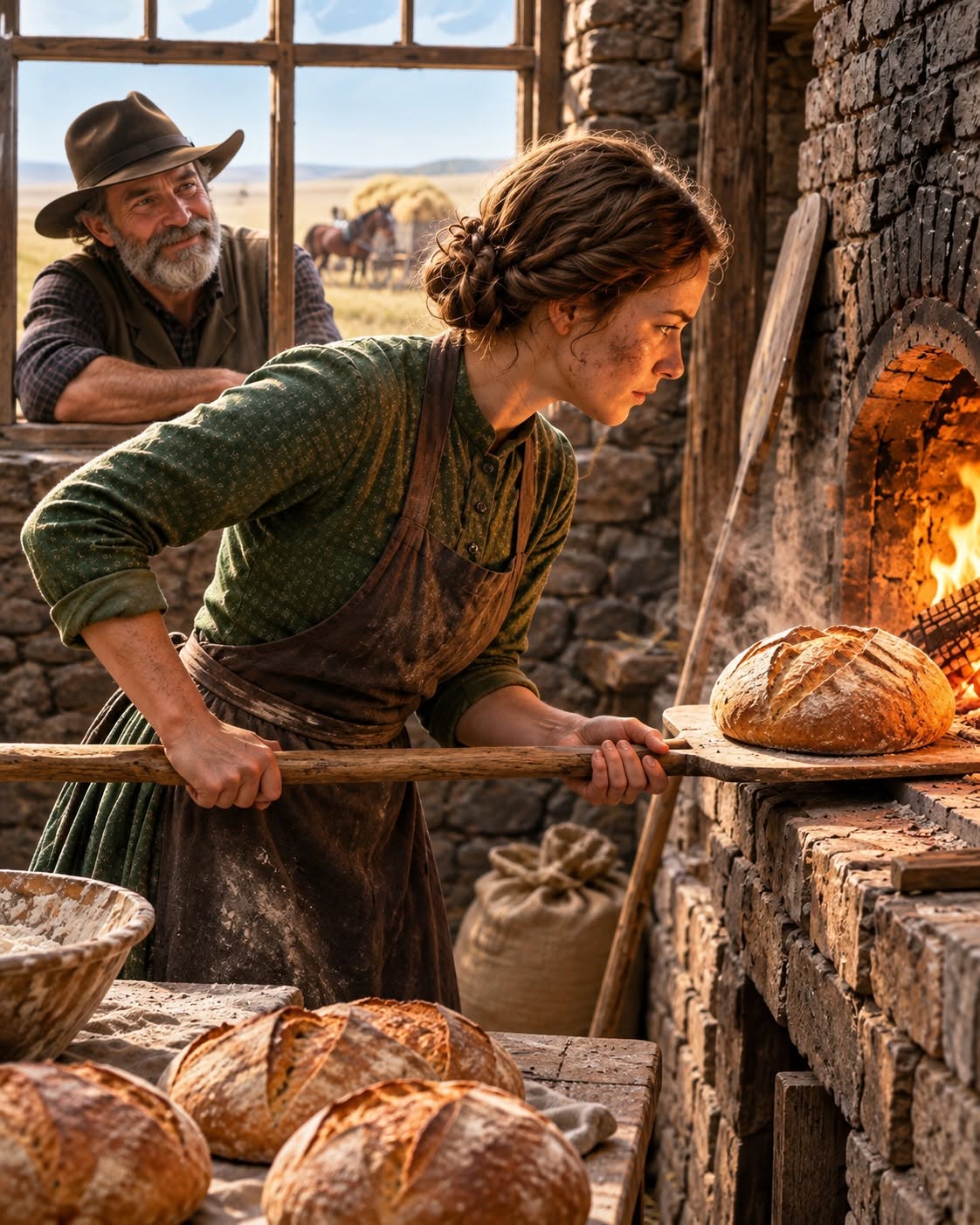
A LONELY COWBOY GAVE A HOMELESS YOUNG WOMAN HIS LATE WIFE’S ABANDONED OVEN—BY HARVEST, HER HOMEMADE BREAD HAD BROUGHT THE WHOLE VALLEY BACK TO HIS TABLE
PART 2 — THE OVEN THAT BROUGHT THEM BACK
Eliza didn’t take the oven.
Not at first.
She stood beside the old iron stove with her fingers curled around the edge of the cracked wooden table, staring at Wyatt as though he had just offered her something far more valuable than a cooking stove.
“I can’t accept this.”
Wyatt pulled his hat lower.
“You can.”
“I don’t have money.”
“I didn’t ask for any.”
“I can’t pay you back.”
“You don’t have to.”
She looked at him suspiciously.
“Then what do you want?”
Wyatt glanced toward the oven.
“Nothing.”
It was the first lie he’d told her.
Because he wanted something.
He wanted to hear that old oven come alive again.
He wanted to smell bread coming from it.
He wanted, just once, to feel like the years before Margaret died hadn’t disappeared completely.
But he wasn’t ready to say that.
So he walked toward the door.
“There’s flour in the pantry. Coffee too.”
Eliza stared after him.
“Why are you helping me?”
Wyatt stopped.
He looked back over his shoulder.
“My wife used to bake.”
Something softened in Eliza’s expression.
“She must have been good.”
“She was.”
A pause.
“Very good.”
Then he left.
For the next week, Eliza stayed in the line shack.
Wyatt didn’t ask her to leave.
He also didn’t visit every day.
Instead, strange things began appearing outside her door.
A dozen eggs.
A jar of honey.
A sack of potatoes.
Fresh milk.
Once, a bundle of clean blankets.
Eliza knew who left them.
She never mentioned it.
On Sunday morning, Wyatt smelled something he hadn’t smelled in eleven years.
Bread.
He stopped his horse outside the main house.
The scent drifted across the yard.
Warm yeast.
ʙuттer.
Honey.
Something sweet and earthy that reached straight through his chest.
He closed his eyes.
Margaret.
For one terrible second, he could almost hear her laughing.
Then he opened them.
And remembered.
She was gone.
Wyatt rode toward the line shack.
Eliza was standing outside holding a loaf of bread.
It was crooked.
The crust was too dark.
One side had collapsed.
She looked embarrᴀssed.
“I think I killed it.”
Wyatt took the loaf.
He broke off a piece.
He chewed.
Eliza watched him anxiously.
“Well?”
Wyatt swallowed.
“Best bread I’ve tasted in eleven years.”
She stared at him.
“You don’t have to lie.”
“I’m not.”
He took another bite.
She smiled.
It was small.
Careful.
But it was the first smile he’d seen on her face.
Then a little boy appeared from behind the barn.
“Mr. Cooper!”
Wyatt turned.
It was Tommy Bell, the neighbor’s youngest.
“Ma says you have bread.”
Wyatt looked at Eliza.
Eliza laughed.
“Apparently I do.”
By noon, six children were outside the shack.
By evening, there were twelve.
The next morning, Mrs. Bell arrived with an empty basket.
“My husband says I ought to pay.”
Eliza shook her head.
“I don’t need payment.”
Mrs. Bell put three eggs on the table.
“Then take eggs.”
Another woman brought ʙuттer.
Someone else brought apples.
A ranch hand offered firewood.
Within two weeks, the line shack had changed.
 There were flour sacks stacked against the wall.
Clean curtains in the window.
A little wooden sign outside:
ELIZA’S BREAD
Wyatt pretended not to notice how many times he rode past that sign.
Then one afternoon, Eliza found something tucked behind the oven.
A small tin box.
Inside was a recipe book.
The pages were yellowed.
The handwriting was unmistakably old-fashioned.
At the top of the first page were two words.
Margaret Cooper.
Eliza closed the book.
She carried it to the main house.
Wyatt was sitting on the porch.
“Where did you find this?”
“Behind the oven.”
His face changed.
“I thought everything had been taken out.”
“It wasn’t.”
She handed him the book.
He didn’t touch it.
“Keep it.”
Eliza blinked.
“Are you sure?”
“No.”
His voice cracked.
“But I think Margaret would have wanted somebody to use it.”
Eliza sat beside him.
She opened the book.
The first recipe was for honey wheat bread.
“She wrote notes in the margins.”
Wyatt looked down.
“She always did.”
Eliza smiled.
“‘Needs more salt.'”
Wyatt laughed.
A real laugh.
It startled both of them.
They sat quietly.
Then Eliza said, “You miss her.”
“Every day.”
“Was she your whole world?”
Wyatt looked toward the mountains.
“She was the part of it that made sense.”
Eliza closed the book.
“I understand.”
He turned toward her.
“You?”
She looked at her hands.
“My mother died when I was sixteen.”
Wyatt waited.
“My grandmother raised me. When she died, I went to work in Billings.”
“And the bakery?”
“I loved it.”
“What happened?”
“The owner sold it.”
She hesitated.
“The new owner said women like me weren’t worth keeping.”
Wyatt’s jaw тιԍнтened.
“What kind of woman?”
“Poor.”
Silence.
Then Wyatt said quietly:
“That’s not a kind of woman.”
Eliza looked at him.
“What?”
“Poor isn’t a kind of woman.”
Her eyes filled.
Wyatt looked away.
He wasn’t good with tears.
Especially not hers.
By summer, Eliza’s bread was being sold in three towns.
She made cinnamon loaves, honey rolls, rye bread, biscuits, and small apple cakes.
The money was enough to buy shoes.
Then a proper dress.
Then flour.
But Eliza refused to leave the line shack.
“Why?”
Wyatt asked one evening.
She looked around.
“Because nobody has ever given me a place and asked nothing in return.”
Wyatt leaned against the doorway.
“You don’t owe me.”
“I know.”
She smiled.
“That’s why I’m staying.”
For the first time in years, Wyatt began eating at his own kitchen table.
And slowly, people began coming too.
Mrs. Bell.
Tommy.
Old ranch hands.
Widows.
Children.
Neighbors.
The table that had sat empty since Margaret’s funeral began filling again.
Laughter returned.
Coffee was poured.
Bread was pᴀssed.
Wyatt sat at the head of the table and watched Eliza move between the chairs.
He realized something frightening.
He was beginning to love having her there.
Not because she reminded him of Margaret.
Because she didn’t.
Eliza was different.
She was alive in a way he had forgotten life could be.
Then, one evening, a man arrived at the ranch.
He wore a black coat and carried a folded paper.
“Mr. Cooper?”
Wyatt stood.
“Yes.”
The man handed him the document.
“Notice from the county.”
Wyatt opened it.
His eyes hardened.
“What is this?”
“The old line shack sits on disputed land.”
Wyatt looked toward the hill.
“That’s my land.”
“Apparently someone has filed a claim.”
“Who?”
The man hesitated.
“Daniel Voss.”
Wyatt’s face went cold.
Daniel Voss had been trying to buy part of the Cooper ranch for years.
“What does he want?”
The man pointed toward the line shack.
“Everything on that ridge.”
Wyatt looked at the distant smoke rising from Eliza’s chimney.
“Why?”
The man lowered his voice.
“They found something under the property.”
“What?”
“Coal.”
Wyatt folded the paper.
“And the woman?”
“She’s living there illegally.”
Wyatt’s jaw тιԍнтened.
“She has permission.”
“Not according to the county.”
The man mounted his horse.
“Mr. Cooper, if the claim holds, the shack will be cleared within thirty days.”
Wyatt watched him ride away.
Then he looked toward Eliza.
She was standing in the doorway.
She had heard everything.
“Wyatt?”
He walked toward her.
She looked frightened.
“Are they taking my home?”
Wyatt stopped.
“No.”
“You don’t know that.”
He looked directly into her eyes.
“I know one thing.”
“What?”
“I gave you that oven.”
He glanced toward the shack.
“And I’m not letting anyone take the home that grew around it.”
But neither of them knew that Daniel Voss wasn’t really after the land.
He was after something hidden beneath the oven.
Something Margaret had buried eleven years ago.
And the moment Voss learned Eliza had found Margaret’s recipe book—
he knew the secret was close.