PART 6 — THE NIGHT THE CALHOUN FAMILY FINALLY LEARNED THE TRUTH
PART 6 — THE NIGHT THE CALHOUN FAMILY FINALLY LEARNED THE TRUTH
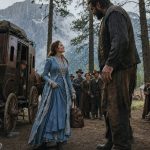
Thomas stood on the porch with a traveling bag beside him.
Two men waited near his carriage.
He looked perfectly composed, as though he had arrived for an ordinary family supper.
“Grant,” he said. “It’s been too long.”
Grant remained in the doorway.
“You’re not welcome here.”
Thomas sighed.
“Still holding grudges?”
“I’m holding evidence.”
For the first time, Thomas’s expression changed.
Then he glanced past his brother and noticed Norah standing in the hallway with the twins.
“Ah. The housekeeper.”
Norah didn’t answer.
Thomas removed his hat.
“I’ve come to discuss something important. Surely you can spare your own brother ten minutes.”
Grant stepped outside and closed the door behind him.
“What do you want?”
“The ranch.”
There was no hesitation.
No attempt to disguise it.
Thomas looked toward the pastures.
“Father built an empire. I worked beside him for years. Then he left everything to you.”
“He left it to me because I was the one who stayed.”
Thomas laughed bitterly.
“You were the favorite.”
“I was the son who never abandoned him.”
The words landed heavily.
For a moment, Thomas looked almost wounded.
Then his expression hardened again.
“Margaret should never have involved herself in our affairs.”
Grant went completely still.
“What did you say?”
Thomas looked at him.
“She was always interfering. She believed she could save everything with her little notebooks and receipts.”
Norah stepped into the doorway.
“Those notebooks proved that the ranch debt had been paid.”
Thomas turned toward her.
“You should learn when to remain silent.”
“Perhaps you should learn when to tell the truth.”
Grant raised a hand.
“Enough. Sheriff Bell is investigating. You can explain everything to him.”
Thomas smiled.
“Investigating what? A few missing receipts?”
He reached into his coat and produced a folded document.
“This is the original property agreement. Margaret signed it before she died. The ranch belongs to the bank, and the bank transferred its rights to me.”
Grant took the paper.
Norah approached.
“May I see it?”
Thomas pulled it away.
“No.”
“Then you have something to hide.”
He turned toward Grant.
“Your little housekeeper has made you suspicious of everyone.”
Grant’s voice was quiet.
“No. You did that yourself.”
Thomas stared at him.
 Then he placed the document back inside his coat.
“You have until tomorrow morning to accept my offer. I’ll give you enough money to start over somewhere else.”
“Get off my property.”
Thomas put on his hat.
“You’ll regret refusing.”
He descended the porch steps.
Before climbing into his carriage, he looked back at the house.
“Enjoy your supper, Grant. It may be the last one you eat here.”
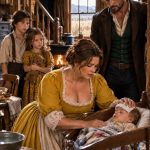
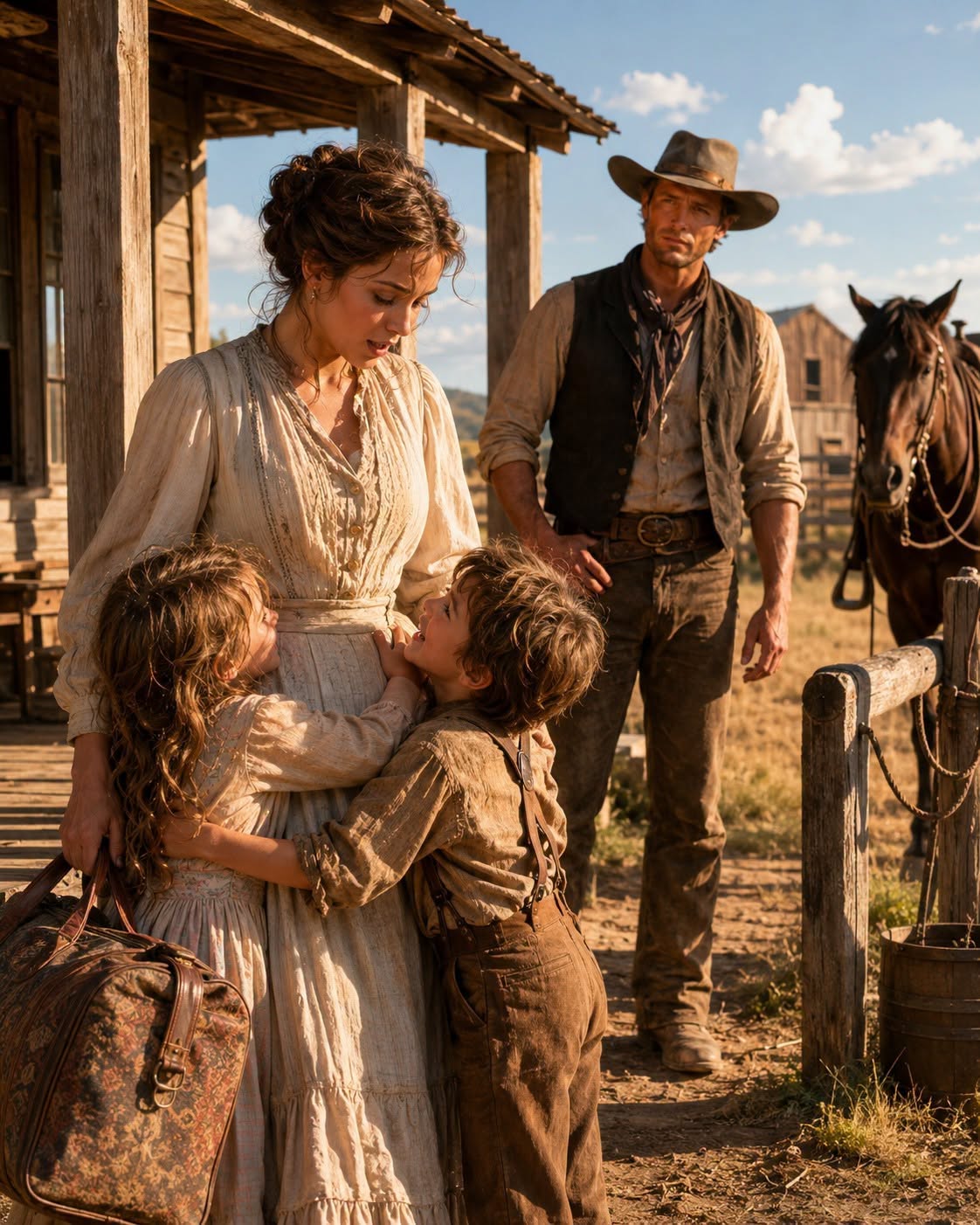
Inside, the twins were waiting.
Lizzy ran to her father.
“Papa, is Uncle Thomas taking our house?”
Grant knelt.
“No, sweetheart.”
“But he said—”
“I know what he said.”
He looked at both children.
“Your mother left us something. And we’re going to find out what it means.”
Norah placed Margaret’s final letter on the table.
Grant unfolded it.
The first lines were ordinary.
My dearest Grant,
If you have found this letter, then Thomas has probably returned.
I wish I could explain everything in person, but I am afraid I have waited too long.
There is something you must know about the night I became ill.
Grant stopped.
His face drained of color.
Norah sat beside him.
“Keep reading.”
He continued.
Thomas visited me that evening. He was angry because I had discovered the forged bank documents. He demanded that I give him the original receipts.
I refused.
He left before supper, but not before telling me that if I continued asking questions, the children would lose their inheritance.
I did not tell you because I was afraid you would confront him before we had enough evidence.
Grant’s hand trembled.
The next paragraph was even more troubling.
I became ill shortly after drinking the tea he brought me.
Norah looked up sharply.
Grant continued.
The doctor said it was probably exhaustion and a fever. I have no proof that Thomas caused it, and I do not want you to accuse anyone without evidence.
But I want you to know that I was frightened.
If anything happens to me, please find Dr. Samuel Reed. He examined me the following morning and wrote down everything I told him.
Grant lowered the letter.
“Dr. Reed.”
Norah searched through the remaining papers.
There was an address written on the back of the envelope.
“He may still be practicing.”
Grant stood.
“Then we’re going to find him.”
Dr. Samuel Reed had retired to a small property outside Cheyenne.
When Grant and Norah arrived the following afternoon, the old physician recognized the Calhoun name immediately.
He invited them inside.
“I wondered when someone would come asking about Margaret.”
Grant leaned forward.
“You knew she was in danger?”
The doctor looked troubled.
“I knew she was frightened. She told me about the threats, the forged papers, and her brother’s visits.”
“Why didn’t you tell me?”
“Because Margaret asked me not to. She believed you would confront Thomas, and she feared that would make things worse.”
He opened an old medical journal.
“I kept my notes.”
Grant stared at him.
“What did you discover?”
“Margaret had been unwell for several days before her final illness. She described severe exhaustion and recurring symptoms. I advised her to remain under observation.”
“Was it natural?”
The doctor shook his head.
“I couldn’t establish that. I had no reason to conclude that anyone had deliberately harmed her.”
Norah asked, “Did she mention the bank manager?”
“Several times. She also told me she had received a letter from a lawyer in Denver. She believed the lawyer had been pressured into preparing documents he knew were questionable.”
Grant looked at Norah.
“Harold Bennett.”
The doctor nodded.
“He may be the person who can explain the legal papers.”
He closed his journal.
“There’s something else. Margaret gave me a sealed envelope. She asked me to deliver it to you if the ranch ever came under threat.”
He went to a cabinet and returned with a small package.
Grant recognized his wife’s handwriting.
Inside was a letter and a folded legal document.
The letter read:
Grant,
I know you love this ranch, but please remember that it is only a home because we made it one together.
If Thomas succeeds in taking it, do not let the children grow up believing they were powerless.
Teach them to stand up for what is right. Teach them that kindness is not weakness. And please, when the time comes, allow yourself to be happy again.
You have spent too long believing that loving someone new would mean forgetting me.
It won’t.
Grant closed his eyes.
For the first time in two years, he allowed himself to cry.
Norah remained beside him without saying a word.
When he finally looked up, he handed her the document.
It was a copy of the original property deed.
And beneath it was a second paper bearing the seal of a Denver court.
Norah read it carefully.
Then she looked at Grant.
“Your father placed a condition on the inheritance.”
“What condition?”
“The ranch could never be transferred to another family member without your written consent. Not even through a bank foreclosure based on a disputed debt.”
Grant frowned.
“Why didn’t I know about this?”
“Because the original document was kept with the lawyer.”
The door opened.
A man entered carrying a leather briefcase.
“Mr. Calhoun?”
Grant stood.
“Harold Bennett?”
The lawyer nodded.
“I received your telegram. And I believe I can explain why your brother has been so desperate to obtain this ranch.”
He opened his briefcase.
Inside were several original documents.
One was the inheritance agreement.
Another was the bank’s original loan ledger.
And the third was a letter signed by Thomas.
Harold placed them on the table.
“Your brother never had a legal claim to the ranch. But he believed he did. Whitcomb convinced him that if he could produce a signed transfer from Margaret, the bank would recognize him as the rightful owner.”
Grant stared at the letter.
“What does it say?”
Harold hesitated.
“It is an agreement between Thomas and Whitcomb. They planned to divide the ranch’s proceeds after the foreclosure.”
Norah examined the document.
There were dates, amounts, and signatures.
Everything they needed.
But then she noticed something.
“Mr. Bennett, look here.”
She pointed to the bottom of the page.
The agreement had been signed three months before Margaret’s death.
Grant leaned closer.
“So they planned this while she was still alive?”
Harold nodded.
“Apparently.”
Norah turned another page.
And found a handwritten note.
It was dated just two days before Margaret’s final illness.
The original deed has been moved. Margaret knows where it is. We must recover it before she speaks to Grant.
The room went silent.
Grant looked at the lawyer.
“Where is the original deed?”
Harold studied the note.
“I believe Margaret hid it somewhere on the ranch.”
They returned home just before sunset.
Grant gathered the ranch hands in the main room and explained what they had discovered.
Nobody spoke for several moments.
Hank Dawson finally stepped forward.
“Then we stand with you, boss.”
Charlie nodded.
“So do we.”
Grant looked around at the men who had worked beside him for years.
“Thank you.”
But Norah was thinking about something else.
Margaret had hidden the deed.
She had left clues in her letters, her notebook, and the old trunk.
And if she had wanted Grant to find it, she would have chosen somewhere meaningful.
Norah went upstairs.
She entered Margaret’s bedroom and looked around.
The sewing basket.
The curtains.
The pH๏τograph.
Then she remembered Lizzy mentioning something.
Mama used to sit by the window and sew whenever it rained.
Norah approached the small wooden sewing cabinet.
Inside were spools of thread, needles, scraps of fabric, and a half-finished quilt.
She lifted the quilt.
Something hard rested beneath it.
A small wooden compartment.
Her heart began racing.
She called Grant.
“Mr. Calhoun!”
He hurried upstairs.
“What happened?”
Norah pointed.
Grant opened the compartment.
Inside lay an envelope wrapped in oilcloth.
The original property deed.
And beneath it was one final letter.
Grant opened it.
My dearest family,
If you have found this, then the truth has finally come into the light.
I have one final request.
Please don’t let the ranch become a place where everyone is afraid to speak, where children hide their feelings, and where sadness decides what happens next.
Let this house be full of laughter again.
And Grant, thank you for loving our children enough to keep going.
He read the final line twice.
One day, I hope they will have someone beside them who makes them feel safe enough to laugh again.
Grant slowly folded the letter.
Downstairs, Lizzy and Sam were waiting.
“Did you find something?” Lizzy asked.
Grant knelt and opened his arms.
“We found it, sweetheart.”
Sam looked at the envelope.
“Does that mean we’re keeping the ranch?”
“Yes.”
The boy threw both arms around his father’s neck.
Lizzy began crying.
Then she turned toward Norah.
“Does that mean you’re staying?”
Norah knelt beside her.
“I hope so.”
Lizzy hugged her тιԍнтly.
“Good. Because Sam and I have decided something.”
“What is that?”
Sam looked at his sister.
Then both children spoke together.
“We don’t want another housekeeper.”
Grant raised an eyebrow.
“What do you want, then?”
Lizzy took Norah’s hand.
“We want Norah to be part of our family.”
For a moment, nobody spoke.
Grant looked at Norah.
He had spent two years believing that the only way to honor Margaret was to keep the past untouched.
Now he understood what she had been trying to tell him.
A family could remember someone and still make room for happiness.
He turned to Norah.
“You came here needing a place to work. I never expected you would become so important to this household.”
Norah lowered her eyes.
“I never expected to find a home here.”
Grant paused.
“I won’t ask you to stay because you feel indebted to me. You deserve to choose your own future.”
Norah looked at the twins.
Then at the man who had finally begun opening his heart again.
“I would like to stay,” she answered. “But not as someone who was bought at an auction. I want to stay because this is where I belong.”
Grant nodded.
“Then that’s how it will be.”
Three weeks later, Whitcomb’s fraudulent accounts were exposed, and the sheriff arrested him on charges related to the forged documents. Thomas was required to answer for his part in the scheme, while the court confirmed that the ranch belonged to Grant.
The Calhoun family kept their home.
But the greatest change was not in the legal papers.
It was in the house itself.
Lizzy began singing while helping Norah prepare breakfast.
Sam stopped hiding food beneath his mattress.
And Grant started coming home early enough to eat supper with his children.
One Sunday morning, he found Norah sitting on the porch with the twins.
Lizzy was braiding a ribbon into Norah’s hair.
Sam was explaining why his wooden horse needed a proper name.
Grant leaned against the doorway.
“What’s the horse called?”
“Mr. Biscuit,” Sam announced.
Grant laughed.
“That sounds respectable.”
“It is,” Sam replied. “He’s going to own a ranch someday.”
Norah looked up at Grant.
For a moment, their eyes met.
Neither hurried to look away.
The future was still uncertain, but it no longer seemed frightening.
And on the mantel inside the house, beside Margaret’s pH๏τograph, Grant placed the little blue ribbon Lizzy had once been afraid to touch.
Not as a reminder of what they had lost.
But as a reminder of the love that had made their family possible.
Because the girl who had arrived at the Calhoun ranch as an eighteen-year-old with nowhere else to go had given two grieving children something they thought they would never have again: a reason to believe that people could stay.