The Little Girl With a Purple Birthmark Across Her Face: Understanding Amelia’s Journey With Sturge-Weber Syndrome
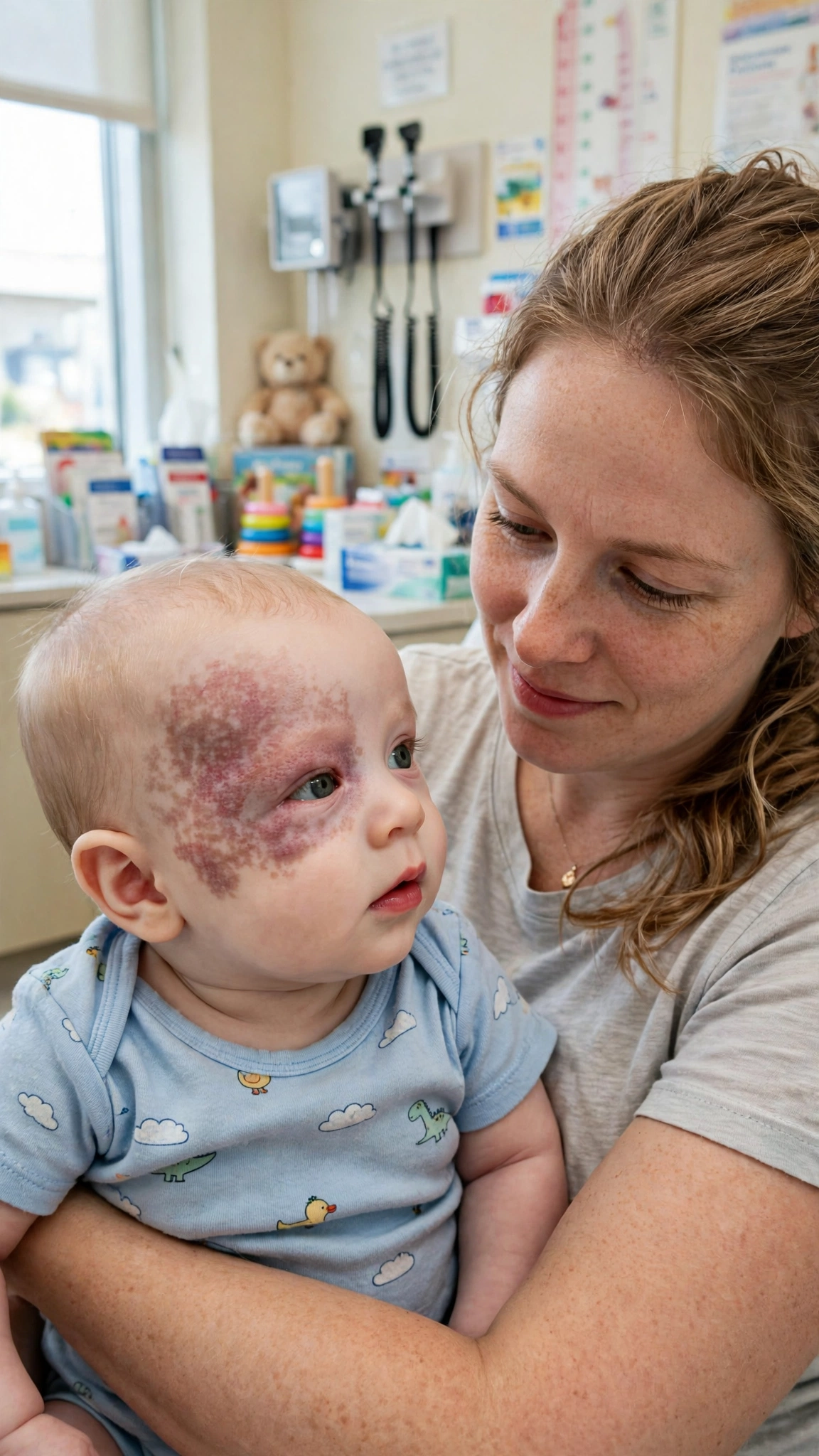
At just two years old, Amelia had a distinctive facial birthmark that made her appearance different from that of many other children her age.
A deep reddish-purple patch covered one side of her forehead, extended across her upper eyelid, and continued down toward her cheek. The mark was clearly visible and covered a considerable area of her face.
Her parents first noticed the unusual discoloration shortly after her birth. Although they initially thought it might be an ordinary birthmark, they became increasingly concerned as they learned more about its appearance and possible medical significance.
After seeking professional medical advice and undergoing specialist examinations, Amelia was diagnosed with Sturge-Weber syndrome, a rare condition involving abnormal blood vessels that can affect the skin, brain, and eyes.
Understanding the Birthmark on Amelia’s Face
The distinctive mark on Amelia’s face is known as a port-wine birthmark, a type of capillary vascular malformation.
It develops when small blood vessels near the surface of the skin form abnormally, creating a flat patch of reddish, pink, or purple discoloration. These birthmarks are usually present at birth and may become darker or thicker over time.
In Amelia’s case, the birthmark extended across a significant portion of one side of her face, including her forehead, eyelid, and cheek.
While a port-wine birthmark can occur on its own, it may also be ᴀssociated with certain medical conditions. One of these is Sturge-Weber syndrome.
The presence of a birthmark alone does not necessarily mean a child has this syndrome. However, when doctors identify certain characteristic facial patterns, particularly involving the forehead and upper eyelid, they may recommend further neurological and ophthalmological evaluations.
What Is Sturge-Weber Syndrome?
Sturge-Weber syndrome is a rare, usually congenital condition characterized by abnormal blood vessels involving the skin and, in some cases, the tissues surrounding the brain and eyes.
The condition is ᴀssociated with a genetic change that occurs during early development. It is generally not inherited from parents.
The severity varies considerably from one child to another. Some children experience primarily skin-related symptoms, while others may develop neurological or eye complications.
Possible complications include:
- Seizures: Some children develop seizures because of abnormal blood vessels affecting the tissues surrounding the brain.
- Glaucoma: Increased pressure inside the eye can damage the optic nerve and potentially affect vision.
- Neurological difficulties: Depending on the extent of involvement, some children may experience weakness on one side of the body, headaches, or developmental challenges.
- Developmental concerns: Certain children may experience delays in reaching developmental milestones and require additional support.
Not every child with Sturge-Weber syndrome experiences all these complications. Their symptoms and medical needs depend on the areas affected and the severity of the condition.
Medical Monitoring and Ongoing Care
Following her diagnosis, Amelia’s family learned that regular medical monitoring would be an important part of her childhood.
Her healthcare team recommended ongoing ᴀssessments to evaluate her neurological development and monitor her eyes for signs of glaucoma.
Eye examinations are particularly important because glaucoma can sometimes develop during infancy or childhood. Early identification and appropriate treatment can help protect a child’s vision.
Neurological monitoring is also essential. Doctors ᴀssess children for possible seizures, changes in movement, developmental concerns, and other symptoms that may require additional investigation.
Treatment for Sturge-Weber syndrome is individualized. Depending on a child’s symptoms, medical care may involve medication to control seizures, treatment for glaucoma, developmental therapies, and other specialist interventions.
The facial birthmark may also be treated with laser therapy in some cases. However, treatment decisions depend on the child’s individual circumstances and should be discussed with qualified medical professionals.
For Amelia’s parents, understanding the condition meant learning to navigate medical appointments, ask questions, and make decisions based on professional guidance.
The Emotional Journey of Her Family
Receiving a diagnosis of a rare medical condition can be overwhelming for any family, especially when the child is still so young.
Amelia’s parents had imagined a childhood filled with ordinary milestones: her first words, first steps, favorite toys, and countless happy family memories.
After the diagnosis, however, they also had to think about medical appointments, possible complications, and the uncertainty surrounding her future.
Her mother sometimes found herself staying awake at night, checking on her daughter and worrying about symptoms that might appear as Amelia grew older.
Every examination brought a mixture of hope and anxiety. Her parents wanted to understand everything they could about the condition while making sure Amelia’s everyday life remained as happy and comfortable as possible.
Over time, they began to understand that although the diagnosis would remain part of their family’s journey, it did not have to define every aspect of their daughter’s childhood.
A Childhood Filled With Little Moments of Happiness
Despite the medical challenges, Amelia continued to enjoy the simple pleasures of being a toddler.
Music was one of her favorite things. Whenever a familiar song played, she would move her little body to the rhythm, sometimes smiling and laughing as her parents joined in.
She also loved stuffed animals and often carried her favorite toys around the house. They accompanied her during playtime, quiet afternoons, and moments when she wanted to feel close to her family.
Her father had a special way of making her laugh. He would pretend to be cartoon characters, make funny expressions, and perform silly movements just to see her smile.
For Amelia, these moments were simply part of everyday life.
For her parents, they were reminders that their daughter was much more than her medical diagnosis.
They wanted her to grow up feeling loved, accepted, and confident. They hoped she would have the freedom to discover her interests, make friends, learn new things, and experience the world without feeling limited by the appearance of her birthmark.
Looking Beyond the Birthmark
Amelia’s journey with Sturge-Weber syndrome requires ongoing medical attention, patience, and support. Her condition may present challenges as she grows, and her family remains committed to following the care recommended by her doctors.
However, her story is also about something beyond medicine.
It is about a little girl whose appearance may attract attention, but whose personality deserves to be recognized first. It is about parents learning to face uncertainty while celebrating every small achievement. And it is about understanding that children with rare conditions deserve the same kindness, dignity, and opportunities as everyone else.
The purple birthmark across Amelia’s face may be the first thing a stranger notices, but it is not what makes her who she is.
She is a little girl who loves music, treasures her stuffed animals, laughs at her father’s silly performances, and is slowly discovering the world around her.
Amelia is not defined by the color of her birthmark or the name of her condition. She is a child with her own personality, her own dreams, and an entire lifetime of possibilities ahead of her.