PART 2 — A Door Left Open
PART 2
By Tuesday morning, Elias knew more about Clara Whitmore than he had intended to learn.
Not because he had asked.
In a town like Bellweather, people rarely needed to be asked.
Mrs. Hattie Monroe ran the boarding house beside the church, and she possessed the particular talent of knowing everyone’s history while appearing to mind none of it.
Elias had stopped there for coffee.
He had barely set his cup down when she said,
“You’re thinking about the widow.”
Elias nearly choked.
“I’m not.”
Mrs. Monroe smiled.
“Of course you aren’t.”
He knew better than to argue with her.
She told him Clara had come to Texas with her husband believing they would build a new life.
Then the wagon broke.
Her husband died.
She had eleven dollars left.
Now she lived above the blacksmith’s shop and earned enough to survive by sewing.
“She’s proud,” Mrs. Monroe said.
Elias said nothing.
“Too proud to ask for help.”
He looked into his coffee.
“Nothing wrong with that.”
“No.”
Mrs. Monroe’s voice softened.
“But there’s a difference between pride and loneliness.”
That sentence followed him all the way home.
That night, Elias sat at the kitchen table repairing a cracked leather strap.
The lamp burned low.
Outside, the horses shifted in the darkness.
Samuel had already gone to bed.
The house was quiet.
Too quiet.
Elias looked toward Margaret’s rocking chair.
Two years.
Two years since he had touched it.
Two years since he had allowed himself to say her name unless someone else said it first.
He had always believed that moving forward meant leaving the ᴅᴇᴀᴅ behind.
But perhaps that was why he had spent two years going nowhere.
He looked at the empty chair.
“I’m tired, Margaret.”
The words came out before he could stop them.
His hand тιԍнтened around the leather.
“I’m tired of pretending I’m not.”
He sat there for a long time.
Then he remembered the woman in the blue dress.
I miss him every day.
Maybe grief wasn’t something you finished.
Maybe it was something you learned to carry differently.
The following morning, Elias found himself sorting through a pile of clothes.
Three shirts.
A coat with a torn lining.
Two pairs of trousers.
None of them urgently needed repairing.
He stared at the pile.
Then at the door.
Then back at the clothes.
He almost laughed at himself.
There were half a dozen reasons he could give for going into town.
The nearest one was sewing.
The real one was harder to name.
He saddled his horse.
Clara heard the knock shortly after sunrise.
She expected Mrs. Monroe.
Instead, when she opened the door, Elias Harper stood on the narrow landing with a bundle of clothing under one arm.
His hat was in his other hand.
For some reason, that surprised her.
“Good morning, Mr. Harper.”
He blinked.
“You remember my name.”
“I remember people who introduce themselves.”
A faint smile touched her face.
It disappeared quickly.
He held out the bundle.
“I’ve got some things that need repairing.”
Clara took them.
She glanced at the first shirt.
“These aren’t badly damaged.”
Elias looked uncomfortable.
“No.”
She looked up.
“Then why bring them?”
For the first time, the rancher seemed to have no answer.
The silence between them stretched.
Finally, he said,
“I suppose I wanted an excuse to come here.”
Clara’s fingers stopped moving.
Neither of them spoke.
Outside, a horse whinnied somewhere in the street.
The sound seemed strangely loud.
Elias looked toward the small window.
“I don’t know why I’m telling you this.”
“Perhaps because you don’t have to pretend with me.”
His eyes returned to hers.
Something changed in his expression.
Not desire.
Not yet.
Something quieter.
Recognition.
The same thing she had seen in his eyes that afternoon with Samuel.
A man who had been surviving for so long that he had forgotten what living felt like.
Elias lowered his voice.
“Since my wife died, it’s just me and Samuel.”
Clara said nothing.
“We manage.”
He paused.
Then he looked toward the floor.
“But managing isn’t the same as living.”
The words landed between them with the weight of a confession.
Clara knew that feeling.
She had spent months managing.
Managing the rent.
Managing the hunger.
Managing the silence.
Managing the nights when memory hurt so badly she had to sit beside the window until morning.
She looked down at the shirts in her hands.
Then back at him.
“You shouldn’t feel guilty for wanting something more.”
Elias’s jaw тιԍнтened.
“You think that’s what this is?”
“I don’t know what this is.”
Neither did he.
And perhaps that was what frightened them both.
From somewhere downstairs came the distant sound of the blacksmith’s hammer.
Clang.
Clang.
Clang.
Life continuing as it always did.
Elias finally reached for his hat.
“I’ll come back Saturday.”
Clara raised an eyebrow.
“For more shirts?”
A small smile appeared on his face.
“Maybe.”
He started down the stairs.
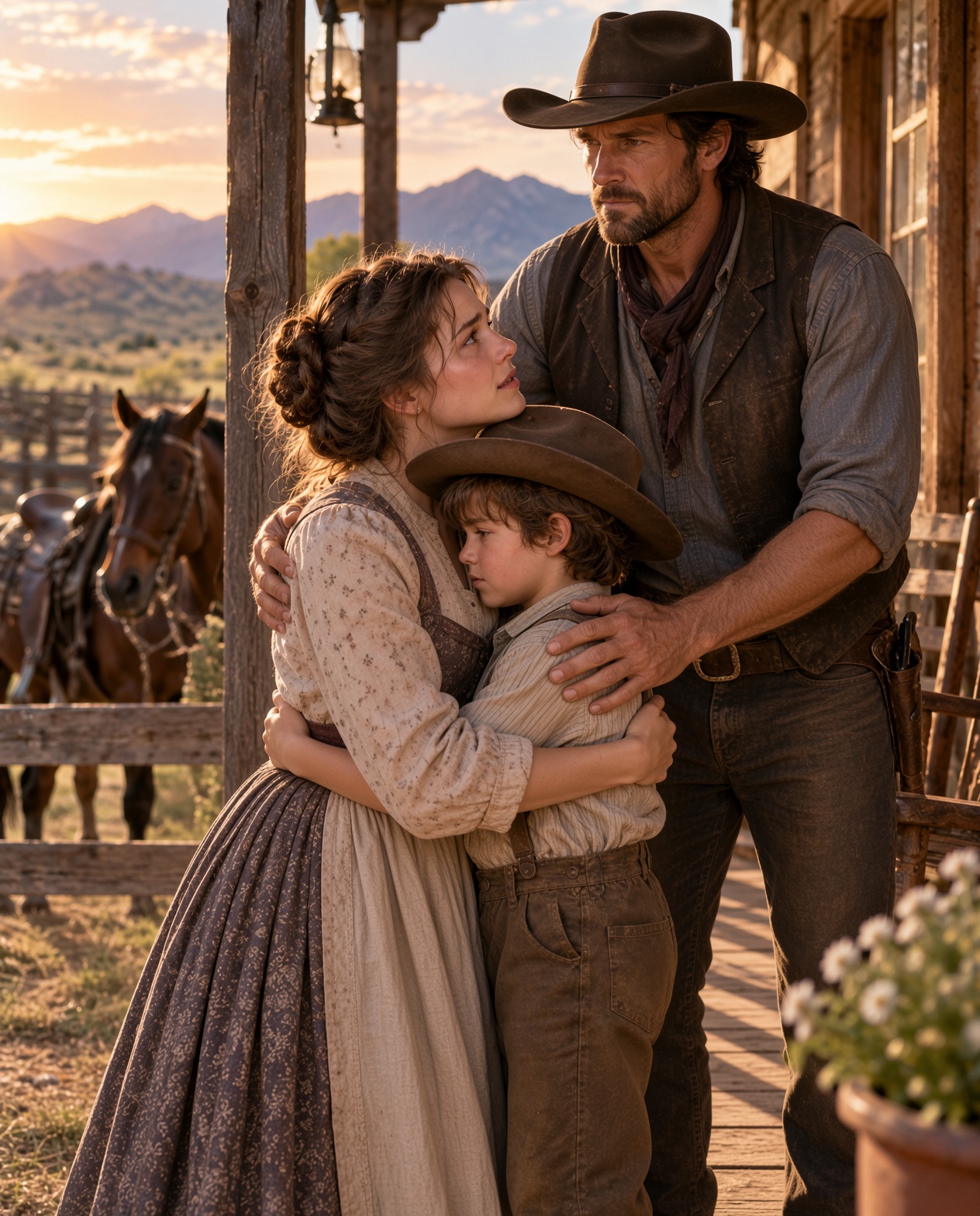
Then Samuel’s voice suddenly called from the street below.
“Pa!”
Elias stopped.
Clara stepped toward the window.
Samuel was standing beside the wagon, holding something тιԍнтly in his fist.
He looked up at the window.
At Clara.
Then at his father.
And with the fearless certainty only a child could possess, he shouted:
“Is she coming home with us?”
Elias went completely still.
Clara’s hand тιԍнтened around the curtain.
Neither of them knew what to say.
And for the first time since Clara had arrived in Bellweather, the little room above the blacksmith shop did not feel quite so empty.