No, 68-Million-Year-Old T. rex Blood Vessels Do NOT Prove a Young Earth — Scientists Are Not Panicking.lh

No, 68-Million-Year-Old T. rex Blood Vessels Do NOT Prove a Young Earth — Scientists Are Not Panicking
The 2005 discovery of preserved soft tissue (blood vessels, cells, and flexible matrix) inside a Tyrannosaurus rex femur from Montana’s Hell Creek Formation is real and scientifically remarkable. However, it does not support a young-Earth interpretation, and the scientific community has never “panicked.”
What was actually found
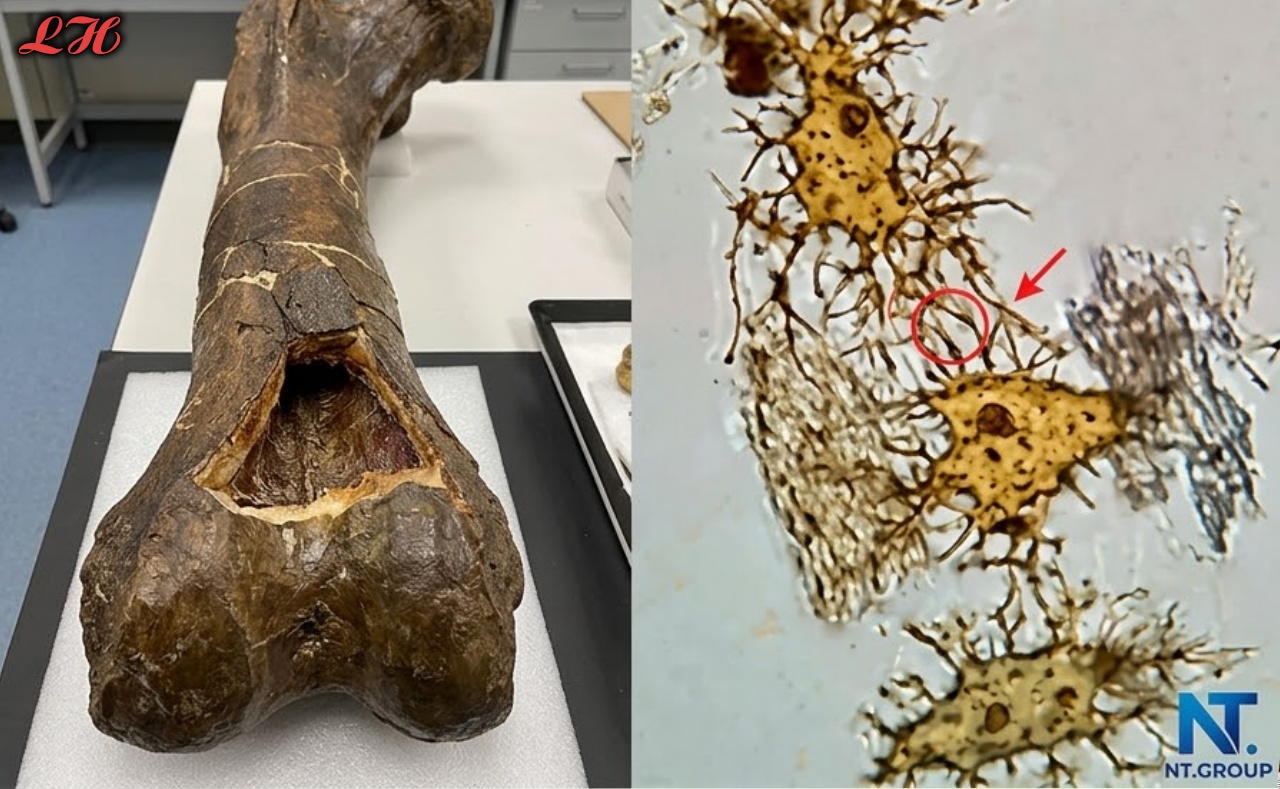
Mary Schweitzer’s team at North Carolina State University reported in Science (2005) that demineralised fragments of the femur contained flexible, branching structures resembling blood vessels, plus what appeared to be red blood cells and collagen. The bone is dated to approximately 68 million years ago using multiple independent methods (radiometric dating of surrounding ash layers, biostratigraphy, etc.).
Why the tissue survived
Subsequent research has explained the preservation through well-understood chemical processes:
- Iron-mediated cross-linking: Iron from the dinosaur’s blood acted as a natural fixative, similar to how formaldehyde preserves modern tissue, stabilising proteins against decay.
- Rapid burial and mineral replacement: The animal was quickly buried in fine sediment, limiting oxygen and bacterial activity. Over time, original organic material was partially replaced or stabilised by minerals.
- Similar soft-tissue preservation has now been documented in many other Mesozoic and even Paleozoic fossils, showing it is a rare but repeatable taphonomic phenomenon, not evidence of recent burial.
Creationist claims vs. reality
Young-Earth creationists frequently cite this find as “proof” that the bone cannot be 68 million years old. This argument ignores:
- The extensive radiometric, stratigraphic, and geochemical evidence placing the Hell Creek Formation firmly in the Late Cretaceous.
- Laboratory experiments showing that certain proteins and collagen can survive for tens of millions of years under ideal conditions.
- The fact that the preserved structures are chemically altered and mineralised, not fresh modern tissue.
No peer-reviewed study has ever concluded that these vessels prove a young Earth. The discovery is instead celebrated as a breakthrough that expands our understanding of fossilisation and offers potential for future molecular studies of ancient life.
From the Hell Creek badlands, the T. rex soft tissue remains one of the most extraordinary windows into dinosaur biology — a testament to exceptional preservation, not a challenge to deep time. Science continues to study it calmly and rigorously, without panic.