His own mother couldn’t bring herself to look at him for an entire week after he was born
His own mother couldn’t bring herself to look at him for an entire week after he was born.
Years later, Robert Hoge would read the diary where she had written just how frightened she had been.
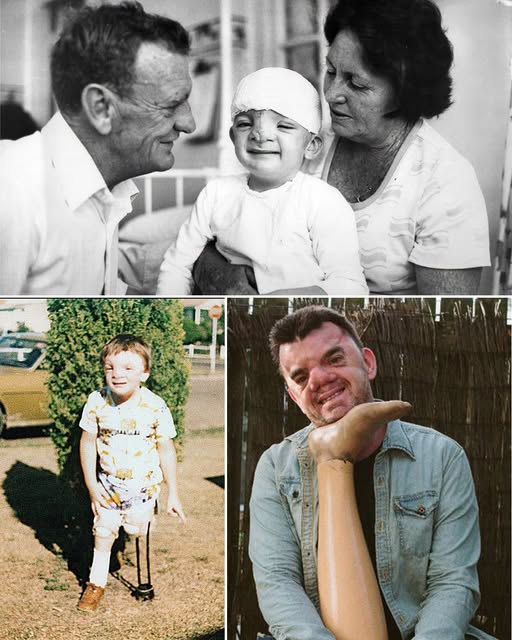
Robert was born in Brisbane, Australia, in 1972 with a large facial tumor where his nose should have been. The condition pushed his eyes far apart, and he was also born with severely deformed legs that would later require amputation.
His mother, Mary, was overwhelmed by fear and uncertainty. At first, she even told hospital staff she didn’t think she could take him home. One doctor suggested placing him in an insтιтution.
But everything changed after difficult conversations and one simple question.
Robert’s brothers and sisters were asked if they wanted their baby brother to come home.
Not one of them hesitated.
From that moment on, Robert’s life became a journey of resilience. He endured countless hospital visits, facial reconstruction surgeries, and procedures to help him breathe, see, and live more comfortably. By the age of 14, he had already undergone 24 operations.
Then doctors offered one more major surgery.
It could bring his eyes closer together and further change his appearance.
But there was a serious risk.
He could lose his eyesight.
For the first time, his parents told him the decision was entirely his.
During the family discussion, his brother Michael asked a question Robert would never forget:
“What’s the point of looking different if you can’t even see yourself?”
Robert declined the surgery.
He chose to keep the face he already had rather than risk losing his vision.
That decision didn’t spare him from cruel comments, stares, or rejection. But over time, Robert stopped allowing his appearance to define his worth.
He became a journalist, worked in politics, built a loving family, and wrote his memoir, Ugly, where he spoke openly about living with a visible difference instead of pretending it didn’t exist.
One of his most memorable reflections was:
“If I’m not ugly, no one is.”
His point wasn’t that appearance doesn’t matter.
It was that people naturally notice differences. Real acceptance isn’t pretending they don’t exist—it’s recognizing them while understanding they never determine a person’s value.
The 14-year-old boy who once had the chance to risk his eyesight for a different face chose the face he already had.
And in doing so, he showed the world that courage isn’t about changing who you are.
Sometimes, it’s about learning to live fully as the person you already are.