PART 3 — THE WOMAN WHO OWNED THE WINTER
PART 3 — THE WOMAN WHO OWNED THE WINTER
Josephine stood in the doorway, staring at the ruined supplies.
The snow was fresh, barely an inch deep, but the wool and canvas had been dragged through the mud. Someone had cut the bundles open with a sharp blade, leaving the fabric soaked and useless.
Nathaniel came around the side of the cabin carrying an armful of firewood.
He saw the damage.
For several seconds, he said nothing.
Then he set down the wood.
“Who did this?”
“I don’t know.”
“I’ll find out.”
“And then what? Break his jaw? That won’t replace the fabric.”
Nathaniel’s hands тιԍнтened.
“They’re trying to frighten you.”
“Then they have chosen the wrong woman.”
Josephine crouched and began separating the damaged material. Some pieces could still be washed and dried. Others were beyond saving. She worked until her fingers went numb, refusing to give the person responsible the satisfaction of seeing her surrender.
Nathaniel watched her for a while.
Then he picked up the remaining bundles and carried them inside.
That afternoon, Josephine went to Rose Haven.
She did not go to Montgomery’s mercantile.
She went to the blacksmith.
Mr. Barlow was a thick-necked man with soot permanently embedded in the creases of his hands. He had brought her a pair of trousers the previous week, and she had repaired them so well that he had sent three other customers.
“Someone destroyed my supplies,” she told him.
Barlow’s face darkened.
“Montgomery?”
“I don’t have proof.”
“Don’t need proof to know who’s benefiting.”
He glanced toward the street.
“His new tailor has been telling everyone you’re an amateur. Says that machine of yours can’t handle proper winter clothing.”
Josephine smiled faintly.
“Then perhaps we should let the winter decide.”
She asked Barlow for something unusual: narrow strips of leather, several brᴀss rivets, and a supply of strong cord. In return, she offered to repair the heavy canvas aprons worn by his apprentices.
He agreed.
Next, she visited the boardinghouse and spoke to the cook. She offered to teach two young women how to cut patterns and prepare garments while she handled the more complicated sтιтching.
By sunset, Josephine had made a new arrangement.
She would not depend on one supplier, one customer, or one pair of hands.
She would build a workshop.
Nathaniel was skeptical when she explained it.
“You’re talking about hiring people.”
“I’m talking about teaching people.”
“With what money?”
“With the money we earn.”
“And where will they work?”
Josephine looked at the cabin.
“Here, for now. But not forever.”
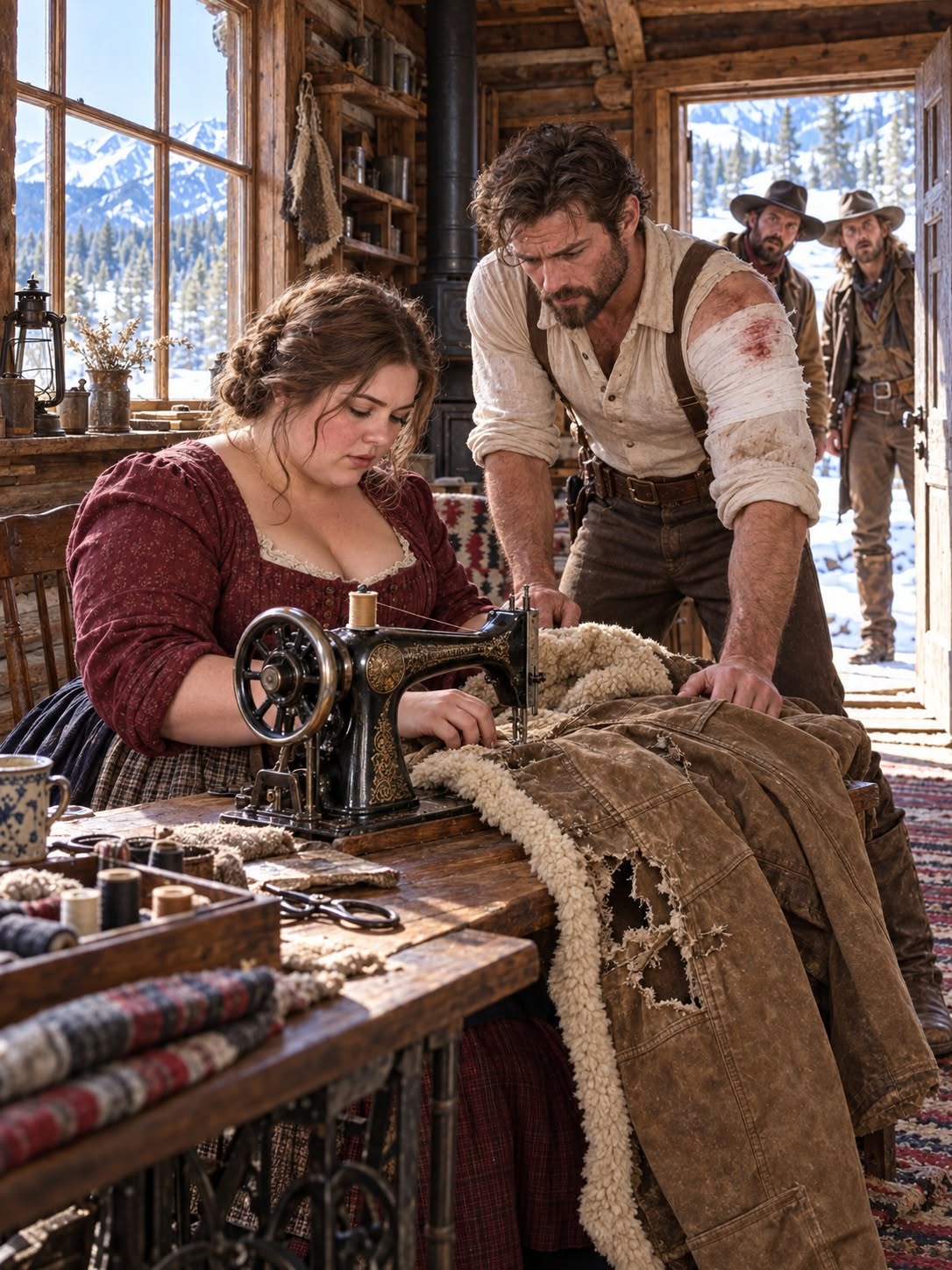
For the next several days, she worked with relentless determination. She washed the salvageable cloth, repaired the torn bundles, and designed a heavy winter coat using canvas, wool, and leather reinforcement.
It was not elegant.
It was durable.
She called it the Mountainman’s Coat.
The first one went to Samuel Turner, the miner who had brought her the original torn garment.
He wore it to the bunkhouse.
By the following morning, Josephine had orders for fourteen more.
Montgomery’s tailor had never made a coat quite like it.
He could sew fine city garments, but he had little experience with the brutal conditions of the Rockies. His first batch of winter coats looked handsome in the store window. Unfortunately, the seams split when the miners bent, climbed, or swung their picks.
Josephine’s coats were built for work.
And the men noticed.
By the middle of November, she had more orders than she could finish alone.
Two women from town began working at her cabin. One cut patterns, the other prepared ʙuттons and lining. Nathaniel built a larger workbench and installed a second stove. He even hauled a load of firewood to the cabin every evening so the women could work without freezing.
The town began calling the place Miller’s Sewing Room.
Josephine corrected them at first.
“My name is Hayes now.”
But Nathaniel, hearing her, shook his head.
“Keep Miller’s. It’s the name that brought you here.”
She looked at him.
“And Hayes is the name that kept me here.”
He had no answer.
Only a quiet smile.
Then Montgomery struck again.
One morning, Josephine received a notice from the bank. Her husband’s timber claim was scheduled for seizure unless the outstanding balance was paid before the end of the month.
Nathaniel read the notice slowly, his lips moving over the words.
“They’re taking the cabin.”
“Not yet.”
“Josephine, there’s no way we can pay four hundred dollars.”
She took the notice and examined it.
“Do you remember the original loan?”
“Montgomery gave me the papers. I signed where he pointed.”
“Did you receive four hundred dollars?”
Nathaniel hesitated.
“No. He said the money covered the land patent, tools, supplies, and fees.”
“Did you ever see an itemized account?”
“No.”
Josephine laid the notice beside the old foreclosure document.
“Then we need to see his ledger.”
Nathaniel shook his head.
“He won’t show it to us.”
“Then we shall make him show it to the entire town.”
The opportunity came sooner than either expected.
The Rose Haven Miners’ ᴀssociation had arranged a winter meeting at the town hall. The miners were concerned about the cost of food, clothing, and supplies. Montgomery was invited to explain why prices had risen so sharply.
Josephine attended with Nathaniel.
She carried a leather folder containing every receipt from her sewing business, a list of completed orders, and the original loan notice.
 Montgomery stood at the front of the room, looking confident.
He spoke about the difficulties of transporting goods through the mountains. He spoke about risk, credit, and the generosity of merchants who extended loans to hardworking men.
Then he announced that his new clothing department would provide winter garments at reduced prices.
A few people applauded.
Josephine stood.
“May I ask a question, Mr. Montgomery?”
He recognized her immediately.
“Of course, Mrs. Hayes.”
“How much did your tailor charge to repair a miner’s coat?”
Montgomery glanced toward the tailor standing beside him.
“Depends on the garment.”
“And how much do you charge for a new winter coat?”
“Between eight and twelve dollars.”
Josephine opened her folder.
“Then why did your store charge Mr. Turner ten dollars for a coat that split at the shoulder after two days?”
A murmur pᴀssed through the room.
Montgomery’s expression hardened.
“Faulty workmanship is regrettable.”
“Indeed. I repaired it for two dollars.”
She held up the receipt.
“And I reinforced the shoulders, replaced the lining, and added leather protection at the elbows.”
Someone in the back called out, “That’s true! She’s repaired half the camp’s coats!”
Josephine continued.
“Your prices are not the only concern. Your store sells ordinary thread for nearly twice what it costs in Denver. Your canvas is marked up even more. And the men who owe you money are required to purchase their supplies from you.”
Montgomery’s smile vanished.
“You have no understanding of business, Mrs. Hayes.”
“Perhaps not your kind of business.”
A few miners laughed.
Josephine turned toward the room.
“I came here with two pennies and an old sewing machine. I have earned every dollar I possess by providing something people need. I do not ask anyone to owe me their land. I do not ask them to surrender their wages before they have earned them. I do not charge a man for a coat that will fail him in the snow.”
Montgomery stepped forward.
“Your little operation is not a business. It’s a cottage hobby.”
“Then why have you spent so much time trying to destroy it?”
The room fell silent.
Nathaniel stood beside her, his broad shoulders nearly blocking the lamplight.
Montgomery looked around and realized that the people who once laughed at Josephine were no longer laughing.
He changed the subject.
“Since we’re discussing business, perhaps we should discuss Mr. Hayes’s debt. His property is scheduled for foreclosure. A man who cannot manage his own land should not lecture others about responsibility.”
Josephine took out the notice.
“Then let’s discuss it.”
She placed the paper on the table.
“Mr. Hayes borrowed money for his land and equipment. He has worked every day to repay it. But the account lists charges he never received, fees that were never explained, and interest calculated in a manner that no one here has been allowed to examine.”
Montgomery reached for the paper.
Josephine held it back.
“I have written to the bank’s district office. Their representative is arriving tomorrow.”
Montgomery’s face changed.
He had not expected that.
Josephine had sent the letter a week earlier, asking for an independent review of the debt. She had included copies of Nathaniel’s notices and the receipts he had kept in a tin box.
She had also asked the miners to bring their own accounts.
Now several men began stepping forward.
One produced a receipt for a loan he had already repaid.
Another showed a bill for supplies he had never received.
A third admitted that Montgomery had threatened to seize his mule unless he signed a new agreement.
The meeting dissolved into angry voices.
Montgomery left before anyone could demand an explanation.
But he was not finished.
That night, a fire broke out in the storage shed behind Miller’s Sewing Room.
Josephine was awakened by shouting.
She ran outside to find flames climbing the wooden wall. Her sewing machine was inside, along with weeks of orders and the patterns she had designed.
Nathaniel charged toward the building.
“Stay back!” he shouted.
But Josephine was already running for the water barrels.
Together with the two women who worked for her, they formed a line. Nathaniel broke open the rear door, dragged out the machine, and carried it through the smoke.
The fire brigade arrived minutes later.
By the time the flames were extinguished, the shed was ruined.
But the Singer was safe.
Josephine stood in the snow, coughing, her hair covered in ash.
Then Samuel Turner appeared with a lantern.
“I saw a man running toward the road,” he said. “Had a horse waiting near the creek.”
“Did you recognize him?”
Samuel nodded grimly.
“One of Montgomery’s stable boys.”
Nathaniel turned toward the dark road.
Josephine caught his arm.
“Don’t.”
“He tried to burn our business.”
“And if you chase him into the mountains tonight, he’ll have exactly what he wants.”
Nathaniel looked at her, breathing hard.
For once, he listened.
The following morning, the bank representative arrived.
His name was Mr. Whitcomb, a narrow-faced gentleman who carried a leather case and wore spectacles that seemed permanently balanced on the end of his nose.
He examined the documents at the mercantile.
Then he examined the original loan agreement.
Then he examined Montgomery’s ledger.
The room grew quiet as he turned the pages.
Finally, he removed his spectacles.
“Mr. Montgomery, this account contains charges that are not supported by the original agreement.”
Montgomery leaned back.
“Those are ordinary business fees.”
“Not according to the bank’s records.”
Whitcomb pointed to several entries.
“The equipment was charged twice. The land patent fee is listed at nearly three times the recorded amount. And the interest was compounded in a manner not authorized by the agreement.”
Montgomery’s face turned red.
“This is a misunderstanding.”
“No,” Whitcomb replied. “It is an accounting discrepancy requiring a formal investigation.”
He turned toward Nathaniel.
“Mr. Hayes, your debt is not four hundred dollars.”
Nathaniel’s hands curled around the brim of his hat.
“How much is it?”
“After correcting the unauthorized charges and crediting your payments, the remaining balance is sixty-eight dollars.”
Josephine closed her eyes.
Sixty-eight dollars.
Not four hundred.
Not a lifetime of labor.
Just sixty-eight.
Nathaniel looked at her, unable to speak.
The bank representative continued.
“Your property will not be foreclosed while this matter is under investigation. The bank will also review other accounts connected to Mr. Montgomery’s business.”
The room erupted.
Montgomery tried to protest, but the miners were already demanding that their own accounts be examined.
Within a week, the bank suspended his authority to collect several disputed debts. The sheriff began investigating the fire at the sewing shed. Montgomery’s stable boy, faced with the prospect of being charged, admitted that he had been paid to set the fire.
He also admitted who had paid him.
Caleb Montgomery was not arrested that afternoon, but his power over Rose Haven was beginning to crumble.
And Josephine had something more important to do.
She had orders to fill.
By December, Miller’s Sewing Room had moved into a larger building near the main street. It had six treadle machines, two cutting tables, a stove, and a small office where Josephine kept her accounts.
The two women who had first helped her now supervised their own teams.
Samuel Turner delivered finished coats to the mining camps. The blacksmith supplied buckles and rivets. A widow named Mrs. Bell managed the books.
Josephine paid every worker a fair wage, kept clear records, and refused to accept orders she could not fulfill.
The business grew beyond anything she had imagined.
Miners came from neighboring settlements. Ranchers ordered reinforced coats. Teamsters purchased gloves and canvas trousers. Women brought their daughters to learn sewing, cutting, and pattern making.
By the end of winter, nearly thirty people depended on the sewing room for their wages.
The townsfolk who had once bet that Josephine would starve before November now stood in line outside her door.
Some came to apologize.
Others came to ask for work.
Josephine did not turn away those who were willing to work honestly.
One evening, after the last worker had gone home, Nathaniel entered the workshop carrying a small wooden box.
“What’s that?” she asked.
“Something I made.”
Inside was a brᴀss nameplate, polished until it shone.
It read:
MILLER & HAYES
FRONTIER GARMENT WORKS
Josephine ran her fingers over the letters.
“You made this?”
“Had Barlow help with the engraving.”
She smiled.
“It’s beautiful.”
Nathaniel shifted his weight.
“I’ve been thinking.”
“That sounds dangerous.”
He laughed.
Then his expression grew serious.
“I wasn’t the man in those letters. I couldn’t give you the life you expected. I couldn’t even tell you what I wanted when you arrived.”
Josephine looked at him.
“You gave me a roof when I had nowhere to go.”
“I gave you a cold cabin and a pile of unpaid debts.”
“You also gave me room to work. You never asked me to put away my machine or become someone I wasn’t.”
He lowered his eyes.
“I don’t know how to be the husband those letters promised.”
Josephine stepped closer.
“Then don’t try to be him.”
Nathaniel looked up.
“Be the man who carried my machine up the mountain. Be the man who built my worktables. Be the man who saved my Singer from the fire.”
She touched his scarred cheek.
“That is the man I chose.”
He reached for her hand, holding it as carefully as though it were something precious.
Outside, snow began falling over Rose Haven.
Inside the workshop, the machines stood silent for the night, their black iron bodies reflecting the warm glow of the lamps.
Josephine had arrived in Colorado with two pennies, an old sewing machine, and a marriage built on letters written by someone else.
She had found something the letters had never promised.
A home she had helped build.
A husband who had learned to stand beside her rather than in front of her.
And a business that gave dozens of families a reason to believe they could survive the winter.
Years later, when newcomers asked how a woman with nothing had managed to build the largest garment works in the county, the old miners told them the same story.
They told them about the woman who arrived in Rose Haven with a three-hundred-pound sewing machine.
They told them how the town laughed.
And then they told them how, when the snow came and the cold threatened every cabin in the valley, the people who had once mocked her stood outside her workshop, waiting for the chance to earn an honest living.
Above the workshop door, Josephine had hung a small wooden sign.
It carried the words her mother had taught her long ago:
“A broken thing is not a worthless thing. Sometimes it only needs someone who knows how to mend it.”
And beneath those words, in smaller lettering, was the name of the woman who had proved it.
JOSEPHINE MILLER HAYES.