PART 2 — THE MACHINE THAT CHANGED EVERYTHING
PART 2 — THE MACHINE THAT CHANGED EVERYTHING
Josephine placed her foot on the treadle.
For a moment, she simply stared at the machine.
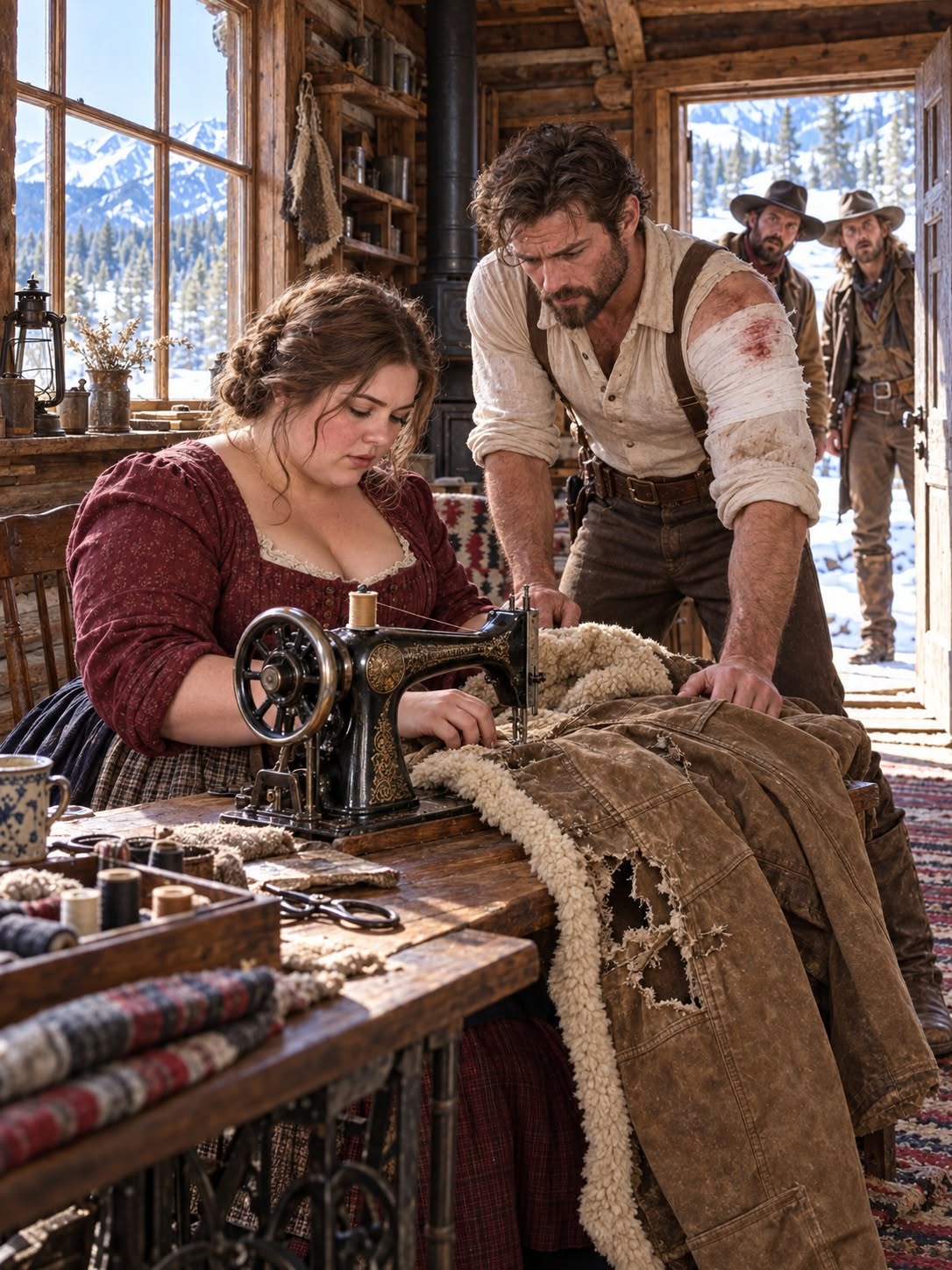
Its black enamel had dulled with age, and a small brᴀss plate near the wheel bore the Singer name. Her mother had taught her to use it when she was nine years old, first making crooked handkerchiefs, then dresses, coats, and finally the heavy work garments worn by dockworkers along the Brooklyn waterfront.
Her mother used to say that a sewing machine was not merely a device for joining pieces of cloth.
It was a way to turn what people discarded into something they could depend upon.
Josephine lifted Nathaniel’s ruined coat and examined the tear.
“The leather is too thick for the machine,” she said. “But the canvas isn’t.”
Nathaniel frowned. “I thought you said you could mend it.”
“I said I could fix it. I did not say I would do it foolishly.”
She removed the torn section of canvas, carefully separating the damaged sheepskin lining from the outer layer. Then she searched her crate for a bundle of heavy canvas scraps she had brought from a tailor’s shop in Brooklyn. They were leftovers, things nobody had wanted to pay for, but Josephine had kept every useful piece.
She cut a long reinforcement patch, folded its edges, and guided the canvas beneath the machine’s presser foot.
The first sтιтches came slowly.
The machine rattled and clicked, its needle punching through the material with a rhythm that seemed strangely loud in the little cabin. Nathaniel watched as Josephine worked the treadle with steady pressure, guiding the fabric beneath the needle.
When the patch was finished, she took a leather awl and a stout curved needle. She hand-sтιтched the thick leather edges, fastening the repaired canvas securely to the coat. Then she replaced the torn lining with a new piece of wool.
It took nearly four hours.
When she finally held the coat up, the repair was strong, neat, and almost invisible.
Nathaniel ran one enormous hand over the seam.
“That’ll hold?”
“Longer than the rest of your coat, if you stop dragging it through every tree on the mountain.”
He looked at her.
Then, unexpectedly, he laughed.
It was a rough, unfamiliar sound, as though laughter had been stored away somewhere inside him and forgotten.
“You’re a strange woman, Josephine Miller.”
“And you’re a difficult man to keep dressed.”
For the first time since she had arrived, the cabin felt a little less cold.
The next morning, Nathaniel wore the repaired coat into the forest. He returned that evening with a small bundle of coins and an expression Josephine had never seen before.
“Where did you get those?” she asked.
“Old man Turner at the lower timber camp. His coat’s been splitting for weeks. He saw mine and asked who fixed it.”
Josephine looked at the coins.
“How much?”
“Two dollars.”
Two dollars.
It was not a fortune, but it was more money than she had held since leaving Brooklyn.
And it had come from something she knew how to do.
That night, Josephine barely slept. She sat beside the fire with a pencil stub and a scrap of paper, making calculations. There were miners in Rose Haven, lumbermen in the mountains, teamsters hauling supplies, women trying to keep their families warm, and children whose clothes were being patched until the fabric could no longer remember its original shape.
Every one of them needed clothing repaired.
Every winter, every year.
And there was not a single proper tailor within fifty miles.
The next morning, Josephine told Nathaniel she wanted to go to town.
“Road’s bad,” he said.
“I’ve noticed.”
“Montgomery owns the mercantile. He’ll charge you for breathing if he thinks he can.”
“Then I shall make sure he charges me for nothing.”
Nathaniel stared at her for a long moment before hitching the wagon.
Rose Haven looked even harsher in daylight. Mud covered the boardwalk, smoke rose from the saloon chimney, and miners crowded outside the ᴀssay office. When Josephine stepped down from the wagon, several men recognized her.
“There’s the mail-order bride!” someone called. “Come to sell that iron contraption?”
Another man laughed. “Maybe she’ll sew herself a husband who can pay his debts!”
Josephine ignored them.
She entered the mercantile and approached the counter. Behind it stood Caleb Montgomery, a broad man with silver at his temples, polished boots, and a gold watch chain stretched across his vest.
His smile was pleasant enough to fool someone who had never watched him collect a debt.
“Mrs. Hayes,” he said. “How is our mountain gentleman?”
“Working hard, Mr. Montgomery.”
“Hard work is admirable. Unfortunately, it doesn’t always settle an account.”
He tapped the foreclosure notice lying beside his ledger.
“Four hundred dollars. The first snowfall is approaching. I trust you understand what that means.”
“I understand that you have lent my husband money against his land.”
“I have done considerably more than that. I have kept him supplied when no sensible merchant would extend him credit.”
“At prices you set yourself.”
Montgomery’s smile thinned.
Josephine placed a small list on the counter. She needed thread, needles, canvas, wool scraps, ʙuттons, and several lengths of heavy cotton.
“I would like to purchase these.”
“Cash?”
“Naturally.”
He looked at the two dollars Nathaniel had earned and then at her worn dress.
“Perhaps you should save your money. Winter is not kind to people who arrive here without practical skills.”
Josephine held his gaze.
“I have a practical skill, Mr. Montgomery. I intend to earn my living with it.”
He laughed softly and rang up her purchases at an inflated price.
She paid without arguing.
Then she walked through town, stopping at the boardinghouse, the blacksmith’s shop, and the miners’ bunkhouse. At each place she asked the same question.
“Do you have clothing that needs repairing?”
At first, people laughed.
Then a miner named Samuel Turner brought her a torn coat. A teamster asked whether she could replace the lining in his winter gloves. The boardinghouse cook offered two aprons and a child’s dress.
By the time Josephine returned to the wagon, she had six orders.
That evening, she worked by lamplight.
Nathaniel watched her from the table, where he was sharpening an axe.
“You can’t keep that up every night.”
“I can if the work pays.”
“You need sleep.”
“I need customers.”
He looked at the growing pile of garments.
“How much are you charging?”
Josephine told him.
Nathaniel stopped sharpening.
“That’s all?”
“People here don’t have much money. I won’t charge them as if they do.”
“Then you’ll work yourself into the ground.”
“Not if I work efficiently.”
She showed him how she grouped the repairs: all the torn seams together, all the ʙuттons together, all the patches cut at once. She used the Singer for the ordinary fabric work and reserved hand sтιтching for leather, thick seams, and places where strength mattered most.
 Within a week, the little cabin had become a workshop.
Josephine worked at the machine while Nathaniel built a second table and shelves for thread. He even repaired the cabin’s broken shutter so she could work in daylight without the wind blowing through the room.
For the first time in years, he seemed to have a reason to hurry home.
Then came the first real test.
A bitter cold front swept down from the peaks, bringing a sharp wind that cut through the mining camp. Men discovered that their coats were too thin, their gloves were split, and their trousers were failing at the knees.
Josephine worked until her fingers ached.
She repaired eleven coats in three days.
When a miner named Elias arrived with a ripped sleeve and a little girl in a dress too thin for the weather, Josephine did something she had not planned.
She made the child a warm wool coat from scraps.
The girl put it on and hugged her mother.
“Thank you,” the woman whispered.
Josephine smiled, but Nathaniel saw the tears she tried to hide.
That evening, he placed a small wooden box on her worktable.
Inside were several silver dollars.
“What’s this?” she asked.
“Your earnings.”
“I keep my money in the tin beneath the bed.”
“Not these. These are mine.”
She looked up.
Nathaniel shifted uncomfortably. “You came here with two pennies. I figured you ought to have something more than that.”
Josephine touched the coins.
“Thank you.”
He nodded, then turned toward the door.
“There’s something else.”
“What?”
“Montgomery’s been asking about your machine. He sent a man up the road today. Wanted to know how many orders you have and how much money you’re making.”
Josephine’s smile disappeared.
“Why would he care?”
Nathaniel looked toward the dark window.
“Because he owns most of the town. And he doesn’t like anyone making money without owing him for it.”
Two days later, a notice appeared on the mercantile door.
Caleb Montgomery had announced that he was opening a clothing and repair department of his own. He had hired a tailor from Denver, purchased bolts of cloth, and declared that all Rose Haven residents would receive a special discount if they brought their work to his store.
It was a direct challenge.
Nathaniel read the notice aloud, stumbling over several words. Josephine gently corrected him, then folded the paper.
“He thinks he can buy a sewing machine and take my customers.”
“Can he?”
Josephine looked toward the Singer.
“No.”
She had no idea yet how much Montgomery was willing to risk to prove her wrong.
But the following morning, when she opened her door, she found her entire supply of canvas and wool scattered across the snow.
Someone had cut the bundles open during the night.
And pinned to the door was a small piece of paper.
STOP TAKING ORDERS FROM THE TOWN, OR YOU WILL HAVE NOTHING LEFT TO SEW.