PART 2 — THE NIGHT THE WHOLE COUNTY CAME KNOCKING
PART 2 — THE NIGHT THE WHOLE COUNTY CAME KNOCKING
Nettie Burgess did not ask how many people were coming.
She simply stepped aside.
“Get her inside, Birdie. Quickly!”
The older woman carried little Ruth Henderson toward the stove while Nettie shut the door against the screaming wind. Snow swirled across the floorboards, and the child’s small body trembled beneath a blanket that had become stiff with ice.
“Where are her parents?” Nettie asked.
“Trying to save what remains of their home,” Birdie answered. “The barn caught fire. They lost their woodpile, most of their hay, and the little shelter where they kept the animals.”
Nettie looked at Ruth.
“Did they send you ahead?”
Birdie nodded.
“Her mother wanted me to get the child somewhere warm. She and her husband are coming behind us with the other two children.”
Nettie poured warm water into a cup and placed it near the girl.
“Ruth, sweetheart, can you hear me?”
The child opened her eyes.
“Is Mama coming?”
“Yes,” Nettie said gently. “And she’ll find you here.”
Birdie sat beside the stove, exhausted.
Nettie wrapped another blanket around the little girl and checked that the fire was steady. Then she looked upward.
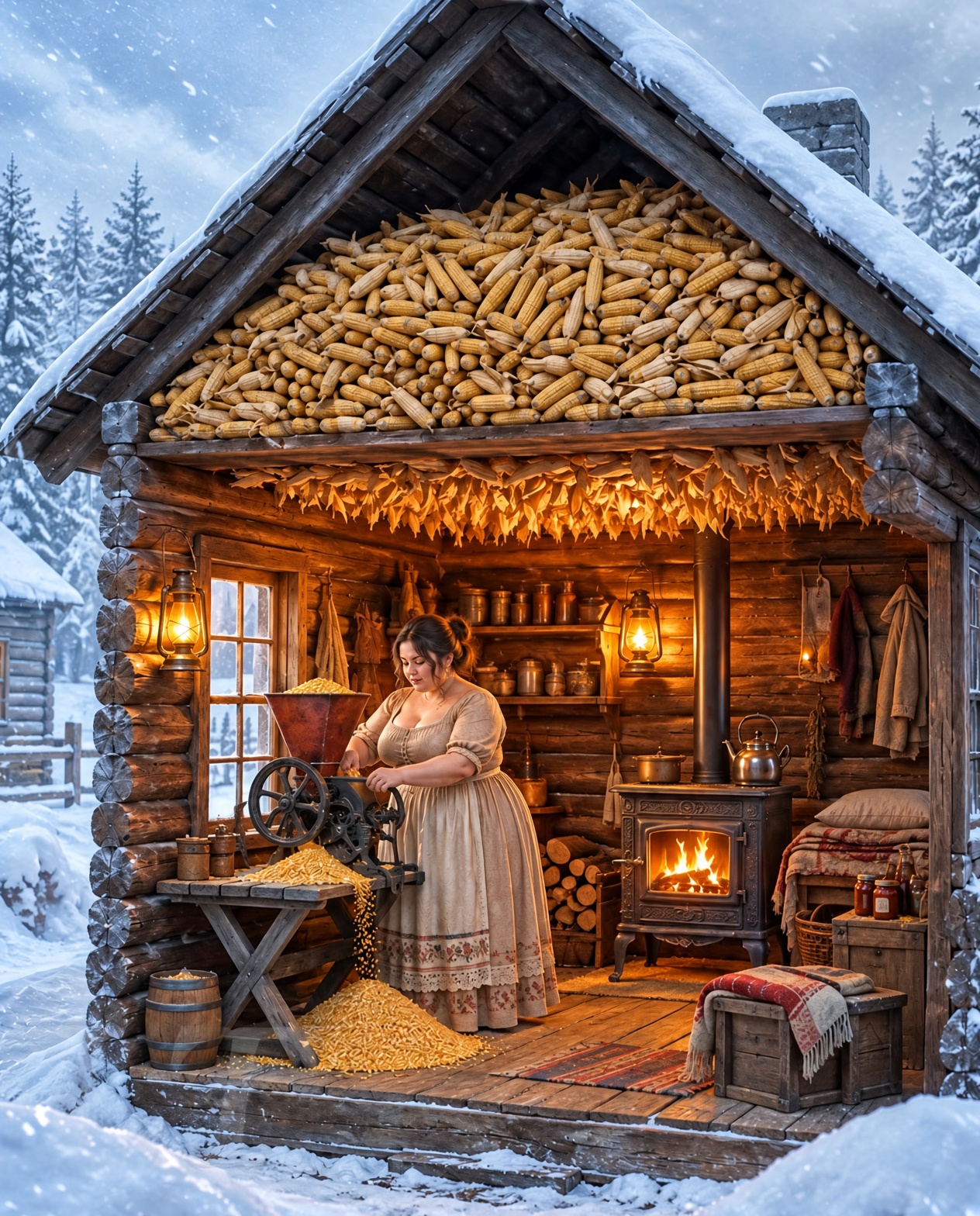
Four hundred bushels of corn rested in the reinforced attic.
For months, people had laughed at her.
Now that strange harvest might be the difference between shelter and suffering.
But she knew one thing Birdie had warned her about: a roof could not be treated like a miracle simply because it held warmth.
The attic supports needed watching. The stored corn had to remain dry, and the house still required careful tending.
She could not promise everyone safety.
But she could offer them a place to begin.
“Birdie,” Nettie said, “how many people are out there?”
The older woman looked down.
“Seven from the Henderson place. Three from the Miller farm. And I saw smoke from the old Turner homestead, though I couldn’t reach it.”
Nettie counted silently.
At least ten people.
Possibly more.
Her little sod house had never been built for a crowd.
Still, she took down the extra quilts.
“Then we make room.”
By midnight, the Henderson family arrived.
Mary Henderson stumbled through the doorway carrying a bundle of clothing. Her husband, Amos, followed with their two older children, his beard covered in snow.
The moment Mary saw Ruth lying beside the stove, she dropped to her knees.
“Ruth!”
The child reached for her mother.
Nettie turned away, giving them a moment.
Amos looked around the room.
“You took her in?”
“Of course.”
“But you barely have enough for yourself.”
Nettie placed another kettle near the fire.
“Tonight, that’s not what matters.”
Mary began crying.
“We lost the barn. The shed. Nearly everything. Amos tried to keep the fire going, but the wood was wet, and the wind—”
“I know,” Nettie said.
She did not tell them that she had spent the previous night listening to the same wind.
She did not tell them how frightened she had been when the temperature dropped.
Instead, she showed them where they could lay their blankets.
Then she brought down several ears of corn from the attic.
“Can you help me prepare supper?” she asked Mary.
Mary looked confused.
“With what?”
“With this.”
Nettie placed the corn on the table.
“Birdie taught me how to make meal from it. We can stretch it into enough food for everyone.”
Amos stared at the ears.
“You stored all that up there?”
“Yes.”
“Your entire harvest?”
“Most of it.”
He shook his head.
“I thought you were foolish.”
“So did a lot of people.”
Nettie began removing the husks.
“But foolish or not, we’re eating tonight.”
For the first time that evening, Mary smiled.
By the following morning, Nettie’s cabin had become a shelter.
The Miller family arrived shortly after sunrise. Then came old Mr. Turner, whose hands shook so badly that he could barely hold his walking stick.
He had walked nearly two miles through the snow after his chimney collapsed.
By noon, fourteen people were gathered beneath Nettie’s roof.
The room was crowded.
The fire needed constant attention.
And the food had to be divided carefully.
But the house held its warmth better than any of the families expected.
Mary Henderson noticed it first.
“It’s strange,” she said, rubbing her hands together. “The wind is howling outside, but it doesn’t feel as bitter in here as it did at our place.”
Nettie looked up toward the ceiling.
“The corn helps slow the heat from escaping. At least, that’s what Birdie taught me.”
Mr. Turner raised an eyebrow.
“You mean that whole attic full of corn is keeping us warm?”
“It’s part of it,” Nettie replied. “The walls, the stove, the way the doors are sealed, and the dry material overhead all work together. It isn’t magic.”
Birdie chuckled from her place near the stove.
“Some people need a miracle. Others need a woman who pays attention.”
A few people laughed.
For a little while, the cabin felt almost cheerful.
Then someone knocked.
Three slow, deliberate knocks.
Nettie opened the door only a little.
Cyrus Pemberton stood outside, wearing a thick fur coat. Two hired men waited behind him.
His eyes moved past Nettie and into the crowded room.
“What is this?”
“A shelter.”
He looked toward the families.
“Whose permission did you get to turn your property into a public refuge?”
Nettie frowned.
“My property needs no permission to offer someone a warm floor.”
Pemberton stepped closer.
“You have no idea what you’re doing. These people should be paying for fuel, not crowding into your house.”
“They have almost nothing left.”
“Then they should have planned better.”
Birdie stood up.
“Careful, Cyrus. Poverty isn’t a crime.”
Pemberton ignored her.
His gaze moved to the ceiling.
“I came to make you one final offer.”
Nettie folded her arms.
“For the corn?”
“For the farm.”
The room fell silent.
Pemberton took a paper from his coat.
“Your mortgage is overdue. Your taxes are unpaid. You have until the end of the month to settle your account.”
“I know what I owe.”
“Then sign this agreement. I’ll take the farm, the corn, and the buildings. In return, I’ll give you enough money to start somewhere else.”
Nettie looked at the document.
It was not a fair offer.
It was not even an honest one.
“You told me my corn was worthless,” she said.
Pemberton’s jaw тιԍнтened.
“That was before I understood the circumstances.”
“You laughed when I put it in the attic.”
“I don’t recall.”
“I do.”
He lowered his voice.
“Listen carefully, Mrs. Burgess. When the storm ends, the county will remember who owns the grain. You cannot feed every family in Kansas.”
Nettie glanced back at the people behind her.
“No. I cannot.”
For a moment, Pemberton seemed satisfied.
Then she continued.
“But I can feed the people standing in my house tonight.”
His expression hardened.
“You’ll regret this.”
He placed the paper against the doorframe.
“Sign before the sheriff comes.”
Nettie did not take it.
Pemberton turned and walked away.
That afternoon, Birdie found Nettie standing beneath the attic hatch.
“You’re thinking about him.”
“I’m thinking about the mortgage.”
“Same thing, perhaps.”
Nettie looked up.
“If he takes the farm, he’ll take the corn. All of it.”
Birdie nodded.
“And if he takes the corn, what happens to these families?”
Nettie did not answer.
Birdie moved closer.
“Your husband planted that harvest believing it would give you a future. He didn’t work himself sick so a rich man could take it for twelve dollars.”
Nettie’s eyes filled.
“I know.”
“Then remember it.”
Birdie reached into her apron and pulled out a small envelope.
“I found this among James’s old papers when I helped you clean the farmhouse last spring. I meant to give it to you sooner.”
Nettie recognized the handwriting immediately.
James.
Her hands trembled as she opened it.
Inside was a receipt from a grain elevator in a neighboring county. It showed that James had once stored several loads of corn there. Beneath it was a short note.
If Pemberton tries to take the farm, speak to Elias Whitcomb. He knows what happened to the original mortgage.
Nettie read the words again.
“What original mortgage?”
Birdie shook her head.
“I don’t know. James never told me.”
Nettie looked toward the door.
“Where can I find Elias Whitcomb?”
“His farm is north of the river. But the bridge may be buried.”
Nettie folded the letter.
“Then I’ll find another way.”
Birdie caught her hand.
“Not tonight. The storm is worsening.”
Nettie looked at the crowded room.
She could not leave.
Not while children slept on her floor and families depended on the fire.
For the first time, she understood the real burden of having something worth protecting.
It was no longer only her own future.
Near midnight, the wind changed.
It began to howl from the north with such force that the cabin walls seemed to shudder.
A crack sounded above them.
Everyone looked up.
Nettie’s heart stopped.
Another crack followed.
Then a small shower of dust fell from the attic hatch.
“Everybody away from the middle of the room!” she shouted.
Amos moved the children toward the far wall. Samuel Miller helped Mr. Turner stand.
Nettie and Birdie hurried outside to inspect the roof from the ground, using lanterns to see through the snow.
One of the supporting beams had shifted.
The weight above was pressing against the old structure.
Nettie felt sick.
The corn that had helped keep them warm could now become dangerous if the supports failed.
She looked at the roof.
Then at the storm.
She had spent months strengthening the attic, but no structure was invincible.
“Can we unload part of it?” Amos asked.
“Not safely in this weather,” Nettie answered.
Birdie studied the roofline.
“Then we need someone who understands timber.”
Nettie remembered the carpenter who had helped reinforce the attic.
Mr. Caleb Dorsey lived three miles away.
If he was still alive, he might know how to brace the structure.
Amos тιԍнтened his coat.
“I’ll go.”
“No,” Nettie said. “You have children here.”
“I can make the journey.”
Birdie looked at him.
“Not alone.”
The room fell quiet.
Then Mr. Turner slowly raised his walking stick.
“I know a shorter trail through the cottonwoods.”
Nettie shook her head.
“You’re not going out in this.”
The old man smiled faintly.
“I’m too old to be useful in many ways, child. Let me be useful in this one.”
Before she could argue, another sound came from the door.
A horse.
Then a voice.
“Open up! I have news from Blackwood!”
Nettie rushed to the entrance.
A young rider stumbled inside, covered in snow.
He was carrying a leather satchel.
“Mrs. Burgess?”
“Yes?”
He looked around at the families, then back at her.
“I’m carrying a message from the county courthouse.”
Nettie’s stomach тιԍнтened.
“From whom?”
“Judge Crowley.”
He handed her the envelope.
Nettie opened it.
Her face went pale.
The sheriff had been ordered to seize her farm at sunrise.
And Cyrus Pemberton had already filed a claim for every bushel of corn in her attic.
But there was something else.
A second paper had been attached.
It was a copy of a document James had supposedly signed three months before his death.
Nettie stared at the signature.
It looked like her husband’s handwriting.
But James had been too ill to leave his bed on the date written there.
Someone had forged his name.
And the man who had witnessed it was none other than Cyrus Pemberton.
Nettie looked toward the dark window.
The storm was not the only thing threatening her home.
Someone had planned to take everything from her long before the first snow fell.