PART 2 – THE CLAUSE BENNETT FORGOT
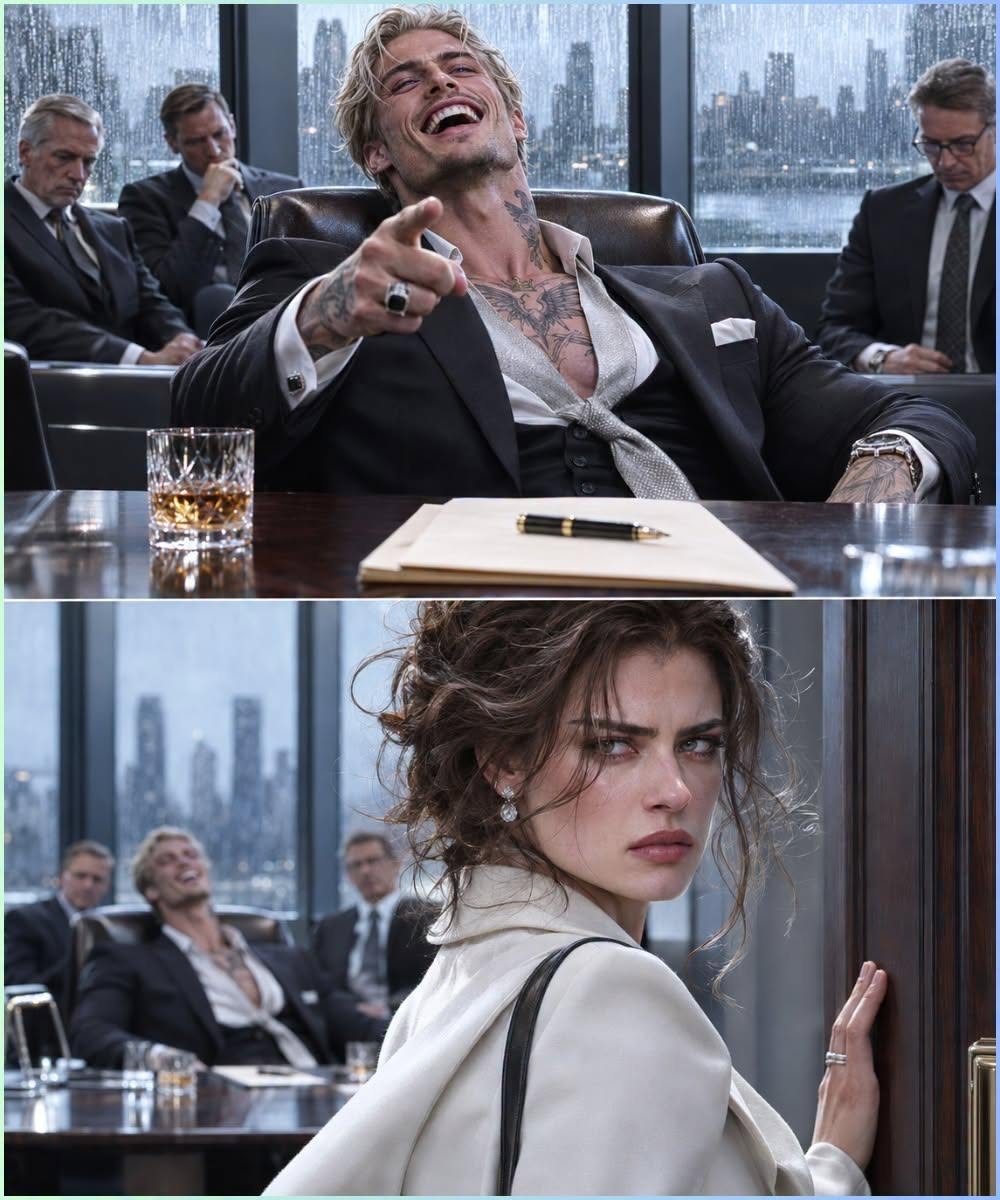
Tessa looked directly into Bennett’s eyes.
“Accountability.”
For several seconds, nobody moved.
Then Bennett laughed again, but this time the sound was forced.
“Accountability? You think you can threaten a twenty-eight-billion-dollar company with an old software license?”
“No,” Tessa replied. “I think you can destroy a twenty-eight-billion-dollar company by pretending you own something you don’t.”
Bennett’s expression hardened.
“Dana, terminate this meeting.”
Nobody stood.
“Dana!”
The general counsel slowly turned her tablet toward him.
“Bennett, you need to read this.”
“I said terminate the meeting.”
“You need to read it now.”
Something in her voice finally made him look down.
On the tablet was a copy of the original Rookline license, dated eight years earlier. Beneath the ownership provisions were several paragraphs highlighted in yellow.
Bennett skimmed them.
Then he stopped.
“What is this?”
“The breach and termination provision,” Dana said.
“I’m familiar with the agreement.”
“Apparently not.”
She enlarged the section.
The license granted Crestline commercial use of Rookline for as long as the company maintained accurate ownership disclosures, respected the trustee’s rights, and refrained from retaliatory interference with the trust.
A material breach gave the trustee the right to suspend the license following written notice and the contractual cure period.
Bennett’s jaw тιԍнтened.
“That’s unenforceable.”
“That’s what your outside counsel needs to determine,” Dana replied. “But the agreement is validly executed, and the trust’s ownership has never been transferred.”
Tessa reached into her handbag.
She removed a thin black envelope and placed it beside the separation agreement.
“There’s something else.”
Bennett didn’t touch it.
“What now?”
“Your investor disclosure.”
“I know what we disclosed.”
“You declared that Crestline owned the entire Vector technology stack without restriction.”
“Because we do.”
“No. You declared it because you wanted investors to believe the company owned something it only licensed.”
Miles Fenwick finally spoke.
“Bennett, the auditors requested confirmation of the underlying intellectual property last quarter. I asked for the original license.”
Bennett turned toward him.
“And?”
“And your office instructed legal to provide the amended ownership summary instead.”
The room seemed to lose oxygen.
Bennett stared at Miles.
“You’re accusing me of falsifying financial disclosures?”
“I’m telling you what happened.”
Tessa opened the envelope.
Inside were three documents.
The first was the original license.
The second was the complete amendment history, including the version Bennett had attempted to use to transfer voting authority over the Rookline trust.
The third was a letter from an independent intellectual property firm confirming that the trust remained the registered owner of the underlying library.
Bennett looked at the letter.
Then at Tessa.
“You prepared all this before today?”
“I prepared it three weeks ago.”
“Then why didn’t you bring it to the board?”
“I did.”
He frowned.
“What?”
“Three weeks ago. I sent the complete evidence package to the board’s independent audit committee.”
Dana’s face went white.
Bennett slowly turned toward her.
“You received this?”
“I received a copy.”
“And you didn’t tell me?”
“I told you there was a serious ownership dispute.”
“You said it was a documentation issue!”
“I said it needed independent review.”
Bennett pushed his chair backward.
“Who else has seen this?”
“Your external auditors. The independent directors. And the attorneys representing the Rookline trust.”
His face darkened.
“You went outside the company?”
“You left me no independent channel inside it.”
For the first time, Bennett seemed unable to find an immediate response.
Then he pointed at the door.
“Get her out.”
Two security officers appeared in the doorway.
Tessa looked at them.
Neither moved.
“Her access has been revoked,” Bennett snapped. “She’s no longer an employee.”
One of the officers glanced toward Dana.
Dana stood.
“Do not touch her.”
Bennett stared.
“Excuse me?”
“She is not trespᴀssing. She was invited to this meeting, and her legal counsel has already notified the company that any attempt to interfere with her access to protected corporate records will be documented.”
Bennett looked as though someone had slapped him.
“You’re supposed to be my lawyer.”
“I’m supposed to protect the company.”
“And I am the company!”
“No,” Miles said quietly.
Every head turned.
Miles had finally left the window.
“You’re the CEO, Bennett. That’s not the same thing.”
Bennett’s face turned crimson.
“You’re fired.”
Miles placed a thick folder on the table.
“Then you should probably know what you’re firing me for.”
Bennett looked down.
It was the quarterly risk report.
The one Miles had repeatedly requested permission to present to the board.
Inside were three pages of unresolved intellectual property exposure, two warnings from external auditors, and a preliminary ᴀssessment of the financial consequences of losing Rookline.
Bennett flipped through them.
His fingers began to tremble.
“How much?”
Miles swallowed.
“Depending on the transition period, between six and eleven billion dollars in direct and indirect exposure.”
Bennett stared at him.
“That is an absurd number.”
“It’s the conservative estimate.”
“Vector runs without Rookline.”
“Vector can calculate without Rookline. But the insтιтutional settlement process relies on Rookline’s synchronization and verification functions. Replacing those functions would require extensive redevelopment, independent certification, and regulatory approval.”
“How long?”
“Possibly eighteen to thirty months.”
Bennett looked at Tessa.
She hadn’t moved.
“You wouldn’t do that.”
“I haven’t done anything.”
“You’re threatening to shut down the company.”
“No. I’m refusing to let you pretend the company owns my property.”
Bennett walked around the table.
His voice dropped.
“Listen carefully. Whatever you think you’ve won, you haven’t. I can make one phone call and ensure you never work in this industry again.”
Tessa looked at him with something approaching pity.
“You still think this is about getting another job?”
He said nothing.
“I don’t need Crestline to employ me. I don’t need your recommendation. And I certainly don’t need your fifty thousand dollars.”
She took the separation agreement and folded it once.
Then she placed it back in front of him.
“Keep it.”
Bennett’s eyes narrowed.
“Where are you going?”
“To finish what you started.”
She turned toward the door.
“Tessa!”
She stopped.
Bennett’s voice had changed.
The laughter was gone.
“Let’s negotiate.”
She slowly looked back.
“About what?”
“Your shares. Your compensation. The license. Whatever you want.”
Tessa studied him.
“You had eight years to negotiate with me.”
“I made a mistake.”
“No. You made a strategy.”
He stepped closer.
“We can fix this privately.”
“Privately?”
She glanced at the board members who had watched him humiliate her less than an hour earlier.
“You made sure everyone knew I had forty-two dollars in my wallet. You laughed about it in front of your executives. You wanted them to remember me as a disgraced employee who couldn’t afford groceries.”
Bennett’s face тιԍнтened.
“You don’t understand how business works.”
“I understand perfectly.”
She picked up her handbag.
“You thought financial pressure would make me sign away something I had spent eight years protecting.”
Then she delivered the sentence that made Miles lower his eyes.
“You didn’t bankrupt me, Bennett. You just showed everyone how little you understood about the woman you were trying to buy.”
She walked out.
This time, nobody laughed.
At 12:46 p.m., an emergency board meeting was called.
At 1:15 p.m., Crestline’s independent directors requested a formal review of the Vector ownership disclosures.
At 1:38 p.m., the external auditors placed several outstanding intellectual property representations under review.
At 2:05 p.m., the company’s stock began falling.
And at 2:17 p.m., Bennett received a message from his chief of staff.
The Rookline Trust has delivered formal notice of material breach.
He read it twice.
Then a third time.
The notice did not immediately terminate Crestline’s license. It initiated the contractual cure process and reserved the trust’s rights, including suspension if the breach remained uncured.
Bennett threw his phone onto the desk.
“Get me Tessa.”
His ᴀssistant hesitated.
“She isn’t answering.”
“Then find her lawyer.”
“We’ve already received a response.”
“What response?”
The ᴀssistant placed a printed email on his desk.
It contained only four sentences.
All communications concerning Rookline must be directed to the trust’s independent counsel.
Ms. Calder will not participate in informal negotiations.
The trust will cooperate with the contractual review process.
Please preserve all relevant records.
Bennett stared at the page.
For the first time in eight years, Tessa was no longer waiting for him to decide whether she deserved a seat at the table.
She had built another table.
And he wasn’t invited.
At 4:30 p.m., Bennett returned to the boardroom.
The directors were waiting.
Miles sat at the far end.
Dana stood beside the presentation screen.
A new document was displayed.
INDEPENDENT REVIEW OF VECTOR INTELLECTUAL PROPERTY AND GOVERNANCE
Bennett dropped into his chair.
“Let’s get this over with.”
The lead independent director, Eleanor Price, folded her hands.
“Before we begin, we need to address the voting trust.”
Bennett rubbed his forehead.
“It’s a technical matter.”
“Is that why Tessa’s voting rights were transferred without her informed consent?”
“I had legal authorization.”
Dana looked up.
“No, you didn’t.”
Bennett turned sharply.
“Dana.”
“The documents you relied upon do not authorize the transfer you executed.”
“You approved them!”
“I approved the original restructuring proposal. I did not approve the subsequent modification.”
Eleanor turned toward Bennett.
“Did you personally authorize that modification?”
Silence.
“Bennett?”
He looked around the table.
For the first time, he noticed that nobody was looking at him with admiration.
They were looking at him as a liability.
“I was protecting the company.”
Miles opened his folder.
“Then why did you freeze the trust’s compensation accounts after the ownership dispute was raised?”
Bennett said nothing.
“And why,” Miles continued, “did you instruct finance to classify Tessa’s intellectual property claims as a potential employee misconduct issue?”
“That was a legal recommendation.”
“No,” Dana said. “It wasn’t.”
The silence that followed was absolute.
Eleanor closed her notebook.
“Effective immediately, the board is placing you on administrative leave pending an independent investigation.”
Bennett slowly stood.
“You cannot remove me.”
“We aren’t removing you permanently today.”
“You don’t have the votes.”
Eleanor looked directly at him.
“We have enough votes to suspend your executive authority under the company’s governance provisions.”
Bennett’s face changed.
“You’re making a terrible mistake.”
“Perhaps,” Eleanor replied. “But we won’t make another one by ignoring the evidence.”
Two members of corporate security entered.
Bennett looked toward the door.
Then back at the directors.
He had once walked into that room and watched everyone stand.
Now nobody moved.
At 6:12 p.m., Tessa stood beneath the awning of a small coffee shop three blocks from Crestline’s headquarters.
The rain had stopped.
Her phone vibrated.
An unknown number.
She answered.
“Ms. Calder?”
“Yes.”
“This is Eleanor Price, independent chair of Crestline’s board. I wanted to speak with you directly.”
Tessa looked across the street at the tower.
“What about?”
“The board would like to discuss restoring your position, recognizing your founder status, and negotiating a permanent settlement concerning Rookline.”
Tessa was silent for a moment.
Then she asked, “Has Bennett been removed?”
“He has been placed on administrative leave.”
“Then I think you should understand something before we speak again.”
“Of course.”
“I don’t want his office. I don’t want his тιтle. And I don’t want a ceremonial founder plaque in the lobby.”
Eleanor waited.
“I want the original ownership records restored. I want the voting trust independently reviewed. I want every false disclosure corrected. And I want the people who helped conceal what happened held accountable.”
“That is reasonable.”
“And I want the company to understand that Rookline is not a bargaining chip. It is my intellectual property.”
“I understand.”
Tessa looked down at her wallet.
Forty-two dollars.
That morning, those forty-two dollars had been used to humiliate her.
Now they seemed almost funny.
“Send everything through my attorney,” she said.
“I will.”
She ended the call.
For a moment, she simply stood there, breathing.
She hadn’t won everything.
The legal investigation would take months. The financial damage could be enormous. And Crestline still employed thousands of people whose livelihoods depended on the technology she had helped create.
She had no intention of punishing them for Bennett’s arrogance.
But she was finished sacrificing herself to protect his reputation.
Across the street, the giant electronic display above Crestline’s entrance changed.
Bennett’s pH๏τograph disappeared.
A corporate announcement replaced it.
CRESTLINE EXCHANGE TECHNOLOGIES ANNOUNCES INTERIM LEADERSHIP TRANSITION.
Tessa watched the words appear.
Then she put her phone away and started walking.
She had forty-two dollars, a patent, and eight years of work that nobody could erase.
And for the first time in a very long time, she was walking toward a future that belonged entirely to her.