PART 4 — THE SECRET HIDDEN IN THE STONES
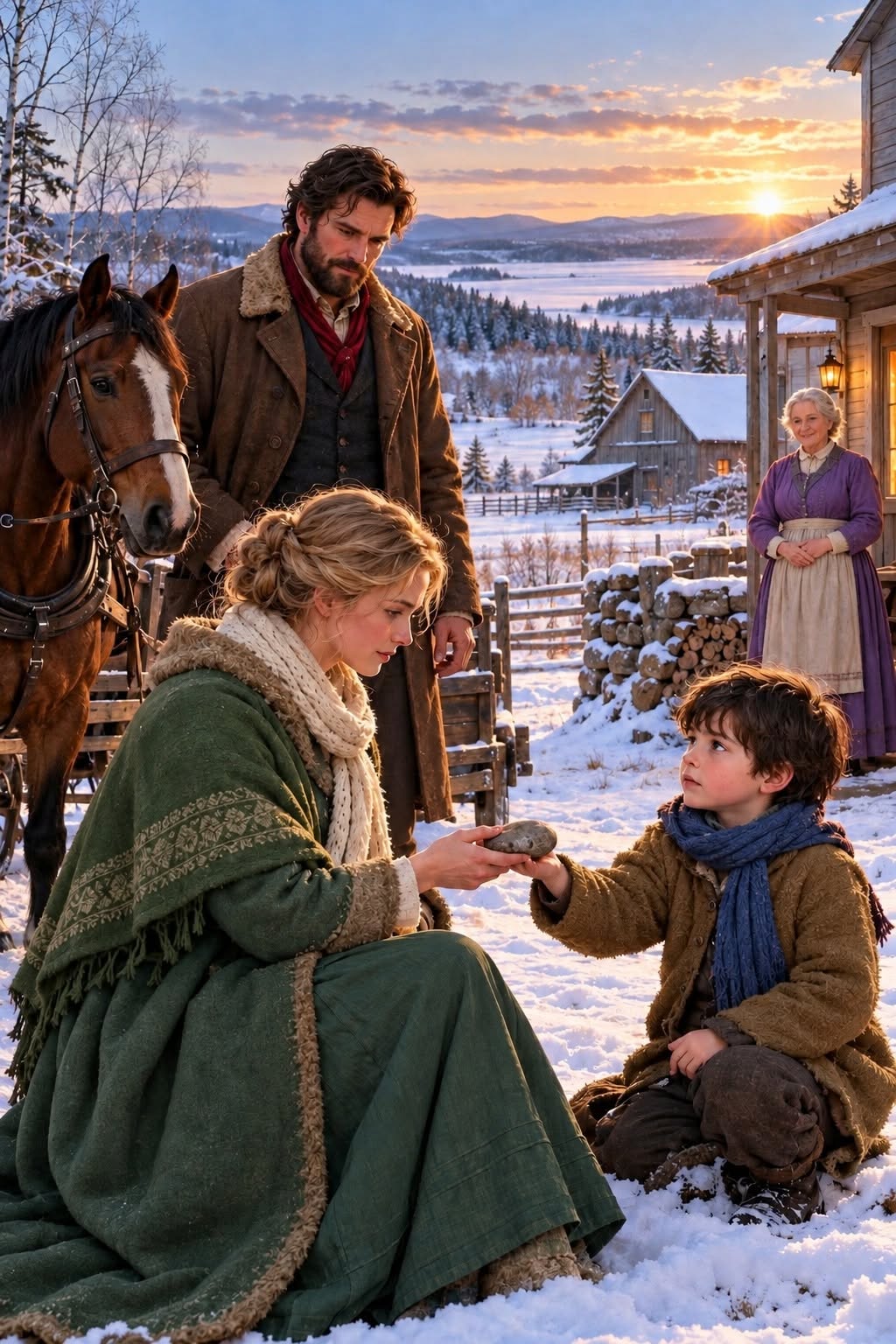
PART 4 — THE SECRET HIDDEN IN THE STONES
For three days, Ingrid tried to understand the boy.
Every morning, she found Einar sitting on the floor of his bedroom, arranging his stones into careful little patterns. Sometimes they formed circles. Sometimes they became long lines stretching from one end of the rug to the other.
And every time Ingrid entered, he chose one stone and placed it in her hand.
He never explained why.
His father, whose name was Anders, offered little help.
“He’s always been like that,” he said one evening while repairing a broken chair near the stove. “Since his mother died.”
Ingrid looked up.
“How long ago?”
“Almost a year.”
“What happened to her?”
Anders stopped working. For a moment, the only sound in the kitchen was the ticking of the clock.
“Anna was sick for some time. She grew weaker through the winter. By spring, she was gone.”
He returned his attention to the chair.
Ingrid sensed there was more, but she did not press him.
Instead, she began learning the rhythms of the household.
Elsa showed her where the flour was kept, how the stove behaved when the wind came from the north, and which floorboard creaked outside Einar’s room.
She also warned Ingrid not to expect too much.
“Mr. Anders has become a quiet man,” Elsa said one afternoon. “And the little one has his own way of seeing the world.”
“I have noticed.”
“His mother understood him. She could sit with him for an hour without saying a word.”
Ingrid smiled faintly.
“Perhaps that is not such a difficult thing.”
 Elsa studied her.
“You don’t seem frightened of silence.”
Ingrid glanced toward the window.
“Where I come from, there are things people carry that words cannot improve.”
Elsa said nothing more.
That evening, Ingrid discovered something unusual.
She had been putting away Einar’s clean clothes when she noticed a small wooden box beneath his bed. It was not locked, but its lid was carefully tied with a piece of blue ribbon.
Inside were dozens of stones.
Some were ordinary gray pebbles. Others were white, black, or streaked with pale blue.
At the bottom lay a folded piece of paper.
Ingrid hesitated before opening it.
The handwriting was delicate and unfamiliar.
For my little Einar. When words become difficult, let the stones speak.
Below that was a name.
Anna.
Ingrid sat very still.
She had never met the woman, yet the tenderness in those few words seemed to fill the entire room.
When Einar appeared at the doorway, Ingrid immediately placed the paper back in the box.
He looked at her, then at the stones.
She waited.
Slowly, he walked over and picked up a small white stone.
Then he placed it beside the wooden box.
Ingrid understood that he was showing her something.
She pointed gently at the stone.
“Your mother gave you this?”
Einar nodded.
It was the first answer he had given her.
Ingrid smiled.
“Then we shall take good care of it.”
For the first time, the boy’s expression changed.
Not quite a smile.
But something close.
The following morning, Anders found Ingrid sitting beside Einar near the kitchen window.
The boy had arranged five stones in a row.
Ingrid was drawing simple shapes on a piece of scrap paper, and Einar was matching each stone to a shape.
Anders stopped in the doorway.
“What are you doing?”
“Learning his language,” Ingrid answered.
He frowned.
“Those are just stones.”
“Perhaps to you.”
Anders looked at his son.
Einar continued arranging the pebbles, seemingly unaware of the conversation.
Ingrid lowered her voice.
“Your wife left him something important. I think these stones help him remember her.”
Anders’s expression тιԍнтened.
“Anna left many things.”
“Have you kept them?”
He looked away.
“Most of them are in the attic.”
“Then perhaps Einar would like to see them.”
“No.”
The answer came too quickly.
Ingrid studied him.
“Why?”
“Because there’s nothing up there he needs.”
He walked out before she could respond.
That afternoon, Ingrid climbed to the attic herself.
She did not intend to search through anything private. She only wanted to understand why the mention of Anna’s belongings had troubled Anders so deeply.
The attic smelled of dust and old wood.
Near a trunk, she found a small writing desk covered with a sheet.
Inside its drawer were sewing patterns, a faded pH๏τograph, and several envelopes tied with the same blue ribbon as Einar’s wooden box.
One envelope had been addressed to Anders.
Another bore no name at all.
Ingrid was about to close the drawer when she noticed a small drawing tucked beneath the envelopes.
It showed a house, a tree, and a little boy holding a stone.
Underneath, in Anna’s handwriting, were the words:
When the snow melts, he will show you where I left the truth.
Ingrid read the sentence twice.
Then she heard footsteps on the stairs.
Anders stood in the doorway.
His face had gone pale.
“You shouldn’t be here.”
Ingrid carefully placed the drawing back.
“I wasn’t looking for secrets.”
“Then why are you holding that?”
He stepped forward and took the paper from her.
For several seconds, he stared at it.
Then he whispered, “She told me she had destroyed this.”
“What truth was she talking about?”
Anders folded the drawing and slipped it into his pocket.
“Something that should have stayed buried.”
Before Ingrid could ask another question, a small voice came from behind them.
“Papa.”
Both adults turned.
Einar stood on the stairs, holding a dark stone in his palm.
He walked into the attic and placed it on the floor beside an old wooden trunk.
Then he looked directly at his father.
“Open.”
Anders stared at his son.
It was only one word.
But it was the first time Ingrid had heard Einar speak since arriving at the farm.
Anders slowly knelt beside the trunk.
His hands trembled as he lifted the lid.
Inside lay a bundle of letters, a small leather notebook, and a pH๏τograph of Anna standing beside a stranger Ingrid had never seen.
On the back of the pH๏τograph was a date.
And a sentence that made Anders close his eyes.
He knows what happened to the land.
Ingrid looked from the pH๏τograph to the farmer.
“Who is that man?”
Anders swallowed.
“My brother.”
He paused.
“Henry was supposed to be ᴅᴇᴀᴅ.”
But the notebook inside the trunk held something even more troubling.
A record showing that someone had been visiting the farm long after Henry’s supposed disappearance.
And the last entry had been written only two weeks before Anna died.
Someone had returned to the farm. And Anna had known exactly who it was.