PART TWO: THE STRANGER WHO CAME WITH THE STORM
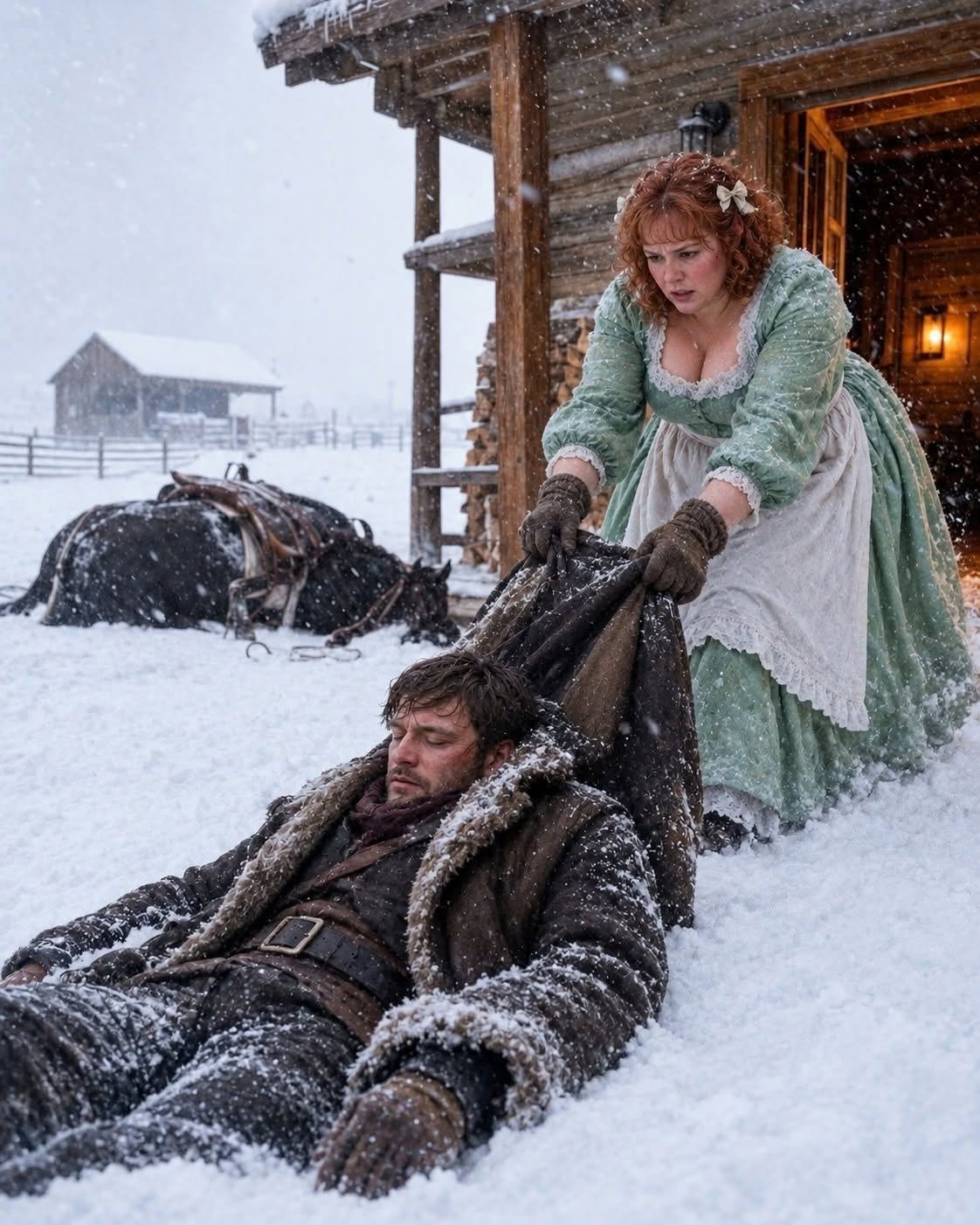
His hand moved toward his waist.
Hannah pressed the point of her needle against his chest.
“Don’t.”
He froze.
For a moment, they stared at each other across the dim cabin. Firelight flickered over his unshaven jaw, the blood on his shirt, and the revolver sitting on the mantel beyond his reach.
Then his eyes dropped to the needle.
“Is that necessary?”
“You were reaching for a gun.”
“I was reaching for my gun.”
“It’s mine now.”
One corner of his mouth lifted.
“That’s a bold interpretation of property law.”
“I’m a widow in Wyoming during the worst blizzard of the year. You can explain property law to me when you’re no longer bleeding on my floor.”
He studied her for another moment, then leaned back against the folded blanket.
“Yes, ma’am.”
“Hannah.”
“What?”
“My name is Hannah. If you’re going to die in my cabin, you can at least know whose floor you’re ruining.”
His smile faded.
“I’m not planning to die.”
“Good. Neither am I planning to bury a stranger in the spring.”
She returned to the wound.
The bullet had cut a ragged channel along his left side, missing the center of his chest but tearing through enough flesh to make the bleeding dangerous. Hannah had treated injured ranch hands before. She knew how to clean a wound, apply pressure, and recognize when a man was losing too much blood.
She also knew when to stop pretending she was a doctor.
“You’ll need a physician when the road opens,” she told him. “Until then, you’ll do exactly what I say.”
“And if I don’t?”
She pulled the needle away and gave him a level look.
“Then you’ll be welcome to crawl back into that blizzard.”
He glanced at the frosted windows.
“On second thought, I find your terms reasonable.”
Hannah almost smiled.
Almost.
She worked in silence until the wound was cleaned and firmly bandaged. The stranger clenched his jaw but made no sound, which irritated her more than a little cursing would have.
“What’s your name?” she asked.
“Thomas.”
“Thomas what?”
“Thomas Reed.”
“Where are you from?”
“East.”
“Very informative.”
“I’m a private man.”
“And I’m a private woman. That doesn’t mean I make a habit of dragging half-ᴅᴇᴀᴅ men out of the snow.”
He turned his head toward her.
“You could have left me outside.”
“Yes.”
“Why didn’t you?”
Hannah tied the bandage and sat back on her heels.
“Because I don’t want another ᴅᴇᴀᴅ man on my conscience.”
Something changed in his expression.
It was brief, but she saw it.
“Your husband?”
She gathered the bloody cloths.
“Caleb Mercer. Died three winters ago.”
“I’m sorry.”
“Everyone says that.”
“What should I say instead?”
She looked at him.
“Nothing. Most people ruin it by talking.”
To her surprise, he obeyed.
Outside, the wind slammed against the cabin. The old timber walls groaned, and snow hissed against the windows like handfuls of sand.
Thomas tried to sit up.
Hannah pushed his shoulder down.
“Absolutely not.”
“I need to check my horse.”
“Your horse is in the barn, alive and warmer than you are.”
“His name is Duke.”
“Then Duke is doing better than Thomas.”
He gave a quiet laugh, then winced as the movement pulled at his wound.
Hannah shook her head.
“Men. You can be bleeding to death and still worry about who’s looking after your horse.”
“Duke’s a better judge of character than most people I know.”
“Then he must have been disappointed when he met you.”
This time, Thomas laughed properly.
For the first time in three years, Hannah found herself smiling at a man without immediately feeling guilty about it.
She disliked that.
She disliked it even more when she noticed how tired he looked once the laughter faded.
“Sleep,” she ordered.
“Will you be here when I wake?”
The question was so quiet that she nearly missed it.
Hannah glanced at the door.
“Where else would I go?”
He looked as though he wanted to say something else, but exhaustion dragged his eyelids shut.
Within minutes, he was asleep.
Hannah remained beside the stove, listening to the storm.
She told herself that she had done the decent thing. Nothing more.
She had given shelter to a wounded stranger because the alternative was to let him freeze.
That was all.
But when she checked the lock for the third time, she found herself wondering who had put a bullet into Thomas Reed—and whether the danger had followed him all the way to her door.
She had no idea that, before the snow melted, she would learn the answer.
Nor that the answer would reach back into the final hours of Caleb Mercer’s life.
PART THREE: FOOTPRINTS OUTSIDE THE CABIN
By dawn, the storm had buried the lower half of the front door.
Hannah woke in her chair with a blanket around her shoulders and the taste of cold coffee in her mouth. The fire had burned low, and the cabin was quiet except for the wind.
For one disorienting moment, she forgot she had a guest.
Then she heard a rough cough from the bed.
Thomas was awake.
“You snore,” he said.
Hannah stared at him.
“You’re welcome to return to the snow.”
“I was beginning to miss your hospitality.”
“You’ve been here twelve hours. Don’t get sentimental.”
She rose, stirred the fire, and put a pot of coffee on the stove.
Thomas watched her move around the cabin. His eyes lingered on the neat stacks of kindling, the repaired window frame, the rifle beside the door, and the pair of men’s boots she had placed beneath a shelf.
“Caleb’s?” he asked.
“Yes.”
“You kept them.”
“I haven’t found a reason to throw them away.”
He nodded, apparently understanding that the answer was the end of that conversation.
Hannah poured coffee into two tin cups. She brought him one and set it on a stool within reach.
“Drink slowly.”
He sniffed it.
“Is there a reason I should be suspicious?”
“Because I made it.”
He took a cautious sip.
“That’s terrible.”
“Then make your own next time.”
“I’ll look forward to it.”
She pulled a chair beside the stove and studied him over the rim of her cup.
“Now that you’ve survived the night, you can tell me why a man carrying three weapons was riding through a blizzard with a bullet wound.”
Thomas held the cup between both hands.
“I was trying to reach Cinder Creek.”
“Why?”
“I had business there.”
“What kind?”
“The kind that doesn’t concern you.”
Hannah set her cup down.
“Then your business can wait until the road opens. You can eat, rest, and leave. I don’t need your secrets, Mr. Reed.”
“Thomas.”
“I’m not in the habit of giving strangers familiar names.”
“Then I’ll try to earn one.”
The words caught her off guard.
She turned toward the stove before he could see it.
For a while, they ate in silence. Hannah served him oatmeal and a piece of bread. He ate as if he hadn’t seen a proper meal in days.
When he finished, she collected the bowls and went to check the back door.
That was when she noticed the tracks.
They were nearly covered by fresh snow, but three sets of boot prints crossed the narrow space between the woodshed and the cabin. Someone had approached during the night, stopped near the window, then retreated toward the tree line.
Hannah crouched beside them.
The prints were too large to be hers. One had a distinctive crescent-shaped heel mark.
She had seen that mark before.
Silas Boone’s foreman wore boots made by a local cobbler who stamped a small crescent into the leather.
Hannah stood slowly.
“Thomas.”
He was already reaching for the cup he had set aside.
“What is it?”
“Someone came here last night.”
His expression hardened.
“How many?”
“Three, maybe. They didn’t come close enough to leave clear tracks by the porch, but one walked past the woodshed.”
He swung his legs over the side of the bed.
Hannah pointed at him.
“Don’t even think about it.”
“If they’re looking for me—”
“They’re on my property. That’s my concern.”
He stared at her.
“You shouldn’t have to get involved.”
“That’s an interesting thing to tell someone after you’ve brought armed trouble to her door.”
He accepted the rebuke without protest.
Then he looked at the window.
“Did you recognize the tracks?”
“One of the men works for Silas Boone.”
At that, Thomas went very still.
“You know Boone?”
“I know his offers. And I know what he wants.”
“What does he want?”
“My land.”
Thomas looked at the floor.
For several seconds, he seemed to be fighting with himself.
Finally, he said, “Boone isn’t just interested in your acreage.”
Hannah folded her arms.
“Then tell me what else he’s interested in.”
He reached inside the torn lining of his coat and removed a small leather pouch. From it, he took a folded sheet of paper, stained at the edges and creased from being carried for a long time.
He placed it on the table.
“This is a copy of a survey map.”
Hannah unfolded it.
At first, she saw nothing unusual. The map showed North Fork Creek, the surrounding ridges, and several neighboring ranches. Her own property was marked with a rough rectangle.
Then she noticed the red line running beneath the creek bed.
“What is this?”
“An old mineral survey. It indicates a possible deposit of valuable ore along this stretch of the valley.”
Hannah traced the line with one finger.
“It runs through my land.”
“And several other ranches.”
She looked up.
“Boone wants the land because of what’s under it?”
“He wants to control enough of the valley to make development possible. But the survey isn’t proof that the deposit is commercially viable. That’s why he’s been trying to obtain the original records.”
“And you have them?”
“No.”
“Then why are you carrying a copy?”
Thomas hesitated.
“Because the man who gave it to me believed Boone had altered the official survey to make some parcels appear less valuable than others. He thought the original records would show what had changed.”
Hannah’s stomach тιԍнтened.
“Who gave it to you?”
Thomas looked directly at her.
“Caleb.”
The cabin seemed to grow silent around them.
Hannah lowered the map.
“My husband gave you this?”
“Yes.”
“When?”
“About a week before he died.”
She gripped the table.
“Why didn’t you say that last night?”
“Because I didn’t know whether I could trust you with the truth.”
Her face hardened.
“You were lying in my bed, bleeding into my blankets, and you were worried I couldn’t be trusted?”
“I was worried Boone might have someone watching you. If he believed you knew what Caleb had found, you could be in danger.”
“I’m already in danger. Your friends walked around my cabin last night.”
“They aren’t my friends.”
“Then who are they?”
Thomas looked toward the door.
“The men who sH๏τ me.”
A hard gust rattled the shutters.
Hannah stared at the map again.
Three years earlier, Caleb had been working on the western fence line when a freight wagon overturned on the road. The official report said he had been struck while helping the driver. By the time Hannah reached him, he was ᴅᴇᴀᴅ.
She had believed the report because the sheriff had signed it, because the wagon driver had confirmed it, and because grief had left her too exhausted to challenge the story.
But now a wounded stranger was sitting at her kitchen table, telling her that Caleb had been investigating Silas Boone.
“What are you saying?” she asked.
Thomas’s voice dropped.
“I’m saying that I don’t believe Caleb’s death was an accident.”
Hannah felt the floor shift beneath her feet.
Then came a sound from outside.
A horse snorted near the barn.
Thomas rose despite the pain in his side.
Hannah reached for her rifle.
Through the frosted window, she saw a rider emerging from the trees.
He was alone.
He wore no badge, no uniform, and no visible weapon.
But he was riding straight toward her front door.
Thomas whispered, “That’s not one of Boone’s men.”
“How do you know?”
“Because I recognize the horse.”
The rider dismounted, climbed the porch steps, and knocked three times.
Hannah kept the rifle ready as she opened the door a few inches.
A broad-shouldered man in a snow-covered coat stood before her. His face was lined with age, and his gray beard was thick with frost.
“Hannah Mercer?”
“Who wants to know?”
“My name is Sheriff Elias Ward. I need to speak with the man you’re sheltering.”
Hannah didn’t move.
“Why?”
The sheriff looked past her shoulder.
“Because three years ago, I signed the report on your husband’s death.”
Her blood turned cold.
“And I believe I was given false information.”
PART FOUR: THE SHERIFF’S CONFESSION
Hannah opened the door wider, but she did not lower the rifle.
“Come inside,” she said. “Slowly.”
Sheriff Ward stepped into the cabin, removed his gloves, and held his hands where she could see them.
Thomas had gone pale.
“Ward.”
“Cole.”
“You look terrible.”
“So do you.”
Hannah shut the door.
“You two know each other?”
“We’ve met,” the sheriff replied.
Thomas gave a humorless laugh.
“That’s one way to describe it.”
Ward looked at the bandage beneath Thomas’s shirt.
“Who treated that?”
“Hannah did.”
The sheriff turned toward her.
“You should have a physician look at it when the weather clears.”
“I intend to.”
“Good.”
He removed a folded paper from his coat and placed it on the table beside the survey map.
“I came because I received a message from a telegraph station before the storm closed the road. It said Thomas Cole had been seen heading toward North Fork.”
Hannah looked at Thomas.
“Cole?”
He gave a small, apologetic shrug.
“Reed is my mother’s name.”
“You’ve lied about your name, your business, and your reason for being here.”
“I know.”
“And you expect me to keep helping you?”
“No,” he said quietly. “I hope you’ll let me explain.”
Hannah looked at the sheriff.
“Start talking.”
Ward pulled out a chair.
“Three winters ago, I was called to the scene of a freight wagon accident. Caleb was ᴅᴇᴀᴅ when I arrived. The driver claimed the wagon had skidded on ice, and two men said they had seen Caleb step into the road.”
“Were they Boone’s men?”
“One was. I didn’t know that at the time. The other was a hired driver who left the territory shortly afterward.”
Hannah felt a coldness spreading through her that no fire could touch.
“You signed the report.”
“Yes.”
“Without checking whether their stories were true?”
Ward lowered his eyes.
“I checked what I could. But I accepted the driver’s statement too quickly. There was pressure to close the case, and I made a mistake.”
“A mistake?” Hannah repeated.
The sheriff didn’t defend himself.
“Yes. A serious one.”
Thomas leaned forward, grimacing.
“Caleb had found evidence that Boone was manipulating property surveys. He planned to take it to the territorial land office. He asked me to deliver the records if anything happened to him.”
“Then why didn’t you bring them to me?” Hannah demanded.
“Because after Caleb died, I was followed. I thought the safest thing was to get the documents out of the territory. I sent copies to an attorney in Cheyenne, but before I could arrange a meeting, Boone’s men found me.”
“And you ran.”
Thomas looked at her.
“Yes.”
The honesty of the answer hurt more than an excuse would have.
Hannah walked to the window.
For three years, she had lived with the idea that Caleb’s death was a terrible accident. It had been the only explanation she could bear.
Now she had to consider the possibility that someone had arranged it.
She pressed her hand against the window frame until her fingers hurt.
“What happens now?”
Ward answered carefully.
“First, we preserve the documents. Then I contact the territorial authorities and arrange for the survey records to be examined. We need independent evidence. If the documents support what Thomas says, investigators can reopen the inquiry into Caleb’s death.”
“And Boone?”
“We don’t confront him without a plan.”
Hannah turned.
“He sent men to my cabin.”
“I know.”
“They fired at my door.”
Ward’s expression darkened.
“Did you see who fired?”
“No. I heard the sH๏τ and saw the damage.”
“Then we’ll document it and investigate. I won’t promise you an arrest tonight, but I won’t ignore what happened.”
Thomas watched her.
“I can leave when the weather clears. I’ll take Boone away from your property.”
Hannah laughed once, without humor.
“You still don’t understand, do you?”
He said nothing.
“Boone was trying to buy my land before you ever arrived. If the survey is real, he’ll keep coming whether you stay or leave.”
She picked up the map.
“This is my home. My husband died here. I spent three years keeping this place alive while men in town told me I should sell it and move somewhere safe.”
She looked from Thomas to the sheriff.
“I’m not running now.”
Ward nodded slowly.
“Then we’ll do this properly.”
He took out a notebook and began recording the details of the attack on the cabin. Thomas gave his account of the shooting and the route he had taken through the storm. Hannah described the footprints and the damaged door.
By the time they finished, the fire had burned low.
Ward stood and pulled on his gloves.
“I’ll return as soon as the road is pᴀssable. Until then, keep your doors locked. If anyone approaches, don’t go outside to confront them.”
Hannah glanced at her rifle.
“I’ll keep that in mind.”
The sheriff gave her a tired smile.
“You always were Caleb’s match.”
After he left, the cabin seemed smaller than before.
Hannah turned to Thomas.
“There’s one thing I still don’t understand.”
“What?”
“Why did you come here? Why not go straight to the sheriff?”
Thomas stared at the fire.
“Because I was afraid the wrong people would hear about the documents before I could deliver them.”
“And now?”
He looked up.
“Now I’m afraid they’ll hurt you because I brought them here.”
Hannah studied him for a long moment.
Then she carried his empty cup to the sink.
“You don’t get to decide what I’m willing to risk.”
“No,” he said. “I suppose I don’t.”
She turned back.
“But if you stay under my roof, you tell me the truth. No more false names. No more half-answers. And if you think you’re doing me a favor by disappearing without a word, I’ll personally drag you back here by your good arm.”
For the first time, Thomas’s smile reached his eyes.
“Yes, Hannah.”
“Good.”
She went to check the fire.
Behind her, Thomas watched the woman who had dragged him out of a blizzard, treated his wound, and refused to surrender her home to a man who had frightened half the valley.
He had come to North Fork believing his only duty was to deliver Caleb’s evidence.
He was beginning to understand that the hardest part of his journey might be learning how to stay.
PART FIVE: THE SPRING THAT CHANGED EVERYTHING
The blizzard lasted four days.
During those four days, Hannah and Thomas learned the rhythms of each other’s silence.
She discovered that he woke whenever the wind changed direction and that he never slept deeply unless Duke was safely in the barn. He discovered that Hannah sang under her breath when she kneaded bread, swore at stubborn hinges, and talked to the milk cow as though the animal were an especially difficult neighbor.
On the third morning, Thomas tried to stand without help.
He made it two steps before his knees buckled.
Hannah caught him around the waist.
For one awkward second, they stood pressed together, his arm braced against her shoulder and her hands gripping his coat.
His face was inches from hers.
“You can let go now,” he murmured.
“I could.”
“But you won’t?”
“Not until you’re steady. I’m not cleaning blood off the floor again.”
He smiled faintly.
“Of course.”
She helped him back to the bed, then pulled the blanket over his legs.
“Next time you want to walk, ask.”
“Next time?”
“If you’re still here tomorrow, there will be a next time.”
The words escaped before she could stop them.
Thomas looked at her.
Hannah turned toward the stove.
“Don’t make anything of it.”
“I wouldn’t dare.”
But his voice had changed.
The next afternoon, the wind finally eased. Sunlight broke through the clouds, revealing a world transformed into hills of white.
Hannah shoveled a narrow path to the barn while Thomas sat near the window, restless and frustrated. By evening, the road was still impᴀssable, but the sheriff managed to reach the neighboring ranch on horseback.
He brought news.
A territorial investigator in Cheyenne had confirmed receipt of the documents Thomas had sent months earlier. The survey discrepancies were serious enough to warrant a formal examination. The inquiry into Caleb’s death would also be reopened, though the sheriff cautioned that the evidence had to be verified before anyone could be accused or charged.
Silas Boone, meanwhile, had sent no further riders to the cabin.
That did not make Hannah feel safe.
It made her suspicious.
“He’s waiting,” she said.
Ward nodded.
“Likely.”
“Then we’ll be ready.”
The sheriff looked at Thomas.
“You’re fit enough to travel in a few days, if the wound continues healing. You should go to Cheyenne and make a full statement.”
Thomas glanced at Hannah.
She busied herself with a stack of clean cloths.
“It’s your decision,” she said.
It was the truth.
She had no right to keep him simply because she had grown accustomed to his presence. He had his own life, his own obligations, and a past that had followed him across half the territory.
Still, when the sheriff left, the cabin felt strangely quiet.
Thomas watched Hannah put the cloths away.
“Would you be sorry if I left?”
She kept her back to him.
“Would you be sorry if I asked you to stay?”
He was silent long enough that she turned.
“I came here to do what Caleb asked,” he said. “I thought once I delivered the documents, I could leave the past behind me.”
“And now?”
He looked at the framed pH๏τograph above the mantel.
“Now I think the past isn’t the only thing waiting for me here.”
Hannah’s breath caught.
She wanted to tell him that he was injured, exhausted, and confusing graтιтude with affection. She wanted to remind him that she had buried a husband and had no intention of building her life around another man who might disappear when things became difficult.
Instead, she said, “You should get some sleep.”
Thomas nodded.
He didn’t press her.
And somehow, that made it harder to ignore what was growing between them.
Spring arrived slowly.
Snow retreated from the fence lines first, then from the southern slopes. The creek began to run beneath the ice. Mud returned to the road, and the first birds appeared around the woodshed.
Thomas’s wound healed enough for him to ride, though the doctor in Cinder Creek warned him not to push himself too hard.
He made his statement to the investigators and helped identify the men involved in the shooting. The survey documents were sent for examination, and officials began reviewing the disputed land records.
The process was neither quick nor simple.
Boone denied wrongdoing. His attorneys challenged the survey’s interpretation, and investigators continued gathering records and witness accounts. No one promised Hannah that justice would arrive simply because the truth had begun to emerge.
But something had changed.
For the first time in years, people in Cinder Creek were willing to speak openly about Boone’s land deals. Several ranchers came forward with documents of their own. The territorial authorities began examining the transactions, and Boone could no longer rely on every neighbor remaining silent.
Hannah returned to her work.
She repaired the fence along the creek, planted potatoes, and rebuilt the section of barn roof damaged by the storm. Thomas helped when he was able, though she refused to let him lift anything heavy until the doctor gave permission.
“You’re worse than the doctor,” he complained one afternoon.
“The doctor doesn’t have to clean blood off his floor.”
“You’ve mentioned that.”
“And I’ll mention it again if you keep being foolish.”
He laughed.
The sound had become familiar in the cabin.
One evening, as the sun turned the western mountains gold, Hannah found him standing beside the fence, watching Duke graze in the newly exposed pasture.
“You’re leaving tomorrow,” she said.
Thomas turned.
“I am.”
The words hurt more than she expected.
He looked down at the leather gloves in his hands.
“The investigators need me in Cheyenne. There are statements to give and records to identify. I can’t stay here indefinitely.”
“I know.”
“I don’t want to leave things unfinished.”
Hannah folded her arms.
“What things?”
He stepped closer.
“The things I should have said before now.”
Her heart began to pound.
“Thomas—”
“I know what I owe you. I owe you my life. I owe you the truth about Caleb. But what I feel for you isn’t a debt, Hannah.”
She stared at him.
He continued, his voice quiet.
“I’ve spent years riding from one place to another, telling myself that if I kept moving, no one could be hurt by standing too close to me. Then I arrived at your door, and you treated me like a troublesome stranger who needed a warm bed and a clean bandage.”
“You were a troublesome stranger.”
“I know.”
“And you nearly bled to death on my floor.”
“I know that too.”
Despite herself, Hannah smiled.
Thomas’s expression softened.
“You made room for me when you had every reason not to. You gave me shelter before you knew my name. And when you learned the truth, you didn’t ask me to become someone else. You asked me to stop lying.”
He took a breath.
“I don’t know what the future looks like. I won’t promise you a life without trouble. But I know I don’t want to spend the rest of mine pretending that this cabin is just another place I pᴀssed through.”
Hannah looked toward the mountains.
Three years earlier, she had promised herself she would never need another man. She had built her life around that promise until it became a wall she no longer knew how to climb.
Caleb had been her great love.
Nothing Thomas said could change that.
And she would never dishonor the man she had buried by pretending she had stopped loving him.
But she was beginning to understand that love was not a single room with a locked door.
It could be a home that grew larger without erasing what had come before.
She looked back at Thomas.
“I won’t be anyone’s rescue project.”
“I wouldn’t ask you to be.”
“I won’t leave my land.”
“I wouldn’t ask you to.”
“And if you stay, you work. You mend fences, split wood, and learn how to make coffee that doesn’t taste like boiled boot leather.”
Thomas’s smile widened.
“I was hoping you’d teach me.”
Hannah held his gaze.
“Then come back in spring.”
He looked puzzled.
“It’s already spring.”
“Not enough of it.”
For a moment, neither moved.
Then Thomas reached for her hand, slowly enough that she could refuse.
She didn’t.
He lifted her fingers and pressed a kiss to her knuckles.
“I’ll come back,” he said.
Hannah squeezed his hand once before letting go.
“See that you do, Thomas Reed.”
The next morning, he rode out of North Fork with Duke beneath him and the road stretching toward Cheyenne.
Hannah watched from the porch until the horse and rider disappeared over the rise.
Then she went inside, closed the door, and returned to her work.
She did not cry.
But for the first time in three years, she found herself counting the days until spring could begin again.
EPILOGUE: HE CAME BACK FOR MORE THAN THE ROAD HOME
Thomas returned in late May.
Hannah heard Duke before she saw him: the steady rhythm of hooves on the road, followed by the creak of a saddle and a familiar voice calling from beyond the fence.
“Hannah Mercer! You wouldn’t happen to have any of that terrible coffee left?”
She dropped the wrench she was holding.
For a moment, she simply stood in the doorway, afraid that if she moved too quickly, the sight of him would vanish like a dream.
Thomas sat astride Duke, looking healthier, his wound hidden beneath a clean shirt. His coat was brushed, his hat was new, and his gray eyes held the same crooked humor she remembered.
He dismounted carefully.
“You came back,” she said.
“I did.”
“Why?”
He looked toward the cabin, then back at her.
“I finished my business in Cheyenne. The investigators have the records they need, and the land inquiry is moving forward. I can’t promise how quickly it will be resolved, but I won’t let it disappear quietly.”
Hannah nodded.
“And after that?”
Thomas reached into his saddlebag and pulled out a small bundle wrapped in brown paper.
“I brought you something.”
She eyed it suspiciously.
“If it’s another gun, I’m throwing you off the porch.”
“It’s not a gun.”
She unwrapped the parcel.
Inside was a framed copy of an old pH๏τograph.
Caleb stood beside a younger Thomas near the North Fork fence line, both men squinting into the sun. Caleb was laughing, one hand resting on Thomas’s shoulder.
Hannah touched the edge of the frame.
“Where did you get this?”
“Caleb gave it to me. I found it among my papers in Cheyenne. I thought you should have it.”
She couldn’t speak for a moment.
Then she looked up.
“Thank you.”
Thomas nodded.
“I also brought flour, coffee, a new hinge for your barn door, and a promise not to complain about your cooking.”
“That’s a very ambitious promise.”
“I’ve had time to think.”
She stepped aside.
“Come in, then. The coffee is terrible, and the roof still leaks over the table.”
Thomas smiled as he crossed the threshold.
“Sounds like home.”
Hannah closed the door behind him.
Outside, spring sunlight spilled across the pasture. The creek ran clear beneath the willows, and the first wildflowers had appeared along the fence.
The North Fork homestead was still hers. She had not surrendered an inch of it, and she never would.
But the cabin no longer felt quite so lonely.
Thomas had arrived in winter as a wounded stranger with a false name, a stolen night of shelter, and a past he was afraid to face.
He had returned in spring with the truth, a pH๏τograph, and the quiet hope that a woman who had learned to survive alone might one day choose not to be alone anymore.
Hannah set two cups on the table.
“Tell me everything,” she said.
So he did.
And when the evening settled over the mountains, he was still there.
Not because he needed a place to hide.
Not because she owed him anything.
But because, for the first time in years, the road home was no longer the only place he wanted to go.