She Rode Into Town With Four Guns to Kill an Outlaw—But the Blacksmith Knew She Was Hunting the Wrong Man
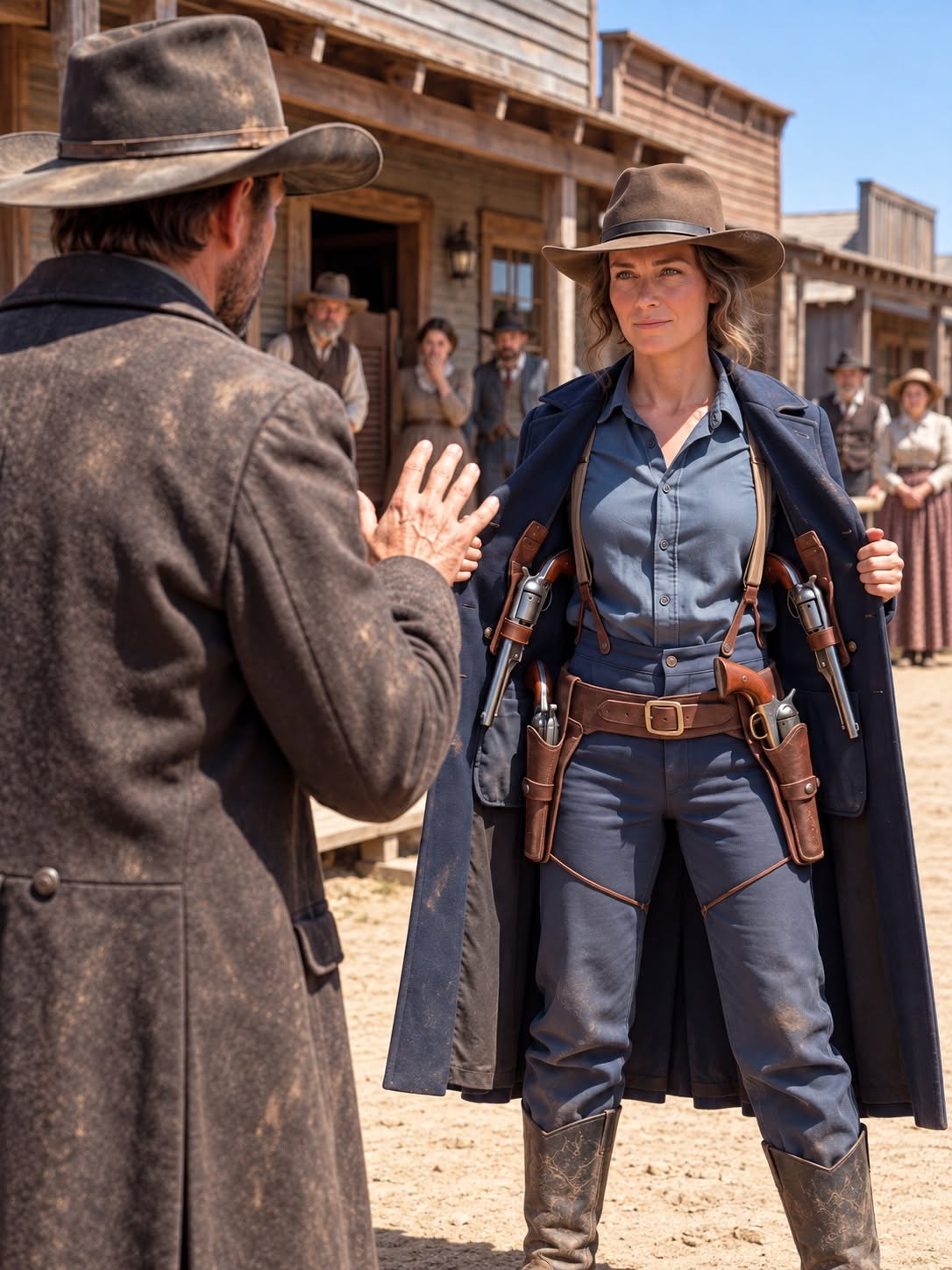
The first thing the people of Hollow Creek noticed about Colette Marsh was that she rode into town alone.
The second was the four revolvers beneath her long leather coat.
The third was the look in her eyes.
It was not the look of a woman searching for shelter, work, or a husband. It was the look of someone who had traveled six hundred miles with death riding beside her, waiting for the right moment to climb down.
The afternoon sun burned over the New Mexico desert as Colette guided her exhausted chestnut mare along the main street. Dust swirled around her boots. Wooden storefronts leaned beneath faded signs, and men standing outside the saloon stopped talking when they noticed her.
She ignored them.
Her eyes moved from the general store to the livery, then to the saloon at the end of the street.
A wooden sign creaked above its entrance.
THE DEVIL’S REST.
That was where Silas Bragg spent his afternoons.
The outlaw had murdered dozens of men, robbed stagecoaches, and disappeared into the desert whenever a sheriff gathered enough courage to pursue him. His name was whispered across territorial borders, usually followed by a warning.
But Colette Marsh had not come to Hollow Creek because Silas Bragg was feared.
She had come because eight months earlier, her brother had died with his blood soaking into the dirt outside a saloon in southern Colorado.
And before he took his final breath, Thomas Marsh had managed to whisper one name.
Silas Bragg.
Thomas had been more than a brother. After their parents died of fever, he had worked himself nearly to death to keep them together. He taught Colette to read by candlelight, showed her how to ride before she could reach the stirrups properly, and once walked forty miles through a snowstorm to bring her medicine when she was sick.
He had promised her that no matter how difficult life became, she would never have to face the world alone.
Then someone put a bullet through his chest.
The local sheriff called it an outlaw’s robbery. A frightened bartender claimed he had seen Bragg near the saloon that night. Another witness said the killer wore a black hat and carried a silver-handled pistol.
The evidence was thin.
The name, however, was clear.
So Colette sold the small cattle herd Thomas had left her, bought ammunition, and spent months learning everything she could about the men who killed for money.
She practiced drawing until her fingers cramped. She learned to shoot with either hand. She trained herself to recognize the slightest movement beneath a man’s coat.
She had one purpose now.
Find Silas Bragg.
Make him confess.
Then kill him.
Colette dismounted outside the saloon and tied her mare to the hitching post.
The conversations inside fell silent when she entered.
Smoke hung beneath the ceiling. A piano player sat motionless with his hands hovering over the keys. Several rough-looking men occupied a table near the back, their pistols resting within easy reach.
And in the center of them sat a broad-shouldered man with a scar running from his left eyebrow to his cheek.
Silas Bragg.
He was older than she had expected, perhaps forty-five, with gray beginning to creep into his dark beard. His black hat shadowed a pair of pale, restless eyes.
He looked Colette up and down, then laughed.
“Lost, little lady?”
“No.”
“Looking for somebody?”
“Silas Bragg.”
The laughter around the table grew louder.
Bragg leaned back in his chair.
“You found him. Now tell me why a pretty thing like you would ride into Hollow Creek looking for trouble.”
Colette stepped forward.
“Eight months ago, you killed Thomas Marsh outside the Red Lantern Saloon.”
Bragg’s smile disappeared.
For a moment, something moved behind his eyes. Surprise, perhaps. Or recognition.
Then he began laughing again, though this time the sound was forced.
“Never heard of him.”
“You’re lying.”
“Careful, girl. Men who accuse me of things usually don’t live long enough to regret it.”
Colette’s hand slipped beneath her coat.
“I didn’t come here to accuse you.”
She drew two revolvers in a single movement and pointed them at his chest. Her other two guns remained holstered, but every man in the room understood why they were there.
Bragg’s men reached for their weapons.
“Nobody move!” she shouted.
For one heartbeat, the entire saloon froze.
Then a gunsH๏τ shattered the silence.
The room erupted.
Tables overturned. Glᴀss exploded against the walls. Colette threw herself behind a heavy wooden table as bullets tore through the furniture. She fired twice, forcing two of Bragg’s men to retreat behind the bar.
When she looked up again, Bragg was running through the rear door.
She followed him into the alley.
He was already mounting a dark horse.
“Bragg!” she screamed. “You don’t get to run!”
He turned in the saddle.
Their eyes met across the dusty alley.
And then he said something that stopped her cold.
“If Thomas was your brother, girl, then you ought to pray you never learn who really killed him!”
He spurred his horse and disappeared between the buildings.
Colette raised her revolver, but the sH๏τ never came.
A terrible doubt had entered her mind.
Before she could follow him, a voice thundered from the street.
“Drop your weapons!”
The town marshal stood at the alley entrance with six armed deputies. His badge gleamed in the sunlight, and his hand rested on the grip of a polished revolver.
Amos Whitfield.
A tall, neatly dressed man with silver at his temples, he carried himself like someone who had never questioned his own authority.
“Put those guns down, Miss.”
Colette slowly lowered her revolvers.
“Silas Bragg just escaped.”
“I can see that.”
“He murdered my brother.”
Whitfield’s expression hardened.
“Then you should have brought your complaint to my office instead of starting a gunfight in the middle of town.”
“He ran.”
“And you will leave Hollow Creek before sunrise.”
Colette stared at him.
“You’re protecting him.”
The marshal stepped closer.
“I am giving you an opportunity to leave this town alive.”
Something in his voice made the hairs rise along her neck.
Then Colette mentioned her brother’s name again.
“Thomas Marsh.”
The marshal’s expression changed.
Only for a second.
His jaw тιԍнтened. His eyes shifted toward the alley where Bragg had vanished, and his hand closed around his gun belt.
But Colette saw it.
Fear.
The same fear she had seen in Bragg’s eyes.
“Get her out of here,” Whitfield ordered.
Two deputies approached.
Before they could touch her, a quiet voice came from the blacksmith’s shop across the street.
“Marshal, perhaps you should let the lady explain herself.”
The speaker was a tall man with broad shoulders, soot-darkened sleeves, and a face marked by years of working beside a furnace. He carried no visible weapon.
Nathaniel Ward, the town blacksmith.
Whitfield glared at him.
“This is none of your concern, Ward.”
“Funny thing about concern,” Nathaniel replied. “It tends to become everyone’s business when the law starts looking frightened.”
The street went silent.
The marshal stared at him for several seconds before turning back to Colette.
“Sunrise,” he repeated. “Be gone by then.”
He marched away with his deputies.
Colette remained in the alley, her fingers trembling around her revolvers.
Not from fear.
From rage.
She had found Bragg, but she had not killed him. Worse, she had discovered that the man wearing the town’s badge seemed more frightened by her brother’s name than by the outlaw himself.
Nathaniel approached her slowly.
“You’re bleeding.”
Colette glanced down. A bullet had grazed her upper arm, tearing through her sleeve.
“It’s nothing.”
“That’s what people say before they fall over.”
“I don’t need help.”
“No,” he said quietly. “You need answers. But you’ll have a harder time finding them if you bleed to death in my street.”
He led her into the blacksmith’s shop.
The air smelled of coal, H๏τ iron, and leather. Nathaniel cleaned the wound and wrapped it carefully while Colette watched him.
“How long have you known Bragg?” she asked.
“Long enough.”
“Did he kill my brother?”
Nathaniel’s hands stopped moving.
Outside, a horse galloped past the shop. Somewhere down the street, a door slammed.
Finally, the blacksmith looked at her.
“Maybe you came here hunting the wrong truth.”
Colette reached for the revolver resting beside her.
“Tell me what you know.”
Nathaniel moved toward the shop’s front window and checked the street before speaking.
“Your brother came to Hollow Creek three months before he died.”
Colette felt the blood drain from her face.
“That’s impossible. Thomas never mentioned this town.”
“He didn’t want you involved.”
“Involved in what?”
Nathaniel turned back toward her.
“Something that could get every person in this town killed.”
He crossed the shop, unlocked a small iron cabinet, and removed a folded piece of paper stained with old blood.
When he opened it, Colette recognized the handwriting immediately.
Thomas’s handwriting.
There were only seven words on the page.
If anything happens to me, trust no badge.
Colette stared at the message, unable to breathe.
Then Nathaniel spoke the words that shattered the last certainty she had carried across six hundred miles of desert.
“Your brother wasn’t killed because he crossed Silas Bragg.”
He folded the paper and placed it in her trembling hand.
“He was killed because he discovered what Marshal Whitfield had been hiding.”
And outside the blacksmith’s shop, someone quietly lifted a rifle toward the window.
PART 2: THE BLACKSMITH’S ᴅᴇᴀᴅLY SECRET
Nathaniel saw the reflection in the window before Colette did.
He grabbed her shoulder and pulled her down.
The rifle cracked.
Glᴀss exploded across the workbench, and a bullet buried itself in the wooden cabinet behind them.
Colette hit the floor hard, her wounded arm striking the boards. Her revolver was in her hand before the echo faded.
“Stay down,” Nathaniel ordered.
She ignored him and crawled toward the back wall.
Through the broken window, she caught a glimpse of a rider disappearing around the corner. A dark hat. A gray horse. A rifle balanced across one shoulder.
“One of Whitfield’s men,” she whispered.
“Perhaps.”
“You know who it was.”
Nathaniel’s silence was answer enough.
Colette pushed herself to her feet.
“Tell me everything. Now.”
For several moments, the blacksmith watched her as though deciding whether she could bear what he was about to reveal.
Then he closed the shop’s front shutters and barred the door.
“Your brother wasn’t a rancher when he came here,” he began. “Not entirely. He had been asking questions about missing cattle, stagecoach robberies, and men who disappeared after being arrested.”
“Thomas never worked with the law.”
“He didn’t. But he knew how to follow money.”
Nathaniel explained that, for nearly three years, Hollow Creek had been the center of a quiet criminal operation. Cattle were stolen from struggling ranchers, then sold under false ownership records. Stagecoaches were robbed along remote stretches of road, but the money rarely reached the outlaws who supposedly carried out the attacks.
Instead, it disappeared into accounts controlled by respectable men.
Men who attended church on Sundays.
Men who donated to the town’s schoolhouse.
Men who shook hands with the governor’s representatives and spoke proudly about law and order.
And at the center of the operation stood Marshal Amos Whitfield.
“He uses Bragg and his men to do the dirty work,” Nathaniel said. “Then he makes sure the evidence disappears. Witnesses are threatened. Records burn. Anyone who gets too close becomes a criminal, a drunk, or a corpse.”
Colette thought of the frightened expression on Bragg’s face.
“Why would Bragg be afraid of the marshal if they’re working together?”
“Because partnerships built on greed rarely end with friendship.”
Nathaniel returned to the cabinet and removed a small leather ledger.
Inside were names, dates, payment amounts, and descriptions of shipments. Several entries were marked with a black cross.
Colette scanned the pages.
Then she found a familiar name.
Thomas Marsh.
Beside it was a date: the day before her brother died.
Underneath his name, someone had written:
Recovered documents. Payment authorized.
Her knees weakened.
“They paid someone to kill him.”
Nathaniel nodded.
“Thomas discovered that Whitfield was selling stolen land deeds. Ranchers who couldn’t pay the marshal’s invented fines lost their property. Their land was then transferred to companies that didn’t exist outside paper records.”
“And my brother found proof?”
“He found enough to frighten Whitfield. But he also found something more dangerous.”
Nathaniel pointed to a final entry near the back of the ledger.
Shipment 17. The Marsh property. Original deed recovered.
Colette stared at the words.
Her family’s ranch had been sold after Thomas died. The documents had claimed that her brother owed money to a lender she had never heard of. With no proof otherwise, she had been forced to surrender the land.
She had believed it was simply another tragedy in a life that had offered her little mercy.
Now she understood.
Her family’s land had not been lost because of debt.
It had been stolen.
“Where is the original deed?” she asked.
Nathaniel closed the ledger.
“That’s what Whitfield is looking for.”
“And Bragg?”
“He took something from Thomas the night he died. Something Whitfield never recovered.”
Colette’s mind raced.
“Then why did Bragg run from me?”
“Because he knows you have every reason to kill him. And because he may be the only living man who can tell you where your brother hid the evidence.”
She stared at Nathaniel.
“You expect me to believe an outlaw might help me?”
“No. I expect you to understand that a guilty man can still be afraid of someone worse.”
Before Colette could answer, three hard knocks sounded against the back door.
Nathaniel went still.
A man’s voice followed.
“Ward! Open up. Marshal’s orders.”
The blacksmith quietly reached beneath the workbench and produced a short iron bar.
“There’s a pᴀssage behind the coal shed,” he whispered. “Take the ledger and go to the abandoned mission north of town.”
“What about you?”
“I’ll keep them busy.”
“No.”
“Miss Marsh, if you stay here, Whitfield will take the ledger, arrest you for murder, and bury the truth alongside your brother.”
Another series of knocks shook the door.
“Open it!”
Nathaniel pressed the ledger into her hands.
“Your brother trusted someone in this town. He made a mistake trusting the wrong people. Don’t make the same mistake.”
Colette wanted to argue, but she recognized the determination in his face.
She slipped through the narrow pᴀssage just as the back door splintered.
From the darkness, she heard men shouting.
Then came the unmistakable sound of a fist striking flesh.
She almost turned back.
Instead, she ran.
The abandoned mission stood on a rocky rise beyond the northern edge of Hollow Creek. Its roof had collapsed, its windows were empty, and the wind carried sand through the cracks in its walls.
Colette reached it just before sunset.
She had barely entered when a voice came from behind the ruined altar.
“Put the guns away, Thomas’s sister.”
Silas Bragg stepped into the fading light.
His revolver was pointed at the floor, but his hand rested near the grip.
Colette drew one of her Colts.
“You have ten seconds to explain why I shouldn’t put a bullet through your head.”
Bragg looked exhausted. His shirt was stained with sweat, and a fresh cut crossed his forehead.
“Because your brother begged me to keep you alive.”
Colette froze.
“What did you say?”
“Thomas knew he was being followed. He came to me because he had nowhere else to go.”
“You’re lying.”
“I wish I were.”
Bragg slowly reached into his coat and removed a small brᴀss key.
“He found proof that Whitfield had been stealing land from families all across the territory. He wanted to take it to a federal investigator in Santa Fe. But Whitfield learned about it before he could leave.”
Colette’s gun remained trained on his chest.
“Who sH๏τ him?”
Bragg’s face тιԍнтened.
“I did not.”
“Then why were you at the saloon?”
“Because Thomas arranged to meet me there. He believed I could get him out of town.”
“You expect me to believe you were helping him?”
“No. I expect you to hate me. I deserve plenty of that. I’ve robbed men, threatened families, and killed people who stood in my way. But your brother wasn’t one of them.”
Bragg placed the brᴀss key on the broken altar.
“Thomas gave me this the night he died. He told me to hide it where Whitfield would never look. I was supposed to deliver it to someone he trusted if he didn’t make it out alive.”
“Who?”
Bragg looked directly into her eyes.
“Nathaniel Ward.”
Colette felt the ground shift beneath her.
“The blacksmith?”
“Your brother saved Nathaniel’s life years ago. They were friends before either of us came to Hollow Creek.”
“Then why didn’t Nathaniel tell me?”
“Because he’s been hiding something too.”
Bragg took a slow breath.
“Thomas wasn’t just investigating Whitfield’s land scheme. He had discovered that the marshal was planning to eliminate every witness before a shipment of stolen deeds left the territory. And the man who gave Whitfield the list of those witnesses was someone Thomas trusted like family.”
Colette тιԍнтened her grip on the revolver.
“Who?”
Before Bragg could answer, a voice echoed through the ruined mission.
“That’s enough, Bragg.”
Marshal Whitfield appeared in the doorway, flanked by four armed deputies.
Behind them stood Nathaniel Ward, his face bruised, his hands bound.
Colette’s heart sank.
Whitfield smiled as if he had just caught two troublesome children stealing apples.
“Miss Marsh, you have made a great many mistakes since arriving in my town.”
He gestured toward Bragg.
“Your first was believing an outlaw.”
Then he looked at Nathaniel.
“Your second was trusting a blacksmith.”
Finally, his eyes settled on Colette.
“But your greatest mistake was thinking your brother’s death was an isolated incident.”
He drew a folded document from his coat.
“Thomas Marsh didn’t merely discover my operation. He helped build it.”
Colette’s face went white.
Whitfield held the document up to the light.
“Your brother signed the original land-transfer papers. His name appears on every deed we recovered. And if you think anyone will believe a woman carrying four illegal guns over a respected marshal, you haven’t understood this town at all.”
Colette looked at Nathaniel.
For the first time since she had met him, the blacksmith refused to meet her eyes.
Then Whitfield raised his revolver toward Bragg.
“Now, Miss Marsh, you have a choice.”
He smiled coldly.
“Tell me where your brother hid the original deed, and perhaps I’ll allow you to leave Hollow Creek alive.”
His finger тιԍнтened on the trigger.
“Refuse, and everyone who knew Thomas Marsh will die before sunrise.”
PART 3: THE TRUTH BENEATH THE BADGE
For several seconds, nobody moved.
Colette could hear the wind sweeping through the broken mission and the restless breathing of the men surrounding her.
Marshal Whitfield held his revolver against Silas Bragg’s chest.
Nathaniel stood with his hands tied behind his back.
And Colette had four guns, a stolen ledger, and no clear idea whom she could trust.
“You said my brother helped build your operation,” she told Whitfield. “Prove it.”
The marshal laughed.
“Still asking questions. Just like Thomas.”
He unfolded the document.
It was a land-transfer agreement bearing her brother’s signature. The handwriting looked convincing, and a red seal marked the bottom of the page.
“Thomas worked as a clerk for a land company before he returned to Colorado,” Whitfield explained. “He understood property records better than most men. He helped us identify vulnerable ranches and prepare the paperwork.”
Colette felt a sharp ache in her chest.
Thomas had once spent an entire winter teaching her to write her name properly. He had told her that honest work was the only thing a person could truly own.
She refused to believe he had betrayed innocent families.
“Why would he turn against you?” she asked.
“Conscience,” Whitfield replied with a shrug. “A troublesome habit.”
Bragg suddenly laughed.
It was a bitter, humorless sound.
“Show her the date, Amos.”
Whitfield’s smile faded.
“What?”
“The date on the document. Show her.”
The marshal glanced down.
Bragg continued.
“Thomas died on October fourteenth. The document you are holding was notarized on October sixteenth.”
Silence filled the mission.
Colette stared at the paper.
Two days after her brother’s murder.
Whitfield folded the document quickly.
“A clerical error.”
“Of course,” Bragg said. “And I suppose the signature was written by a ghost.”
Whitfield struck him across the face with the barrel of his gun.
Bragg staggered but remained standing.
Colette’s suspicions sharpened into certainty.
The marshal had forged the document.
But she still needed the truth about Nathaniel.
“Why won’t you look at me?” she asked the blacksmith.
Nathaniel slowly raised his head.
His eyes were full of pain.
“Because I knew Thomas was in danger, and I failed him.”
“Tell me what happened.”
Whitfield interrupted.
“Enough. Give me the ledger.”
Colette held it against her chest.
“No.”
The marshal’s expression hardened.
“Then I’ll take it from your corpse.”
He gestured to his deputies.
Two men stepped forward.
At that moment, Nathaniel slammed his bound hands against the wooden post behind him, pulling the loose rope around a jagged nail. The fibers snapped.
He swung his arms forward and struck the nearest deputy across the face.
The mission erupted into chaos.
Bragg drove his shoulder into Whitfield, sending the marshal’s gun skidding across the floor. A deputy fired, shattering a piece of the altar.
Colette dropped behind a stone pillar and drew both revolvers.
She fired once into the ceiling, forcing the men near the doorway to scatter. Then she turned her second gun toward the deputy attempting to seize the ledger.
“Move again,” she warned, “and you’ll regret it.”
The deputy froze.
Nathaniel grabbed a fallen rifle and tossed it toward Bragg, who caught it before Whitfield could recover his weapon.
But the marshal was faster than anyone expected.
He drew a concealed pistol from his boot and aimed it at Colette.
“Put the guns down!”
She turned.
Whitfield’s weapon was steady.
“You want the truth?” he snarled. “Fine. Your brother found the original deeds and threatened to expose me. I offered him money. He refused. I offered him a share of the profits. He refused again.”
His eyes burned with hatred.
“So I ordered Bragg to kill him.”
Bragg’s face twisted.
“You told me to frighten him into surrendering the documents!”
“And you failed.”
“I never fired the sH๏τ!”
Whitfield’s gaze shifted toward him.
“No. You didn’t.”
A terrible silence followed.
Colette felt her heart hammer against her ribs.
“If Bragg didn’t kill Thomas,” she whispered, “who did?”
The marshal smiled.
“Your brother was stubborn. He fought back. I had to do it myself.”
For eight months, Colette had imagined this moment.
She had imagined the killer begging for mercy. She had imagined looking into his eyes as she pulled the trigger. She had imagined the terrible emptiness that would follow revenge.
But now, standing before the man who had ordered her brother’s death, she understood that killing him would not restore a single thing she had lost.
She needed him alive.
She needed his confession.
And she needed the evidence.
“Where are the original deeds?” Whitfield demanded.
Colette looked at the brᴀss key lying beside the altar.
Then she remembered Nathaniel’s words.
Your brother trusted someone in this town.
She turned toward the blacksmith.
“Where did Thomas hide them?”
Nathaniel’s eyes widened slightly.
Then he understood.
“Under the forge.”
Whitfield’s face changed.
Colette smiled for the first time since entering Hollow Creek.
“You’ve been searching the wrong place.”
The marshal fired.
The bullet struck the stone pillar beside her head.
Colette dropped low, rolled across the floor, and fired at his hand. Her sH๏τ knocked the pistol away without striking him.
Bragg tackled Whitfield before he could reach his second weapon.
Nathaniel seized the remaining deputy, and within moments, the marshal was on the ground with his arms pinned behind his back.
For the first time in years, Amos Whitfield looked like an ordinary man.
A frightened, cornered man.
Colette stood over him.
“Eight months,” she whispered. “Eight months I’ve lived with the thought that I failed my brother.”
Whitfield spat dust from his mouth.
“Go ahead. Shoot me. You’re no better than Bragg.”
She looked at the revolver in her hand.
Then she lowered it.
“No. I’m better than you.”
She turned to Nathaniel.
“Take us to the forge.”
They returned to Hollow Creek shortly before dawn.
The town was beginning to stir, but the news of the marshal’s arrest spread quickly. By the time they reached Nathaniel’s shop, several townspeople had gathered outside.
Some were frightened.
Others were angry.
And a few looked as though they had been waiting years for someone to challenge the man who had ruled them through fear.
Nathaniel moved the coal bins aside and lifted a section of the forge’s stone foundation. Beneath it lay a small iron box.
The brᴀss key fit perfectly.
Inside were original land deeds, signed statements from displaced ranchers, records of payments to Whitfield’s deputies, and letters connecting the marshal to a network of corrupt land agents.
At the bottom lay a sealed envelope addressed to Colette.
Her hands trembled as she opened it.
My dearest Colette,
If you are reading this, then I failed to come home.
I need you to understand something. I have made mistakes, and I have trusted people I should not have trusted. But I have never betrayed the people whose land was stolen, and I have never willingly helped the men who hurt them.
If I am gone, do not spend the rest of your life chasing revenge. Find the truth, even if it hurts. And when you find it, choose what kind of person you want to become.
You have always been stronger than you know.
Your loving brother,
Thomas.
Colette pressed the letter against her chest.
For the first time in eight months, she allowed herself to cry.
Not because she was weak.
Not because she regretted the journey.
But because the man she had loved more than anyone in the world had finally spoken to her again.
And his last request was not for vengeance.
It was for justice.
Two weeks later, a federal investigator arrived in Hollow Creek with a small group of marshals from outside the territory.
The evidence from Nathaniel’s forge was enough to bring charges against Amos Whitfield and several members of his network. The stolen deeds were returned to their rightful owners, and the investigation expanded into neighboring towns.
Silas Bragg agreed to testify about the operation and the night Thomas died. He was still an outlaw, and no one pretended otherwise. He would face the consequences of his own crimes.
But he had not killed Thomas Marsh.
Before leaving Hollow Creek under guard, Bragg approached Colette outside the saloon.
“I owe your brother more than I can repay,” he said.
“You could start by telling the truth.”
“I will.”
She studied him for a moment.
“That won’t erase what you’ve done.”
“No,” he admitted. “But perhaps it will stop someone else from losing everything.”
Colette nodded once.
It was not forgiveness.
But it was enough.
After the investigation, Nathaniel offered to help her reclaim the family ranch. The original deeds proved that the property had been stolen through forged debts, and the land was eventually returned to her.
She could have left Hollow Creek then.
She had money enough to buy a new herd, a home, and a future far from the ghosts of the past.
Instead, she stayed.
The town needed someone who would not bow to the next man who wore a badge and mistook authority for ownership.
Colette sold two of her four revolvers and kept the other pair locked in a drawer. She no longer practiced drawing them every morning.
Sometimes, she rode out to her ranch and watched the sunrise spill over the desert.
Sometimes, she visited Thomas’s grave and read his letter again.
And sometimes, she stopped by Nathaniel’s blacksmith shop, where the smell of coal and H๏τ iron reminded her of the day her life had changed.
One evening, as the sky turned gold above Hollow Creek, Nathaniel found her standing beside the forge.
“Do you ever regret coming here?” he asked.
Colette considered the question.
“I regret believing that killing one man would make everything right.”
“And now?”
She looked toward the town.
“Now I know revenge can point you toward the truth. But it can’t tell you what to do once you find it.”
Nathaniel smiled faintly.
“Your brother would have liked that answer.”
For a long moment, neither spoke.
Then Colette glanced at the two revolvers resting in their leather holsters.
“I rode six hundred miles to kill an outlaw,” she said.
“And instead?”
She looked at the man who had helped her uncover the truth.
“I learned that the most dangerous men aren’t always the ones everyone fears.”
Nathaniel nodded toward the street, where children ran between the storefronts and ranchers spoke openly without looking over their shoulders.
“Sometimes,” he said, “the most dangerous man is the one everyone has been taught to trust.”
Colette watched the last sunlight disappear beyond the desert hills.
She had arrived in Hollow Creek carrying four loaded guns and a heart consumed by grief.
She had expected to find a monster.
Instead, she had uncovered a town built on lies, a brother who had died trying to expose them, and a truth powerful enough to bring an entire criminal network to its knees.
She had not brought Thomas back.
She never would.
But she had restored his name, returned stolen land to innocent families, and refused to let the man who killed him decide what kind of person she would become.
And for the first time since the day she buried her brother, Colette Marsh no longer felt the need to keep riding.
Because sometimes, the bravest thing a person can do is put down the gun, face the truth, and refuse to become the very evil they set out to destroy.