PART 2: THE STRANGER WHO KNEW HER HUSBAND
It arrived just when a person was too tired to fight, whispered that tomorrow might be different, and then disappeared when they reached for it.
So she did not reach for it now.
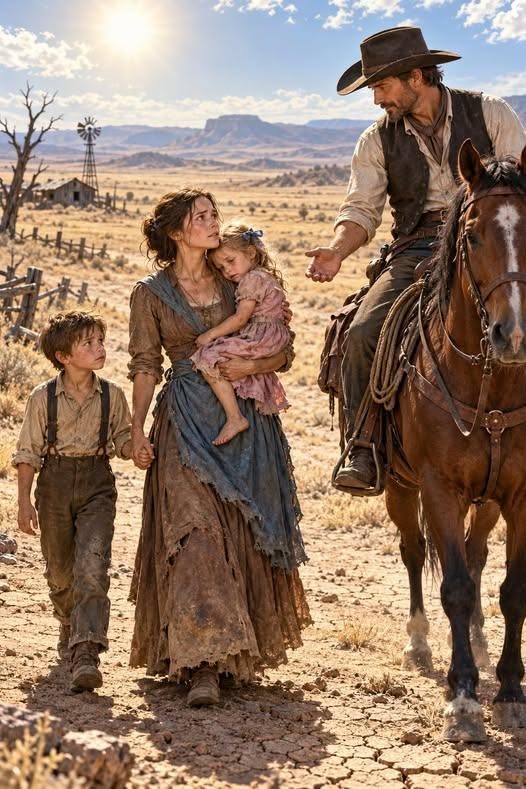
She stood in the middle of the dusty Wyoming road, one arm wrapped around Emma, her other hand gripping Samuel’s small shoulder. The stranger waited beside his horse, giving her enough distance that she did not feel cornered.
“What’s your name?” Norah asked.
“Caleb Whitmore.”
“Where’s this ranch?”
“About eight miles west. Past Cottonwood Creek, then north toward the foothills.”
“Whose ranch?”
“Mine.”
That answer made Norah more suspicious, not less.
She looked at his horse, his weathered boots, and the revolver strapped to his hip. His clothes were worn but clean. He had the appearance of a man who spent most of his days outdoors and expected the world to obey the same rules he did.
“You’re telling me a stranger can show up at your ranch with two hungry children, and you’ll give us work?”
“I’m telling you I need a cook, a laundress, and someone to help keep the house running. My last cook left three weeks ago, and the woman handling the laundry has a bad knee.”
“Then why haven’t you hired anyone from town?”
“I have.”
“And?”
“They wanted more money than I could pay.”
Norah’s chin lifted.
“Then you can’t afford me either.”
For the first time, something resembling a smile touched Caleb’s face.
“Maybe not. But I can afford to feed three more people, and I can pay you for honest work. That’s more than you seem to have been offered this morning.”
The words stung because they were true.
Samuel tugged at her skirt.
“Mama, can we go with him?”
Norah looked down at her son.
He was trying not to stare at the canteen hanging from Caleb’s saddle. The boy had been hungry for so long that even the sight of water had become a temptation.
“We don’t know this man, Samuel.”
“He’s got water.”
Norah closed her eyes for a moment.
Seven years old, and already measuring strangers by whether they might help him survive another day.
She turned back to Caleb.
“If we come with you, I need to know where we’re going. I need to see the ranch before I agree to anything. And my children stay with me. No one takes them into another room, no one sends them away, and no one decides I’m too much trouble and separates us.”
Caleb’s expression grew serious.
“That’s fair.”
“And I want to know why you’re helping us.”
He glanced down the road toward town.
“Because I’ve seen what happens when good people run out of choices.”
“That isn’t an answer.”
“No,” he admitted. “It isn’t.”
He placed one boot in the stirrup but didn’t mount.
“My wife died six years ago. Fever took her in less than a week. We had a little girl, barely three years old. After the funeral, I spent months convincing myself that working harder would somehow make everything right again.”
His eyes moved toward the children.
“It didn’t.”
Norah’s grip on Emma loosened slightly.
“What happened to your daughter?”
“She lives with my sister in Cheyenne. She’s safer there than on a ranch where her father spends every waking hour trying to outrun his grief.”
He paused.
“I couldn’t save my wife. But I learned that a person shouldn’t have to face every hardship alone.”
Norah studied him, searching for the hidden price behind his words.
There was sorrow in his face, certainly. But sorrow could make a man kind, or it could make him dangerous. She had lived long enough to know that one did not guarantee the other.
“Eight miles,” she said finally. “You said the ranch is eight miles away.”
“Yes, ma’am.”
“And you expect me to believe you can get us there safely?”
Caleb nodded toward his horse.
“You and the little girl can ride. The boy can sit in front of me. I’ll walk if the horse needs the weight taken off him.”
Samuel’s eyes widened.
“Can I ride a horse?”
“If your mother says yes.”
Every instinct in Norah told her to refuse.
But Emma’s head had begun drooping against her shoulder. Samuel’s lips were cracked, and his steps had become unsteady.
Norah looked toward town.
She could keep walking, reach the county poorhouse, and hope the children would be placed with a family that wanted them. She could surrender them to strangers and spend the rest of her life wondering whether they had cried for her at night.
Or she could take a chance on another stranger.
She hated that those were the choices left to her.
“All right,” she whispered. “We’ll see your ranch.”
Caleb helped her mount the horse, then settled Samuel in front of him. He gave the boy a small piece of dried apple from his saddlebag.
Samuel ate it slowly, as though afraid the food might disappear if he moved too quickly.
Norah watched him chew.
Then she turned her face away.
She had failed to feed her son. She had walked toward town prepared to surrender him. And now a stranger was feeding him a piece of fruit while she sat helplessly in the saddle.
She promised herself she would never forget that feeling.
Not the shame.
The debt.
If Caleb Whitmore was truly giving her a chance, she would work until her hands bled before she wasted it.
She would scrub floors, mend shirts, cook for twenty men, and rise before sunrise every morning.
But she would never again allow her children to go hungry without fighting for them first.
The horse began moving west.
And behind them, the road to town slowly disappeared into the dust.
They reached the ranch shortly after noon.
Norah had expected a modest homestead, perhaps a farmhouse and a few cattle.
Instead, she found a sprawling spread nestled between golden hills and a narrow creek that still carried water despite the drought. A large white farmhouse stood near a line of cottonwood trees. Beyond it were barns, corrals, a bunkhouse, and several smaller buildings.
Cattle grazed in the distance.
Smoke rose from a chimney.
And somewhere behind the house, a woman was laughing.
For the first time in weeks, Norah smelled something other than dust and ᴅᴇᴀᴅ grᴀss.
She smelled bread.
Fresh bread.
Emma lifted her head from Norah’s shoulder.
“Mama?”
“I smell it, sweetheart.”
“Is there food?”
Norah couldn’t answer immediately.
Caleb dismounted and helped Samuel down.
“There’s always food in the kitchen,” he said. “Whether there’s enough of it depends on how hungry the men have been.”
Samuel looked at him with solemn concern.
“I’m very hungry.”
Caleb’s face softened.
“Then we’d better get you inside.”
He led them toward the house.
Before they reached the porch, the front door opened, and a broad-shouldered woman in her fifties stepped outside. She wore a dark blue dress beneath a flour-dusted apron, and her silver hair was pinned firmly at the back of her head.
Her gaze moved from Caleb to Norah, then to the two children.
“Caleb Whitmore,” she said sharply. “Who have you brought home now?”
“Someone who needs work, Mrs. Bell.”
“I can see that. I can also see two children who look like they haven’t eaten properly in a month.”
“They haven’t,” Norah said quietly.
The woman’s expression changed.
Not to pity.
Something much more practical.
“Then stop standing in the sun and bring them inside.”
Norah hesitated at the threshold.
Mrs. Bell noticed.
“Well? The floor won’t bite you, child.”
“I don’t want to impose.”
“You’d impose more by letting those babies faint on my porch. Come along.”
She turned and marched toward the kitchen.
Caleb gave Norah a reᴀssuring nod.
“That’s Margaret Bell. She’s been running this house longer than I’ve owned the place.”
“I heard that!” Margaret called from inside.
Caleb’s mouth twitched.
“She hears everything.”
Norah stepped into the house.
The kitchen was warm, bright, and filled with the smell of bread, stew, and roasted potatoes. A wooden table stood near the window, and several loaves rested beneath a clean cloth.
Margaret pulled out two chairs.
“Sit.”
Norah sat.
“Children first,” Margaret announced, placing bowls on the table.
Samuel looked at his mother before reaching for his spoon.
Norah nodded.
“Go ahead.”
The boy began eating.
Emma followed, clutching her spoon with both hands. She took one mouthful, then another, until the tears began falling down her cheeks.
Margaret pretended not to notice.
She simply placed another slice of bread beside the little girl’s bowl.
Norah watched her children eat and felt something inside her loosen for the first time since Thomas’s burial.
She had not given them away.
They were still beside her.
They were safe enough to eat without wondering where their next meal would come from.
And for that moment, it was enough.
But the moment did not last.
When the children had finished, Margaret sent them to the sitting room with a small plate of biscuits. Then she turned to Norah.
“Now, tell me what you can do.”
“Cook. Bake. Sew. Wash clothes. Keep accounts, if they’re simple. I can mend tack and tend chickens. My husband taught me how to milk a cow.”
“Can you work long hours?”
“Yes.”
“Can you take orders?”
“Yes.”
“Can you keep your temper when a room full of cowboys tracks mud across a floor you’ve just scrubbed?”
“That depends on how much mud.”
Margaret stared at her.
Then she laughed.
It was a loud, unexpected laugh that seemed to surprise even Caleb.
“Well, at least you’ve still got some fight left in you.”
Norah almost smiled.
Almost.
Margaret leaned against the counter.
“The work is hard. The pay isn’t generous. You’ll have a room upstairs, and the children can stay with you. There’s a schoolhouse four miles away, though the teacher sometimes cancels when the weather gets bad.”
Norah’s heart quickened.
“You mean I can keep them here?”
“If you do your job and they mind the rules, I don’t see why not.”
Norah swallowed.
“What are the rules?”
“No stealing. No fighting. No wandering into the cattle pens. And if a child gets sick, you tell me before trying to be a hero and hiding it.”
Her last words landed more heavily than Norah expected.
Margaret studied her.
“I’ve seen too many women try to carry the whole world on their backs. It never ends well.”
Norah lowered her eyes.
“I’ll do the work.”
“I expect you will.”
Margaret held out her hand.
“Welcome to Whitmore Ranch, Mrs. Hail.”
Norah stared at the offered hand for a moment before taking it.
“Thank you.”
And then, to her own embarrᴀssment, she began to cry.
Not loudly.
Not dramatically.
Just a few tears slipping down her face as she tried to apologize for them.
Margaret squeezed her hand.
“Don’t apologize for being tired, child. There’s enough work here to keep you busy without wasting time pretending you’re made of stone.”
Across the room, Caleb watched in silence.
He had brought Norah to the ranch because he believed she deserved a chance.
But he hadn’t expected the sight of her crying over a simple job to remind him so painfully of his own wife.
He looked away before anyone noticed.
Because there was something he hadn’t told Norah.
Something about her husband.
Something he had recognized the moment she mentioned the crooked wooden cross two miles back.
And something that made him wonder whether bringing her to the ranch had been a coincidence at all.
That evening, Norah settled the children into the small room Margaret had prepared for them.
It had two narrow beds, a washstand, a window overlooking the creek, and a quilt folded neatly at the foot of each mattress.
Emma climbed onto one bed and hugged her cloth doll.
“Are we staying here, Mama?”
Norah brushed the girl’s hair away from her forehead.
“For tonight.”
“What about tomorrow?”
Norah looked at Samuel.
He was standing beside the window, watching the ranch hands move cattle toward the barn.
“I don’t know yet,” she admitted. “But we’ll face tomorrow together.”
Samuel turned.
“Do we have to go to town and find a family?”
Norah’s throat тιԍнтened.
“No, sweetheart.”
His lower lip trembled.
“You’re not giving us away?”
She crossed the room and knelt before him.
“No.”
“Promise?”
Norah pulled him into her arms.
“I promise I’ll do everything I can to keep us together.”
He held her тιԍнтly, and she felt the small shudder that ran through his body as he finally allowed himself to cry.
“I thought you didn’t want us anymore.”
Norah pulled back so she could see his face.
“Oh, Samuel. No. Never.”
“Then why did you say we had to go?”
Because she had been terrified.
Because she had watched her children grow weaker every day and could no longer bear the thought of finding them cold and lifeless in the morning.
Because sometimes love forced a person to consider the very thing that would destroy them.
But Samuel was seven.
He needed his mother, not the full weight of her despair.
“Because I was scared,” she whispered. “And I made a decision when I couldn’t see another way.”
He wiped his nose with his sleeve.
“Papa wouldn’t have wanted us to go.”
Norah held him closer.
“No. He wouldn’t.”
For several minutes, they remained that way.
Then Emma called from the other bed.
“Mama? Can we have bread tomorrow?”
Norah looked at her daughter.
“Yes, sweetheart.”
“And milk?”
“Yes.”
Emma considered this.
“Then I like this ranch.”
A small laugh escaped Norah before she could stop it.
Samuel smiled, too.
For the first time in weeks, the room felt almost like a home.
Norah tucked them into bed, kissed their foreheads, and waited until their breathing grew slow and steady.
Then she went downstairs.
She intended to thank Caleb once more before beginning work at dawn.
Instead, she found him standing alone in the study, holding a small, weathered pH๏τograph.
He didn’t hear her approach.
In the pH๏τograph, a younger Caleb stood beside another man in front of a cattle pen.
Norah stopped breathing.
She knew the other man.
The broad smile. The crooked nose. The way his left shoulder sat slightly lower than his right.
Her husband.
Thomas.
“Where did you get that?” she whispered.
Caleb turned so quickly the pH๏τograph nearly slipped from his fingers.
For several seconds, he stared at her.
Then he looked down at the picture.
“How long were you married to Thomas Hail?”
“Nine years.”
Caleb closed his eyes.
When he opened them, the expression on his face was no longer one of simple sympathy.
It was guilt.
“I was hoping you’d tell me his full name before I brought you here.”
Norah felt the room tilt.
“You knew my husband?”
Caleb set the pH๏τograph on the desk.
“Yes.”
“How?”
He hesitated.
“Thomas worked for me before he settled on his own homestead. He was one of the best ranch hands I’ve ever employed.”
Norah gripped the edge of the desk.
“He never told me.”
“He left before you married. We lost touch for a while.”
“Then why did you recognize me?”
Caleb looked at her carefully.
“Because Thomas once showed me a pH๏τograph of you. He carried it in his coat pocket. He used to talk about the woman he intended to marry.”
Norah’s eyes filled.
She had never known that.
Not once in nine years had Thomas told her that some rancher in the western hills remembered him that way.
But Caleb wasn’t finished.
He walked to a locked drawer beneath the desk and took out a folded envelope, yellowed with age.
Norah recognized the handwriting immediately.
Thomas’s handwriting.
Her knees weakened.
“Where did you get that?”
Caleb placed the envelope on the desk between them.
“Your husband left it with me shortly before he moved away. He asked me to keep it until he thought you might need it.”
Norah stared at the envelope.
Her name was written across the front.
Norah.
Beneath it, in smaller letters, were four words that made her blood run cold.
If I don’t come back.
She reached for it with trembling fingers.
“Why didn’t you send this to me?”
“Because Thomas asked me not to unless—”
“Unless what?”
Caleb looked toward the dark window.
“Unless you and the children ever found yourselves with nowhere else to go.”
Norah felt the air leave her lungs.
For three months, she had watched her world collapse. She had buried her husband, watched her garden die, and walked toward town prepared to surrender the two people she loved more than life itself.
And all that time, there had been a letter waiting for her.
A letter her husband had left behind.
A letter that somehow connected her starving children to the ranch where she had just found shelter.
She looked up at Caleb.
“What did Thomas know?”
Caleb’s face тιԍнтened.
“I don’t know everything. But I know he was afraid of something when he left this ranch.”
“Afraid of what?”
Before he could answer, a sharp knock sounded at the front door.
Caleb froze.
Norah turned toward the hallway.
A man’s voice called from the porch.
“Whitmore! Open up. We’ve come about the Hail woman and her children.”
Caleb’s expression changed instantly.
He crossed the room and reached for the revolver hanging beside the door.
Norah clutched Thomas’s letter against her chest.
Outside, a second man spoke.
“Don’t make this difficult, Caleb. We know you’ve taken them in.”
Norah’s heart pounded.
“Who are they?” she whispered.
Caleb looked at her, and for the first time since she’d met him, she saw genuine fear in his eyes.
“Men who should never have known you were here.”
Another knock shook the door.
Then came the words that made Norah’s blood run cold.
“Mrs. Hail, we know your husband left something behind. We’re not leaving without it.”
Norah looked down at the envelope in her hands.
Whatever Thomas had hidden, it was important enough that someone had followed his widow across Wyoming to find it.
And now her children were caught in the middle.
To be continued in Part 3…