PART 2: THE MOUNTAIN MAN’S PROMISE
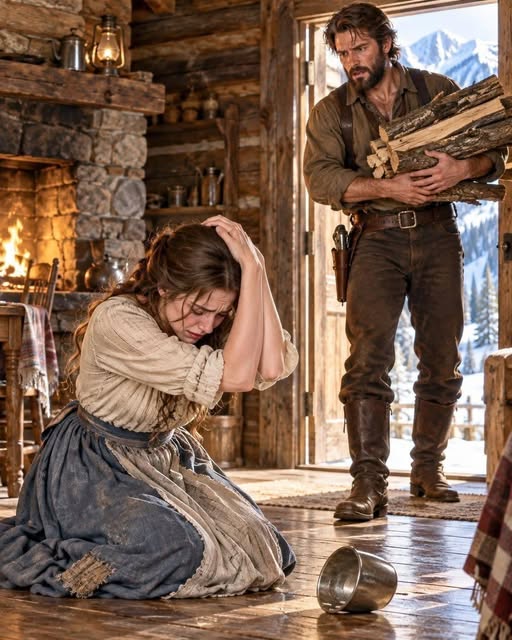
But nothing had ever made him feel as helpless as the sight of a young girl kneeling on his cabin floor, shielding her head from a blow that was never coming.
“Abigail.”
His voice was low.
She flinched so violently that her shoulder struck the cupboard behind her.
“Please,” she whispered. “I’m sorry. I’ll clean it up. I promise I won’t break anything else.”
Cole slowly set the firewood beside the hearth.
“Girl, look at me.”
Abigail shook her head, her arms still covering her face.
“I said look at me.”
The words came out sharper than he intended.
Abigail let out a frightened gasp and curled even тιԍнтer against the cupboard.
Cole immediately regretted raising his voice.
He had spent most of his life alone in the mountains. He knew how to track an injured animal, mend a broken rifle, and survive with nothing but a knife and a handful of matches.
But he had no idea how to speak to someone who was terrified of him simply for standing in the same room.
So he did something that felt strangely unnatural.
He lowered himself onto one knee.
“Abigail,” he said more gently, “I’m not going to hit you.”
She remained motionless.
“Do you hear me?”
A tiny nod.
“Then why are you still hiding?”
Her lips trembled.
“Because you haven’t decided how angry you are yet.”
The words struck him harder than any bullet ever could.
Cole looked at the shattered tin bowl scattered across the floor.
Then he looked at her bleeding knuckles.
“How long has someone been making you afraid like this?”
Abigail swallowed.
“I don’t know.”
“You don’t know?”
“Since I was little, I suppose.”
For several seconds, Cole said nothing.
Then he stood, walked to the table, and picked up a clean cloth. He poured warm water into a small basin and placed both beside her.
“Can you stand?”
Abigail hesitated before slowly unfolding herself from the floor.
Her knees trembled so badly that she nearly fell.
Cole reached out instinctively.
She recoiled.
He stopped with his hand suspended between them.
“All right,” he murmured. “I won’t touch you.”
He moved the basin closer.
“Wash your hands. Then sit down. Breakfast is getting cold.”
Abigail stared at him as though he had just spoken a language she had never heard before.
“But the bowl…”
“I’ll pick it up.”
“And the floor…”
“I’ll clean it.”
“But I broke—”
“Abigail.”
She fell silent.
Cole scratched his beard, struggling to find the right words.
“It was a tin bowl. Not a gold mine. We’ll survive.”
For the first time since entering the cabin, Abigail looked directly at him.
Something flickered across her face.
Not quite a smile.
But almost.
By noon, Cole had discovered that Abigail was more frightened of kindness than she was of hunger.
He watched her from the chopping block outside as she swept the cabin for the third time.
Every board was already clean.
Every dish had been washed.
The blankets had been folded so neatly that they looked as though they had never been used.
Yet she continued working, moving from one task to another with the desperate urgency of someone trying to outrun an approaching storm.
Finally, Cole set down his axe.
“That’s enough.”
Abigail froze with a broom in her hands.
“Have I missed something?” she asked quickly.
“No.”
“Is there more wood to gather?”
“No.”
“The water bucket is nearly empty. I can fetch more.”
“It’s full.”
She glanced toward the bucket, then back at him.
“Then perhaps I should prepare supper.”
“It’s noon.”
“I can prepare it early.”
Cole exhaled slowly.
“Abigail, come sit outside.”
Her face drained of color.
“Have I done something wrong?”
“No.”
“Then why do you want me outside?”
“Because I asked you to sit outside.”
She lowered her head.
“Yes, sir.”
That word again.
Sir.
Every sentence came wrapped in obedience. Every movement seemed to ask permission.
Cole dragged a wooden chair onto the porch and sat down, leaving another chair several feet away.
Abigail approached cautiously.
“Sit,” he said.
She perched on the very edge of the chair, her hands clasped тιԍнтly in her lap.
Cole gazed across the pine-covered mountains.
“See that ridge over there?”
She followed his gaze.
“Yes.”
“Snow usually comes early on the northern slope. By the time it reaches the valley, the creek will be running high. When that happens, you don’t cross it.”
Abigail blinked.
“Is that why you brought me here?”
He turned toward her.
“What?”
“To work outside? To learn the mountains?”
“No. I’m telling you because I thought you might want to know.”
She looked genuinely confused.
“You mean… you aren’t going to give me work?”
Cole frowned.
“You’ve done enough work for three people.”
“But I owe you.”
“Who told you that?”
“My mother.”
He leaned back in his chair.
“And what exactly do you owe me for?”
Abigail’s fingers twisted together.
“You gave her gold. You bought me.”
The word hung between them.
Bought.
Cole looked out at the mountains again, his jaw тιԍнтening.
“I paid Martha because I knew she’d never let you leave otherwise.”
Abigail stared at him.
“Then what am I supposed to be?”
“A person.”
She shook her head slightly.
“No. I mean… what am I supposed to do for you?”
Cole turned back toward her.
“Nothing you don’t choose to do.”
She stared at him for so long that he wondered whether she understood.
Finally, she whispered, “People don’t do things for nothing.”
“Some do.”
“Why?”
Cole rubbed a hand across his weathered face.
It was a question he had never considered answering.
“Because sometimes,” he said, “someone needs help. And if you’re able to give it, you give it.”
Abigail looked down at her hands.
“I don’t know how to live like that.”
“Then we’ll figure it out.”
For the first time, Cole noticed that her eyes were not merely frightened.
They were exhausted.
Not the ordinary exhaustion that came from hard labor, but the deep weariness of someone who had spent years believing that her existence was an inconvenience to everyone around her.
He wondered how many nights she had gone to bed hungry.
How many times she had been struck for spilling water or breaking a plate.
And how many people had watched without doing anything.
The thought made his hands curl into fists.
Three days pᴀssed.
Abigail began to learn the rhythms of the cabin.
Cole rose before dawn, fed the fire, and brewed coffee in a battered iron pot. He checked his traps, chopped wood, and returned before sunset whenever the weather allowed.
He never demanded that Abigail accompany him.
He never ordered her to cook.
And when she accidentally spilled flour across the table, he simply handed her a cloth.
Still, she watched him constantly.
She studied the way his mouth тιԍнтened when he was tired. She memorized the sound of his footsteps. She learned to recognize the difference between his silence when he was thinking and his silence when something troubled him.
She was preparing for the moment everything changed.
Because, in her experience, it always did.
On the fourth evening, Cole returned from checking his traps to find Abigail standing beside the stove.
A pot of stew simmered over the fire.
The table had been set.
Two bowls waited beside a loaf of bread she had baked from the flour he had left her.
Cole stopped in the doorway.
“What’s all this?”
Abigail immediately straightened.
“I thought you might be hungry.”
He glanced at the table.
“Smells good.”
She lowered her eyes.
“I tried to make it the way my father used to.”
Something changed in her voice when she mentioned him.
Cole pulled out a chair.
“Tell me about your father.”
Abigail hesitated, then ladled stew into his bowl.
“He used to sing while he worked. Terrible songs, mostly. He couldn’t remember all the words, so he’d make up the rest.”
A faint smile appeared on her face.
“He’d sing about the chickens, the weather, even the broken fence. He said every miserable thing became easier if you gave it a tune.”
Cole listened without interrupting.
“He was kind,” she continued. “He never shouted at me. When I was small, he used to let me sit on his shoulders while he walked to the creek.”
Her smile faded.
“Then he got sick.”
“What happened?”
“Fever. It lasted nearly two weeks.”
Abigail placed the ladle down.
“Mama said the doctor cost too much. By the time she finally sent for him, Papa couldn’t speak anymore.”
Cole looked at her.
“And after he died?”
Abigail’s fingers тιԍнтened around the edge of the table.
“She said everything wrong with our lives was my fault.”
The cabin seemed to grow colder.
“She said Papa worked himself to death because he had to feed me. She said she would have been free to marry a better man if she hadn’t been burdened with a child.”
Her voice cracked.
“Sometimes I believed her.”
Cole slowly set down his spoon.
“Listen to me, Abigail.”
She flinched at the seriousness in his tone.
“Your father didn’t die because you needed food. He didn’t suffer because you needed a roof over your head. And you didn’t make your mother cruel.”
Abigail’s eyes filled with tears.
“But she said—”
“I don’t care what she said.”
He leaned forward, his rough hands resting on the table.
“A child is not a debt. You hear me? You were never supposed to earn the right to be loved.”
Abigail stared at him.
A tear slipped down her cheek.
She quickly wiped it away, as though she had committed another offense.
“I’m sorry.”
Cole shook his head.
“Don’t apologize for that.”
“For what?”
“For crying.”
Her mouth trembled.
“I don’t know how to stop.”
“Then don’t.”
And for the first time in years, Abigail allowed herself to cry without trying to hide the sound.
Cole sat quietly across from her while the stew cooled between them.
He did not reach for her.
He did not tell her to be strong.
He simply stayed.
Sometimes, he was beginning to understand, staying was the most important thing a person could do.
The trouble arrived on the sixth morning.
Cole was repairing a broken hinge when he heard a horse approaching along the narrow mountain trail.
Few people traveled this far into the wilderness, and fewer still came without warning.
He reached for his rifle and stepped onto the porch.
A rider appeared between the pines.
It was Sheriff Thomas Bell, a broad-faced man with a gray mustache and a reputation for avoiding trouble whenever possible.
He reined in his horse.
“Morning, Cole.”
“Sheriff.”
Bell glanced toward the cabin.
“Got a problem I need to discuss with you.”
Cole rested his rifle against the porch post.
“What kind of problem?”
“Martha’s been in town telling everyone you’ve stolen her daughter.”
Cole’s expression hardened.
“Her daughter?”
“That’s what she says. Claims you threatened her and took the girl against her will.”
“Did she mention the three gold coins?”
Bell shifted uncomfortably.
“She mentioned money. Says you forced it on her.”
Cole let out a humorless laugh.
“Funny how a woman remembers the gold but forgets the paddle she was swinging at a child’s back.”
The sheriff’s eyes narrowed.
“Is that what happened?”
“You want the truth, or do you want the version Martha tells over a bottle of gin?”
Before Bell could answer, the cabin door creaked open.
Abigail stood in the doorway.
The moment she saw the sheriff, the color drained from her face.
“Abigail,” Bell called. “Come here a minute, would you?”
She didn’t move.
Cole glanced back at her.
“You don’t have to come out if you don’t want to.”
Her eyes darted between the two men.
The sheriff dismounted.
“I’m not here to hurt you, girl. Your mother’s demanding that you return home.”
Abigail’s hands began to shake.
“I don’t want to go back.”
Bell sighed.
“Now, Abigail, your mother says she’s sorry for whatever happened. She says she’s been worried sick.”
Abigail stared at him in disbelief.
“She’s sorry?”
“That’s what she told me.”
“She wasn’t worried when she hit me.”
The sheriff fell silent.
“She wasn’t worried when she made me sleep in the cold pantry because I spilled a cup of milk. She wasn’t worried when she took my father’s coat and sold it for gin.”
Her voice grew stronger with every word.
“She wasn’t worried when I begged her to stop.”
Cole watched her with quiet astonishment.
Abigail had barely spoken above a whisper since arriving at his cabin.
Now, standing in the doorway, she was telling the truth to a man who wore a badge.
Bell removed his hat.
“I’m sorry, Abigail.”
She looked at him.
“Will you make me go back?”
The sheriff hesitated.
“I need to speak with the county judge before I can make any promises.”
Abigail’s courage faltered.
Cole stepped forward.
“She stays here until that matter is settled.”
Bell looked at him sharply.
“You can’t simply decide that.”
“No,” Cole replied. “But I can make sure nobody drags her off this mountain while we’re waiting for the judge to decide what happens next.”
The sheriff studied him for a long moment.
Then he nodded.
“I’ll speak to the judge. But you should know something, Cole. Martha isn’t the sort to let this go.”
“I figured.”
Bell mounted his horse.
Before riding away, he looked at Abigail once more.
“If your mother comes here, stay inside and send word to me. Don’t put yourself in danger.”
Abigail nodded.
The sheriff rode down the trail, leaving the cabin surrounded by silence.
Then Abigail whispered, “She’s coming, isn’t she?”
Cole watched the disappearing rider.
“Probably.”
“She’ll be angry.”
“I expect so.”
“She’ll tell everyone I’m ungrateful.”
“Let her.”
“She’ll say you stole me.”
Cole turned toward her.
“Then we’ll tell the truth.”
Abigail swallowed hard.
“What if nobody believes us?”
Cole looked at the young woman standing in his doorway.
“Then we’ll keep telling it until somebody does.”
Martha arrived two days later.
She came in a hired wagon, wearing a faded blue dress and a black bonnet. Her cheeks were flushed, and her eyes were sharp with fury.
Cole saw her coming from the ridge and immediately went down to the cabin.
“Abigail.”
The girl looked up from the table.
One glance at his face told her everything.
Her hands went numb.
“She’s here?”
“She’s on the trail.”
Abigail stood so quickly that her chair scraped backward.
“I have to go.”
Cole frowned.
“What?”
“I have to go outside. If she sees you hiding me, she’ll make things worse.”
“Abigail, you don’t have to—”
“She’ll hurt you because of me.”
Cole stepped between her and the door.
“Listen carefully. You are not responsible for what your mother chooses to do.”
Abigail shook her head frantically.
“You don’t understand. She always finds a way.”
A sharp voice rang out from the porch.
“Abigail!”
The girl went rigid.
Martha climbed the steps and struck the door with the flat of her hand.
“Open this door right now!”
Abigail backed away, trembling.
Cole opened it himself.
Martha stood before him, her expression twisting into theatrical outrage.
“You have some nerve keeping my child up here!”
Cole folded his arms.
“She’s safe.”
“She’s my daughter!”
“And she’s terrified of you.”
For a brief moment, Martha’s mask slipped.
Then she spotted Abigail behind him.
“There you are, you little wretch!”
Abigail recoiled.
“Come here!”
She took one involuntary step forward.
Cole glanced over his shoulder.
“Abigail, you can stay where you are.”
Martha’s face darkened.
“Don’t you dare teach her to disobey me!”
“She doesn’t belong to me,” Cole said. “But she doesn’t belong to you like a piece of furniture, either.”
Martha laughed bitterly.
“You paid for her! Don’t pretend you did it out of charity.”
Cole’s jaw тιԍнтened.
“I paid you because you wouldn’t let her leave.”
“You think you’re some kind of hero?”
“No.”
“Then give her back!”
Cole stepped aside, leaving the doorway open.
He looked directly at Abigail.
“The choice is yours.”
Martha stared at him.
“What kind of foolish game is this?”
Cole ignored her.
“Abigail, you can speak for yourself. Nobody here is going to punish you for what you say.”
The girl stared at the open doorway.
Beyond it stood the woman who had controlled every breath of her life.
Her mother.
The woman who had taught her to fear footsteps, raised voices, and the sound of objects striking the floor.
Martha held out a hand.
“Come home, Abigail. You’ve embarrᴀssed me enough.”
Abigail’s lips parted.
No sound emerged.
“Now!”
The old fear rushed through her.
Her body remembered what her mind was trying to forget.
She looked at Cole.
He did not beckon her forward.
He did not tell her what to say.
He simply waited.
Abigail drew a shaky breath.
“No.”
Martha blinked.
“What did you say?”
Abigail’s voice trembled, but she repeated it.
“I said no.”
“You ungrateful little—”
“I won’t go back!”
The words burst from her with such force that even Abigail seemed startled by them.
Tears streamed down her face.
“I worked until my hands bled! I went hungry so you could buy gin! I spent every night listening for your footsteps because I never knew when you’d come looking for me!”
Martha’s expression turned vicious.
“You filthy liar!”
Abigail flinched but did not retreat.
“You told me Papa died because of me,” she continued. “You made me believe I was a burden. You said nobody would ever want me unless I was useful.”
Her voice broke.
“But Cole never asked me to earn my supper. He never hit me when I dropped a bowl. He never made me afraid to sleep.”
Martha stared at her daughter as if she had become a stranger.
Then she turned toward Cole.
“You’ve poisoned her against me.”
“No,” Cole said quietly. “She finally has room to speak.”
Martha stepped forward.
Abigail stumbled backward, and Cole immediately moved between them.
“That’s far enough.”
“You can’t keep her!”
“I haven’t tried to.”
“She is mine!”
Cole’s eyes hardened.
“She’s not property.”
For several seconds, neither adult moved.
Then Martha lowered her voice.
“You’ll regret this, mountain man. I’ll see you ruined for what you’ve done.”
She turned toward Abigail one last time.
“When he gets tired of feeding you, don’t come crawling back to me.”
Abigail’s face crumpled.
For a moment, Cole thought she might collapse.
Instead, she lifted her chin.
“I won’t.”
Martha climbed down the steps and returned to her wagon.
The wheels creaked as she drove away, carrying her anger down the mountain.
Abigail remained standing in the doorway long after the wagon disappeared.
Then her knees buckled.
Cole caught himself before reaching for her.
“Abigail?”
She sank onto the floor, covering her face.
“I said no,” she whispered.
“Yes, you did.”
“She’ll hate me.”
Cole crouched a few feet away.
“Maybe.”
Abigail looked up, horrified by his answer.
He continued gently, “But her feelings aren’t your responsibility. And you don’t have to return to someone who hurts you just to make them happy.”
Abigail pressed both hands against her chest, struggling to breathe.
“I’m scared.”
“I know.”
“What if she comes back?”
“Then we’ll deal with that when it happens.”
“What if I can’t be brave again?”
Cole glanced toward the road.
“Then you can be scared. You don’t have to be brave every minute of the day.”
Something inside Abigail finally gave way.
She began to sob.
This time, Cole did not move away.
He sat on the floor beside her, close enough that she knew she wasn’t alone, but far enough to let her choose what happened next.
After a long while, Abigail reached toward him.
Her fingers barely touched the sleeve of his coat.
“Could you… stay here for a little while?”
Cole nodded.
“Of course.”
She leaned against his shoulder, tentative and trembling.
And Cole, who had spent years believing that a man’s strength was measured by what he could endure alone, sat perfectly still while a frightened girl learned that she no longer had to endure everything alone.
That night, Abigail woke to the sound of the wind rattling the shutters.
For a moment, she forgot where she was.
Then came the familiar terror.
She had spoken against her mother.
She had refused an order.
There would be consequences.
Martha always made sure of that.
Abigail stumbled from her bed and hurried toward the kitchen, searching for something to clean, something to repair, anything that might prove she was still worth keeping.
She found Cole’s old coat draped over a chair.
Its sleeve had torn near the elbow.
Abigail seized a needle and thread.
She worked by candlelight, forcing her trembling fingers through the thick fabric. Every sтιтch was uneven, but she kept going until the tear was closed.
Then she folded the coat and placed it neatly beside the hearth.
At dawn, Cole found her asleep at the table, her cheek resting on her folded arms.
The needle lay beside her hand.
He lifted the coat and examined the repair.
It wasn’t pretty.
But it was careful.
He looked at Abigail, then quietly placed a blanket around her shoulders.
When she woke, he had breakfast ready.
On the table sat two bowls of oatmeal, a plate of biscuits, and a small wooden box.
Abigail stared at the box.
“What is it?”
“Open it.”
Inside lay a sewing kit, a small pocketknife, and a simple silver locket.
Abigail looked up in alarm.
“I can’t take this.”
“It’s yours.”
“Why?”
“Because I wanted you to have it.”
“But I haven’t done anything to deserve—”
“Abigail.”
She stopped.
Cole pulled out the chair opposite her.
“You keep asking what you must do to deserve every decent thing that comes your way.”
He paused.
“You don’t have to deserve breakfast. You don’t have to deserve a warm bed. And you don’t have to deserve the right to feel safe.”
Abigail stared down at the locket.
“Who did this belong to?”
“My wife.”
The answer surprised her.
Cole rarely spoke about his past, and she had never dared to ask.
“Was she… kind?”
A faint sadness crossed his face.
“The kindest person I ever knew.”
“What happened to her?”
“Winter fever. Years ago.”
Abigail’s fingers тιԍнтened around the locket.
“I’m sorry.”
“So am I.”
He looked toward the window, where sunlight was beginning to spill across the snow-dusted pines.
“For a long time, I thought living alone was easier. Nobody to lose. Nobody to worry about.”
He turned back to her.
“Then you came along and started apologizing to bowls.”
A surprised laugh escaped Abigail.
It was small and uncertain, but it was real.
Cole smiled faintly.
“Figured this cabin could use a little laughter.”
Abigail touched the silver locket.
“Do you think I’ll ever stop being afraid?”
Cole considered the question carefully.
“I don’t know how long it’ll take.”
Her smile faded.
“But I know this,” he continued. “You don’t have to face it all at once. And you don’t have to face it alone.”
Abigail looked at him through tear-filled eyes.
“Can I stay here?”
Cole answered without hesitation.
“If that’s what you want, we’ll find a way to make it work.”
She lowered her head, holding the locket тιԍнтly in her palm.
For the first time, the future did not look like an endless corridor of locked doors.
It looked like a cabin.
A warm fire.
A man who kept his promises.
And a life she might finally be allowed to choose for herself.
But neither of them knew that, far below the mountain, Martha was already telling a very different story.
She had gone to the county courthouse that morning.
And she had brought with her a document bearing Abigail’s father’s signature.
A document that, if the judge believed it, could change everything.
Because Martha had not merely come to reclaim her daughter.
She had come to claim the mountain cabin, the land beneath it, and every dollar she believed Cole possessed.
And the secret hidden inside that document was something Abigail had never been told.
Something her father had taken to his grave.
TO BE CONTINUED…