400,000-Year-Old Teeth Preserve Ancient Proteins, Offering New Insights Into Human Evolution
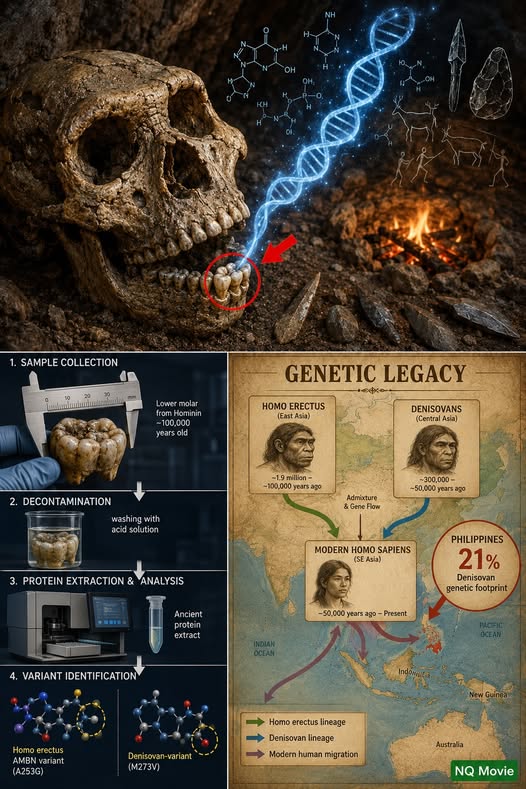
A groundbreaking study of ancient teeth dating back approximately 400,000 years is providing scientists with an unprecedented glimpse into the complex history of human evolution. By analyzing preserved proteins extracted from the teeth of Homo erectus, researchers are uncovering clues that could reshape current understanding of how ancient human populations interacted, migrated, and evolved across vast regions of the world.
The discovery highlights the growing importance of paleoproteomics—the study of ancient proteins—as a powerful tool for investigating evolutionary relationships that are often beyond the reach of traditional DNA analysis. While genetic material tends to degrade relatively quickly over time, proteins can survive for hundreds of thousands or even millions of years under favorable conditions, preserving valuable biological information long after DNA has disappeared.
Researchers examining the ancient teeth identified molecular signatures that may reveal previously unknown connections between Homo erectus, Denisovans, and populations that later contributed to the ancestry of modern humans. Although the exact nature of these relationships remains under investigation, the findings suggest that interactions among different human groups may have been more widespread and complex than once believed.
For much of the twentieth century, human evolution was commonly depicted as a straightforward progression from one species to another. Over recent decades, however, new fossil discoveries and genetic evidence have revealed a far more intricate story. Scientists now understand that multiple human species often lived simultaneously, occupying overlapping territories and occasionally interbreeding with one another.
The newly analyzed proteins add another layer to this emerging picture. By comparing ancient molecular data with information from other fossil populations, researchers can investigate how different groups may have been related and whether they exchanged genes during periods of contact. Such studies are helping to reveal a dynamic evolutionary landscape characterized by migration, adaptation, and biological interaction.
Homo erectus occupies a particularly important place in this story. Emerging nearly two million years ago, the species became one of the most successful early humans, spreading across Africa and into large parts of Eurasia. Its wide geographic distribution makes it a key candidate for understanding how ancient populations dispersed and influenced later human groups.
The possibility of biological connections between Homo erectus and later populations such as Denisovans has significant implications for reconstructing the human family tree. Denisovans themselves remain one of the most mysterious branches of humanity, known primarily from limited fossil remains and genetic evidence recovered in recent decades. Any new information about their origins and relationships could substantially improve scientists’ understanding of human evolutionary history.