380-Million-Year-Old Antarctic Fish Fossil Sheds Light on the First Steps Toward Life on Land
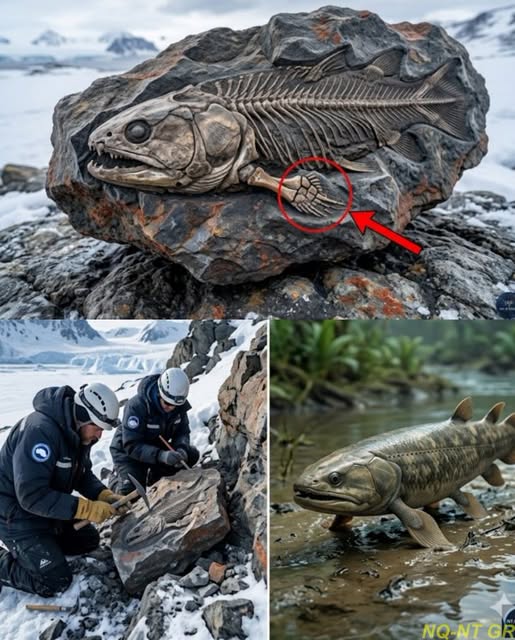
Scientists working in Antarctica have uncovered a remarkably well-preserved fish fossil estimated to be around 380 million years old, offering new insights into one of the most important transitions in the history of life on Earth: the move from water to land.
The fossil, found embedded in ancient rock layers, belongs to a period long before the rise of dinosaurs, when Earth’s ecosystems were dominated by early marine and aquatic vertebrates. What makes this discovery particularly significant is the combination of features preserved within the specimen. Researchers report that it displays both fully aquatic characteristics and early adaptations that suggest the beginnings of life on land.
Among the most notable traits are fin structures that appear limb-like in form, along with skeletal elements that indicate increased strength and flexibility compared to earlier fish species. These adaptations are considered crucial evolutionary steps that eventually led to the development of walking capabilities in vertebrates. Scientists believe such features represent an intermediate stage in the gradual transformation from finned creatures to early land-dwelling animals.
The discovery supports the widely accepted scientific view that the transition from sea to land was not a sudden event, but rather a slow and complex evolutionary process spanning millions of years. Environmental changes, including shifting coastlines, fluctuating oxygen levels, and new ecological pressures, are thought to have driven these adaptations as early vertebrates explored new survival opportunities outside of aquatic habitats.
Paleontologists emphasize that fossils like this are extremely rare, especially in regions such as Antarctica, where extreme climate conditions make excavation challenging. However, the continent’s ancient rock formations continue to reveal important evidence of prehistoric life, helping researchers reconstruct ecosystems that existed hundreds of millions of years ago.
Further analysis of the fossil is ongoing, with scientists aiming to better understand its anatomy and evolutionary significance. The findings could contribute to a deeper understanding of how complex life gradually adapted to terrestrial environments, ultimately paving the way for the diversity of land animals seen today.