🏔️ PART 2: THE HOME HIDDEN BEHIND THE STONE WALL
🏔️ PART 2: THE HOME HIDDEN BEHIND THE STONE WALL
Thessaly stood motionless before the opening.
For eight nights, she had slept in a miserable cave, shivering beneath a thin blanket and wondering whether she would survive the winter.
Yet only a few feet behind her, someone had built an entire home.
She raised the lantern.
The light traveled across a stone floor, climbed a plastered wall, and revealed a narrow wooden table.
There was a chair beside it.
A shelf.
And, farther inside, the dark outline of a fireplace.
Thessaly covered her mouth.
“Good heavens…”
She stepped through the opening.
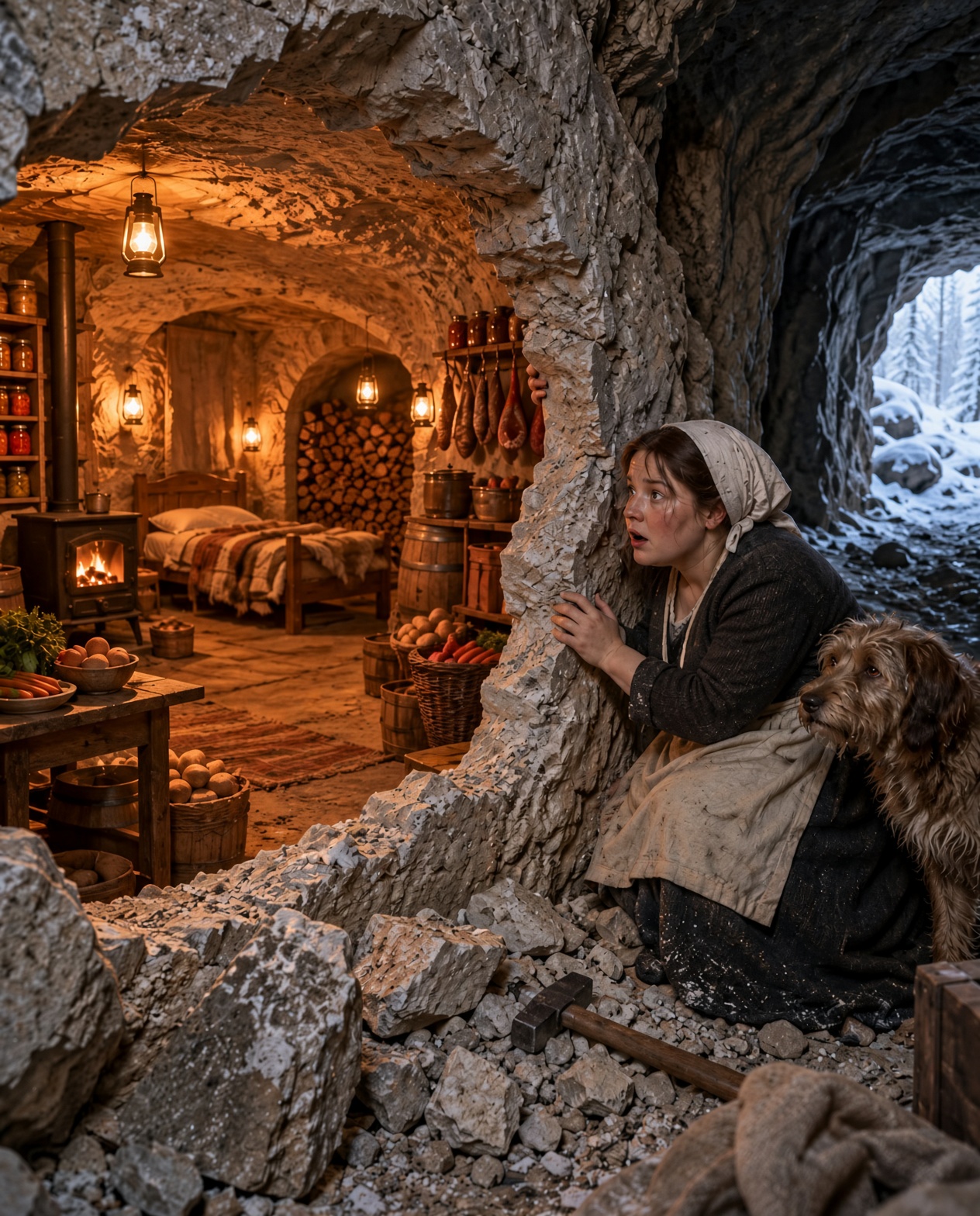
The air was cool, but not damp. Unlike the outer cave, this hidden chamber smelled faintly of dry timber and old ashes. The ceiling rose high enough for her to stand comfortably, and the walls had been carefully fitted with stone.
It wasn’t a natural shelter.
It was a house.
A house someone had concealed inside the mountain.
Thessaly moved slowly, holding the lantern ahead of her.
On the table lay a cracked clay cup and a small iron key.
Beside them was a leather-bound book, its cover darkened by age.
She reached for it.
The first page contained a name.
JONAH BELL.
Beneath it was a date.
December 1868.
Thessaly turned the page.
A short sentence had been written in careful handwriting.
If anyone finds this room, understand that it was built to protect more than one life.
She read it again.
More than one life.
A chill moved through her.
Had a family hidden here?
Had someone been running from danger?
She continued through the pages, discovering entries written over several years.
Some described repairs to the fireplace. Others mentioned food stores, rainwater collection, and the condition of the outer entrance.
Then she found an entry that made her stop.
October 1868. The men from the company came again. They asked about the ridge and the old survey. I told them I had seen nothing. They do not believe me.
Thessaly looked toward the doorway.
The hidden house had been built almost nineteen years earlier.
And whoever Jonah Bell was, he had been afraid of someone.
She searched the room.
Behind a hanging piece of canvas, she discovered a narrow sleeping alcove. Inside stood a wooden bed, a small chest, and a folded quilt.
The quilt was faded but clean.
Someone had taken care to keep the room in order.
On a shelf above the bed sat three children’s books.
Thessaly picked up the smallest one.
Its pages contained simple drawings of birds, trees, and farm animals.
On the inside cover, a name had been written in a child’s hand.
ELIZA.
Thessaly swallowed.
There had been a child here.
Perhaps more than one.
She opened the chest.
Inside were two woolen dresses, a man’s coat, a tin box of ʙuттons, and a bundle of letters tied with blue ribbon.
The first letter was addressed to Jonah.
The handwriting was different from the journal.
My dearest Jonah,
I know you believe the mountain is the only place where we can be safe. But I cannot keep Eliza hidden forever. She deserves sunlight, a garden, and the sound of other children playing.
I pray the day will come when we can leave without looking over our shoulders.
There was no signature.
Only one word at the bottom.
Amelia.
Thessaly sat on the edge of the bed.
For several minutes, she couldn’t move.
The room had not been abandoned by someone who simply wanted a secret refuge.
It had been a home.
A family had lived here.
A woman had dreamed of a garden.
A child had learned to read beneath this mountain.
And then, for reasons Thessaly had yet to understand, they had disappeared.
She spent the next hour exploring.
At the back of the hidden chamber, she found a second pᴀssage leading to a small storage room.
It contained several barrels, most of them empty, and a wooden rack holding rusted tools.
But the most remarkable discovery was a cast-iron stove.
It was connected to a narrow chimney that disappeared through the rock.
Someone had designed the room so smoke could escape without revealing the entrance.
Thessaly examined the stove.
The iron was dusty, but intact.
Beside it lay a bundle of old kindling wrapped in oilcloth.
She almost laughed.
A stove.
A real bed.
A table.
A dry floor.
She had spent eight days believing she would die in the outer cave.
Now she was standing in a home that could protect her through the winter.
But she wasn’t foolish enough to believe that finding shelter meant finding safety.
The journal had mentioned men searching for something.
And the letters suggested that the family had been forced into hiding.
She returned to the table and examined the book more carefully.
The final entries were dated December 1868.
The handwriting had become hurried.
They found the trail.
I moved the survey papers.
Amelia says we must leave before the next snowfall.
Then came the last entry.
If we do not return, let the mountain keep what we could not protect.
Thessaly felt her fingers тιԍнтen around the book.
What had Jonah been protecting?
And why had he left everything behind?
She looked again at the iron key on the table.
Perhaps it opened the small tin box.
She tried it.
The lock turned.
Inside lay a folded map, several old coins, and a sealed envelope.
The map showed the surrounding mountains, but there was something unusual about it.
A series of lines ran beneath the ridge.
They were marked in blue ink.
At the center was a small symbol resembling a spring.
Beside it, Jonah had written:
THE WATER MUST REMAIN FREE.
Thessaly stared at the words.
Water.
The phrase appeared again in the journal.
She folded the map carefully and placed it inside Merritt’s medical dictionary.
Then she heard something.
A faint scraping sound.
It came from the outer cave.
She extinguished the lantern.
Silence.
Then came another sound.
A boot against gravel.
Someone was outside.
Thessaly moved behind the stone parтιтion and listened.
A man’s voice drifted through the opening.
“There’s a fire pit here.”
Another voice answered.
“Someone’s been using this cave.”
Thessaly’s heart began pounding.
She looked around for a place to hide.
The hidden room had no second entrance, and the opening was still large enough for someone to crawl through.
The first man stepped into the cave.
“Hello?”
Thessaly held her breath.
The lantern outside moved across the walls.
Then the man noticed the broken stones.
“What in the devil…”
His companion joined him.
“Somebody opened it.”
The first man crouched and examined the opening.
“Get the horses. I’ll take a look.”
Thessaly gripped the hammer.
She had no idea who these men were.
But she knew one thing.
She could not let them discover the hidden room.
The man pushed a loose stone aside and leaned toward the opening.
His lantern illuminated the first few feet of the chamber.
Then his eyes settled on the old wooden table.
He went completely still.
“Well, I’ll be…”
He stepped inside.
Thessaly raised the hammer.
But before he could move farther, his companion shouted from outside.
“Calder! You need to see this!”
The man turned.
“What?”
“Tracks. Fresh ones. Leading up from the creek.”
Calder backed out of the opening.
“Someone else is here.”
The two men spoke in low voices.
Then one of them said something that made Thessaly’s blood turn cold.
“If that old house is still here, the papers might be here too.”
Calder looked toward the stone wall.
“Then we’d better find them before anyone else does.”
Their footsteps faded.
Thessaly waited until she could no longer hear the horses.
Only then did she lower the hammer.
She had found a home.
But apparently, someone else had been searching for it for nineteen years.
And they were not finished.