The Baby Whose Face and Body Changed as He Grew: Understanding Mucopolysaccharidosis Type I
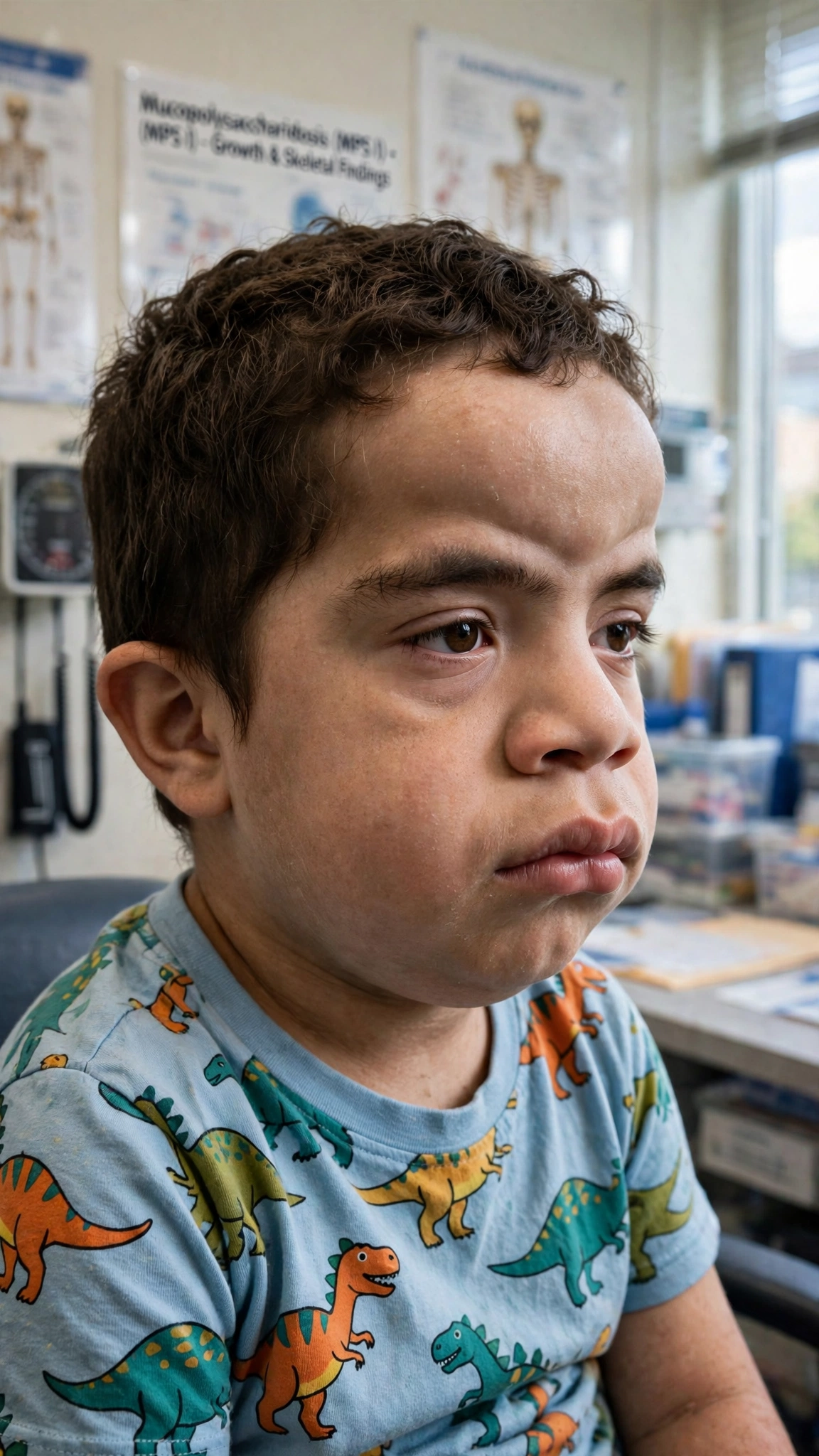
When little Benjamin was born, he appeared to be a healthy newborn baby.
His parents had no immediate reason to suspect that their son was living with a rare genetic disorder. During his first months of life, his development appeared relatively normal.
However, as Benjamin grew older, his parents began noticing unusual changes in his facial appearance.
His forehead gradually became more prominent, his nose appeared broader, and his lips became noticeably thicker. His facial features slowly developed a distinctive appearance that raised concerns about his physical development.
Over time, additional symptoms began to emerge.
His joints became increasingly stiff, limiting the range of movement in his arms and legs. His body also developed unusual skeletal changes that affected his posture, mobility, and overall growth.
After extensive medical examinations and specialized laboratory testing, doctors diagnosed Benjamin with mucopolysaccharidosis type I, commonly known as MPS I.
This rare inherited metabolic disorder causes certain complex substances to accumulate inside cells because the body cannot properly break them down.
The diagnosis explained the changes in Benjamin’s appearance and skeletal development, but it also meant that several important organs could be affected as he grew older.
Understanding Mucopolysaccharidosis Type I
Mucopolysaccharidosis type I is a rare inherited disorder caused by pathogenic changes in the IDUA gene.
Under normal circumstances, this gene provides instructions for producing an enzyme called alpha-L-iduronidase.
This enzyme helps break down two types of complex sugar molecules known as glycosaminoglycans: dermatan sulfate and heparan sulfate.
These substances are naturally present in connective tissues and other structures throughout the body.
When alpha-L-iduronidase is missing or insufficient, the body cannot break down these molecules effectively.
Instead, glycosaminoglycans accumulate inside cells and tissues over time.
This accumulation interferes with normal cellular function and contributes to progressive abnormalities involving bones, joints, connective tissues, the heart, respiratory system, and other organs.
MPS I is generally classified into severe and attenuated forms. The severe form was historically called Hurler syndrome, while attenuated forms include Hurler-Scheie and Scheie syndromes.
The symptoms, rate of progression, and severity can vary significantly between affected individuals.
Why Did Benjamin’s Facial Features Change?
One of the characteristic manifestations of MPS I is the gradual development of distinctive facial features.
As glycosaminoglycans accumulate in connective tissues and other structures, affected children may develop a prominent forehead, a broad or flattened nasal bridge, thicker lips, an enlarged tongue, and changes in facial proportions.
These features are sometimes collectively described as coarse facial features in medical terminology.
Unlike some congenital facial conditions that are clearly visible at birth, the characteristic appearance of MPS I may become more noticeable during early childhood.
Parents may initially observe subtle differences before recognizing that their child’s facial structure is gradually changing.
In Benjamin’s case, the increasing prominence of his forehead, broader nose, and thicker lips were among the physical signs that prompted further medical investigation.
Skeletal Changes and Progressive Joint Stiffness
Another major feature of MPS I is the development of skeletal abnormalities.
Many affected children develop a condition known as dysostosis multiplex, which refers to a characteristic pattern of abnormalities involving multiple bones.
The spine, ribs, pelvis, skull, hands, and long bones may all be affected.
These abnormalities can influence the shape and growth of the skeleton, resulting in shortened stature, abnormal posture, spinal deformities, and restricted joint movement.
Joint stiffness is particularly common and can become progressively more limiting.
Unlike some inflammatory joint disorders, the stiffness ᴀssociated with MPS I is primarily related to abnormalities in connective tissues, joint structures, and surrounding soft tissues.
For Benjamin, reduced joint mobility made ordinary movements increasingly difficult.
Activities such as lifting his arms, bending his knees, reaching for objects, and extending his fingers could become challenging.
Physical therapy and occupational therapy could help preserve mobility, support independence, and improve his ability to perform daily activities.
How the Disease Can Affect Other Organs
MPS I is a multisystem disorder, meaning that its effects can extend far beyond the face and skeleton.
One important concern is cardiovascular involvement.
Glycosaminoglycan accumulation can affect the heart valves, potentially causing thickening, dysfunction, and other cardiovascular complications.
The respiratory system may also be affected.
Abnormalities involving the upper airway, enlarged tonsils and adenoids, and thickened soft tissues can contribute to breathing difficulties and obstructive sleep apnea.
Some children also develop recurrent ear infections, hearing impairment, corneal clouding, and enlargement of the liver and spleen.
In severe MPS I, the accumulation of substances within the central nervous system can cause progressive neurological and developmental difficulties.
Because complications vary between individuals, Benjamin required comprehensive medical ᴀssessments rather than treatment focused only on his visible physical changes.
Diagnosis and Specialized Medical Testing
Confirming MPS I requires more than observing unusual facial features or skeletal abnormalities.
Doctors may measure glycosaminoglycan levels in urine and perform specialized enzyme testing to determine whether alpha-L-iduronidase activity is significantly reduced or absent.
Genetic testing can then identify disease-causing changes in the IDUA gene and help confirm the diagnosis.
Additional investigations may include skeletal imaging, cardiac ultrasound, respiratory ᴀssessments, hearing tests, eye examinations, and neurological evaluations.
These examinations help doctors understand the extent of the disease and establish an appropriate treatment plan.
Early diagnosis is particularly important because some treatments are more effective when started before irreversible complications develop.
Treatment Options for MPS I
Although MPS I is a lifelong genetic disorder, treatments are available to help manage its progression and reduce certain complications.
One treatment option is enzyme replacement therapy with laronidase.
This medication provides a laboratory-produced form of the enzyme that the body cannot produce adequately.
It can help reduce the accumulation of glycosaminoglycans in certain tissues and may improve or stabilize some symptoms involving organ function, mobility, and physical endurance.
However, laronidase has limited ability to enter the brain because it does not effectively cross the blood-brain barrier.
Consequently, it cannot adequately prevent or treat the neurological complications ᴀssociated with severe MPS I.
For children with severe disease, hematopoietic stem cell transplantation may be recommended.
This procedure uses blood-forming stem cells from a suitable donor to establish a source of cells capable of producing the missing enzyme.
When performed early in carefully selected children with severe MPS I, transplantation can improve long-term outcomes and help preserve neurological function.
However, it is an intensive procedure with significant risks and requires ᴀssessment at a specialized treatment center.
The most appropriate treatment depends on the child’s disease severity, age, neurological status, and overall health.
Lifelong Monitoring and Support
Benjamin’s diagnosis meant that his family would need to work closely with a multidisciplinary medical team.
His care could involve metabolic disease specialists, geneticists, cardiologists, pulmonologists, neurologists, orthopedic specialists, physical therapists, and other healthcare professionals.
Regular examinations would help monitor his heart function, breathing, skeletal development, joint mobility, hearing, vision, and neurological progress.
Supportive treatments could also help manage individual complications.
Orthopedic interventions may be necessary for certain skeletal abnormalities, while respiratory support, hearing devices, and rehabilitation may improve daily functioning.
Even with disease-specific treatment, some skeletal abnormalities and established physical changes may persist, making ongoing supportive care important.
A Future Beyond a Rare Genetic Diagnosis
For Benjamin’s parents, discovering that their son had MPS I was a life-changing moment.
They had initially believed he was a healthy baby, only to gradually discover that his changing facial features and stiff joints were signs of a complex inherited disorder.
They knew that the years ahead could involve medical procedures, regular hospital visits, and difficult decisions about treatment.
However, they also learned that early intervention, appropriate disease-specific treatment, and coordinated specialist care could make a meaningful difference.
Their greatest hope was to help Benjamin maintain as much independence and comfort as possible while giving him the opportunity to experience childhood.
His condition might affect the way his face and body developed, but it would not erase his individuality, personality, or potential.
MPS I is a serious genetic disorder that can progressively affect a child’s entire body. Yet with early diagnosis, specialized treatment, and continuous support, families can work toward giving affected children the best possible quality of life.