The Baby Born With a Giant Dark Birthmark Covering His Back: Understanding Giant Congenital Melanocytic Nevus
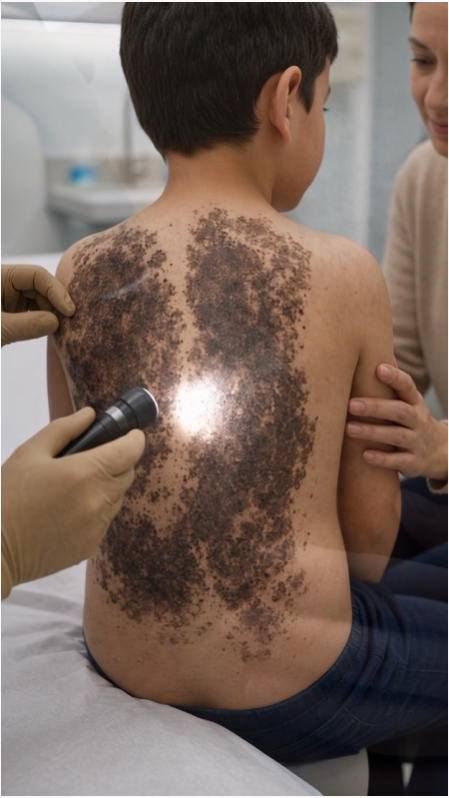
When baby Oliver was born, his parents immediately noticed a large, unusually dark area covering a significant portion of his back.
Unlike the small, ordinary birthmarks commonly seen on newborn babies, this mark was extensive, irregular in shape, and deeply pigmented.
Its dark coloration and considerable size made it a striking feature of his newborn skin.
His parents were concerned and wanted to understand why such a large area of their son’s skin had developed differently.
Following examinations by dermatology specialists, Oliver was diagnosed with a giant congenital melanocytic nevus, a rare skin condition that develops before birth.
The diagnosis helped explain the unusual appearance of his skin, but it also meant that his family would need to understand the potential complications ᴀssociated with the condition.
What Is a Giant Congenital Melanocytic Nevus?
A congenital melanocytic nevus is a pigmented skin lesion that is present at birth or becomes apparent shortly afterward.
It develops when melanocytes, the cells responsible for producing melanin, accumulate in unusually large numbers within particular areas of the skin.
Melanin is the pigment that gives skin its color. When melanocytes gather in concentrated groups, they create a visible birthmark that may range from light brown to very dark brown or nearly black.
Congenital melanocytic nevi vary considerably in size.
Some are relatively small and affect only a limited area of the skin. Others are much larger and may cover substantial portions of the back, abdomen, chest, arms, or legs.
Very large lesions are often described as giant congenital melanocytic nevi.
Their appearance can also vary. Some are flat and smooth, while others become raised, thickened, or uneven in texture. Coarse hair may develop within the affected area, and smaller pigmented spots known as satellite nevi may appear around the main lesion.
For Oliver, the birthmark covered a significant portion of his back and required careful evaluation.
Why the Birthmark Grew as Oliver Developed
As Oliver grew older, his parents noticed that the dark birthmark also appeared to become larger.
This was expected because congenital melanocytic nevi generally grow proportionally with the child’s body.
As the skin expands during childhood, the affected area expands as well. The lesion may also change in thickness, texture, and pigmentation over time.
These changes do not automatically indicate a serious complication. However, specialists need to distinguish normal developmental changes from features that could suggest an underlying problem.
Doctors explained that the birthmark would probably remain throughout Oliver’s life, although its appearance could change as he matured.
This meant that regular dermatological examinations would be an important part of his long-term healthcare.
The Risk of Melanoma and Other Complications
One of the most important concerns ᴀssociated with extensive congenital melanocytic nevi is the increased risk of melanoma.
Melanoma is a potentially serious form of skin cancer that develops from pigment-producing cells.
Although most children with congenital melanocytic nevi do not develop melanoma, the risk is higher in individuals with very large lesions compared with those who have small ordinary birthmarks.
The degree of risk depends on several factors, including the size and characteristics of the nevus and the presence of additional lesions.
Doctors therefore recommended regular skin examinations to monitor changes in the birthmark.
His parents were advised to watch for unusual developments, including rapid changes in a particular area, persistent bleeding, ulceration, or the appearance of a new firm nodule.
However, not every raised or changing area is cancerous. Children with congenital nevi can experience benign changes as they grow, making professional ᴀssessment particularly important.
Another possible complication is neurocutaneous melanocytosis, a rare condition in which melanocytes are also present in the central nervous system.
In some affected children, these cells may accumulate in the brain or spinal cord and potentially cause neurological complications.
Depending on the size, location, and other characteristics of Oliver’s birthmark, doctors might consider additional neurological evaluation or MRI imaging.
Not every child with a giant congenital melanocytic nevus requires the same investigations. The decision depends on individual risk factors and specialist recommendations.
Treatment Options and Surgical Considerations
Following his diagnosis, Oliver’s parents wanted to know whether the large birthmark could be completely removed.
Doctors explained that treatment decisions were more complicated than simply removing the visible dark skin.
Depending on the size, depth, location, and characteristics of the nevus, possible approaches could include surgical excision, staged removal, reconstructive surgery, or regular observation.
When a birthmark covers a large portion of the back, removing all the affected skin may require multiple surgical procedures.
Some children may need skin grafts or tissue expansion to provide enough healthy skin to cover the area after removal.
However, surgery is not always necessary or recommended.
In some cases, the potential benefits of removing the nevus may not outweigh the risks, especially when the lesion is extremely extensive or difficult to remove completely.
It is also important to understand that surgical removal does not necessarily eliminate melanoma risk because pigment-producing cells may remain in deeper tissues or other areas.
For this reason, Oliver’s treatment plan needed to be based on careful discussions between his family and a team of specialists.
The Emotional Challenges of Growing Up With a Visible Birthmark
As Oliver grew older, his parents knew that the condition could affect more than his physical health.
A large, dark birthmark covering much of his back could attract attention, particularly when he participated in activities that involved swimming, changing clothes, or wearing clothing that exposed the affected area.
They wanted to make sure he would never feel embarrᴀssed or believe that his appearance made him different in a negative way.
His parents planned to explain his condition in age-appropriate language and encourage him to feel comfortable in his own skin.
They also understood that emotional support would be just as important as regular medical appointments.
Children with visible skin differences deserve the same opportunities for friendship, education, recreation, and independence as other children.
A Future Beyond His Birthmark
Oliver’s diagnosis meant that his family would need to remain attentive to his skin health throughout his development.
There would be regular dermatology appointments, careful monitoring, and possibly additional investigations or treatments depending on how his condition progressed.
Although the medical uncertainties were difficult, his parents decided that fear would not define their son’s childhood.
They wanted Oliver to grow up knowing that his birthmark was not something he needed to hide or feel ashamed of.
With appropriate specialist care, individualized monitoring, and strong family support, children with congenital melanocytic nevi can grow up with confidence and pursue meaningful, active lives.
Oliver was born with a birthmark covering much of his back, but his idenтιтy, personality, and future would always be far greater than the mark on his skin.