PART 4 — THE FIRE THAT REFUSED TO DIE
❄️ THEY THREW HER OUT INTO THE FIRST SNOW… BUT THE CAVE SHE BUILT DEFIED A BLIZZARD THAT SHOULD HAVE KILLED EVERYONE
PART 4 — THE FIRE THAT REFUSED TO DIE
The first time Ruth Calder realized her stove was failing, the smoke was already filling the cave.
She coughed hard, stumbled backward, and pulled her wool scarf over her mouth. The little flame inside the firebox flickered once, twice, then disappeared beneath a thick cloud of gray smoke.
Outside, the wind screamed against the limestone ridge.
Ruth stared at the stove.
“No,” she whispered.
She had spent four days building it. Four days hauling stones, mixing creek clay, shaping the firebox, and fitting the heavy pieces together. Her fingers were cracked. Her shoulders ached. Two fingernails had split so badly that she could barely close her right hand.
And now the stove would not draw.
She had built something that looked like the old masonry stove her father had shown her years ago. But looking right and working right were two different things.
Ruth opened the small entrance wider and stepped outside to breathe.
The snow had already buried her woodpile halfway.
The clouds hung so low that the mountains seemed to have disappeared. She could barely see the creek below.
She had less than a day before the storm reached its worst.
Then she heard a voice.
“Woman! Are you still alive in there?”
Elias Boone.
He appeared through the swirling snow, leading a second horse. His beard was white with frost, and his coat looked as though someone had thrown a bucket of ice over it.
Ruth waved him toward the entrance.
He stepped inside, looked at the smoking stove, and frowned.
“That thing isn’t working.”
“I noticed.”
“Then why haven’t you left?”
“Because I haven’t finished fixing it.”
Elias stared at her.
“You stubborn woman.”
“I’m beginning to hear that a lot.”
Despite the situation, he almost smiled.
He removed his gloves and examined the stove from a distance. He had spent thirty years around ranch buildings, fireplaces, and winter cabins. He knew enough to recognize that something was wrong.
“Your smoke isn’t finding a clear way out,” he said.
“I know. I think the problem is somewhere behind the firebox.”
“Can you fix it?”
Ruth looked at the dark opening.
“I can try.”
Elias shook his head.
“There’s a cabin six miles east. Solid roof, dry wood, two beds. You can have it until spring.”
Ruth turned toward him.
“And what happens when I arrive?”
“Nothing.”
“Your wife?”
“I haven’t got one.”
“Your children?”
“Never had any.”
“Then why are you offering me a cabin?”
Elias looked uncomfortable.
“Because nobody should be left out here alone.”
Ruth lowered her eyes.
For a moment, she remembered Vernon standing in her doorway, speaking about kindness while his family carried her belongings outside.
She remembered how quickly people could turn generosity into a weapon.
“I appreciate it,” she said. “But this place is mine now.”
Elias followed her gaze toward the unfinished stone entrance.
“You own that cave?”
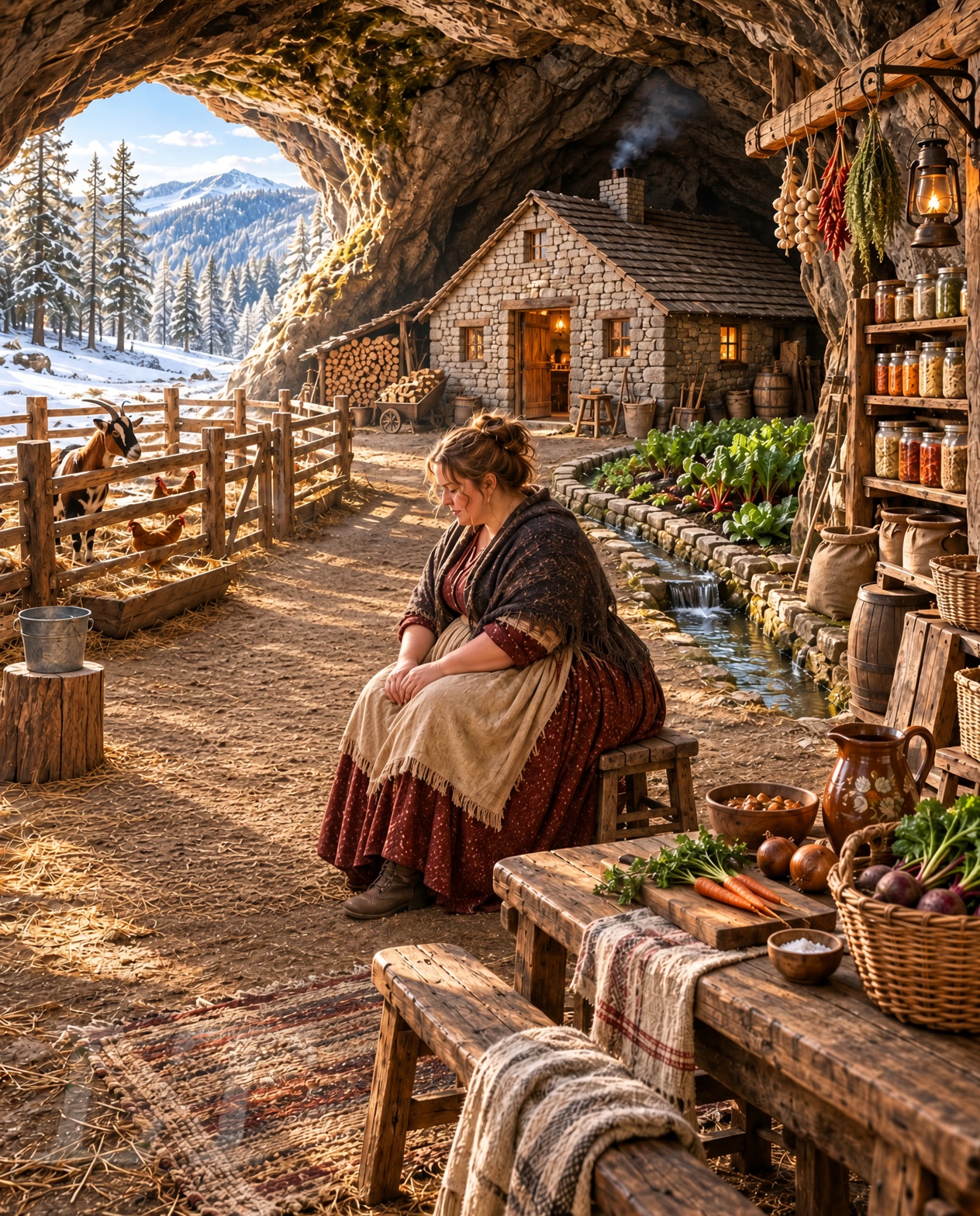
“No. But I built the home inside it.”
He didn’t argue.
Instead, he reached for his pack and pulled out a small leather bundle.
“Dried meat. Coffee. Some matches. Take them.”
Ruth hesitated.
“Elias—”
“Don’t make me ride all the way back with a pack full of things I brought for someone who refuses to starve.”
She accepted the bundle.
“Thank you.”
He glanced toward the cave entrance.
“I’ll return tomorrow morning if the weather allows.”
Then he disappeared into the snow.
Ruth watched until the storm swallowed him.
After that, she returned to the stove.
She examined every joint, every stone, every place where clay had dried unevenly. Her father had taught her that stonework demanded patience. A wall could look perfect and still contain one weakness capable of bringing the whole thing down.
She remembered something else.
Her father’s old stove had never been built against an exposed wall. It had been surrounded by thick masonry, with a carefully designed route for the smoke.
Ruth looked at her own construction.
She had been thinking too much about making it look like the stove she remembered.
She needed to understand what her own stove was doing.
For the next several hours, she worked slowly, checking the structure and allowing the smoke to clear between attempts. She found a section where the clay had slumped and partially blocked the pᴀssage.
That was not the only problem.
The outlet was also exposed to a strong crosswind that made the stove unreliable.
By late afternoon, she had made a difficult decision.
She dismantled part of the upper masonry.
The work was painful. Each stone she removed represented hours she could never recover.
But she refused to keep a mistake simply because she had worked hard to create it.
When the last piece came free, she sat on the floor and stared at the rubble.
Then she began again.
Outside, the first real gust of the blizzard struck the ridge.
Snow rushed through the opening, covering the floor with a white sheet.
Ruth worked until darkness.
Finally, she managed to get a small, controlled fire going.
This time, the smoke traveled away from her living space.
She waited.
Five minutes.
Ten.
The fire continued burning.
Ruth placed her hand against the thick outer stones.
They were beginning to warm.
A laugh escaped her before she could stop it.
It wasn’t much.
But it was something.
She fed the fire carefully, then placed a pot of water near the warm masonry. The cave slowly began to feel less hostile.
For the first time since Vernon had thrown her out, Ruth allowed herself to believe she might survive the winter.
But the weather had other plans.
Near midnight, the wind changed.
It came from the north, roaring down the mountain with a force that made the limestone ridge tremble. Snow poured into the entrance, covering the stones she had stacked there.
Ruth pulled her blanket around her shoulders and listened.
Then came a sound that made her sit upright.
A horse.
Not Elias’s horse.
Someone was shouting outside.
“Help!”
Ruth grabbed her lantern and rushed toward the entrance.
Through the blowing snow, she saw a dark shape crawling along the ground.
A man.
He had lost his horse, and one of his arms hung uselessly at his side.
Ruth pulled the entrance barrier aside enough to reach him.
“Come here!”
The stranger lifted his head.
“Please…”
She caught him beneath his shoulders and dragged him into the shelter.
His coat was frozen stiff. His face was pale, and his lips trembled.
“What’s your name?” Ruth asked.
“Samuel… Samuel Pike.”
“Are you alone?”
He shook his head.
“My wife. My boy. They’re coming behind me.”
Ruth looked toward the entrance.
“Where are they?”
“Near the creek. Our wagon overturned.”
For a moment, Ruth couldn’t speak.
She had enough room for one person.
Perhaps two, if she rearranged everything.
But three more people?
She looked at the stove, then at the entrance, where snow was already gathering against the stones.
The stranger grabbed her sleeve.
“Please. My boy is only six.”
Ruth turned toward the darkness.
“Then we’d better find him.”
And as she stepped back into the storm, she had no idea that the family she was about to rescue would bring the greatest danger yet to her little stone home.
Because Samuel Pike had not been traveling alone.
He had been carrying something that several powerful men were willing to kill to recover.
And one of those men was Vernon Calder.