PART 3: THE WIDOW HELPED HIM STAND, AND THE MAN ROSE TO FACE THE MEN WHO HAD TRIED TO BURY HIM ALIVE
THE WIDOW HELPED HIM STAND, AND THE MAN ROSE TO FACE THE MEN WHO HAD TRIED TO BURY HIM ALIVE
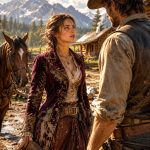
The three riders stopped outside the Miller homestead.
Cora recognized the man in front.
Jedidiah Rust.
He sat tall in his saddle, his gray beard moving with a smile that did not reach his eyes.
“Mrs. Miller,” he called. “You’ve been keeping some company.”
Cora stepped onto the porch.
“That’s my home. You don’t get to decide who stays in it.”
Rust laughed.
“I came to collect something that belongs to me.”
Deputy Marshal Harlan stepped beside her.
“Mr. Rust, I suggest you choose your next words carefully.”
Rust’s smile disappeared.
“This is a private matter.”
“Not anymore.”
Judd appeared in the doorway behind them, leaning against the frame. His legs were still useless, but his eyes were steady.
Rust stared at him.
“You should have died in that stable.”
Judd’s voice was quiet.
“You should have buried me deeper.”
The men behind Rust shifted uneasily.
Harlan unfolded the paper he had brought.
“Judd Mercer surveyed the northern ridge five years ago. His report identified a series of illegal graves near the old mining road. The men buried there were workers who disappeared after discovering that Rust’s company was stealing government-owned silver.”
Rust spat into the dirt.
“Lies.”
“Then you won’t mind explaining why your name appears in the original survey.”
Cora looked at Judd.
He nodded.
“There’s more,” he said. “I found a second ledger. Names, payments, shipments. I hid it before they caught me.”
“Where?” Cora asked.
“Under the old stone marker above the creek.”
Rust’s expression changed.
It lasted only a second, but Cora saw it.
He knew Judd was telling the truth.
Rust’s hand moved toward his coat.
Harlan drew his revolver.
“Don’t.”
For a moment, nobody moved.
Then one of Rust’s men turned his horse and bolted.
Harlan’s deputy raced after him while the remaining riders scattered. Rust was pulled from his saddle and disarmed.
But the danger was not over.
The escaped rider knew where the ledger was hidden.
And if he reached the ridge first, the evidence could disappear forever.
Harlan gathered two men.
“We ride now.”
Judd tried to push himself away from the doorway.
“I have to go.”
Cora stepped in front of him.
“You can barely sit without pain.”
“Then I’ll go lying down.”
“Judd—”
“Those men killed innocent workers. They nearly killed me. If that ledger disappears, they’ll walk free.”
He looked at her.
“I won’t ask you to risk your life.”
Cora reached for her coat.
“Good. Because I wasn’t waiting for permission.”
They loaded Judd into the wagon and followed the marshal toward the northern ridge.
The journey was rough. Every rut sent pain through Judd’s back, but he refused to turn around.
At the old stone marker, the escaped rider was already there.
He had a shovel in his hands.
When he saw the marshal, he drew his pistol.
A sH๏τ cracked across the hillside.
The horses scattered.
Cora threw herself behind a boulder as Harlan returned fire. Judd lay in the wagon, unable to move quickly enough to protect himself.
The rider ran toward the ridge.
Judd saw him reach for a small leather packet beneath the stone.
“Cora!” he shouted. “The marker!”
She understood.
She scrambled across the loose ground, grabbed the packet, and threw herself behind the rocks just as the rider fired again.
The sH๏τ struck the stone above her head.
Judd’s hands clenched.
For one terrible moment, he tried to rise.
His legs did not move.
But he kept pushing against the wagon’s wooden edge, dragging his upper body forward until his injured back screamed.
“Judd, stop!” Cora cried.
He looked at her.
“I’ve spent months lying down while other men decided what I was worth.”
His arms shook.
“Not today.”
The marshal caught the rider from behind and brought him down. The gun fell into the dirt.
Cora opened the leather packet.
Inside were pages of names, dates, payments, and shipment records. There were also letters signed by Rust himself, ordering the men to silence the workers who had discovered the stolen silver.
The evidence was undeniable.
By sunset, Rust and his accomplices were in custody.
The men of Rosehaven had spent months laughing at a paralyzed mountain man.
Now they watched as the marshal rode him back into town with the stolen ledger secured beneath his coat.
Nobody laughed.
But Judd’s greatest battle was still waiting for him at the Miller ranch.
The months that followed were not easy.
He wore a heavy leather brace and worked with Dr. Whitcomb every morning. Cora built him parallel bars from two sturdy fence posts. At first, he could only hold himself upright for a few seconds.
Then came the day he moved one foot.
 It was barely an inch.
But Cora saw it.
“Again,” she said.
Judd’s face was wet with sweat.
“I can’t.”
“You just did.”
He tried again.
The foot moved.
Then another.
Weeks pᴀssed. His muscles strengthened. The doctor adjusted the brace. Cora learned how to support his weight without hurting his back.
Judd fell more times than either of them could count.
Each time, he wanted to quit.
Each time, Cora helped him back into the chair.
She never called him brave.
She never called him a miracle.
She simply treated him as a man who still had work to do.
By spring, he could stand between the wooden rails.
By early summer, he could take three steps.
The first time he crossed the kitchen without ᴀssistance, Cora covered her mouth and cried.
Judd reached the table and gripped it with both hands.
He turned toward her.
“I stood.”
She nodded, unable to speak.
“I stood, Cora.”
Then he laughed—a deep, disbelieving sound that seemed to fill every corner of the little house.
She crossed the room and wrapped her arms around him.
He held her carefully, afraid that one wrong movement might make the moment disappear.
But it didn’t.
And for the first time in a long while, Judd felt like his body belonged to him again.
The story spread across the plains.
The mountain man who had been left to die was walking.
The widow who had taken him home was rebuilding her ranch.
And the two of them had helped bring down the most powerful criminal in Rosehaven.
But Judd did not become a legend because he could stand.
He became one because he refused to let his suffering make him cruel.
He helped other injured men find work. He taught young ranchers how to read the land, locate water, and survive the mountains. He used the money recovered from Rust’s stolen accounts to build a small rehabilitation house beside the creek, where men injured in mines and ranch accidents could recover without being treated as burdens.
Cora ran the books and made sure every man who arrived was greeted with a warm meal.
Two years after the day she found him in the stable, Rosehaven held its annual cattle fair.
Judd rode into town on a strong chestnut horse.
His movements were still stiff. A walking stick rested across his saddle, and he sometimes needed it after a long day. He would never move exactly as he had before the accident.
But he was upright.
His shoulders were broad beneath his dark coat. His beard was neatly trimmed. His pale blue eyes were as fierce as ever.
The crowd went quiet when he dismounted.
Jedidiah Rust was gone, convicted and sent away. The men who had once mocked Judd now stepped aside to make room for him.
The mayor approached with a silver medal.
“Judd Mercer,” he announced, “the people of Rosehaven wish to honor you for your courage and service to this territory.”
Judd looked at the medal, then at the crowd.
“I don’t deserve a medal for standing,” he said.
A murmur moved through the gathered townspeople.
“I had help. A doctor who didn’t give up. Men who stood beside me. And a woman who saw a man when everyone else saw a broken body.”
He turned toward Cora.
She stood near the edge of the crowd, wearing the same plain blue dress she had worn when she first walked into the livery.
Judd held out his hand.
“Mrs. Miller,” he called. “Would you come here?”
Cora walked toward him.
He took her hand and faced the crowd again.
“This woman gave me a home when the town gave me a stable. She gave me work when I believed I had nothing left to offer. And she reminded me that a man’s worth isn’t measured by how fast he can run, how much he can lift, or whether he can stand without help.”
His voice softened.
“She gave me a reason to rise.”
Cora’s eyes filled with tears.
Judd turned to her.
“I have one more thing to ask.”
He reached into his coat and brought out a small ring.
“I don’t want you to spend another day carrying this ranch alone. I want to stand beside you, for as long as you’ll have me.”
Cora looked at the ring, then at the man who had once asked only to be lifted into her wagon.
“Yes,” she whispered.
Judd slipped the ring onto her finger.
The crowd erupted.
Years later, travelers crossing the plains would hear stories about Judd Mercer, the mountain man who survived a rockslide, exposed a criminal empire, and became one of the most respected ranchers in the territory.
But the people who knew the truth remembered something different.
They remembered a widow with three silver dollars in her pocket, walking into a livery while everyone else laughed.
They remembered how she refused to look at a wounded man and see a ruined life.
And they remembered the day that man stood in the middle of Rosehaven, took her hand, and proved that sometimes the strongest thing a person can do is help someone else believe they are not finished.
Because Cora had never given Judd his strength.
She had simply refused to let the world convince him he had none left.
And together, they built a life no one in Rosehaven had ever expected.