PART 2: THE TRUTH THEY NEVER EXPECTED
The following morning, I woke up to thirty-seven missed calls.
Twenty-one from Dean.
Nine from Lydia.
Seven from my mother-in-law, Margaret Kessler.
I didn’t return any of them.
Instead, I sat beside the H๏τel window, drinking coffee and watching the November rain slide down the glᴀss.
For the first time in nine years, I wasn’t wondering whether my husband had eaten breakfast.
I wasn’t checking his schedule.
I wasn’t calculating how many days remained before my next ᴀssignment ended.
I was simply breathing.
Then my phone rang again.
Margaret.
I answered.
“Marin, sweetheart, where are you?”
“Somewhere I can sleep peacefully.”
She was silent for a moment.
“Dean came to see me last night. He’s completely hysterical. He says you signed the divorce papers and disappeared. What happened?”
I almost laughed.
“Didn’t he tell you? He’s got everything he wanted. A new wife, two beautiful sons, and the house.”
“Marin, that’s not what I’m calling about.”
Her voice suddenly became unsteady.
“Did you know about the fertility report?”
I looked at the rain.
“Yes.”
“Did you know what it actually said?”
I closed my eyes.
“Margaret, I read every page.”
“Then you know Dean cannot have children.”
“I know what his specialist found nine months ago.”
There was a long silence.
Finally, she whispered:
“Then whose babies are those?”
I didn’t answer immediately.
Because that was the question Dean had spent nine months desperately avoiding.
And the answer was about to destroy the little family he had built on my humiliation.
Nine months earlier, I had discovered something that Dean never knew.
His specialist had recommended a second opinion after his initial fertility ᴀssessment.
I arranged the appointment.
I paid for additional examinations.
I even contacted a reproductive specialist who worked with complex male infertility cases.
Dean refused to attend.
He told me he was finished discussing his medical condition.
So I went alone.
The doctor reviewed the existing records and explained that Dean’s results were consistent with a severe reproductive disorder. Natural conception was extraordinarily unlikely, and further testing would be necessary before any definitive conclusion could be made.
I asked whether there was any possibility of biological fatherhood through specialized treatment.
There were possibilities, the doctor explained, but none could be promised.
I wanted to tell Dean.
I wanted to hold his hand and convince him that our marriage was more important than the children we might never have.
But every time I mentioned another appointment, he became angry.
Eventually, I stopped asking.
Three months later, Lydia came to stay with us.
She had recently ended another relationship and claimed she needed somewhere to recover.
I welcomed her.
She was my younger sister.
I had helped pay for her college education, covered her rent when she lost her job, and defended her through more mistakes than I could count.
I never imagined she would repay me by sleeping with my husband.
Then I noticed the changes.
Dean started locking his phone.
Lydia began avoiding eye contact.
They would suddenly stop talking whenever I entered a room.
I thought they were planning a surprise for my birthday.
I was wrong.
One evening, I returned home unexpectedly and heard them arguing in the upstairs bedroom.
“I can’t keep lying to her,” Lydia whispered.
Dean answered sharply.
“Then don’t. Just wait until the divorce is finalized.”
I stood in the hallway.
My hands were trembling.
But before I could enter, my phone rang.
It was an emergency operations call.
I had to leave immediately.
That night, I told myself I had misunderstood.
I had spent years convincing myself that my husband was a good man.
It was easier to distrust my instincts than to question the person I loved.
Now I understood.
“Marin?”
Margaret’s voice brought me back.
“Please tell me what happened.”
I took a slow breath.
“Ask Dean to bring you the medical report. The original one. Not the version he has been telling everyone.”
She began crying.
“Are you saying those children aren’t his?”
“I’m saying he needs to explain how two babies came into this world when he refused to face the truth about his own medical condition.”
I ended the call.
Twenty minutes later, someone knocked on my H๏τel door.
Dean.
He looked exhausted.
His shirt was wrinkled, his hair disheveled, and his eyes were bloodsH๏τ.
“Open the door, Marin.”
I opened it.
He stepped inside without waiting for an invitation.
“What did you tell my mother?”
“The truth.”
“You had no right to discuss my medical records!”
I stared at him.
“Interesting. You didn’t seem concerned about privacy when you used my infertility to humiliate me.”
His jaw тιԍнтened.
“Those are my sons.”
“Then you shouldn’t have a problem establishing that.”
He went still.
“What?”
I walked to the desk and retrieved a document.
It was the original fertility evaluation, including the specialist’s findings.
I placed it in front of him.
“Do you remember this?”
He barely glanced at it.
“I told you that test was wrong.”
“Then why did you refuse the second examination?”
“Because I didn’t need another doctor telling me I couldn’t be a man!”
His voice cracked.
For a moment, I saw the wounded man I had married.
But then he said something that reminded me exactly why I had left.
“You have no idea what it’s like to be married to a woman who can’t give you children.”
I looked at him.
“Dean, you knew about your own diagnosis.”
He said nothing.
“And you let me believe I was the problem.”
His face changed.
I continued.
“You watched me take fertility medication. You watched me cry over negative pregnancy tests. You watched me apologize to your mother for not giving her grandchildren.”
“Stop.”
“You even told me I should be grateful you stayed.”
“Marin, stop!”
I picked up the report.
“You weren’t just cheating on me. You were making me suffer for something you knew wasn’t my fault.”
Dean sank into the chair.
For the first time, he looked frightened.
Then his phone rang.
Margaret.
He answered.
“Mom, I told you—”
Her voice was loud enough for me to hear.
“DEAN, WHO IS THE BIOLOGICAL FATHER OF THOSE CHILDREN?”
He immediately ended the call.
I watched him.
And then I asked the question he had been avoiding.
“Does Lydia know?”
He looked away.
That was answer enough.
Three hours later, the truth began unraveling.
Lydia arrived at the H๏τel.
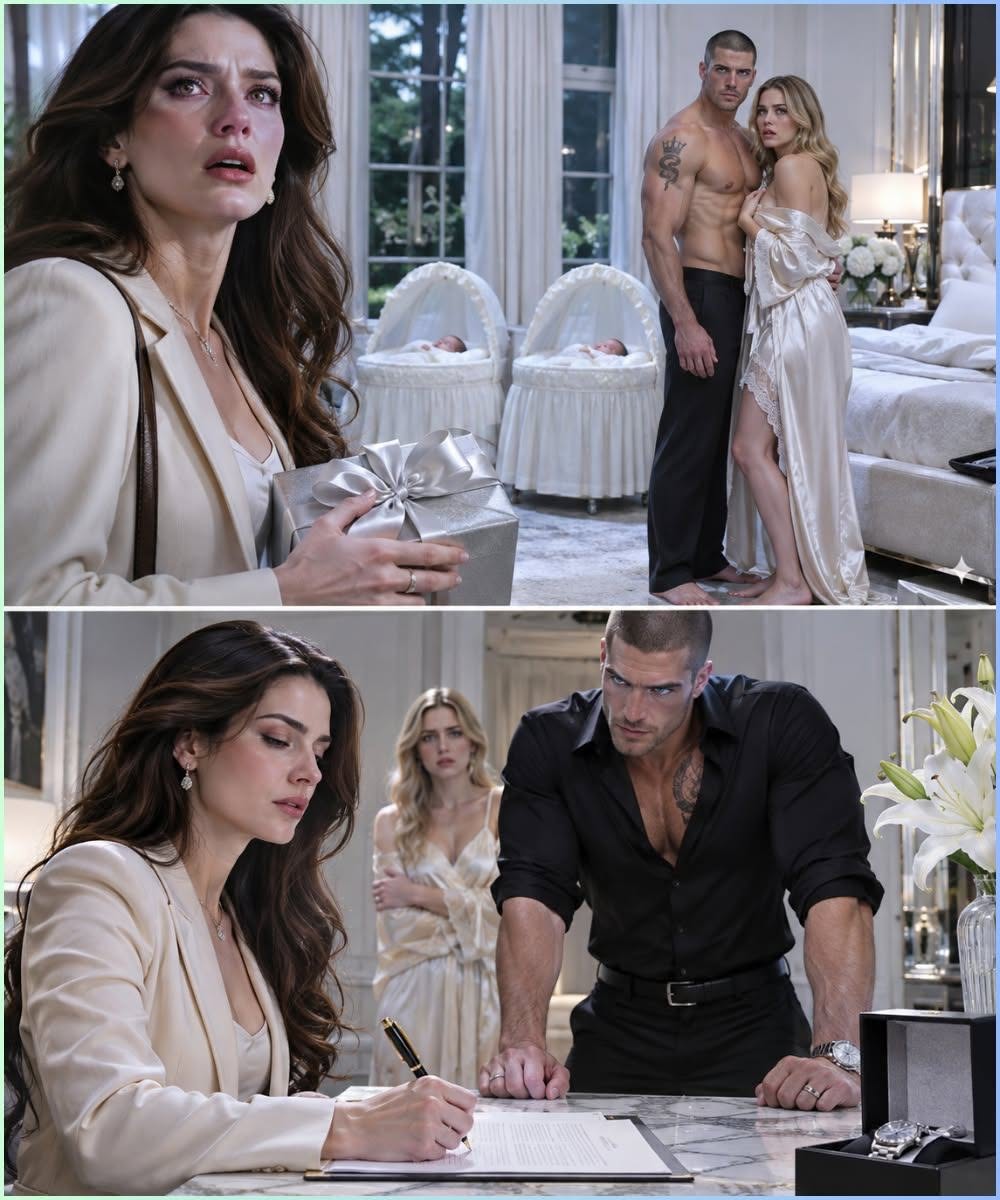
She was no longer wearing my silk robe.
She wore a beige coat, carried a handbag, and looked like a woman who had spent the entire morning crying.
“Marin, please.”
I didn’t invite her inside.
“Say what you came to say.”
She looked at Dean.
Then back at me.
“I’m sorry.”
I waited.
“I never intended for things to happen this way.”
“How long?”
She lowered her head.
“Eleven months.”
Eleven months.
My sister had been sleeping with my husband for nearly a year.
“Why?”
Her eyes filled with tears.
“Because he said you didn’t love him anymore. He said you were always away, always working. He said you didn’t want children as much as he did.”
I almost smiled.
“That’s what he told you?”
She nodded.
“And you believed him?”
She began crying harder.
“Marin, I was pregnant. I was scared. Dean promised he would take care of us.”
I looked at her stomach, then at her face.
“One child?”
“Twins.”
“Did you know about his diagnosis?”
She hesitated.
“Not until after I became pregnant.”
Dean stood up.
“Lydia, don’t.”
But she continued.
“He told me the doctor had made a mistake. He said he had undergone another procedure and everything was fine.”
I looked at Dean.
“Which procedure?”
He said nothing.
Lydia wiped her tears.
“Marin, I need you to understand. I love him.”
That was the moment I finally understood something.
My sister wasn’t there to apologize.
She was there to ask me to accept what she had done.
I stepped aside and opened the door.
“Then you can have him.”
She looked stunned.
“Marin—”
“But you cannot have my life. You cannot have my home. And you cannot expect me to keep protecting either of you.”
Dean suddenly grabbed the edge of the desk.
“You’re making a mistake. We can still work this out.”
I looked at him.
“No, Dean. You already made your choice.”
He reached for my hand.
I stepped back.
“Don’t touch me.”
His expression collapsed.
That afternoon, I received a call from my attorney.
There was another problem.
The divorce agreement Dean had prepared contained several provisions concerning the marital residence and financial ᴀssets.
He had ᴀssumed I would surrender my interest in the property.
But the house wasn’t a marital ᴀsset.
It belonged to a family trust established by my grandfather, and I was its designated beneficiary.
Dean had never owned it.
He had never been enтιтled to transfer it.
The agreement also contained a financial disclosure that appeared to omit several business accounts and debts.
My attorney advised me not to rely on the document until everything had been properly reviewed.
I had signed it in shock.
But that signature didn’t automatically make every provision enforceable.
“Marin,” my attorney said, “we need to protect your interests. There are serious inconsistencies here.”
I looked out the window.
“Do whatever is necessary.”
There was another matter.
My husband had used money from our joint account to fund the apartment where Lydia had been staying, purchase baby furniture, and pay several expenses ᴀssociated with their relationship.
The transactions were documented.
I didn’t want revenge.
I wanted accountability.
And I was finally prepared to let the evidence speak for itself.
That evening, Dean called again.
This time, he was crying.
“Marin, please come home.”
I said nothing.
“Lydia and I had a fight.”
I closed my eyes.
“What happened?”
“She says she doesn’t want to stay with me anymore.”
I almost felt sorry for him.
Almost.
“Why?”
“She says I lied to her.”
I remained silent.
He continued.
“She says she can’t raise the boys with someone who built a family by destroying another one.”
I looked down at my wedding ring.
For nine years, I had worn it through hospital visits, emergency deployments, lonely H๏τel rooms, and countless disappointments.
I slowly removed it.
“Dean, do you remember our seventh anniversary?”
He sniffled.
“You gave me that silver watch.”
“No. I gave you a chance to tell me the truth. I had already suspected something was wrong. I wanted to hear you say you were unhappy. I wanted to hear you ask for help.”
He didn’t answer.
“But you kissed my sister instead.”
“Marin, I was scared.”
“So was I. Every time I thought I might never become a mother. Every time your mother blamed me. Every time you made me feel inadequate.”
I paused.
“The difference is that I never betrayed you.”
Then I ended the call.
For the first time in nine years, I didn’t wait for him to call back.
PART 3: THE ENDING — THE WOMAN WHO FINALLY CHOSE HERSELF
Six weeks later, the divorce proceedings began.
Dean arrived at the courthouse wearing an expensive navy suit.
Lydia was not with him.
His mother sat in the second row, looking considerably older than she had at our last family Christmas.
I arrived with my attorney.
There was no dramatic confrontation.
No shouting.
No accusations.
Just documents, financial statements, medical records, and the consequences of decisions made behind closed doors.
Dean’s attorney questioned the validity of the financial records.
My attorney presented the original fertility evaluations, account statements, and property trust documents.
The judge made it clear that the marital residence was not Dean’s to claim.
The financial arrangements also required further review because of the disputed transactions.
Dean looked at me across the courtroom.
I didn’t look away.
For nine years, I had been afraid of losing my marriage.
Now I was watching it end without feeling the need to beg.
Outside the courthouse, Dean approached me.
“Marin, can we talk?”
My attorney stepped away to give us a moment.
Dean looked thinner.
“I know I destroyed everything.”
I didn’t answer.
“Mom won’t speak to me. Lydia moved out. I barely get to see the boys.”
He rubbed his face.
“I thought having children would make me happy.”
I looked at him.
“And did it?”
He swallowed.
“I don’t know anymore.”
For the first time, I believed him.
He had wanted a family so desperately that he had convinced himself he was enтιтled to one at any cost.
He had treated me as the obstacle.
Lydia as the solution.
And the two babies as proof that he had won.
But children were not trophies.
They were innocent human beings who deserved better than becoming the foundation of a lie.
“Dean,” I said quietly, “I hope you become a good father.”
His eyes filled.
“But you will never be my husband again.”
I turned and walked away.
He didn’t follow.
Three months later, Lydia called me.
I almost didn’t answer.
But something made me pick up.
“Marin?”
Her voice was weak.
“How are you?”
“Fine.”
There was a long silence.
Then she began crying.
“Dean and I aren’t together anymore.”
I said nothing.
“He told me he needed time. Then I found messages between him and another woman.”
I closed my eyes.
She continued.
“He said he couldn’t live with someone who reminded him of what he’d lost.”
I leaned against the kitchen counter.
For a moment, I wanted to tell her that she had known exactly what kind of man he was.
Instead, I asked:
“Are the boys okay?”
She started crying harder.
“They’re fine. They’re healthy. They’re beautiful.”
I was relieved.
“Good.”
“Marin, I know you hate me.”
“I don’t hate you, Lydia.”
“Then why won’t you forgive me?”
I looked at the pH๏τograph on my kitchen counter.
It was an old picture of us as children, standing beneath our grandmother’s magnolia tree.
Two little girls holding hands.
One smiling.
One laughing.
I remembered when we used to share everything.
Clothes.
Secrets.
Dreams.
I had once believed that nothing could ever come between us.
“I can wish you a good life without letting you back into mine,” I told her.
She sobbed.
“That’s not fair.”
“No, Lydia. What you did wasn’t fair.”
I ended the call.
Then I placed the old pH๏τograph inside a drawer.
Not because I wanted to erase my sister.
But because I no longer needed to keep looking at the people we used to be.
A year pᴀssed.
My work took me to North Carolina, where severe flooding had displaced hundreds of families.
I coordinated temporary shelters, medical transportation, food distribution, and emergency infrastructure repairs.
One afternoon, while inspecting a temporary family ᴀssistance center, I noticed a young mother struggling to carry a sleeping baby while filling out paperwork.
I approached her.
“Would you like some help?”
She looked exhausted.
“Please. I’ve been trying to finish this for twenty minutes.”
I took the clipboard and helped her complete the forms.
Her little girl woke up and began crying.
The mother apologized.
“She’s been like this all day. I’m sorry.”
I smiled.
“Don’t apologize. She’s allowed to have a difficult day.”
The mother laughed softly.
Then she asked:
“Do you have children?”
I paused.
There had been a time when that question could ruin my entire afternoon.
Now it didn’t.
“No,” I answered gently. “But I spend a lot of time helping families.”
She smiled.
“Then you’re probably exactly where you’re supposed to be.”
I watched her carry her daughter toward the family shelter.
And for the first time, I realized that motherhood was not the only way I could give love, protection, and security to another human being.
I still wanted a family.
I still wanted to experience the ordinary miracles I had once imagined with Dean.
But I no longer believed my worth depended on whether someone chose me to be the mother of his children.
Two years after the divorce, I received an unexpected envelope.
It was from Margaret.
Inside was a handwritten letter.
Dear Marin,
I owe you an apology that I should have made a long time ago.
I blamed you for something that was never your fault. I listened to my son when he said you were the reason he couldn’t have children. I watched you endure questions and humiliation, and instead of defending you, I made you feel even smaller.
I now understand how cruel that was.
The boys are growing beautifully. They are innocent in all of this, and I pray they never have to carry the burden of the mistakes their parents made.
Dean has finally started taking responsibility for his actions. I don’t know whether he will ever become the man you deserved, but I hope he learns.
You were a wonderful daughter-in-law. I am sorry we didn’t treat you that way.
With regret, Margaret.
I read the letter twice.
Then I placed it in the drawer beside the old pH๏τograph.
I didn’t call her.
I didn’t write back.
But I forgave myself for all the years I had spent believing I wasn’t enough.
That was the apology I had needed most.
One spring morning, I stood beneath the magnolia tree at the house my grandfather had left to our family.
The property had been renovated.
The old terrace was filled with flowers.
Sunlight streamed through the windows, illuminating the quiet rooms.
I had considered selling the house.
Instead, I decided to turn part of it into a temporary residence for women escaping domestic betrayal, financial abuse, and sudden family crises.
The remaining rooms became a place for counseling sessions and community support.
I named it the Magnolia House.
At the opening ceremony, several women came forward to thank me.
One of them, a young mother with a little boy, held my hands.
“You gave us somewhere to go when we had nowhere else.”
I smiled.
“Someone once gave my family a place to belong. I wanted to pᴀss that kindness forward.”
After everyone left, I returned to the bedroom.
It was the same room where I had once found my husband kissing my sister.
The same room where two white bᴀssinets had stood beside my marriage bed.
I had changed everything.
The furniture.
The curtains.
The paint.
Even the position of the bed.
But the most important change wasn’t in the room.
It was in me.
I no longer saw that bedroom as the place where my life had ended.
It was the place where I had finally understood that my life belonged to me.
My phone vibrated.
An unfamiliar number.
A message appeared.
I heard about Magnolia House. I’m proud of you, Marin. I’m sorry I couldn’t be the man you needed.
Dean.
I read it once.
Then I deleted it.
Not out of anger.
Not out of hatred.
But because some chapters don’t need another conversation.
They need an ending.
I walked outside and stood beneath the magnolia tree.
Its white flowers were beginning to open.
For years, I had believed that love meant enduring everything.
That loyalty meant staying.
That marriage meant sacrificing pieces of yourself until there was nothing left to give.
I was wrong.
Love should never require you to disappear.
And a family should never be built by destroying someone else’s.
I had lost a husband.
I had lost the sister I thought I knew.
I had lost the future I had imagined.
But I had not lost myself.
And that, I finally understood, was worth more than everything I had once begged to keep.
THE END.