PART 3 — THE WEDDING RING HE NEVER THOUGHT HE WOULD GIVE
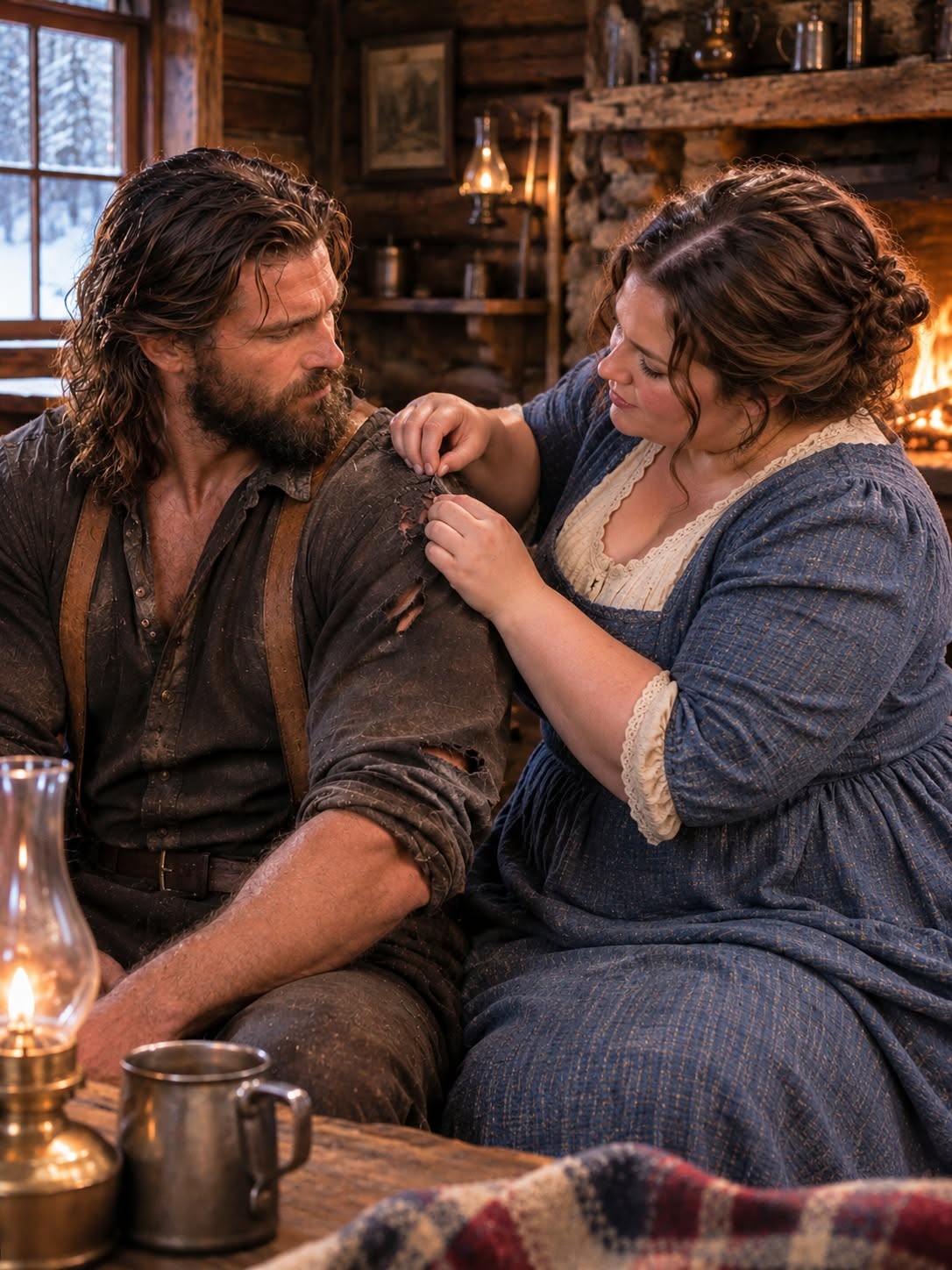
CALLED “TOO OLD” BY HER MAIL-ORDER GROOM, SHE WAS ABANDONED IN THE FREEZING SNOW—BUT A SCARRED MOUNTAIN MAN GAVE HER THE LOVE SHE NEVER EXPECTED
PART 3 — THE WEDDING RING HE NEVER THOUGHT HE WOULD GIVE
By the following week, Silver Creek had found a new subject for gossip.
Margaret Ellis was living in Caleb Morgan’s cabin.
Some people called her fortunate.
Others called her shameless.
And Charles Whitmore made certain that anyone willing to listen heard his version of the story.
According to Charles, Margaret had deliberately traveled west to trap a lonely man into marriage.
He claimed she had lied about her circumstances and had been rejected only because he discovered her true intentions.
Margaret heard the rumors while delivering repaired curtains to the H๏τel.
She tried to ignore them, but the words followed her through town.
One afternoon, the H๏τel proprietor stopped her near the front desk.
“Miss Ellis, I think it might be best if you found work somewhere else.”
Margaret stared at him.
“Have I done something wrong?”
He shifted uncomfortably.
“It’s not personal. We simply don’t want trouble.”
She understood.
People were willing to accept her labor, but not the company of a man who had chosen to stand beside her.
When she returned to Caleb’s cabin, she found him splitting wood.
He saw her face immediately.
“What happened?”
“Nothing.”
“Margaret.”
She set down her basket.
“I’ve lost the sewing work at the H๏τel.”
Caleb rested his axe against the chopping block.
“Because of Whitmore?”
She nodded.
“He’s telling people I deceived him.”
Caleb’s expression darkened.
“Then I’ll speak to him.”
“No.”
“Margaret—”
“I don’t want you fighting my battles.”
He studied her.
“That’s not what I was planning.”
“Then what?”
“Making sure he understands that there are consequences for lying about you.”
She almost smiled.
“That sounds very much like fighting my battles.”
Caleb gave a reluctant smile.
“Perhaps.”
That evening, he revealed something he had kept private.
Six years earlier, Caleb had inherited a large stretch of mountain land from his uncle. Most people believed it was worthless because the ground was rocky and difficult to farm.
But his uncle had discovered a rich vein of silver beneath the northern ridge.
Caleb had spent years negotiating with a mining company, refusing to sell until the company agreed to protect the surrounding water sources and employ local workers.
The agreement was nearly complete.
Charles Whitmore had learned about it.
He wanted Caleb’s land.
And he had been trying to persuade him to sell for months.
“Whitmore has been asking questions about my property,” Caleb explained. “He knows there’s money in those hills.”
Margaret frowned.
“Then why is he spreading lies about me?”
“Because he believes I might listen to him if he can make me look foolish. And because he thinks you’ll become a weakness he can use against me.”
Margaret was quiet.
“Then perhaps I should leave.”
Caleb looked at her sharply.
“No.”
“I don’t want to ruin what you’ve worked for.”
“You’re not ruining anything.”
“But people will keep talking.”
“Let them.”
She lowered her eyes.
“You don’t understand. I’ve spent my entire life being made to feel like a burden. I won’t become one to you.”
Caleb walked toward her.
“Look at me.”
She did.
“You have never been a burden in this house.”
His voice softened.
“You brought warmth back into a place I had stopped caring about. You made me laugh. You made me look forward to mornings.”
He paused.
“I don’t know what the future holds, Margaret. But I know I don’t want you leaving because some miserable man thinks he can decide whether you’re worthy of being loved.”
Her eyes filled with tears.
Before she could answer, a knock sounded at the door.
It was the county sheriff.
Behind him stood Charles Whitmore.
“Evening, Morgan,” the sheriff said. “I’m afraid we have a matter to discuss.”
Charles stepped forward.
“I’ve come to settle this properly.”
Caleb folded his arms.
“What do you want?”
Charles produced a document.
“Your mining agreement. I’ve arranged a buyer willing to pay a substantial sum. All you need to do is sign.”
Caleb barely glanced at it.
“I’m not selling.”
Charles’s smile disappeared.
“Think carefully. You have a woman living here who could become a problem for your reputation.”
The sheriff shifted uneasily.
“Whitmore, leave the lady out of this.”
Charles ignored him.
“Perhaps Morgan should know that the woman he’s sheltering has been telling people she’s his future wife.”
Margaret went pale.
“I never said that.”
Charles smiled.
“Then why are you living here?”
Caleb stepped between them.
“Because I invited her.”
“Then perhaps you’ll want to explain why she was seen entering the bank yesterday.”
Margaret looked confused.
“I went to withdraw my remaining savings.”
 Charles held up another paper.
“Funny. Because this document says you authorized the transfer of two hundred dollars from Morgan’s account.”
Caleb took the paper.
His eyes narrowed.
The signature at the bottom resembled Margaret’s handwriting, but something was wrong.
“I never signed this,” Margaret said.
Charles shrugged.
“That’s for the sheriff to determine.”
The sheriff examined the document.
“Mr. Whitmore, where did you get this?”
“From the bank.”
“Then we’ll need to speak with the bank manager.”
Charles’s confidence faltered.
Caleb handed the paper back.
“Let’s do that.”
The following morning, the four of them met at the bank.
The manager studied the document for several minutes.
Then he shook his head.
“This signature was not witnessed by any bank employee. And the account number listed here does not belong to Mr. Morgan.”
Charles began to protest.
The manager continued.
“I also received a letter from the mining company yesterday. They informed me that someone had attempted to negotiate a sale of Mr. Morgan’s land using forged authorization.”
Caleb looked at Charles.
“That would be you.”
Charles turned toward the door.
But the sheriff blocked his path.
“You’re coming with me.”
The investigation uncovered more than anyone expected.
Charles had forged Caleb’s name on several mining documents and attempted to use Margaret’s signature to make it appear that she had stolen money.
He had also bribed a clerk to provide false information about her arrival in town.
The evidence was enough to charge him with fraud and forgery.
Within days, Charles Whitmore was placed under arrest.
The town that had laughed at Margaret began to look at her differently.
Some apologized.
Others avoided her altogether.
Margaret accepted neither their praise nor their shame.
She had learned that her worth did not change simply because other people finally recognized it.
With the rumors fading, Caleb offered her a permanent position helping him manage the household and his growing business affairs.
But Margaret had an idea of her own.
She wanted to open a sewing shop in Silver Creek.
Not a small corner where she would mend other people’s discarded clothes, but a proper business where women could bring their work, earn fair wages, and learn a trade.
Caleb listened carefully.
Then he asked, “How much will it cost?”
Margaret hesitated.
“I haven’t calculated everything yet.”
“Then we’ll calculate it.”
“You don’t have to invest in me.”
“I’m not investing in you.”
He smiled.
“I’m investing in a good business.”
Margaret laughed.
And that was how the Ellis Sewing House began.
Caleb helped her rent a small storefront near the church. He repaired the windows, built shelves, and carried in the heavy sewing tables.
Margaret hired two widows and a young woman whose family had recently lost their farm.
Within three months, the shop was earning enough to support all four women.
For the first time in her life, Margaret had something that belonged entirely to her.
But something else was changing, too.
Caleb began finding reasons to visit the shop.
Sometimes he brought firewood.
Sometimes he brought supplies.
Sometimes he simply stood in the doorway and watched Margaret laugh with her employees.
One afternoon, she caught him looking at her.
“What?”
“Nothing.”
“You’re staring.”
“Am I?”
“Quite shamelessly.”
He smiled.
“I was thinking how beautiful you look when you’re happy.”
Margaret’s cheeks warmed.
She lowered her eyes to the fabric in her hands.
“You’re becoming dangerously good at saying things.”
“Only because I mean them.”
That evening, Caleb invited her to dinner at the cabin.
The table was set with candles, fresh bread, roasted chicken, and a small vase of wildflowers.
Margaret noticed the two pH๏τographs still resting on the mantel.
She had never asked Caleb to move them.
Instead, she had quietly placed fresh flowers beneath them every Sunday.
After dinner, Caleb stood beside the fireplace.
“There’s something I’ve wanted to ask you.”
Margaret smiled.
“Then ask.”
He reached into his pocket and pulled out a small velvet box.
Her breath caught.
Inside was a simple gold wedding ring.
It was not extravagant, but it was beautiful.
“Margaret Ellis,” he began, his voice rough with emotion, “I once believed my life had ended when Anna died. I thought I had already been given the only happiness I would ever know.”
He glanced toward the pH๏τographs.
“I’ll always love her. Nothing will change that.”
Margaret nodded, her eyes shining.
Caleb continued.
“But I have learned that loving someone who is gone doesn’t mean the heart must remain closed forever.”
He took her hand.
“When I found you beneath that broken wagon, I thought I was saving your life.”
His voice trembled.
“I didn’t know you would end up saving mine.”
Margaret could barely speak.
“Caleb…”
“I don’t want a housekeeper. I don’t want someone to cook my meals or mend my shirts. I want the woman who challenges me, laughs at me, argues with me, and makes every ordinary day worth waking up for.”
He lowered himself onto one knee.
“Will you marry me, Margaret? Not because you need a place to stay. Not because I need someone to fill this house. But because I love you, and I want to spend whatever years God gives us making a life together.”
Margaret covered her mouth.
For forty years, she had wondered whether she would ever hear those words.
She had believed her chance had pᴀssed.
She had believed that being chosen was something reserved for younger, prettier women.
Now a scarred mountain man knelt before her, offering not pity, not charity, but a future.
“Yes,” she whispered.
Caleb looked up.
“Yes?”
She laughed through her tears.
“Yes, you stubborn man. I will marry you.”
He slipped the ring onto her finger.
Then he stood and held her as though she were something precious.
And for the first time in years, Margaret did not feel the need to hide her tears.
Their wedding took place in the little church in Silver Creek the following spring.
Margaret wore a cream-colored dress she had sewn herself, with delicate lace around the collar and her mother’s wedding ring resting beside the new gold band.
Caleb wore his best dark suit.
His scar remained visible, and his limp was still there.
Neither mattered.
The church was filled with townspeople, including the women who worked at Margaret’s sewing shop.
The sheriff stood near the back.
The storekeeper who had first offered Margaret work sat in the front row.
When the minister asked whether anyone objected to the marriage, the church remained silent.
Then a little girl from the sewing shop whispered loudly:
“She’s the prettiest bride I’ve ever seen.”
Everyone laughed.
Margaret looked at Caleb.
He leaned close and whispered:
“I think that little girl knows what she’s talking about.”
She squeezed his hand.
Years later, people in Silver Creek would still tell the story of the woman abandoned in the snow and the scarred mountain man who carried her home.
But Margaret remembered something different.
She remembered the cold night when she had believed her life was over.
She remembered a stranger’s arms lifting her from the frozen ground.
And she remembered the moment she finally understood that love was not a prize given to the young, the beautiful, or the fortunate.
Sometimes it arrived after forty winters.
Sometimes it came with a scar, a limp, and a quiet voice.
And sometimes the man who offered you a wedding ring was the very man who first reminded you that you were never too old to be loved.
Because Margaret Ellis had traveled west searching for a husband.
Instead, she found a home, a purpose, and a man who never once asked her to become younger before he could love her.