PART 3: THE SECRET HIDDEN IN THE RANCH ACCOUNTS
PART 3: THE SECRET HIDDEN IN THE RANCH ACCOUNTS
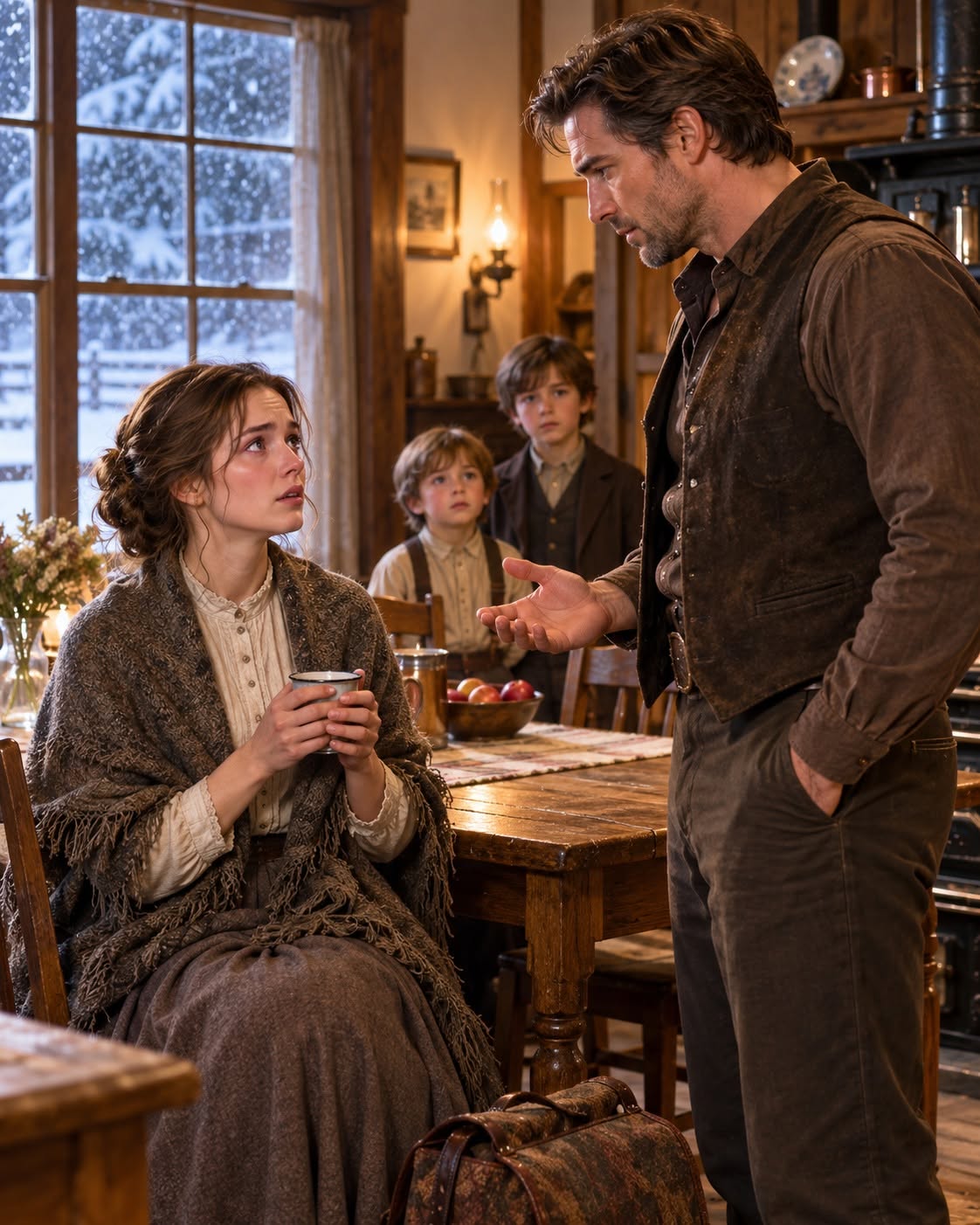
Eleanor waited until Mr. Whitcomb had left before asking Thomas the question.
“Is it true?”
Thomas stood beside the window.
“Yes.”
“How much do you owe?”
“Enough.”
“Mr. Caldwell, I am about to marry you. I believe I have a right to understand the circumstances.”
He turned toward her.
“You do.”
For a moment, his expression suggested he might refuse to say more.
Then he crossed to the desk and removed a thick ledger.
“The ranch borrowed money two years ago to expand the northern pasture and purchase additional cattle. The market collapsed. Several shipments were delayed, and the bank began demanding repayment.”
“How much time do you have?”
“Until March first.”
“And how much money is missing?”
Thomas opened the ledger.
“Nearly twelve thousand dollars.”
Eleanor stared at the figure.
That was more money than she could imagine possessing.
“Why didn’t you tell me before proposing?”
“I should have.”
“Were you hoping I wouldn’t ask?”
“No.”
He closed the ledger.
“I didn’t want you to believe I was asking you to marry me because I needed your money. You have none to give.”
The words were blunt, but Eleanor understood he wasn’t insulting her.
He was trying to explain.
“Then what does my marriage have to do with your debt?”
“Nothing financially. Whitcomb knows I intend to marry. He thinks a wife will make me easier to pressure.”
“Why?”
Thomas hesitated.
“Because he wants control of the ranch.”
Eleanor looked down at the ledger.
“Then why does he have any claim over it?”
“His company financed part of the expansion. The original agreement gave him the right to purchase the northern pasture if I defaulted.”
“Purchase it at market value?”
Thomas didn’t answer.
She read the document again.
The figure was surprisingly low.
Much lower than the land was worth.
“That’s not a fair price.”
“No.”
“Did you agree to it?”
“I agreed to the original terms. I didn’t agree to the changes Whitcomb later introduced.”
Eleanor looked up.
“What changes?”
Thomas pointed to a page.
“Additional charges. Interest. Fees for late deliveries. He claims the railroad delays were my responsibility.”
“But they weren’t.”
“No.”
Eleanor examined the numbers.
She had spent years studying her family’s farm accounts, and she knew how easily a debt could become impossible when small charges were added without explanation.
“May I look through this?”
Thomas appeared surprised.
“Why?”
“Because numbers don’t become honest simply because they’re written in a ledger.”
For the first time that morning, Thomas almost smiled.
He placed the book before her.
“Go ahead.”
Eleanor spent the next several hours studying the accounts.
At first, the figures seemed ordinary. Payments had been recorded, interest calculated, and expenses entered in neat columns.
But something bothered her.
Several charges appeared twice.
A shipment of cattle had been marked as lost, although the delivery receipt showed it had arrived.
And three payments made by Thomas were missing from the balance.
She took a pencil and began marking the pages.
When Thomas returned from the barn, he found her surrounded by papers.
“What have you discovered?”
Eleanor pointed to the first entry.
“This payment was made on October twelfth.”
“Yes.”
“But it doesn’t appear in the balance.”
She turned another page.
“And this shipment was recorded as missing. Yet someone signed for it in town.”
Thomas leaned over the ledger.
“That’s impossible.”
“Then someone made a mistake.”
She continued.
“Or someone wanted you to believe you owed more than you did.”
Thomas stared at the figures.
He had spent months negotiating with Whitcomb, convinced the ranch was slowly slipping beyond his control.
Now a former schoolteacher had discovered discrepancies he had overlooked.
“Can you prove it?” he asked.
“I can prove that these accounts don’t agree.”
He studied her face.
“Eleanor, if you’re right, this changes everything.”
She shook her head.
“Not yet. I need the original receipts.”
Thomas went to the office and returned with a wooden box.
Inside were old invoices, bank statements, and shipping records.
Eleanor worked until the lamps burned low.
Then she found something.
A receipt bearing the signature of the railroad freight agent.
It confirmed that the supposedly missing cattle shipment had arrived six weeks earlier.
But the payment had been credited to a different account.
One belonging to Whitcomb’s company.
Eleanor looked up slowly.
“Thomas.”
He came to her side.
“What?”
She showed him the receipt.
For several seconds, he said nothing.
Then he took the paper and examined the signature.
“That’s Whitcomb’s agent.”
“Can you prove he received the money?”
“I can find out.”
Thomas looked toward the window.
His face had become unreadable.
But Eleanor saw something else beneath the anger.
Hope.
For the first time, the rancher’s problem might have a solution.
The next few days pᴀssed in a strange new rhythm.
Eleanor continued teaching the boys while Thomas rode to town to speak with the bank and retrieve additional records.
Daniel became increasingly comfortable around her.
Samuel began bringing his reading book to breakfast, insisting that every meal should include at least one new word.
One afternoon, Eleanor found Daniel sitting alone in the barn.
He was holding a small wooden horse.
“What’s wrong?”
“Nothing.”
She sat on an overturned bucket nearby.
“You don’t have to tell me.”
Daniel stared at the toy.
“Papa used to take me riding with him.”
“Does he still?”
“No.”
“Why not?”
Daniel shrugged.
“After Mama died, he stopped doing lots of things.”
Eleanor waited.
“He thinks if he works hard enough, he won’t have to remember.”
Her heart ached.
“Your father misses her, Daniel.”
“I know.”
The boy looked up.
“But I miss her too.”
Eleanor gently rested her hand on his shoulder.
“Then perhaps you and your father should remember her together.”
Daniel considered that.
“Would you help?”
“If you want me to.”
That evening, Eleanor asked Thomas whether the boys had any keepsakes from Margaret.
He looked surprised.
“There are some things in the attic.”
“Would you show them to the boys?”
Thomas’s face тιԍнтened.
“I don’t know if that’s wise.”
“Daniel misses his mother. Samuel is beginning to ask questions. They need to know it’s all right to remember her.”
Thomas looked toward the staircase.
 For a long moment, he said nothing.
Then he nodded.
“Tomorrow.”
The following afternoon, he opened an old trunk in the attic.
Inside were Margaret’s dresses, letters, a silver hairbrush, and a small collection of children’s drawings.
Samuel found a blue ribbon and immediately asked whether it belonged to his mother.
Thomas sat down on the floor.
“Yes.”
Daniel picked up a faded pH๏τograph.
It showed Margaret standing on the porch, holding a baby Samuel.
“She was pretty,” he whispered.
Thomas swallowed.
“She was.”
“Did she love us?”
Thomas’s voice broke slightly.
“More than anything.”
The boys moved closer to him.
Eleanor watched from the doorway as Thomas wrapped his arms around both sons.
It was a small moment.
But it changed the house.
That night, Thomas found Eleanor in the library.
“I should thank you,” he said.
“For what?”
“For seeing what I couldn’t.”
She closed her book.
“Your sons needed to hear that their mother hadn’t been forgotten.”
Thomas nodded.
“Perhaps I needed to hear it, too.”
Their eyes met.
For a moment, the distance between them felt smaller.
Then he looked away.
“Whitcomb will be back tomorrow.”
Eleanor’s expression changed.
“Have you found the records?”
“I found the freight agent. He’s willing to testify that the cattle shipment was delivered and the money redirected.”
“Then you can challenge the debt.”
“If the bank accepts the evidence.”
“And if it doesn’t?”
Thomas looked at her.
“Then I may lose the ranch.”
Eleanor thought of Samuel’s laughter, Daniel’s quiet questions, and the warmth of the house that had slowly begun to feel like a home.
She closed her book.
“Then we don’t give up.”
Thomas studied her.
“We?”
Eleanor realized what she had said.
But she didn’t take it back.
“Yes. We.”
The next morning, Whitcomb arrived with two men from the bank.
He looked pleased with himself.
“Thomas,” he said, “I’ve brought the final papers. Sign them, and we can settle this without making an embarrᴀssment of it.”
Thomas remained seated.
“I have evidence that your company redirected a cattle payment.”
Whitcomb’s smile disappeared.
“That’s a serious accusation.”
“Then you’ll have no trouble explaining this receipt.”
Eleanor placed the document on the table.
Whitcomb looked at it.
Then he looked at her.
“I see the schoolteacher has been playing accountant.”
“I’ve been reading your figures,” Eleanor replied.
“Then perhaps you should return to teaching children.”
“Perhaps you should learn to keep honest books.”
One of the bank representatives coughed to hide a reaction.
Whitcomb’s face darkened.
He snatched up the receipt.
“This proves nothing.”
“It proves the cattle arrived,” Thomas said. “And the payment went somewhere other than the ranch account.”
Whitcomb closed his folder.
“You have until March first. The bank will decide whether this evidence matters.”
He turned toward the door.
Then he paused beside Eleanor.
“You should be careful, Mrs. Caldwell.”
Eleanor went still.
The marriage had not yet taken place.
Whitcomb smiled thinly.
“People who interfere with business arrangements sometimes discover that the consequences extend beyond the people they intended to help.”
Thomas stepped between them.
“Leave.”
Whitcomb walked out.
The bank representatives followed.
Eleanor exhaled.
But Thomas didn’t look relieved.
He was staring at a second document Whitcomb had left behind.
“What is it?” she asked.
Thomas picked it up.
His face slowly lost its color.
It was a copy of the original loan agreement.
And beneath the section describing the northern pasture was a clause Eleanor had not seen before.
If Thomas failed to repay the debt by March first, Whitcomb would not simply gain the right to purchase the land.
He would also gain the right to take possession of the entire ranch house and its contents until the debt was settled.
Including the personal property of everyone living there.
Eleanor looked toward the staircase.
The boys were upstairs, arguing cheerfully over a spelling lesson.
“Can he really do that?” she whispered.
Thomas folded the document.
“He believes he can.”
“Then we must find a way to stop him.”
Thomas looked at her.
“I won’t let him take my sons’ home.”
Eleanor stepped closer.
“Then let me help you save it.”
For the first time, Thomas reached for her hand.
He didn’t hold it тιԍнтly.
He simply waited until she chose to let him.
And she did.
But neither of them knew that, across town, Whitcomb had already made another move.
That afternoon, a letter arrived at the Caldwell ranch.
It was addressed to Eleanor Hayes.
The handwriting was unfamiliar.
Inside was a single sheet of paper.
Miss Hayes,
You have been told only half the truth about Thomas Caldwell. Before you marry him, you should learn what happened to his first wife—and why he has never allowed anyone to examine the medical records from the week she died.
Eleanor read the letter twice.
At the bottom was a name.
Dr. Edwin Marsh.
She looked toward Thomas’s study.
For the first time since arriving at the ranch, she wondered whether the secret threatening their future was not hidden in the account books…
But in the past of the man she had agreed to marry.
And the letter contained one final sentence:
Margaret Caldwell did not die the way Thomas told the town she did.