PART 3: THE SECRET CELLAR THAT FED 54 PEOPLE — AND THE WOMAN WHO CHANGED THE RANCH FOREVER
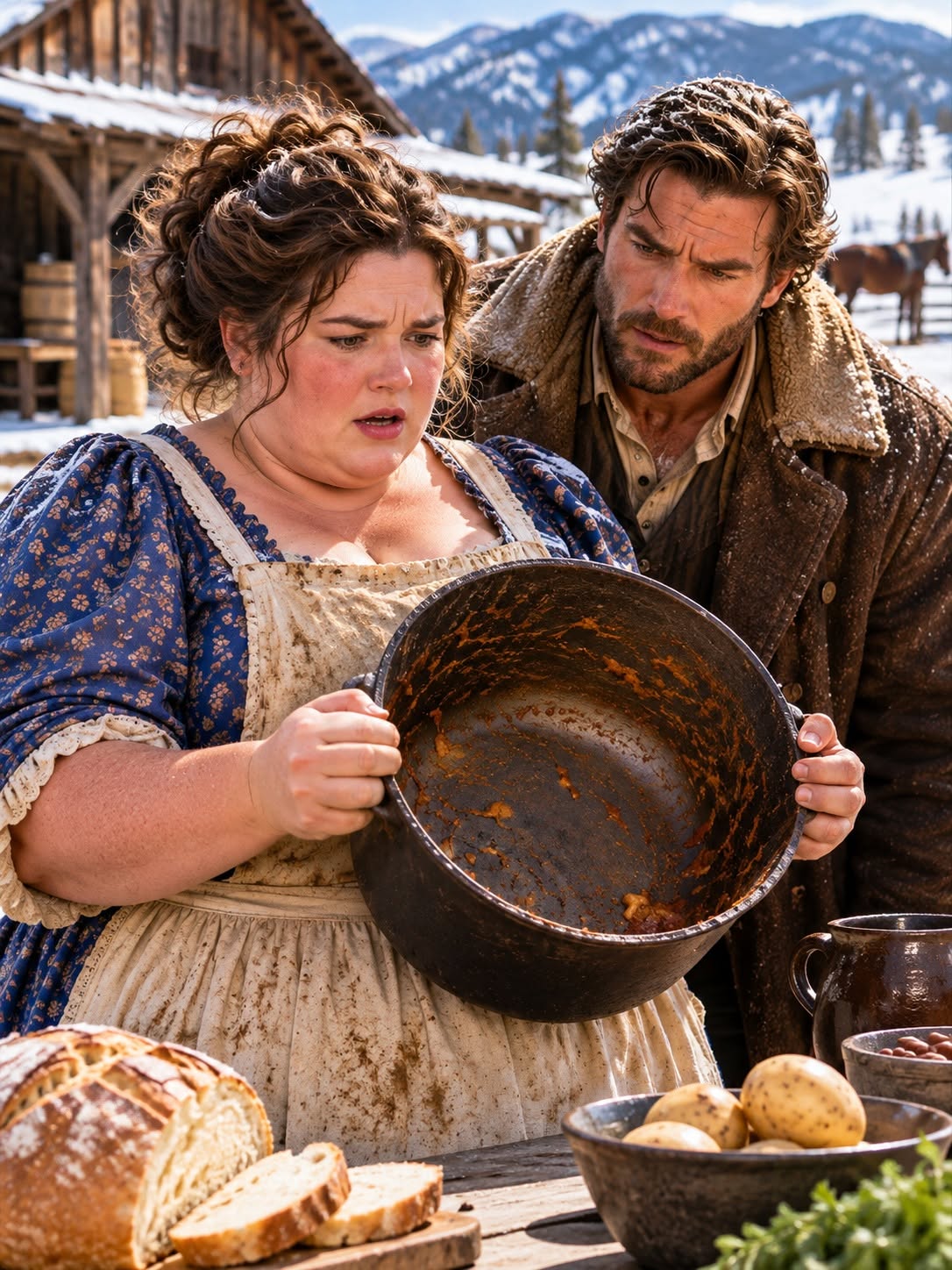
A PLUS-SIZE COOK FED 26 STARVING COWBOYS WITH ONE H๏τ MEAL AND EARNED THEIR RESPECT — BUT WHEN 14 MORE MEN ARRIVED, HER UNEXPECTED PLAN LEFT EVERY COWBOY SPEECHLESS
PART 3: THE SECRET CELLAR THAT FED 54 PEOPLE — AND THE WOMAN WHO CHANGED THE RANCH FOREVER
Nell stared at the muddy footprint.
It was too large to belong to her.
The heel had a distinctive split running through the leather, the kind left by a damaged horseshoe nail.
She knew that boot.
It belonged to Silas Boone, the ranch’s supply foreman.
And Silas had been missing since the previous afternoon.
“Thomas,” she whispered.
He followed her gaze.
His expression hardened.
“Don’t touch that lock.”
But Nell had already noticed something else.
The keyhole was scratched, and a small piece of paper had been pushed beneath the door.
Thomas bent down and pulled it free.
There were only six words written on it.
“Some things are better left buried.”
For a moment, the wind outside seemed to stop.
Thomas looked toward the barn.
“Where’s Silas?”
Ben appeared behind them.
“Haven’t seen him since yesterday.”
Caleb Foster stepped forward.
“What’s going on?”
Thomas folded the note.
“Something that can wait until morning.”
But Nell shook her head.
“No. It can’t.”
She held up the lantern.
“If there’s food down there, fifty-four people need it.”
Thomas looked at her.
Then he nodded.
Together, they opened the old cellar.
The door groaned, releasing a wave of cold, earthy air.
Stone steps descended into darkness.
Ike brought another lantern, and the men followed them down.
What they found made everyone stop.
The cellar was enormous.
It stretched beneath the entire east barn, with thick stone walls and wooden shelves running along both sides.
There were barrels of dried beans, sacks of oats, jars of preserved vegetables, smoked hams, and rows of potatoes covered with straw.
At the far end stood several wooden crates.
Nell approached them.
She lifted the lid of the first.
Inside were sealed jars of peaches.
The second contained dried apples.
The third was filled with flour.
She turned toward Thomas.
“How much food is this?”
He looked around in disbelief.
“Enough to feed this ranch for months.”
Caleb whistled.
“Then why have we been eating out of the main storeroom?”
Thomas’s face darkened.
“Because I was told this cellar had been emptied years ago.”
Ike examined the barrels.
“These aren’t old supplies, boss. Some of this was brought in recently.”
Nell picked up a sack of flour.
The sтιтching was fresh.
A label was attached.
It read: RED WILLOW RANCH — WINTER RESERVE.
Then she found a ledger hidden beneath a crate.
Inside were records of deliveries, dates, quanтιтies, and signatures.
The name appearing most frequently was Silas Boone.
Thomas’s face went cold.
“That thief.”
For months, Silas had been reporting shortages and charging the ranch for supplies that never reached the main storeroom.
He had been hiding food in the cellar, intending to sell it elsewhere when winter prices rose.
The fourteen stranded men were not the only ones who had nearly suffered because of his greed.
The ranch hands had been eating smaller portions while perfectly good food sat hidden beneath their feet.
Nell slowly closed the ledger.
“Then we have enough.”
Caleb looked at her.
“Enough for fifty-four?”
She nodded.
“Enough if we use it wisely.”
The next morning, the fourteen additional cowboys arrived.
Their clothes were stiff with ice.
One man was carrying another whose ankle had been injured when the wagon broke down.
They stumbled into the dining hall, expecting perhaps a little coffee and a corner near the stove.
Instead, they found long tables covered with steaming bowls.
Nell stood beside the kitchen door.
“Come in, gentlemen. There’s food.”
One of the newcomers looked suspiciously at the table.
“How many are eating here?”
“Fifty-four.”
He stared.
“Then how much food is there?”
Nell smiled.
“Enough for breakfast.”
She had prepared a meal unlike anything they expected.
There was thick oat porridge with preserved peaches, cornmeal cakes, fried potatoes, and a small portion of smoked meat for every man.
The kitchen had been working since before sunrise.
Some of the cowboys had peeled potatoes.
Others had ground oats.
Caleb’s men had helped carry the supplies from the cellar.
Even Thomas had rolled up his sleeves and helped stir the largest pot.
Nobody complained.
 Nobody demanded extra.
And when the first newcomer tasted the food, he lowered his spoon.
“Ma’am, I haven’t eaten like this in a month.”
Nell smiled.
“Then you had better enjoy it while it’s H๏τ.”
The dining hall erupted in laughter.
For the next two days, the ranch operated like a small town.
The men cleared snow from the road, repaired the bridge approach, checked the livestock, and helped Nell organize the food reserves.
She created a rotating kitchen schedule so no single person had to carry the burden alone.
She also introduced something the cowboys had never seen on a working ranch.
A community table.
Every evening, the men brought their bowls to the same long table.
Nobody sat according to rank.
Nobody ate before the injured men and the youngest workers had been served.
And nobody left until the kitchen was clean.
Thomas watched the changes with growing admiration.
One afternoon, he found Nell outside the smokehouse, checking the jars.
“You’ve done something remarkable.”
She wiped her hands on her apron.
“I found a cellar.”
“You found more than that.”
He looked toward the men working together in the yard.
“You gave fifty-four strangers a reason to behave like neighbors.”
Nell laughed softly.
“That’s because hungry men are usually better people once they’ve eaten.”
Thomas smiled.
Then his expression changed.
“There’s something I need to tell you.”
Before he could continue, a horse thundered into the yard.
Silas Boone had returned.
He was carrying a pistol and shouting before his horse had fully stopped.
“Who opened my cellar?”
The men turned.
Thomas stepped forward.
“Your cellar?”
Silas dismounted.
“Those supplies belong to me. I’ve been keeping them safe.”
Nell stood near the smokehouse door.
“You were hiding food while men were going hungry.”
Silas pointed at her.
“You’re a cook. You don’t understand business.”
Caleb moved closer.
“Careful how you speak to her.”
Silas laughed.
“All of you have been fooled by a woman who knows how to make a pot of stew.”
Nell did not move.
She took the hidden ledger from her apron pocket.
“Then perhaps you’ll understand these numbers.”
She handed it to Thomas.
He opened the pages and read aloud the dates of missing deliveries, the false invoices, and the amounts Silas had charged the ranch.
Silas’s confidence began to disappear.
“You can’t prove anything.”
A voice came from the dining hall.
“Actually, I can.”
It was Ben.
He held up a small bundle of receipts.
“I found these in Silas’s cabin yesterday. They show the food he sold to the trading post.”
Silas reached for them.
Caleb blocked his path.
A few minutes later, the sheriff arrived, summoned by one of the ranch hands.
Silas was arrested and taken into town.
Before leaving, he turned toward Nell.
“You think you’ve won something?”
Nell looked at him calmly.
“No. I think we’ve finally stopped losing.”
That evening, the fifty-four men gathered in the dining hall.
Thomas stood at the head of the table.
“I have something to say.”
The room quieted.
“For four years, Miss Carter has kept this ranch running through winter, sickness, bad harvests, and every shortage we’ve faced. And when fifty-four men were hungry, she didn’t ask who deserved a meal.”
He looked at Nell.
“She found a way.”
Then he reached into his coat and placed a small envelope on the table.
Inside was a document.
Nell opened it.
It was an agreement naming her the permanent head of the ranch’s kitchen and winter provisions, with a share of the ranch’s profits and authority to manage its food stores.
She looked up in disbelief.
“Thomas, I can’t accept this.”
“Why not?”
“Because I was only doing my job.”
Thomas shook his head.
“No. You were doing the work of someone who understands that a ranch isn’t built only with cattle and fences. It’s built by the people who live on it.”
The men began applauding.
Then Caleb Foster stood.
He removed his hat and placed it over his heart.
“Miss Carter, I brought twenty-six hungry cowboys here expecting a meal. You fed fifty-four, and you taught every one of us something about what it means to be decent men.”
One by one, the cowboys stood.
Some clapped.
Some simply nodded.
A few wiped their eyes.
Nell tried to speak, but her throat тιԍнтened.
For years, she had been the woman people underestimated.
The woman whose body they judged before noticing her hands.
The woman they called slow because she never rushed a meal.
The woman who had learned to make a little food feed a lot of people.
Now fifty-four men were standing because of her.
Thomas stepped beside her.
“You should say something.”
She laughed through her tears.
“I don’t know what to say.”
He leaned closer.
“Tell them what you’re making for supper.”
That brought the biggest laughter of the evening.
Nell looked around the room.
“Beef stew,” she announced. “With potatoes, onions, and enough dumplings to make you forget how cold it is outside.”
The cheers nearly shook the windows.
But when the room finally settled, Thomas quietly handed her one more envelope.
She opened it.
Inside was a deed.
Not to the ranch, but to a small house near the cottonwood creek, with a garden and a kitchen of its own.
Her name was written across the top.
“What’s this?” she whispered.
“A place that belongs to you,” Thomas said. “Not because you work here. Not because you feed us. Because you’ve spent your whole life making sure other people have somewhere to belong. I thought you deserved the same.”
Nell looked at him for a long time.
“Why would you do that?”
Thomas’s voice softened.
“Because somewhere along the way, I stopped seeing you as the woman who cooked our meals. I started looking for you whenever I came through the door.”
Her eyes filled.
For once, she had no clever answer.
Outside, snow still covered the Wyoming hills, but the kitchen windows glowed with warmth.
And inside, fifty-four cowboys sat together, eating a meal that had been made possible by a woman they had once underestimated.
Years later, the men would still tell the story of the winter when the roads closed, the supplies ran low, and a ranch cook somehow fed an entire camp.
But they never remembered her simply as the woman who stretched six days of food.
They remembered Eleanor Carter as the woman who taught them that strength did not always come from the biggest man in the room.
Sometimes it came from the woman standing beside the stove, wearing an old apron, refusing to let another person go hungry.
And every winter after that, whenever a new cowboy arrived at Red Willow Ranch, Thomas would point toward the kitchen and say:
“There’s one person in this house you never underestimate.”
Then Nell would appear in the doorway, smiling.
“And there’s one rule every man follows here.”
The cowboy would ask, “What’s that, ma’am?”
She would point toward the empty bowl in his hands.
“Nobody leaves my table hungry.”