PART 3: THE PROMISE HE MADE BENEATH THE BLUE LANTERN—AND THE WOMAN WHO TAUGHT HIM TO LOVE AGAIN
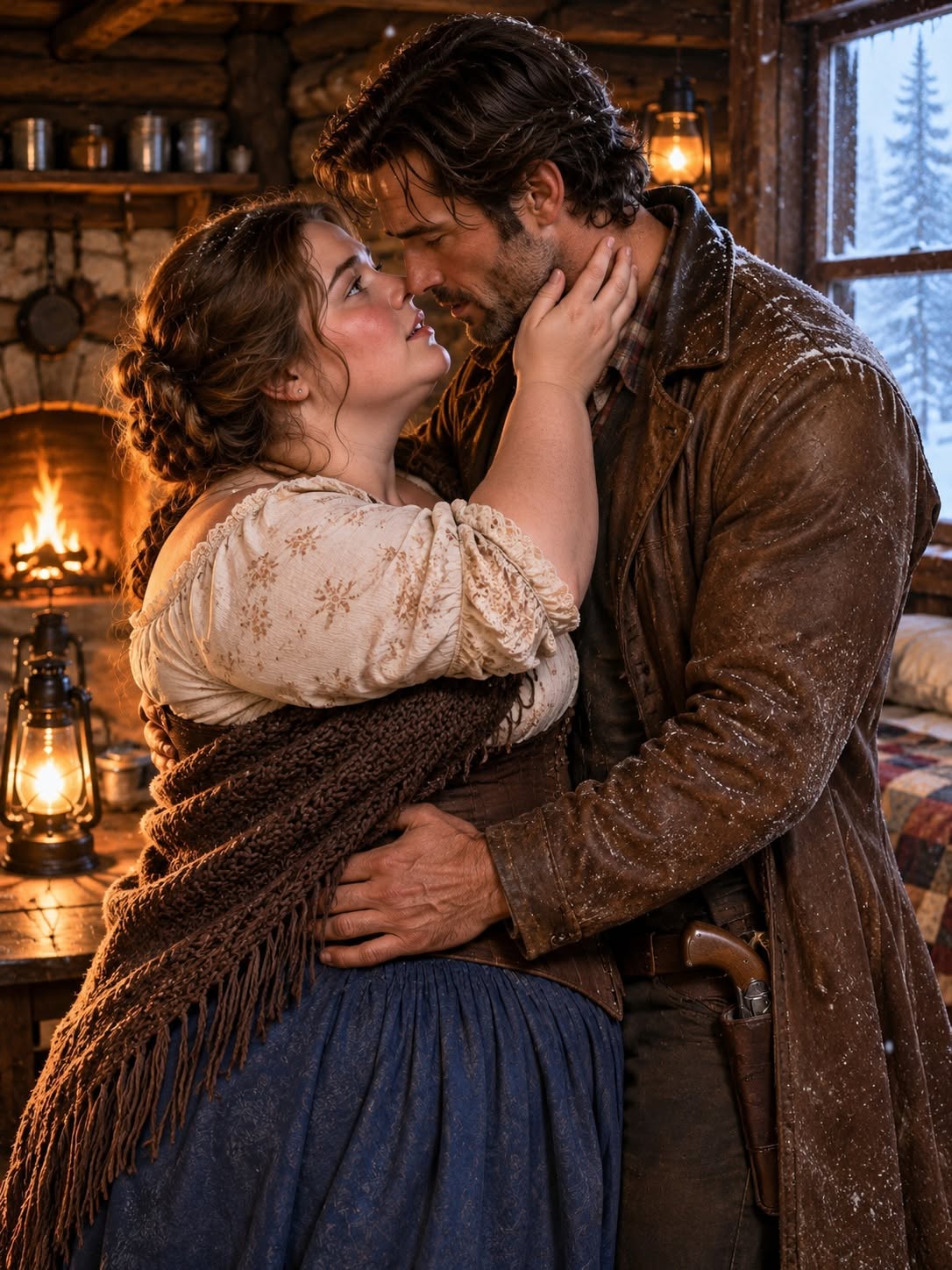
THE RANCHER’S CABIN HAD ONLY ONE BED—AND A RELENTLESS SNOWSTORM TRAPPED THEM TOGETHER FOR DAYS
PART 3: THE PROMISE HE MADE BENEATH THE BLUE LANTERN—AND THE WOMAN WHO TAUGHT HIM TO LOVE AGAIN
Hollis wanted to ride straight into Ouray.
Josie refused.
“Slade will be expecting us.”
“Then we’ll surprise him.”
“With what? Two horses and one revolver?”
He looked at her.
“That’s usually enough for me.”
“Well, it isn’t enough for a man who owns half the toll road office and pays the county clerk.”
Hollis frowned.
Josie held up the brᴀss key.
“We need evidence, witnesses, and a way to make certain the originals cannot disappear.”
They returned to the cabin.
There, Josie wrote three letters.
One went to the county recorder, requesting certified copies of every document filed under Everett Slade’s name.
The second went to the territorial district attorney.
The third went to a former bookkeeper in Denver whose name she had found in her father’s old papers.
She explained the altered loan figures and asked him to confirm the original amount.
Hollis watched her work.
“You’ve got a plan for everything.”
“Not everything.”
“What don’t you have a plan for?”
Josie glanced at him.
“People.”
He smiled faintly.
“People are the hardest thing to manage.”
“Especially stubborn mountain ranchers.”
“Especially women who think they can solve a man’s troubles with a pencil.”
She laughed.
And the sound filled the room.
For the first time in years, Hollis found himself looking forward to the next morning.
Two days later, Gideon Pike appeared at the cabin.
He came on foot, carrying no weapon and looking over his shoulder every few steps.
Hollis met him on the porch.
“You’re a brave man to come here.”
“I’m not brave,” Gideon answered. “I’m tired.”
Josie stepped into the doorway.
“Tell me about the agreements.”
Gideon removed his hat.
“Slade had me witness several loans. He’d give a man one amount, then change the figure after the man signed. Sometimes he’d replace the last page entirely.”
“Why?”
“Because he wanted the land. He knew most of the men couldn’t afford lawyers, and he knew the county recorder wouldn’t question a paper with my signature on it.”
Josie felt sick.
“My father?”
Gideon nodded.
“Your father discovered the change. He came to my office with the original receipt and threatened to report Slade.”
“What happened?”
“Slade told me to make sure your father never had a chance to do it.”
Hollis’s hands тιԍнтened.
“Are you saying Slade caused his death?”
Gideon lowered his eyes.
“I can’t prove that. But I heard him say your father would be easier to deal with once he was gone.”
Josie gripped the edge of the table.
For months, she had wondered whether her father had made some foolish mistake that left her with a debt she could never repay.
Now she understood.
He had tried to protect her.
And the man who had smiled at her ticket window had used her grief as another way to take what was hers.
“Where are the original agreements?” she asked.
“In Slade’s safe. He keeps them in the office behind the toll records.”
“Can you open it?”
Gideon nodded.
“I kept a duplicate key. I was supposed to destroy it.”
He placed a small iron key on the table.
“But I couldn’t.”
Josie looked at him.
“Why come now?”
Gideon’s face crumpled.
“Because Slade has started threatening my daughter. She’s twelve. I don’t want her growing up believing a man can do whatever he pleases because he has money.”
Hollis put a hand on the old clerk’s shoulder.
“Then we’ll make sure he doesn’t.”
The next morning, they rode into Ouray.
Josie wore her best dark blue dress and carried a leather folder beneath her arm. Hollis rode beside her, quiet and watchful.
Gideon followed on a borrowed horse.
They did not go to Slade’s office first.
They went to the district attorney.
Mr. Henry Wallace was a thin, serious man with silver spectacles and a habit of listening without interrupting.
He examined the copies Josie had brought.
Then he looked at Gideon.
“Will you testify?”
Gideon swallowed.
“Yes.”
“Even if Slade threatens you?”
Gideon looked toward the window.
“He already has.”
Wallace stood.
“Then we will proceed carefully.”
He sent a deputy to secure the county records and ordered a formal examination of the disputed documents.
By afternoon, the originals had been recovered from Slade’s office.
And the truth was worse than Josie had imagined.
There were eleven altered land agreements.
Eleven families.
Eleven properties that Slade intended to take when the notes came due.
Hollis’s grazing road was only one piece of a much larger scheme.
But when the deputy opened the final folder, Josie found something that made her blood run cold.
A letter from Slade to his agent.
Pruitt’s father has become troublesome. If he continues asking about the account, see that he no longer interferes. His daughter will have no means of challenging the balance once the note is transferred.
Josie read the words silently.
Then again.
Her father hadn’t simply been unlucky.
Slade had planned to silence him.
Hollis stepped beside her.
“Josie?”
She handed him the letter.
He read it, and his face became hard as stone.
“That man is going to answer for this.”
Everett Slade arrived at the district attorney’s office before sunset.
He entered in his familiar gray coat, removed his gloves one finger at a time, and smiled at the people gathered around the table.
“Mr. Wallace. I understand there’s been some confusion.”
Wallace placed the letter before him.
“Do you recognize this?”
Slade glanced at it.
 His expression did not change.
“Private correspondence.”
“Is it yours?”
“I believe so.”
“And this signature?”
Slade looked at the page.
“Yes.”
Josie stood.
“You told me my father borrowed nine hundred dollars.”
Slade turned toward her.
“He did.”
“No. He borrowed four hundred and fifty. You changed the amount.”
“Your memory is unreliable, Miss Pruitt.”
“My memory is not the only evidence.”
She placed the original receipt on the table.
“My father kept every payment. The total matches the original loan, not yours.”
Slade looked at Gideon.
“You ungrateful old fool.”
Gideon flinched, but he did not look away.
“I signed what you told me to sign. I won’t do it anymore.”
Slade turned back to Josie.
“Your father was a stubborn man. He made poor decisions.”
“His poor decision was believing you were an honest businessman.”
A murmur pᴀssed through the room.
Slade’s face darkened.
“You think these people will stand beside you when the cost becomes inconvenient?”
Hollis stepped forward.
“They already have.”
Behind him stood the eleven families whose land agreements had been altered.
Some were ranchers. One was a widow with two sons. Another was an elderly couple who had spent forty years building their farm.
Every one of them carried a copy of the fraudulent agreement.
Slade looked around the room.
For the first time, there was no smile on his face.
The district attorney rose.
“Everett Slade, you are being charged with fraud, forgery, and conspiracy to unlawfully obtain property. We will also be investigating your involvement in the death of Mr. Pruitt.”
The deputy moved toward him.
Slade tried to step back.
Hollis blocked the doorway.
“Move,” Slade snapped.
“No.”
“You have no authority over me.”
Hollis’s voice was quiet.
“Neither did you over those eleven families.”
The deputy took Slade by the arm.
His gloves fell to the floor.
And for once, the man who had always been able to afford patience had run out of time.
The investigation lasted several months.
The original records proved that Slade had altered the debts and forged the filing dates. Gideon testified. The Denver bookkeeper confirmed the original amount of Josie’s father’s loan. The district attorney also uncovered evidence connecting Slade to threats made against several debtors.
Josie’s father’s debt was declared invalid.
Hollis’s grazing road was released from the lien.
The eleven families kept their land.
But something else changed during those months.
The cabin above Larkspur Hollow no longer felt like a place built around an absence.
Minnow began leaving her toys in Ada’s old room.
At first, Hollis had been uncomfortable seeing the spinning wheel and chair used for anything other than remembrance.
Then one afternoon, he found Josie sitting beside the window, helping Minnow untangle a skein of wool.
The little girl was talking.
She was always talking.
“Miss Josie says numbers are like sheep. If you don’t keep them in order, they’ll wander everywhere.”
Hollis leaned against the door.
“That sounds about right.”
Minnow held up a tangled piece of wool.
“Can you fix this?”
He looked at the mess.
“Your mother was better at that than I am.”
The words came out naturally.
Then he stopped.
He had not spoken of Ada so easily in twelve years.
Josie looked up, but she did not interrupt.
She simply moved the skein aside and made room for him.
Hollis sat down.
Together, they untangled the wool.
And when Minnow asked whether they could use the spinning wheel again, Hollis nodded.
“Yes, sweetheart. I think your aunt Ada would like that.”
Josie looked at him.
He gave her a small smile.
The room was no longer locked.
Spring arrived in the valley.
One evening, Hollis found Josie on the porch, watching the last sunlight fall across the mountains.
He sat beside her.
“Mrs. Bright says you’re planning to return to the ticket office.”
“I am.”
He nodded.
“Good.”
Josie turned toward him.
“That’s all?”
“What would you like me to say?”
“Perhaps that you’ll miss me.”
He looked at her for a long moment.
“I’ll miss you every hour you’re gone.”
Her expression softened.
“Then why aren’t you asking me to stay?”
Hollis looked toward the barn, where Minnow was trying to teach Mr. Parsons to accept a carrot.
“Because I don’t want you to stay out of graтιтude. Or because you think I need saving.”
Josie took his hand.
“I don’t.”
“Then why would you stay?”
She looked at the cabin.
At the lantern in the window.
At the little girl who had made a family out of two lonely adults.
“Because I want to.”
Hollis swallowed.
“Josie, I’ve spent twelve years thinking that loving Ada was the last good thing that would ever happen to me.”
He turned toward her.
“I was wrong.”
His voice grew unsteady.
“I don’t love you because you made my life easier. I love you because you made me want to live it again. You see the things I try to hide, and somehow you don’t make me ashamed of them.”
He took both her hands.
“I love your sharp mind, your stubborn heart, and the way you can make a room feel warm without ever asking anyone to notice.”
Josie smiled through her tears.
“And I love a man who gives away his only bed to a stranger and sleeps beside a stove without once complaining.”
Hollis laughed softly.
“That was a practical decision.”
“Of course it was.”
He leaned closer.
“Would you let me make another practical decision?”
“What would that be?”
“Ask you to stay. Not for a storm. Not for a debt. For all the ordinary mornings that come after.”
Josie rested her forehead against his.
“Yes, Hollis.”
He kissed her gently beneath the fading light.
It was not a kiss born from loneliness or desperation.
It was a promise made freely, by two people who had learned that love did not erase the past. It simply made room for a future.
They married that autumn in the little church at Larkspur Hollow.
Mrs. Odessa Bright cried through the entire ceremony and denied it afterward.
Minnow carried the rings in a small wooden box.
And Mr. Parsons stood outside the church wearing a blue ribbon around his neck, looking as disappointed in everyone as ever.
Josie kept her father’s old clock on the mantel.
It still ran four minutes slow.
Hollis never corrected it.
The blue-paneled lantern remained in the window, but it was no longer lit only for the absent.
It was lit for travelers caught in the snow, for neighbors coming home after dark, and for anyone who needed to know that somewhere in the mountains, a door would open.
Years later, when Minnow was grown, she would tell her own children the story of the winter a stranger arrived at their cabin with frozen fingers, a carpetbag, and nowhere else to go.
She would tell them that there had been only one bed.
That her uncle had given it away.
That a terrible storm had kept them together for eight days.
And that, somewhere between a mended harness, a six-legged horse, and a stack of crooked loan papers, two lonely people had found their way home.
But she always ended the story with the same words:
“The snow brought Aunt Josie to our door. But it was love that made her stay.”