PART 3 — THE DAUGHTER THEY NEVER BELIEVED FINALLY FOUND HER VOICE
“We can make this all go away, Olivia.”
That was the message my father sent six weeks after I fell down the stairs.
I was sitting in my rehabilitation room when I read it.
My legs were still weak.
I needed help transferring from my bed to a wheelchair.
And some nights, I cried because I didn’t know whether I’d ever run again.
But my father wanted to make it all go away.
As if the pain were a misunderstanding.
As if the old injuries had never happened.
As if my brother hadn’t pushed me.
I stared at the message.
Then typed:
Dad, the only thing I ever wanted was for you to believe me.
I paused.
And added:
I’m not going to lie for Tyler anymore.
My parents stopped contacting me directly after my attorney asked that communication be handled through appropriate channels.
Caroline helped me arrange a safe place to live while the authorities addressed my circumstances.
Since I was still seventeen, the arrangements involved child-protection professionals and the necessary legal oversight.
I moved into Caroline’s house after leaving inpatient rehabilitation.
She prepared a bedroom on the ground floor.
There was a wide doorway.
A desk beside the window.
And a little bookshelf she’d filled with my favorite novels.
On the pillow was a handwritten note.
You belong here.
I read those three words six times.
Then cried.
Not because I was sad.
Because for the first time, I felt wanted.
The investigation eventually led to formal proceedings against Tyler concerning the fall.
The evidence included medical records, witness statements, and the account I gave investigators.
My earlier injuries were also examined.
My parents’ conduct became the subject of separate inquiries into whether they’d failed to protect me and provided false information about what had happened.
I didn’t attend every proceeding.
My medical team and advocates helped me determine what participation was appropriate.
Sometimes I wanted to hear everything.
Other times I couldn’t bear to listen.
Caroline reminded me that I didn’t have to follow every development to prove I cared about the truth.
The process didn’t move quickly.
And there wasn’t one dramatic courtroom scene that fixed my childhood.
But for the first time, the people involved were being asked to answer questions they couldn’t dismiss by calling me dramatic.
One afternoon, Benjamin Ross visited.
Caroline had arranged it after checking that I was comfortable meeting him.
He arrived carrying a small bouquet of sunflowers.
“Hey, Olivia.”
I smiled nervously.
“Hi.”
He looked older than I remembered.
Taller.
Quieter.
There was a faint scar near his eyebrow.
He sat across from me.
For a few moments, neither of us spoke.
Then he said:
“I should’ve spoken up sooner.”
I looked down.
“Benjamin, we were kids.”
He shook his head.
“I saw Tyler shove you in the school parking lot. I knew what he was like.”
I swallowed.
“Why didn’t you tell someone?”
He looked away.
“Because I was afraid of him too.”
The room went quiet.
Then he added:
“I tried to stop him once, and afterward things got worse for me.”
I looked at him.
I remembered how quickly he’d disappeared from Tyler’s circle.
How my brother told everyone Benjamin was weak.
How nobody asked what really happened.
Benjamin took a breath.
“I can’t change what happened back then. But I can tell the truth now.”
My eyes filled.
“Thank you.”
He smiled sadly.
“You shouldn’t have needed someone else to prove you were telling the truth.”
I nodded.
“No.”
Then I whispered:
“But I’m glad you came.”
Rehabilitation became the center of my new routine.
Three mornings a week, I worked with a physical therapist.
We practiced strengthening exercises.
Balance.
Safe transfers.
Standing with support.
Some days, the progress felt painfully slow.
Other days, I surprised myself.
At first, I could only stand briefly between parallel bars.
Then I managed a few supported steps.
Eventually, I began using a walker for short distances.
My doctors were encouraged.
But nobody promised a complete recovery.
I’d learned not to measure hope by guarantees.
I measured it by what I could do today.
One afternoon, Caroline drove me back to school for a meeting about returning to classes.
I was terrified.
I hadn’t seen most of my classmates since the fall.
I imagined the whispers.
The questions.
The stares.
But when I entered the hallway, my best friend Hannah ran toward me.
“Olivia!”
She hugged me carefully.
“I missed you so much.”
I started crying.
She stepped back.
“Hey, what’s wrong?”
I laughed through tears.
“Nothing.”
She smiled.
“Good. Because we have approximately forty-seven ᴀssignments to complain about.”
I laughed.
And for a moment, I felt seventeen again.
Not a victim.
Not a case.
Just a girl returning to school.
Months later, my father requested permission to send me a letter.
I agreed to receive it through my advocate.
The envelope was thick.
Inside were three pages.
He wrote about his regrets.
About the mistakes he’d made raising Tyler.
About the years he’d spent believing that protecting his son meant defending him from every consequence.
He admitted he’d dismissed my injuries and pressured me to repeat false explanations.
He said he’d begun counseling.
And he apologized.
I read every word.
Then placed the letter on my desk.
For years, I’d imagined my father finally admitting I was telling the truth.
Now that he had, I felt something unexpected.
Not triumph.
Not happiness.
Just grief for the little girl who should never have needed an apology for being hurt.
I didn’t write back.
I wasn’t ready.
And for once, nobody told me I had to be.
My mother sent a letter too.
Hers was shorter.
She wrote:
Olivia, I knew you were afraid of Tyler.
I saw the way you flinched when he became angry.
And I convinced myself that keeping the family together was more important than confronting what was happening.
I was wrong.
You deserved a mother who protected you.
I’m sorry I wasn’t that mother.
I cried harder reading her letter than I had reading Dad’s.
Because I’d spent my whole childhood wishing she would say those words.
But apologies couldn’t give me back the years when I was frightened in my own home.
I folded the letter.
Placed it beside Dad’s.
And continued building my new life.
The following spring, I turned eighteen.
Caroline made chocolate cake.
Hannah brought balloons.
Benjamin sent a birthday card.
And my physical therapist surprised me with a small notebook.
Inside, she’d written:
Progress isn’t always measured in steps.
Sometimes it’s measured in the courage to begin again.
I smiled through tears.
That afternoon, I stood beside the kitchen table with my walker.
Caroline watched nervously.
“Olivia, do you need help?”
I smiled.
“Just stay close.”
She nodded.
I took one careful step.
Then another.
Then a third.
My legs trembled.
My back ached.
But I was standing.
Moving.
Forward.
Caroline covered her mouth.
I laughed through tears.
“Look, Aunt Caroline.”
She began crying.
“I see you, sweetheart.”
And those words meant more than she knew.
Because for eighteen years, I’d felt invisible.
Now someone was finally seeing me.
I graduated from high school the following year after completing the classes I’d missed.
The ceremony was held in the school auditorium.
I wore a navy cap and gown.
A walker stood beside my seat.
When my name was called, I crossed the stage at my own pace.
Every step required concentration.
But I made it.
And when I accepted my diploma, the audience applauded.
I looked toward the front row.
Caroline was standing.
Hannah was cheering.
Benjamin was smiling.
And I realized something.
The people who loved me weren’t the ones who demanded that I pretend everything was fine.
They were the ones who stayed when things were difficult.
After graduation, I enrolled in community college.
I wanted to study psychology.
Not because I believed my experiences made me an expert.
But because I wanted to understand how people recover from fear, rebuild trust, and find their voices after years of being silenced.
I continued physical therapy.
Some days, I used a walker.
Other days, I needed my wheelchair for longer distances.
I still lived with pain.
I still had difficult nights.
And I still couldn’t predict exactly what my recovery would look like.
But I had plans.
Friends.
A future.
And the freedom to make decisions without wondering whether my family would punish me for them.
Two years after the fall, I visited the lake for the first time.
Not the family estate.
A quiet public park near the water.
Caroline came with me.
We sat beneath a tree while the late afternoon sunlight moved across the surface.
For a long time, neither spoke.
Then she asked:
“Do you ever wish things had been different?”
I smiled sadly.
“Every day.”
She nodded.
I looked toward the lake.
“I wish Tyler had been a brother who protected me.”
My throat тιԍнтened.
“I wish Dad had believed me.”
A tear slipped down my cheek.
“And I wish Mom had helped me when I asked.”
Caroline reached for my hand.
“I know.”
I took a breath.
“But I don’t want to spend the rest of my life waiting for them to become the family I needed.”
She squeezed my hand.
“That’s okay.”
I looked at her.
“Do you think I’ll ever forgive them?”
Caroline smiled gently.
“That’s something only you can decide. And you don’t have to decide today.”
I nodded.
For once, an unanswered question didn’t frighten me.
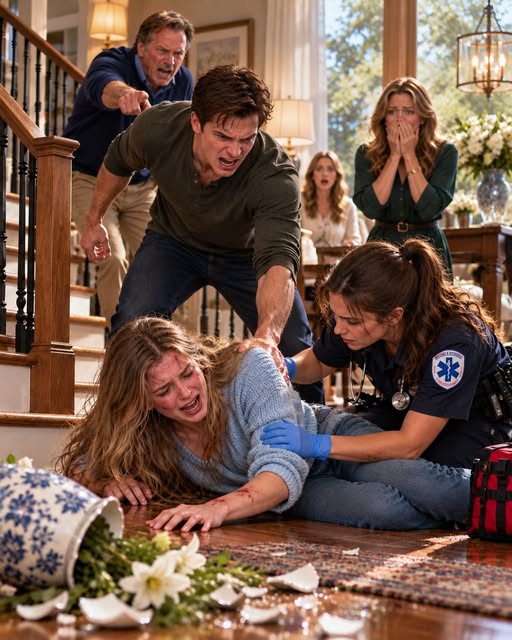
Sometimes, I still remember the stairs.
Tyler’s hands striking my shoulders.
The sudden fall.
The terrible pain.
My father’s voice above me.
Walk it off. You’re fine.
I remember lying there, unable to move my legs, while my brother laughed and my mother complained that I’d ruined the weekend.
But I also remember Aunt Caroline kneeling beside me.
Her phone in her hand.
Her voice shaking as she called for help.
And Dr. Patel sitting beside my hospital bed, asking a question nobody in my family had ever wanted answered.
Has someone hurt you before?
For years, I believed the worst thing about my childhood was that nobody believed me.
Now I understand something.
My family’s refusal to believe me never made my pain less real.
It only meant the people who should have protected me had failed.
I don’t know whether I’ll ever walk without ᴀssistance again.
I don’t know whether Tyler will become a different person.
And I don’t know whether my parents will ever fully understand what their silence cost me.
But I know this.
I am not the dramatic daughter.
I am not the family embarrᴀssment.
And I am not responsible for protecting my brother from the consequences of his choices.
My father told me to walk it off when I couldn’t feel my legs.
But the hardest thing I ever learned to do wasn’t walking again.
It was standing up for myself when the people I loved wanted me to stay silent.
And that was something they could never take away.
THE END. ❤️
💬 What would you have done if your parents defended your brother after he seriously injured you? Could you ever forgive them for hiding the truth?
❤️ Share your thoughts in the comments if you believe every child deserves to be believed, protected, and loved.