PART 2: “YES, OFFICER. I WANT THEM REMOVED.”
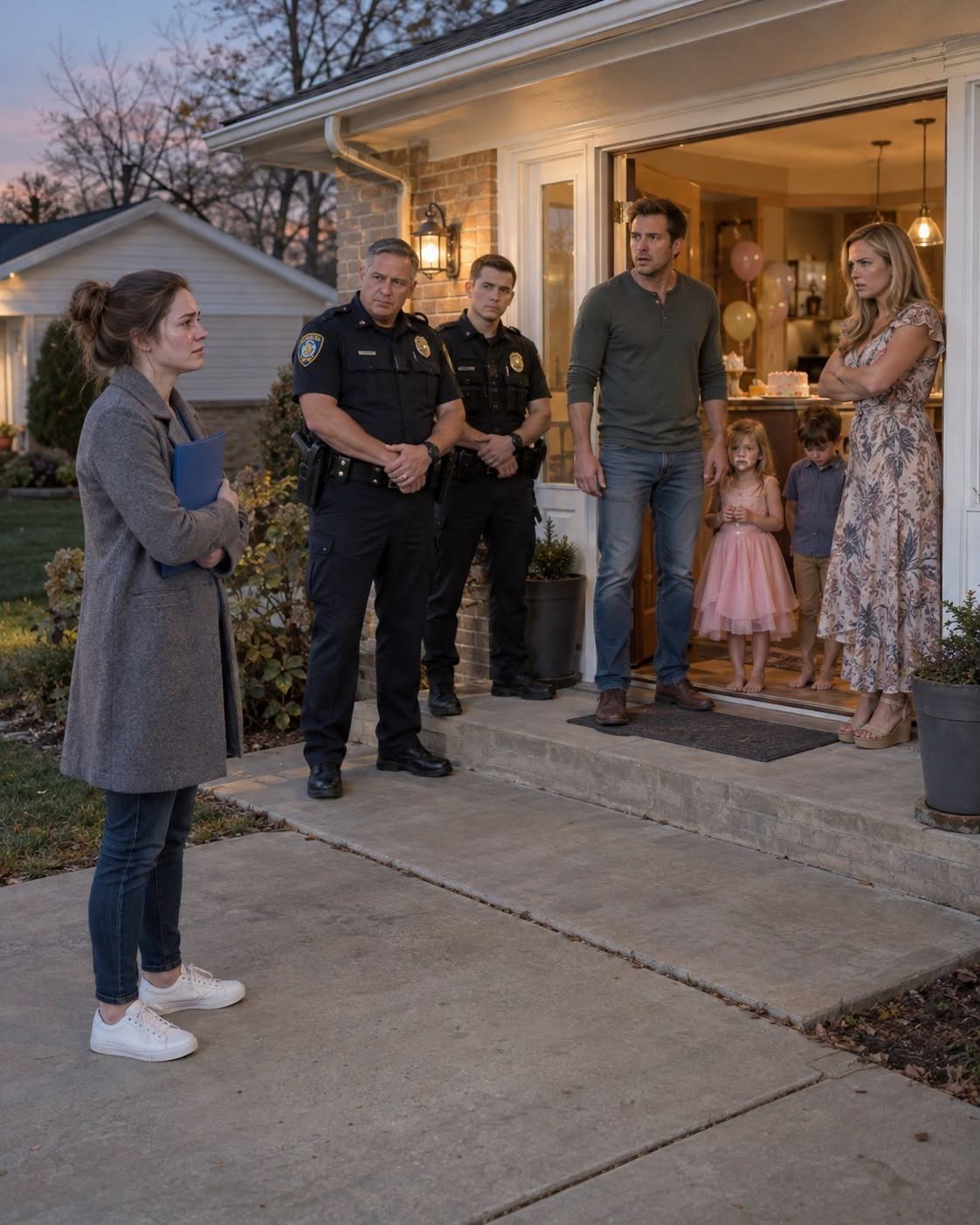
For one long second, I couldn’t speak.
Ava was crying into Britney’s skirt. Mason, my ten-year-old nephew, stood beside the staircase with his hands buried in his pockets. Around them, nearly twenty guests were trying to decide whether they should leave quietly or wait for the show to get worse.
And Travis was watching me.
He knew my weaknesses.
He knew I couldn’t stand seeing children cry. He knew I would rather lose money than watch my mother suffer. Most importantly, he knew I had spent my entire life being taught that saying no to family made me a bad person.
He was counting on all of it.
“Hannah,” he said softly, changing his tone for the first time that evening. “Come on. Look at what you’re doing.”
I stared at him.
“What am I doing, Travis?”
“You’re bringing police into a family disagreement.”
Officer Delgado interrupted.
“Sir, this isn’t a family disagreement. Your sister has provided documentation establishing ownership of this property. You need to answer her question.”
Travis ignored him.
He took one step toward me.
“Listen, we thought you’d be happy to help us out. The kids needed somewhere to celebrate. Our apartment is too small, and Mom said you weren’t using the house yet.”
I looked at the open door behind him.
My furniture was still scheduled for delivery the following week. I hadn’t even slept in my own bedroom.
“You thought I’d be happy to help you out,” I repeated. “So you took my keys?”
His eyes flickered.
Britney spoke quickly.
“We didn’t steal anything. Your mother gave us the keys.”
I turned toward her.
“My mother has never had keys to this house.”
The silence that followed was immediate.
Britney’s lips parted, then closed.
I looked at Travis.
“How did you get inside?”
He rubbed his jaw.
“Mom had a spare.”
“No, she didn’t.”
“Maybe the realtor—”
“The locks were changed yesterday.”
His expression changed.
I held up my phone.
“The front-door camera recorded you trying three different keys before you used the code on the temporary lockbox. You didn’t have permission to enter. You knew that.”
Officer Delgado glanced at his partner.
“Ma’am, do you have that recording available?”
“Yes.”
“Please preserve it. We’ll document the incident and determine the appropriate next steps.”
Travis finally looked at the officers.
“Wait. Hold on. This is ridiculous. We’re already leaving.”
“Then please step outside while we sort this out,” Officer Delgado replied.
Britney grabbed Travis’s arm.
“Tell them!”
“Tell them what?” he snapped.
“That your mother said we could stay here!”
I looked at her.
“Stay here?”
Her face went pale.
Travis closed his eyes for a moment.
It was a tiny movement, but I noticed it.
So did Officer Delgado.
“Sir,” he said, “are you claiming that you have permission to reside at this address?”
Travis hesitated.
“We were going to.”
“From whom?”
He looked at me.
I already knew the answer.
“Mom,” he muttered.
I felt a familiar ache behind my ribs.
My mother had done it again.
She had taken something I had worked for and offered it to Travis as though my sacrifices were simply another resource she could distribute.
But this time, she had made one mistake.
She had offered something that didn’t belong to her.
I turned to Officer Delgado.
“Yes, officer. I want them removed from my property. I want the incident documented, and I want the evidence preserved.”
The words came out steadily.
My hands were shaking.
But my voice wasn’t.
Officer Delgado nodded.
“Understood. We’ll handle this according to the circumstances and applicable law.”
Travis stared at me.
“You can’t be serious.”
“I am.”
“Hannah, there are children here!”
“I can see them.”
“Ava is seven! You’re doing this on her birthday!”
I looked at my niece.
She was a sweet little girl who had done absolutely nothing wrong. She had been brought into a house she believed her aunt had given her permission to use, surrounded by adults who had apparently told her this was a wonderful surprise.
My heart hurt for her.
But I also understood something important.
Protecting children does not require allowing adults to deceive them.
I crouched slightly so Ava could see my face.
“Sweetheart, you haven’t done anything wrong. I love you, and I’m sorry you’re upset. The adults need to sort out a problem, okay?”
She sniffled.
“Are you mad at me?”
“No, honey. Not at all.”
Travis looked away.
I stood again.
“But the party is over.”
For the first time in his life, my brother seemed to realize that I wasn’t going to rescue him from the consequences of his own choices.
And he hated me for it.
PART 3: THE CALL THAT EXPOSED MY MOTHER
The guests began leaving in small groups.
Some avoided looking at me. Others offered awkward apologies. One elderly woman stopped near the porch and whispered that she had thought Travis owned the house.
I thanked her for telling me.
Officer Delgado asked Travis and Britney to gather their belongings and move outside while the situation was documented. He also made clear that the officers would determine what action was appropriate based on the evidence and local law.
Travis kept muttering about misunderstandings.
Britney kept saying my mother had promised them the house.
Neither apologized.
Then Travis’s phone rang.
He looked at the screen.
MOM.
He answered immediately.
“Mom, you need to talk to Hannah. She’s completely lost her mind.”
He put the call on speaker before I could say anything.
My mother’s voice filled the porch.
“What happened? Why are the police there?”
“Because Hannah called them!” Travis shouted. “She’s trying to throw us out!”
My mother inhaled sharply.
“Hannah, what on earth are you doing?”
I looked at the officers, then at my brother.
“I’m enforcing my property rights.”
“Oh, don’t use those ridiculous legal phrases with me! This is your brother!”
“And this is my house.”
“You haven’t even moved in yet!”
“That doesn’t make it yours.”
My mother lowered her voice, adopting the tone she used whenever she wanted to make me feel like a selfish child.
“Your brother has two children. You live alone. He needs more space. We discussed this.”
“No, Mom. You discussed it with yourself.”
Travis looked furious.
Britney crossed her arms.
My mother continued as though she hadn’t heard me.
“We thought you could let them use it temporarily. You have three bedrooms, and Travis has been struggling for years. Surely you can show some compᴀssion.”
I stared at the phone.
“How long were you planning to let them stay?”
A pause.
“Until they got back on their feet.”
“How long is that?”
“How should I know? A few months. Perhaps a year.”
A year.
I had saved for six years to buy that house. I had sold my car, worked extra shifts, skipped vacations, and watched friends take trips I couldn’t afford.
And my mother had decided that I should surrender it for a year without even asking me.
“Mom,” I said quietly, “did you tell Travis that you had the authority to give him my house?”
She didn’t answer.
“Did you tell him that I had agreed?”
“Hannah, I was trying to help the family.”
“That’s not what I asked.”
Her voice sharpened.
“Don’t speak to me like that.”
“Did you tell him I had agreed?”
Finally, she said, “I told him you would come around.”
I closed my eyes.
There it was.
The whole truth in seven words.
My mother hadn’t misunderstood me.
She hadn’t made an innocent mistake.
She had simply decided that my answer didn’t matter.
I opened my eyes.
“Well, I haven’t come around.”
“You are being unbelievably selfish!”
I almost laughed.
For twenty-nine years, I had heard that word whenever I refused to give something away.
When I kept my graduation money, I was selfish.
When I asked for the savings bond Grandma Ruth had left me, I was selfish.
When I refused to pay Travis’s overdue electricity bill a second time, I was selfish.
Now, after saving enough money to buy my own home, I was selfish for wanting to live in it.
“Mom,” I said, “you have a house. Dad has a house. Travis has an apartment. And I have this house. Why is my home the only one that belongs to everybody?”
No one answered.
Then my mother said something that made the entire porch go still.
“Because you’re the only one who can afford to help.”
I stared at the phone.
She said it as though it settled everything.
As though my ability to save money meant I had forfeited the right to keep it.
As though every dollar I earned was family property until someone else decided they had enough.
I spoke slowly.
“Being able to afford something doesn’t mean you own it.”
My mother scoffed.
“After everything this family has done for you—”
“What exactly have you done, Mom?”
Silence.
I continued.
“When Travis needed money, I gave it to him. When you said his roof needed repairs, I gave him three thousand dollars. When you said the family needed help, I helped. I never asked for interest. I never asked for praise. I just wanted to be treated like my sacrifices meant something.”
My voice trembled, but I kept going.
“Now I finally have one thing that is mine, and you decided I didn’t deserve to keep it.”
My mother started crying.
“You’re tearing this family apart.”
“No, Mom. I’m refusing to let the family take my house.”
I ended the call.
For several seconds, I stood in the porch light with my phone in my hand.
Then Officer Delgado asked a question that changed the entire situation.
“Ma’am, do you have any reason to believe your brother or anyone else has accessed your financial accounts or obtained your property information without your permission?”
My heart skipped.
I thought about the temporary lockbox code.
I thought about how quickly Travis had arrived.
Then I remembered something I had almost forgotten.
My mother still had access to my bank account.
And three days earlier, I had received a notification I hadn’t investigated because I was busy signing closing documents.
An unfamiliar transfer request.
I looked at the officer.
“I need to check something.”
PART 4: THE MONEY THAT WASN’T THEIRS
I stepped away from the porch and opened my banking app.
My checking account showed the balance I expected.
My savings account did not.
I stared at the numbers, convinced I had made a mistake.
I refreshed the screen.
The balance remained the same.
Then I opened the transaction history.
A transfer of $12,000 had been initiated from my savings account two days earlier.
The recipient account belonged to Travis.
The transfer was marked as completed.
My hands went cold.
I called the bank’s fraud department using the number on the back of my debit card.
After verifying my idenтιтy, I explained that I had discovered a transfer I did not remember authorizing.
The representative asked whether anyone else had access to the account.
“Yes,” I said. “My mother is listed as a joint account holder.”
“Do you recognize the transfer?”
“No.”
“Did you approve it through your online banking application or provide authorization in another way?”
“No.”
The representative explained that because my mother was a joint account holder, the bank would need to review the account agreement and transaction records before determining what could be reversed. They would also secure my online access and document my dispute.
I thanked her and asked for a case number.
Then I looked at Travis.
He was standing near his car, speaking angrily to Britney.
I walked toward him.
“Travis, did you receive twelve thousand dollars from my savings account?”
He froze.
Britney turned around.
“What?”
I held up my phone.
“Two days ago. Twelve thousand dollars. A transfer from my savings account into your account.”
Travis’s face changed so quickly that I knew he understood exactly what I was talking about.
“Mom said it was for the house.”
“What house?”
He looked away.
“She said you were going to help us with a down payment.”
I stared at him.
“With my savings?”
“She said you’d agreed!”
“I did not agree.”
He rubbed his forehead.
“She told me she’d spoken to you.”
“Did you ask me?”
He didn’t answer.
“Did you call me? Did you send me a message? Did you ask whether I had authorized twelve thousand dollars to leave my account?”
His jaw тιԍнтened.
“I thought Mom had taken care of it.”
I felt sick.
My mother had access to my account, but that didn’t automatically mean she had the right to use my money for someone else’s benefit. The bank would have to review the authorization and the account terms.
And Travis had apparently accepted the money without checking whether I had agreed.
“Did you know where the money came from?” I asked.
“Yes.”
“Did you know it was my savings?”
“Yes, Hannah!”
“Then why didn’t you ask me?”
He threw his hands up.
“Because Mom said you were helping! What was I supposed to do?”
“Be an adult and ask the person whose money you were taking.”
He stared at me.
For a moment, neither of us spoke.
Then Britney stepped forward.
“Look, if this is about the twelve thousand dollars, we can work something out. We needed the money. Travis has been under a lot of pressure.”
I turned toward her.
“That money was my emergency fund.”
She looked uncomfortable.
“We didn’t know you needed it.”
I laughed once, without humor.
“I saved that money because I might need it. That’s what an emergency fund is for.”
Britney glanced at Travis.
He looked at the ground.
I continued.
“I am disputing the transfer with the bank. I want the money returned, and I want a complete record of how it was authorized.”
Travis’s face reddened.
“You’d report your own mother?”
“If the bank finds that the transaction was unauthorized, I will cooperate with whatever review is necessary.”
He stared at me as if I had just threatened to destroy his life.
“You’ve changed.”
I thought about the six years I had spent saving for the house.
The nights at the diner.
The lunches I had skipped to save a few dollars.
The car I had sold.
The childhood savings bond I had surrendered because my mother said family came first.
“Yes,” I replied. “I have.”
Then I walked back to the officers and gave them the bank’s case number.
I didn’t accuse anyone of a crime I couldn’t prove. I didn’t demand that the officers arrest my family based on a phone call.
I simply documented what had happened and made it clear that I had not knowingly authorized the transfer.
The rest would be determined by the evidence.
But as I stood on my own porch, I finally understood something.
The house wasn’t the only thing my family had decided they could take.
They had taken my money because they believed I wouldn’t object.
They had taken my privacy because they believed I wouldn’t notice.
And they had taken my voice because they believed I would always choose their comfort over my own.
That was about to change.
PART 5: THE DOCUMENT MY MOTHER NEVER EXPECTED ME TO FIND
The officers eventually finished documenting the incident.
The guests were gone. Travis and Britney had gathered their belongings, and the house was finally quiet.
Officer Delgado gave me the incident information and advised me to preserve the recordings, secure the property, and contact the appropriate authorities if further evidence emerged.
I thanked him.
Then I stood alone in my living room.
The cake was still on the island.
Someone had left a paper plate on my windowsill. Pink frosting had been smeared across one of the kitchen chairs. A balloon had drifted into the corner of the ceiling.
I looked around the room and felt tears sting my eyes.
This was supposed to be my first weekend in my new home.
Instead, I had spent the evening watching my brother celebrate a future he had ᴀssumed I would pay for.
I cleaned only what I needed to clean that night.
Then I locked the doors, disabled the temporary lockbox, and contacted the locksmith to recheck every exterior lock.
The next morning, I called an attorney recommended by a colleague.
I brought the deed, the closing documents, the security recordings, and the information from the bank.
She reviewed everything carefully.
“Your ownership documents are straightforward,” she said. “The more complicated issue is the bank account, because your mother is listed as a joint holder. We need to review the account agreement and the transaction authorization before deciding what remedies may be available.”
“What about the house?”
“Based on what you’ve shown me, your brother has not established a legal right to occupy it. We should preserve the evidence and make sure any further steps follow the applicable local procedures.”
I nodded.
Then I asked her a question I had been afraid to ask.
“Can I remove my mother’s access to my finances?”
“Possibly, but we need to handle that properly. We’ll review the account structure, open an individual account if appropriate, and determine the best way to protect your funds without interfering with any legitimate obligations.”
For the first time in years, someone was giving me advice that wasn’t based on guilt.
It was based on facts.
Over the following week, I opened a new individual account, redirected my paycheck, and changed my pᴀsswords. The bank placed additional security measures on my access while reviewing the disputed transfer.
I also downloaded and backed up every security recording.
Then I called my mother.
She answered on the second ring.
“Have you calmed down yet?”
I took a breath.
“I’m not calling to argue. I’m calling to tell you that I have secured my accounts and that I expect the twelve thousand dollars to be returned while the bank reviews the transfer.”
She scoffed.
“That money went to family.”
“It went to Travis.”
“Your brother needed help!”
“Then you should have asked me.”
“You would have said no!”
I closed my eyes.
There it was again.
She had made my decision for me because she didn’t like the answer she expected.
“Perhaps I would have said no. Perhaps I would have offered a smaller amount. Perhaps I would have helped him find another solution. You never gave me the chance to decide.”
My mother sighed.
“You’re making this much bigger than it needs to be.”
“No. I’m making it clear that my money is not available without my consent.”
She went silent.
Then she said, “I hope you’re happy. You’ve made your brother feel like a criminal.”
“I haven’t called him a criminal. I’ve disputed a transfer I didn’t authorize. The bank will determine what happened.”
“You could destroy his life over twelve thousand dollars.”
I looked around my new home.
Six years of work.
One house.
One emergency fund.
And somehow, I was still being asked to protect everyone except myself.
“Mom, twelve thousand dollars is not a small amount to me. I worked for it. And the fact that you think I should simply accept losing it tells me exactly why I need these boundaries.”
She hung up.
I set the phone down.
Then I opened the front door and stepped onto my porch.
The lake breeze was cool against my face.
For the first time since closing, I could hear the water in the distance.
I stood there for several minutes, reminding myself that the house was still mine.
The deed hadn’t changed.
The locks were secure.
The money was being investigated.
My family could be angry.
They could call me selfish.
They could tell relatives that I had betrayed them.
But none of those things could turn my home into theirs.
PART 6: WHEN THE TRUTH FINALLY CAME OUT
Three weeks later, the bank contacted me.
They had completed an initial review and identified the authorization used for the transfer. The case remained under review because of the joint-account arrangement, but the bank had enough information to explain how the transfer had been processed.
My mother had initiated the transfer through her authorized access to the joint account.
She had not obtained my separate approval.
Whether that made the transaction legally improper would depend on the account agreement and applicable law, but the records confirmed something I had suspected from the beginning.
She had made the decision without asking me.
I gave the findings to my attorney.
We sent a formal written demand for the return of the disputed funds and requested that all further communication take place in writing.
I also asked the bank to remove my mother’s access where permitted and ensure that my new accounts were completely separate.
The process wasn’t instant.
There were forms, calls, and documents to review.
But for the first time, I wasn’t handling the problem by giving my family more money and hoping the conflict would disappear.
I was addressing it directly.
Travis called me four days after receiving the demand.
“Hannah, what is this letter?”
“A request to return the twelve thousand dollars.”
“Mom says you’re threatening legal action.”
“I’m asking for the money to be returned. My attorney is handling the dispute.”
He exhaled sharply.
“We spent some of it.”
I gripped the phone.
“How much?”
“About four thousand.”
I stared out the window.
“What did you spend it on?”
“Moving expenses. Bills. Some things for the kids.”
I waited.
Then he admitted the rest had gone toward overdue credit-card payments.
Not a house down payment.
Not an emergency medical bill.
Not the roof repairs my mother had once described.
Just the usual collection of expenses Travis had failed to manage.
“Can you return it?” I asked.
“Not all at once.”
“Then you’ll need to discuss a repayment arrangement with my attorney.”
He sounded offended.
“You’re treating me like some stranger.”
I answered quietly.
“You treated my savings like money you were enтιтled to.”
“Mom said you would help!”
“And you believed her instead of asking me.”
He fell silent.
Then he said something I would remember for a long time.
“You always had more than me.”
I looked at the modest living room I had furnished with secondhand furniture.
“I had savings because I worked for them, Travis. I didn’t get lucky. I didn’t inherit a house. I didn’t have someone paying my bills. I saved every month for six years.”
He said nothing.
“I wanted a home of my own. That was the dream. Not to be richer than you. Not to make you jealous. Just to have somewhere I could feel safe.”
My voice cracked.
“And you walked into it, raised a glᴀss, and toasted yourself.”
Travis breathed heavily into the phone.
“I didn’t think you’d actually call the police.”
“That’s the problem. You thought I wouldn’t do anything.”
He didn’t answer.
I ended the call.
The following month, Travis and I reached a written repayment arrangement through our attorneys. The details depended on his ability to pay, and I refused to make promises that weren’t documented.
The money was not returned overnight.
But it was no longer an invisible loss I was expected to swallow.
And my mother no longer had access to my savings.
For the first time in my adult life, my finances belonged to me alone.
EPILOGUE: THE HOUSE NO ONE COULD TAKE
Six months later, I sat on my covered porch with a mug of coffee and watched the sun rise over Lake Erie.
The house had finally become what I had imagined.
There were framed pH๏τographs on the walls. A secondhand sofa faced the fireplace. I had planted flowers along the front path, and the backyard had begun to look less like an empty lawn and more like a place where someone intended to stay.
My security cameras were still in place.
The locks were still changed.
And my bank accounts were no longer tied to my mother’s.
Travis and I barely spoke.
He had sent a short message apologizing for entering the house without permission and for accepting the transfer without checking with me. It wasn’t a perfect apology, and trust would take much longer to rebuild.
I replied that I appreciated the acknowledgment.
I did not invite him over.
My mother was less accepting.
She told relatives that I had become cold and materialistic. She said I cared more about a building than my own brother.
Some relatives agreed with her.
Others quietly reached out to apologize for believing the story before hearing my side.
I learned not to argue with everyone.
The people who genuinely wanted to understand could ask me.
The people who wanted me to surrender my boundaries would never be satisfied with an explanation.
One Saturday afternoon, Walter Dawson, my seventy-four-year-old neighbor, walked over carrying a small potted plant.
“I thought the porch could use something green,” he said.
I smiled.
“That’s very kind of you.”
He placed the plant beside the front door and looked toward the lake.
“How’s the house treating you?”
I glanced inside.
For a moment, I thought about the party. The cake. The police lights reflecting off the windows. My brother’s expression when I refused to give in.
Then I thought about the quiet mornings, the coffee, the freedom to decide who entered my home.
“It’s treating me well,” I said.
Walter nodded.
“Good. A house ought to give you peace.”
After he left, I carried the plant inside and placed it on the kitchen windowsill.
The same kitchen island where Travis had once raised his glᴀss now held a bowl of fresh fruit and a stack of unopened mail.
No balloons.
No strangers.
No one telling me what I owed them.
Just my home.
Later that evening, I found the video of Travis’s toast saved on my phone.
I watched it once.
His confident smile. Britney’s raised glᴀss. The guests cheering beneath the banner that read WELCOME HOME.
For a moment, I felt the old ache.
Then I deleted the copy from my phone, keeping the original securely stored with the other evidence in case it was ever needed.
I didn’t need to keep watching the moment my brother tried to take my dream.
I had something better to look at.
My own front door.
My own keys.
My own life.
For twenty-nine years, I had believed that being a good daughter meant being available whenever my family needed something. I thought being a good sister meant forgiving every betrayal, and being a good person meant never making anyone uncomfortable with the consequences of their choices.
I was wrong.
Kindness without boundaries had turned me into a resource my family felt enтιтled to use.
Love without honesty had allowed resentment to grow.
And silence had convinced the people closest to me that I would never defend myself.
That night, I locked the front door and checked the ᴅᴇᴀᴅbolt.
Then I turned off the porch light and walked through my quiet living room.
I had spent six years saving for that house.
But the most important thing I gained wasn’t the property itself.
It was the knowledge that I could protect what I had worked for without being ashamed of the people who became angry when I did.
My brother had thrown a party inside my house.
My mother had tried to give away my savings.
And when the police asked whether I wanted them removed, I had finally stopped being afraid of what my family would think.
I said yes.
Not because I wanted revenge.
Not because I hated my brother.
But because I had finally understood that being family does not give anyone the right to take what belongs to you.
And the first home I ever truly owned wasn’t just the house by Lake Erie.
It was the life I finally stopped handing away.