PART 2 — THE WOMAN WHO REFUSED TO COOK ANOTHER MAN’S MISTAKES
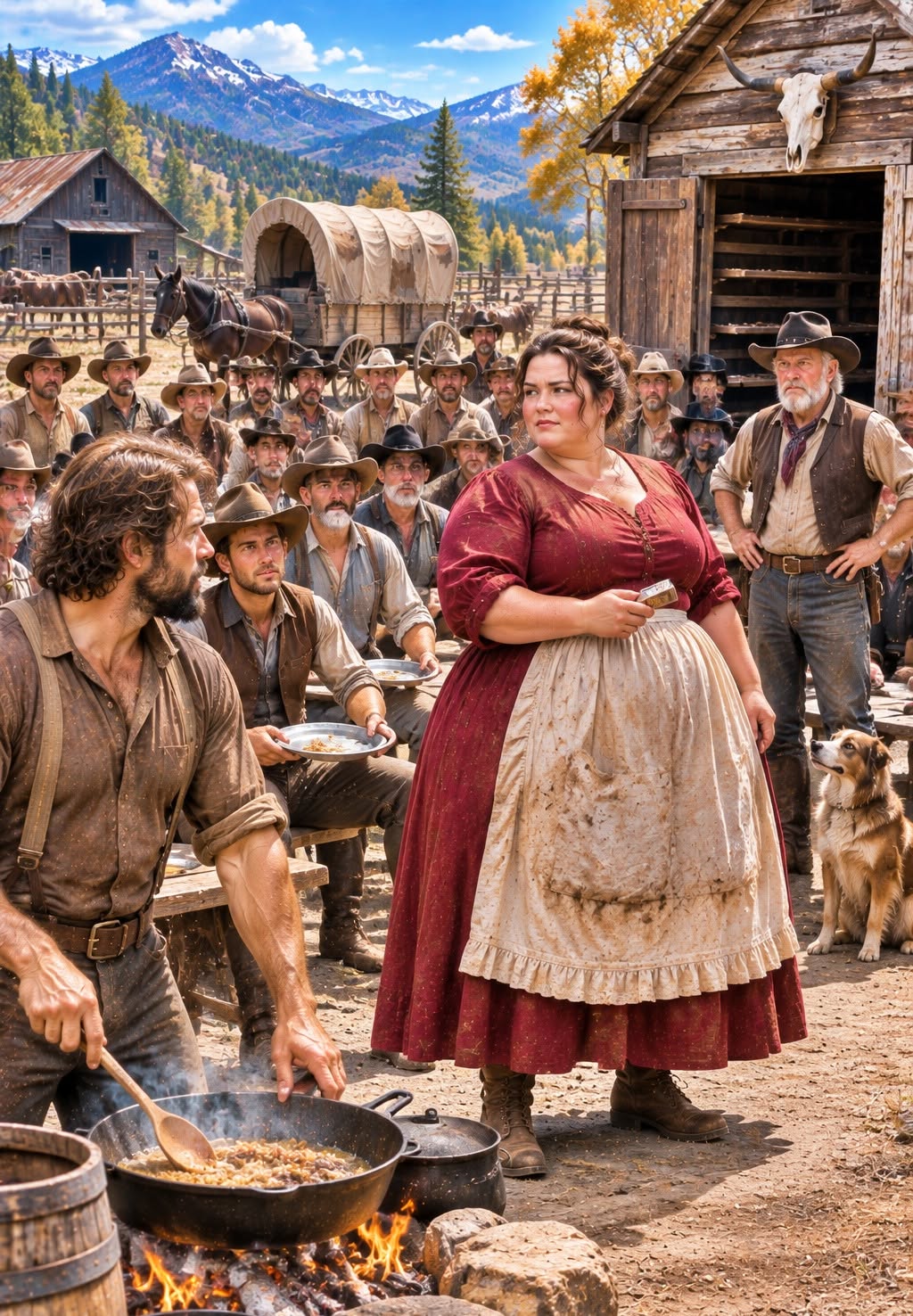
PART 2 — THE WOMAN WHO REFUSED TO COOK ANOTHER MAN’S MISTAKES
The wagon stopped in front of Gideon Hayes.
A woman climbed down from the driver’s seat.
She was perhaps thirty years old, wearing a faded brown traveling dress, a wide-brimmed hat, and a pair of boots that had clearly seen better days. Her sleeves were rolled to her elbows, and a small leather notebook was tucked into her belt.
She wasn’t carrying a rifle.
She wasn’t carrying a suitcase full of fancy clothes.
She carried a wooden box, a canvas sack, and the sort of expression that suggested she had already decided what needed doing.
Gideon looked at her.
“Can I help you?”
“I’m looking for Gideon Hayes.”
“You found him.”
The woman nodded toward the smokehouse.
“That’s yours?”
“It is.”
“Then I believe we have a problem.”
Gideon narrowed his eyes.
“Who are you?”
“Abigail Turner. I answered your advertisement.”
Gideon stared at her.
He had placed an advertisement for a cook three weeks earlier. He had expected an older woman, perhaps someone with experience feeding a large household.
He certainly hadn’t expected this.
“You came about the cooking position?”
“I came because your advertisement said you needed someone who could feed twenty-two working men.”
“That it did.”
Abigail glanced toward the fire.
“Then why are they eating something that looks like it was scraped from the bottom of a wagon wheel?”
One of the ranch hands choked back a laugh.
Gideon didn’t.
“Miss Turner, I don’t believe you understand the situation.”
“I understand perfectly. Your men are hungry, your kitchen is poorly stocked, and that smokehouse is about to become a health hazard.”
She walked past him.
Gideon turned.
“Where are you going?”
“To see what you’ve got.”
She entered the smokehouse before he could stop her.
Inside, the smell was worse.
Several sides of meat hung from hooks. Some were improperly salted, others had been exposed to damp air. The floor was greasy, the shelves were dusty, and a barrel of brine had developed a cloudy surface.
Abigail stood silently for a moment.
Then she turned to Gideon.
“How long has this meat been hanging?”
“Some of it? A month.”
“And the brine?”
“Don’t know.”
She examined the barrel.
“Who prepared it?”
“I did.”
Abigail closed her eyes briefly.
 “Mr. Hayes, I don’t mean to insult you, but you’ve been trying to preserve meat without understanding what makes it safe.”
Gideon crossed his arms.
“I’ve lived in the mountains most of my life. I’ve preserved enough game to feed myself through winter.”
“Feeding yourself is different from feeding twenty-two men.”
She pointed toward the hanging meat.
“Some of this must be discarded. The rest needs to be inspected properly. We will not serve anything questionable just because it cost money.”
Gideon looked offended.
“That represents nearly half my supplies.”
“And serving it could cost you your entire crew.”
The words landed harder than she intended.
For a moment, Gideon said nothing.
Then he stepped aside.
“What do you need?”
Abigail opened her notebook.
“First, clean water. Second, fresh salt. Third, flour that isn’t full of insects. Fourth, beans, onions, potatoes, carrots, and enough fresh meat for tonight.”
“That’s a considerable list.”
“So is feeding twenty-two men.”
Gideon almost smiled.
Almost.
Abigail walked out of the smokehouse and surveyed the ranch yard.
The men were watching her.
She raised her voice.
“Which one of you knows how to chop wood?”
Every hand went up.
“Good. I need two men to bring dry wood. Two to clean the cooking area. Someone find me the largest iron pots on this property. And I need a man who knows where the nearest trading post is.”
Wyatt looked at Ezequiel.
Then he looked at Abigail.
“Ma’am, are you planning to feed us or build a railroad?”
“Depends how many of you keep asking questions instead of working.”
The men laughed.
It was the first genuine laughter Gideon had heard around the campfire in weeks.
Within an hour, the kitchen had changed.
Abigail threw away the spoiled ingredients, scrubbed the cooking pots, and reorganized the pantry. She found sacks of dried beans, a small supply of cornmeal, several onions, and potatoes stored beneath the stairs.
She also discovered something Gideon had overlooked.
A cellar.
It contained jars of preserved vegetables, dried apples, and several sacks of flour that had been purchased months earlier but never properly inventoried.
“Why wasn’t this being used?” she asked.
Gideon looked at the shelves.
“I forgot it was here.”
Abigail stared at him.
“You forgot an entire cellar?”
“I’ve been busy repairing fences.”
She shook her head.
“Tomorrow, we’re making an inventory.”
By sunset, the smell of proper food had spread across the ranch.
A large pot of beef and vegetable stew simmered over the fire. Cornbread baked in cast iron. Onions and potatoes softened in a separate pan, and a fresh pot of coffee sat beside the stove.
The men gathered before Abigail called them.
Wyatt approached first.
“Is it ready?”
“Almost.”
He peered into the pot.
“Ma’am, I believe I can see actual vegetables.”
“Then your eyesight is improving.”
When she finally served the meal, nobody spoke for several minutes.
The men ate slowly at first, as though they were afraid the food might disappear.
Then the silence gave way to conversation.
Ezequiel went back for a second bowl.
Wyatt asked whether there was more cornbread.
One of the younger hands declared that he hadn’t eaten so well since leaving home.
Gideon stood near the doorway, watching.
Abigail noticed him.
“Are you going to eat?”
“I’ve already had something.”
She looked at his untouched plate.
“That’s a lie.”
Gideon frowned.
“I’m the boss.”
“And I’m the cook. Sit down.”
For reasons he couldn’t explain, Gideon obeyed.
He took one spoonful of stew.
Then another.
It was simple food, but it was warm, nourishing, and properly prepared.
He looked at Abigail.
“Where did you learn to cook like this?”
“My mother ran a boardinghouse in Missouri. We fed miners, railway workers, and traveling families. Sometimes forty people in one evening.”
“Why leave?”
Abigail’s expression changed.
“My mother pᴀssed away last winter. The boardinghouse was sold to settle her debts. I needed work.”
Gideon nodded.
He understood loss, though he rarely spoke about it.
After supper, Abigail returned to the smokehouse with a lantern.
She inspected the shelves, checked the remaining supplies, and made a list of everything that needed replacing.
Gideon followed.
“You’ve done enough for one day.”
“Not yet.”
She pointed to a broken section of roof.
“Rainwater has been getting inside. The ventilation is poor, and the shelving needs replacing.”
“Can you fix it?”
“I can tell you how to fix it.”
He studied her.
“You’re not what I expected.”
Abigail gave him a dry look.
“And you aren’t what I expected either.”
“What does that mean?”
“I expected a rancher who knew how to feed his men.”
Gideon let out a quiet breath.
Then, unexpectedly, he laughed.
It was a rough, unfamiliar sound.
The next morning, Abigail began her real work.
She drew a diagram of the smokehouse, separated the damaged supplies from the usable ones, and established a proper schedule for preparing meals and checking stored food.
She also made a list of the ranch’s weekly food needs.
When Gideon saw the figures, he nearly dropped the paper.
“You expect me to spend this much?”
“I expect you to spend less than you’ve been wasting.”
She showed him how much money had disappeared through spoiled meat, unnecessary purchases, and poor storage.
Then she tapped the final column.
“Feed your men properly, and you’ll stop losing money through waste.”
Gideon studied the figures.
For the first time, someone had shown him that the ranch’s problems were not simply bad luck.
They were problems that could be measured.
And solved.
But Abigail had barely begun.
Because when she inspected the old storage shed that afternoon, she discovered a locked wooden cabinet behind a stack of broken barrels.
Inside were several account books.
And on the first page of the oldest ledger was a name she recognized.
Her father’s.
Abigail stared at the handwriting.
She had not seen that name in nearly two years.
And suddenly, the reason she had answered Gideon’s advertisement seemed far more complicated than either of them had imagined.