PART 2: THE WOMAN WHO KNEW WHY THEY HAD BEEN SILENCED
PART 2: THE WOMAN WHO KNEW WHY THEY HAD BEEN SILENCED
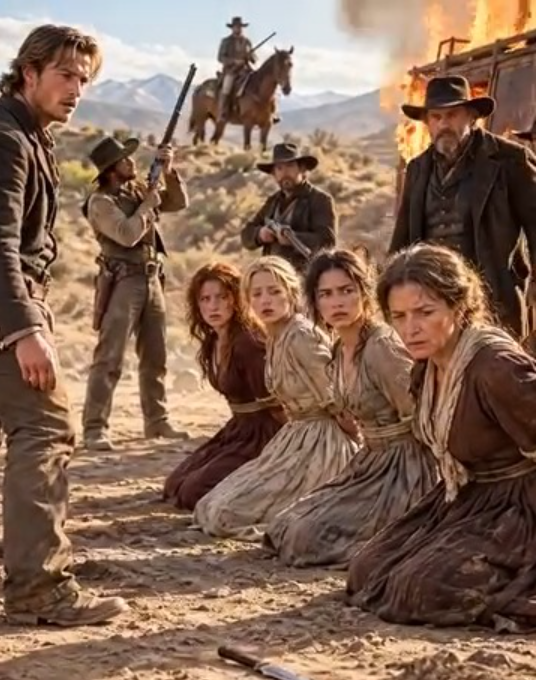
The knife landed in the dirt.
For a heartbeat, nobody moved.
Then the youngest gunman stepped backward, raising both hands.
“I’m done, Harlan.”
The leader stared at him.
“You stupid boy.”
“Maybe,” the young man replied. “But I’m not going to hang for this.”
Harlan’s face twisted.
“You think they’ll spare you?”
“I think I’d rather answer to a judge than spend the rest of my life running from what we’ve done.”
The oldest woman slowly lowered her bound hands toward the knife.
I kept my rifle trained on Harlan.
“Don’t move,” I warned him.
He gave me a cold smile.
“You don’t understand what you’ve walked into, stranger.”
“Then explain it.”
He glanced at the burning coach.
“Those women are thieves. They stole something that belongs to us.”
The oldest woman finally reached the knife.
The youngest gunman looked at her.
“Mrs. Whitmore, I’m sorry.”
She didn’t answer.
Instead, she began working at the rope around her wrists.
Harlan noticed.
“Stop her!”
One of the other men shifted toward the women.
I raised my voice.
“Stay where you are.”
He stopped.
The youngest gunman moved between him and the women.
“It’s over, Harlan.”
Harlan turned on him.
“You owe me everything.”
“I owed you a day’s wages. Not my soul.”
The words hung in the smoky air.
The oldest woman cut through the rope and freed herself. Then she immediately began helping the woman beside her.
I lowered my rifle just enough to gesture toward the women.
“Get them away from the fire.”
They moved quickly.
The youngest woman stumbled as she stood. Her dress was torn at the hem, and her face was streaked with soot.
The oldest woman caught her.
“Easy, Clara.”
“I’m all right, Mrs. Whitmore.”
“No, you’re not. But you will be.”
I recognized the name.
Margaret Whitmore.
She had been a schoolteacher in Red Creek before the schoolhouse burned down the previous winter. The newspapers had reported that she and her three companions were traveling east to meet a lawyer.
I had never expected to find them on a road surrounded by armed men.
“Where were you headed?” I asked.
Margaret looked at me.
“Fort Laramie.”
“What’s in Fort Laramie?”
“A hearing.”
Harlan laughed.
“A hearing? You think anyone will listen to four women with no money and no protection?”
Margaret’s expression didn’t change.
“They’ll listen when they see the documents.”
Harlan’s smile vanished.
There it was.
The thing he feared.
“What documents?” I asked.
Margaret glanced toward the coach.
“Something we were carrying.”
I looked at the burning wreckage.
“Are they still inside?”
She nodded.
“Under the driver’s seat.”
Harlan suddenly lunged toward the coach.
The youngest gunman caught his arm.
“Don’t!”
They struggled briefly before the other men moved between them.
I stepped closer.
“Enough.”
Harlan pulled free, breathing hard.
“You have no idea what you’re interfering with.”
“I’m beginning to.”
The youngest gunman turned toward me.
“My name is Eli Turner. I was hired to escort the coach. Harlan told us the pᴀssengers were carrying stolen company property. He said we’d take the horses and leave them at the next settlement.”
“Then why tie them?”
Eli looked at the ground.
“Because he found out what was in the papers.”
Margaret stepped forward.
“He wasn’t supposed to find out.”
Harlan spat into the dirt.
“You should have kept your mouths shut.”
Margaret faced him.
“You burned a stagecoach with four women tied beside it. I think we’ve pᴀssed the point where silence is useful.”
A faint sound came from the road below.
Hooves.
Several horses.
Harlan heard them too.
His eyes moved toward the ridge.
“You’re making a terrible mistake,” he muttered.
I recognized the sound.
A pᴀssing freight wagon had stopped somewhere beyond the bend, and its driver was likely coming to investigate the smoke.
That meant witnesses.
Harlan knew it.
He stepped toward his horse.
I raised my rifle again.
“Leave the horse.”
 He stared at me.
“You planning to arrest me?”
“No. I’m planning to keep you here until the sheriff arrives.”
He gave a short, bitter laugh.
“You think the sheriff will take your word over mine?”
Margaret answered before I could.
“He’ll have four witnesses.”
Harlan looked at her.
“And four women who’ll be ᴅᴇᴀᴅ before they reach town.”
The threat was quiet.
Too quiet.
Eli moved in front of him.
“Not anymore.”
For a moment, Harlan seemed to consider whether he could force his way past the younger man.
Then he saw the other gunmen watching him.
One by one, they lowered their weapons.
The authority he had held over them was gone.
When the freight driver arrived, I sent him for the sheriff and a doctor. We moved the women to a safe distance from the burning coach and waited beside the road.
While the others watched Harlan and his men, I helped Margaret examine the wreckage.
The driver’s seat had collapsed.
Beneath it lay a small leather document case, blackened around the edges but still intact.
Margaret picked it up with trembling fingers.
“Thank God.”
She opened it.
Inside were several folded pages, a pH๏τograph, and a small envelope sealed with red wax.
She counted the papers twice.
Then her face changed.
“One is missing.”
“What?”
“The original deed.”
She searched the case again.
It wasn’t there.
Margaret looked toward the men.
Harlan was watching her.
His expression told me everything.
“You took it,” she said.
He smiled.
“You’ll never prove that.”
Margaret stepped toward him.
“You can keep the deed, Harlan. But you cannot keep what it proves.”
He leaned forward.
“You should have stayed in Red Creek.”
“And you should never have touched my husband’s land.”
I looked from one to the other.
“Someone had better tell me what this is about.”
Margaret took a breath.
“My husband, Samuel Whitmore, owned a large tract of land near Red Creek. There was a dispute over its water rights. A mining company wanted access to the underground springs, and they offered to buy the property.”
“Why didn’t he sell?”
“Because the company had already been taking water without permission. Samuel discovered that the original land records had been altered.”
She held up the remaining papers.
“These are copies of the original agreements, payment records, and correspondence proving that several officials accepted money to approve the transfers.”
I looked at Harlan.
“Were you involved?”
He said nothing.
Margaret continued.
“He was the company’s local agent. He arranged the transport of the documents and paid men to intimidate anyone who tried to challenge the agreement.”
The woman named Clara stepped closer.
“My father lost his ranch because of those forged papers.”
The second woman spoke.
“My family was forced to leave our farm.”
The third, who had barely spoken since I arrived, lifted her chin.
“My husband was arrested after refusing to sign the transfer.”
Four women.
Four families.
One secret.
The sheriff arrived shortly afterward with two deputies. He took statements, collected the weapons, and ordered Harlan and his men to surrender.
Eli gave his account without argument.
Harlan refused to speak.
Before the sheriff led him away, he looked directly at Margaret.
“You still don’t have the original deed.”
Margaret’s expression remained steady.
“No. But I know where you took it.”
Harlan stopped.
She turned toward me.
“There’s something else you should know. The deed isn’t the only thing missing.”
“What else?”
Margaret reached into the document case and pulled out the pH๏τograph.
It showed a group of men standing outside an old wooden office. One of them was Samuel Whitmore.
Another was a much younger Harlan.
But the third man stood partly in shadow.
I leaned closer.
I knew that face.
I had seen it before.
In the pH๏τograph above my mother’s fireplace.
The man was my father.
Margaret watched my expression.
“You recognize him?”
I nodded slowly.
“My father died twelve years ago.”
“I know.”
She turned the pH๏τograph over.
On the back, in Samuel’s handwriting, were seven words:
Ask Thomas Hale what he promised us.
My father’s name was Thomas Hale.
And suddenly I understood that this had never been just a stagecoach robbery.
My family had been part of the story long before I arrived on that ridge.