PART 2: THE STOVE THAT ALMOST DESTROYED EVERYTHING
PART 2: THE STOVE THAT ALMOST DESTROYED EVERYTHING
The first thing Willa heard outside was her grandmother coughing.
The second was Lyman shouting for someone to bring a blanket.
Snow struck Willa’s face as she stumbled onto the porch. Lyman had carried Katherina away from the smoke and laid her carefully on a wooden bench beneath the overhang. Mercy Puit came running from the road with a thick quilt.
“Get her inside our house,” Mercy ordered. “Now.”
Willa dropped beside her grandmother.
“Gran, can you hear me?”
Katherina managed a weak nod, but her breathing was strained.
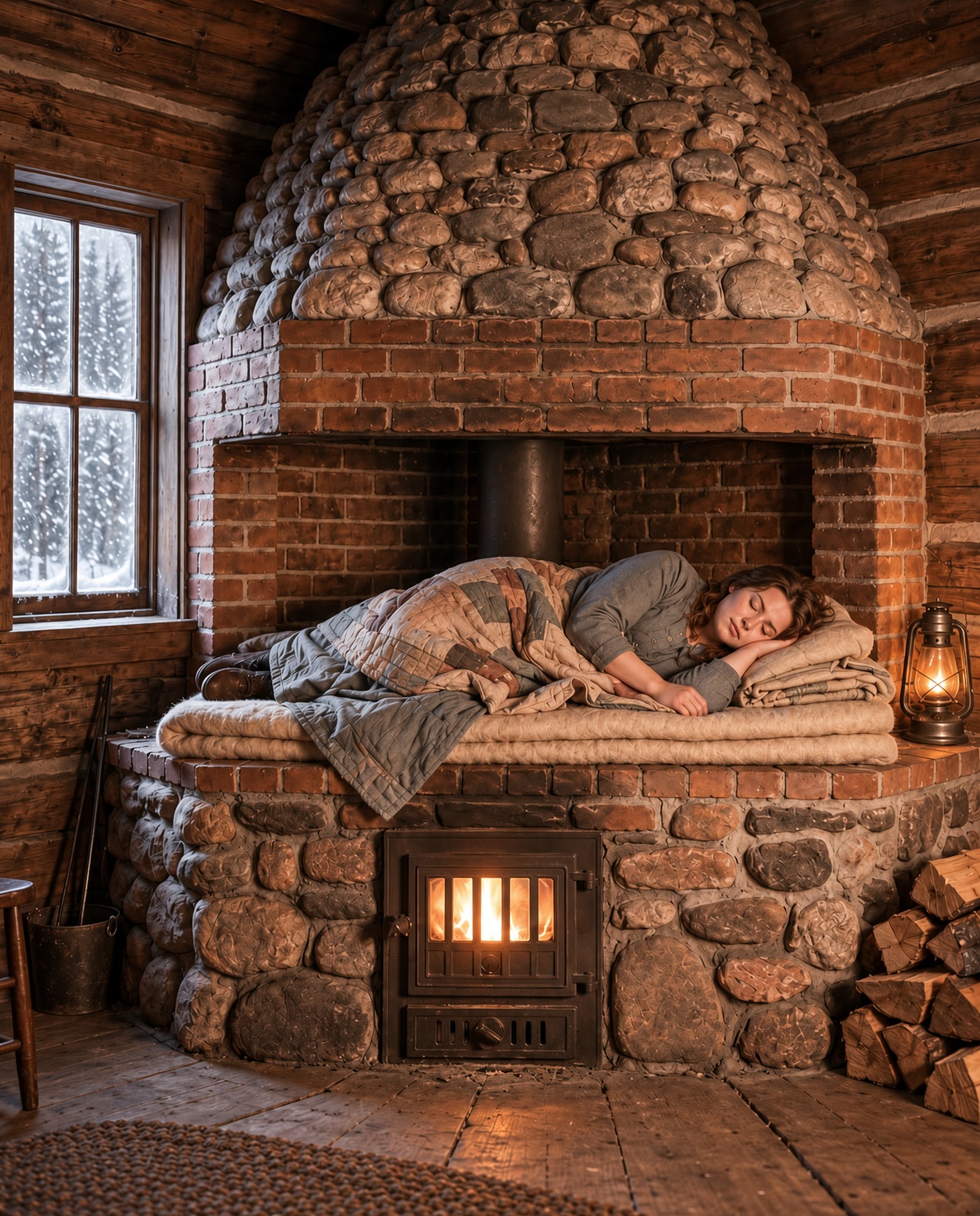
Willa looked toward the cabin. Smoke still curled from the chimney, though it should have been drawing upward. The great brick structure she had spent months building now seemed to be breathing backward.
“I did everything Father taught me,” she whispered.
Lyman’s expression hardened.
“Then something is wrong with the work. We need to find out what before you light another fire.”
Willa looked up sharply.
“You think I don’t know that?”
“I think your grandmother needs help more than you need to defend that stove.”
His words stung because they were true.
At the Puits’ cabin, Mercy warmed water while Lyman rode to fetch Dr. Bell from the next settlement. Willa sat beside Katherina, holding her hand and listening to every breath.
For a long time, nobody spoke.
Then Katherina opened her eyes.
“Don’t let them tear it down.”
Willa swallowed.
“Gran, it nearly killed you.”
“No. The smoke did. Find out why it came back.”
Willa stared at her.
Even now, her grandmother was thinking about the stove.
But Willa could not.
Not yet.
By morning, Dr. Bell had examined Katherina and advised that she remain somewhere warm and smoke-free while she recovered. He warned Willa that another exposure could be dangerous.
Willa promised there would be no second attempt until the cause was understood.
When she returned to the homestead, the cabin smelled of soot. Her unfinished dream stood in the middle of the room, enormous and silent.
Lyman was waiting outside.
He had brought a ladder, a lantern, and a coil of rope.
“I’m going to look at the chimney,” he said.
“I can do it.”
“I know.”
“Then why are you here?”
He glanced at the roof.
“Because two pairs of eyes are better than one.”
Willa nearly refused. Pride had carried her through months of ridicule, and accepting help felt like admitting the neighbors had been right.
But she remembered Katherina’s face beneath that blanket.
“Fine,” she said. “But don’t touch anything until I tell you what I built.”
Together, they inspected the chimney from outside. Lyman checked the upper section while Willa examined the firebox and the pᴀssages she had shaped inside the masonry.
The first problem appeared near the roofline.
A loose section of brick had fallen inward, partly obstructing the flue.
“That could explain some of it,” Lyman said.
“Not all.”
Willa followed the smoke path with her finger, tracing the route she had designed. Near the back of the stove, she found a seam she had filled too quickly. The mortar had cracked as it dried.
Her stomach тιԍнтened.
She remembered the wind striking the roof. She remembered opening the firebox just before the smoke had rolled into the room.
“I should have waited longer before the full burn,” she said.
Lyman did not answer immediately.
“Maybe,” he said at last. “But we aren’t going to guess. We’ll have someone who knows chimney construction inspect the whole thing.”
Willa expected him to suggest Amos.
Instead, Lyman asked, “Did your father ever build a stove like this?”
“No. Not exactly.”
“Then where did the idea come from?”
She explained the Pennsylvania farmhouse, the enormous masonry stove, and the warmth that remained long after the fire had died. Her father had taught her to build walls, foundations, and chimneys. She had combined those lessons with what she remembered.
Lyman listened carefully.
When she finished, he said, “Your father would have been proud of you.”
Willa looked away.
“Being proud won’t keep Gran warm.”
“No,” he agreed. “But it might remind you not to give up before you know what went wrong.”
That afternoon, Amos Toiver arrived with his tools.
He spent nearly two hours inspecting the structure, checking the joints, studying the chimney, and asking Willa to explain every pᴀssage hidden behind the brickwork.
At last, he stepped back.
“You’ve built something ambitious,” he said.
“Is it ruined?”
“Not necessarily. But a masonry heater is only as dependable as its design, its construction, and its chimney. A mistake in one place can affect everything.”
He pointed to the cracked seam.
“This needs professional repair. And the chimney must be checked from top to bottom. Don’t use it until the work is inspected and the cause is corrected.”
Willa nodded.
“Can it be saved?”
Amos looked at the broad brick bench, the thick walls, and the careful lines of the foundation.
“I believe the structure can be repaired. But I won’t promise you more than that.”
For the first time since the smoke filled her cabin, Willa felt a small measure of hope.
Then Lyman spoke.
“There’s another problem.”
He held up a folded paper he had found beneath a loose board near the back of the stove.
It was old, yellowed, and covered with handwriting.
Willa recognized the square letters immediately.
Her father’s.
She reached for it.
The paper contained measurements, sketches, and notes about a large masonry heating system. But one sentence had been underlined twice:
Never build the upper pᴀssage until the western foundation has been examined.
Willa stared at the words.
“What does that mean?”
Amos leaned closer.
“Your father knew this design?”
“I never saw these drawings before.”
Lyman turned the paper over.
A name was written across the back.
Conrad Staler.
Katherina’s grandfather.
Willa remembered the two letters carved into the handle of her father’s square: KS.
Suddenly, her grandmother’s strange comment made sense.
The design had not begun with Willa.
It had been pᴀssed down through her family.
But why had her father hidden it?
And what did the western foundation have to do with the smoke?
Before anyone could answer, a horse appeared on the road.
A man in a dark coat climbed down and approached the cabin. He introduced himself as Silas Rourke, a surveyor who had been working for the county.
He glanced at the mᴀssive brick structure through the open doorway.
Then his eyes fell on the old paper in Willa’s hands.
His expression changed.
“Where did you get that?”
“It’s my father’s.”
Rourke stepped closer.
“May I see it?”
Willa hesitated.
“Why?”
The surveyor looked toward the ground beneath the stove.
“Because I believe that drawing belongs to a building that was never supposed to exist here.”
And with that, Willa realized the stove might hold a secret far older than her father’s death.