PART 2: THE WIDOW WHO REFUSED HIS BED — AND THE SECRET THAT CHANGED EVERYTHING
PART 2: THE WIDOW WHO REFUSED HIS BED — AND THE SECRET THAT CHANGED EVERYTHING
“You’ll sleep beside me, or you won’t sleep at all.”
The widow stared at me.
For several seconds, the only sound inside the cabin was the wind scraping against the windows.
Then she whispered, “Sir, I couldn’t possibly.”
I looked at the thin blanket in her hands.
“You could possibly freeze to death on that floor. That’s what you could possibly do.”
Her cheeks flushed.
“I don’t want to cause you trouble.”
“You already have.”
She lowered her eyes.
I sighed.
“Not the kind you’re thinking of. I haven’t had company in this cabin for eleven years. I’m simply not accustomed to arguing with someone who looks like she might fall asleep standing up.”
She almost smiled.
Almost.
“My name is Ruth,” she said quietly. “Ruth Bennett.”
“Caleb Thornton.”
She nodded, then glanced toward the children.
“My daughter is Annie. My son is Thomas. He’s eight. Annie is six.”
“I know. I heard you tell them while they were eating.”
Ruth looked embarrᴀssed.
“I suppose I talk too much when I’m frightened.”
“Then you’ll fit right in. I don’t talk enough when I’m comfortable.”
This time, she actually smiled.
It was a small, tired smile, but it changed her entire face.
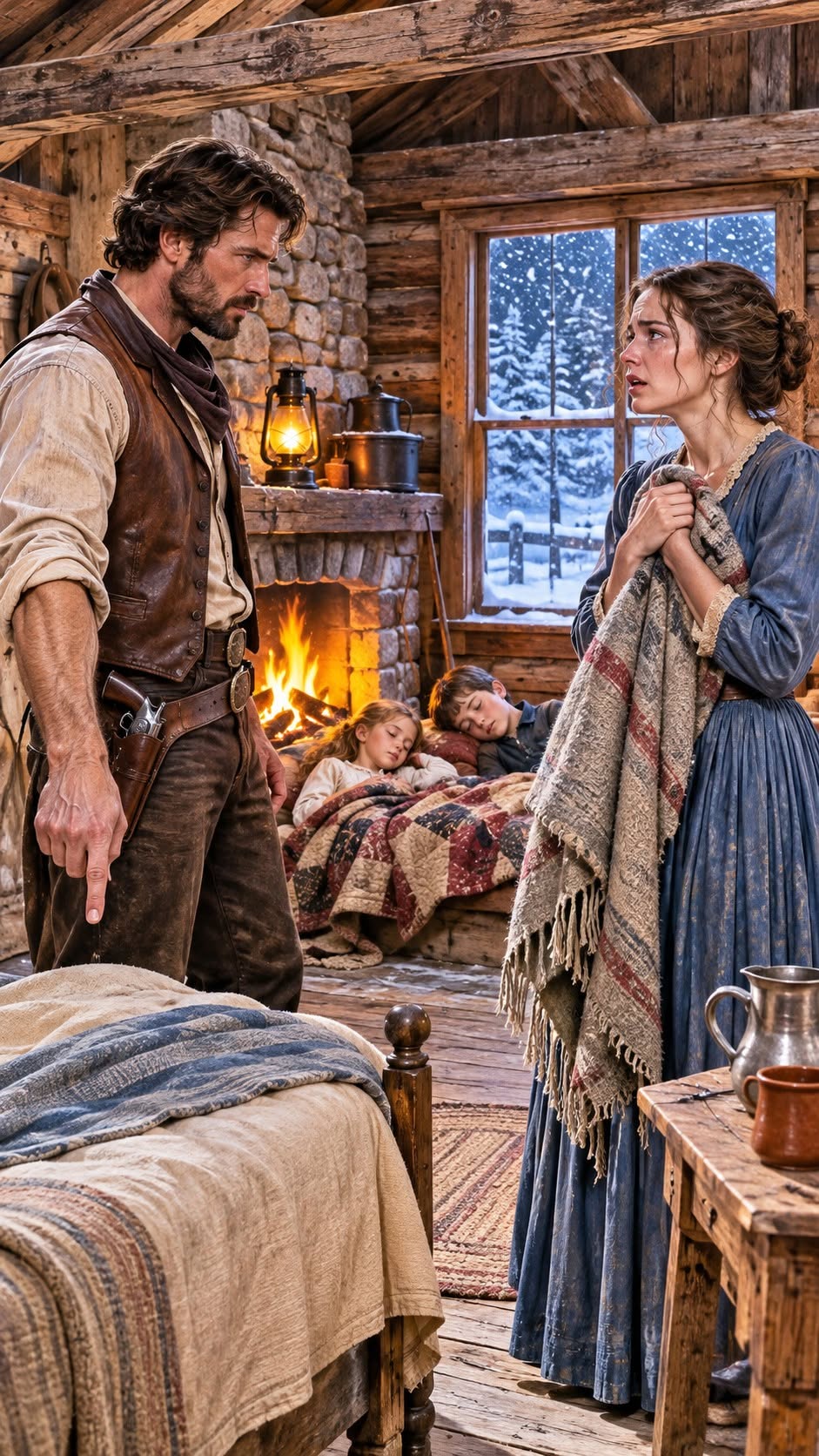
I took the extra mattress from the storage room and laid it beside the fireplace.
“You take the bed. I’ll sleep here.”
Her expression became alarmed.
“I couldn’t let you—”
“Mrs. Bennett, I’m not asking permission to be uncomfortable in my own house.”
She finally nodded.
“Thank you.”
I turned away before she could see how much those two words affected me.
I had lived alone for eleven years.
I had convinced myself that loneliness was simply another winter condition. Something a man learned to endure.
But that night, hearing a woman quietly tuck her children beneath my blankets, I realized how empty my cabin had become.
The storm lasted three days.
By morning, snow had buried the front steps.
The road disappeared beneath white drifts, and the wind howled so fiercely that even my horses refused to leave the barn.
Ruth woke before sunrise.
I found her in the kitchen, attempting to prepare breakfast.
“You don’t have to do that.”
She turned quickly.
“I know. But you’ve already given us shelter. I can’t simply sit here.”
“You can. Nobody’s charging you rent for breathing.”
She lowered the spoon.
“I don’t know how to accept kindness without feeling indebted.”
I studied her.
“Then consider this a loan.”
Her eyes lifted.
“What?”
“A little kindness. You can repay it by making sure those children grow up knowing people aren’t all cruel.”
She looked down at the pan.
For a moment, I thought she might cry.
Instead, she nodded and continued cooking.
By noon, the children had recovered enough to explore the cabin.
Thomas was fascinated by my collection of horseshoes. Annie followed me around asking questions about everything.
“Do you have a wife?”
“No.”
“Why not?”
“Never found the right woman.”
“Is that because you’re mean?”
Ruth nearly dropped the cup she was holding.
I looked at the little girl.
“Probably.”
Annie considered that.
Then she reached for my hand.
“My mama says people can change.”
I looked at Ruth.
She was watching me with an expression I couldn’t quite understand.
On the second evening, Thomas developed a fever.
At first, Ruth thought he was simply tired. But when the boy began shivering beneath two blankets, her face changed.
She placed a hand against his forehead.
“Oh, Thomas.”
I went for the doctor.
The nearest physician lived twelve miles away, and the trail was nearly impossible to cross.
But I saddled my strongest horse anyway.
Ruth caught my arm.
“You can’t ride through that storm.”
“I can.”
“What if something happens to you?”
I looked at her.
“Then you’ll have to explain to Annie why I didn’t bring her a new horseshoe.”
She tried to smile.
But her eyes were filled with fear.
“Please be careful, Caleb.”
I had heard those words before.
From my mother.
From a woman I had once intended to marry.
But hearing them from Ruth did something I wasn’t prepared for.
I squeezed her hand.
“I’ll come back.”
The doctor arrived three hours later.
Thomas had a severe infection, but with medicine and warmth, he would recover.
Ruth sat beside her son throughout the night.
I remained near the fireplace, pretending to read.
At some point, she looked up.
“Why are you doing all this?”
I closed the book.
“Doing what?”
“Helping strangers. Risking your life for children who aren’t yours.”
I considered giving her an easy answer.
Instead, I told her the truth.
“Because once, someone needed help, and I wasn’t there.”
Her expression softened.
I stared into the fire.
“My younger sister, Mary, died during the winter of 1871. We were snowed in at our family farm. I rode for a doctor, but I returned too late.”
Ruth didn’t interrupt.
“I spent years believing I should have ridden faster. Eventually, I stopped letting anyone get close enough to need me.”
She looked toward the sleeping children.
“Grief can make a person build walls so high they forget there’s a door.”
I looked at her.
“And what does a widow know about grief?”
 She gave me a sad smile.
“More than she ever wanted to learn.”
On the fourth morning, the storm finally weakened.
I stepped outside to inspect the fences.
That’s when I found the tracks.
Three horses.
Fresh.
Someone had ridden to my property during the night.
Their trail led directly to the abandoned Bennett farmhouse.
I returned to the cabin with my rifle.
Ruth was folding blankets.
“What’s wrong?”
“Someone has been near your old home.”
Her face drained of color.
“Who?”
“I don’t know.”
She sat down slowly.
Then she told me something she hadn’t mentioned before.
Her husband’s name was Samuel Bennett.
He had died six days earlier after falling from a horse.
But before his death, he had been investigating something.
“He told me the bank papers were false,” Ruth whispered. “He said someone had changed the mortgage records. Our land had already been paid for.”
I stared at her.
“Who did he accuse?”
She hesitated.
“Judge Harlan.”
I knew the man.
Everyone in the county knew him.
He was wealthy, respected, and had been elected judge for three consecutive terms.
“Samuel said he had proof,” Ruth continued. “He hid it somewhere before he died.”
“Where?”
“I don’t know. He only told me that if anything happened to him, I should find the man who owned the old mill.”
I frowned.
“The old mill burned down twenty years ago.”
“I know.”
She reached into her dress pocket and removed a small brᴀss key.
“Samuel gave me this the night before he died.”
I examined it.
A number had been engraved into the metal.
17.
It wasn’t a house key.
It was a safe-deposit key.
I looked at Ruth.
“Did he tell you what it opened?”
She shook her head.
“No. But he said something else.”
“What?”
Her voice dropped.
“He said Judge Harlan wasn’t working alone.”
Before I could respond, a horse approached the cabin.
A man in a black coat rode through the snow and stopped beside my porch.
He dismounted, removed his gloves, and smiled.
“Caleb Thornton.”
I stepped outside.
“Who wants to know?”
“Deputy Marshal Frank Collins.”
He showed me his badge.
“I’ve come to retrieve a woman and two children.”
I glanced toward the window.
Ruth stood behind the curtain.
“On whose authority?”
The marshal produced a folded document.
“Mrs. Ruth Bennett is wanted for questioning in connection with the death of her husband.”
My blood went cold.
“That’s nonsense.”
“Perhaps. But there’s more.”
He unfolded another paper.
A sworn statement.
According to the document, Ruth had murdered Samuel Bennett for control of his land.
And someone had signed it.
Ruth Bennett.
I looked toward the window.
She had gone completely pale.
Then the marshal leaned closer.
“There’s a reward for bringing her in alive, Mr. Thornton.”
I raised my rifle slightly.
“Then you’d better tell whoever offered it that she’s not leaving this cabin.”
The marshal’s smile disappeared.
“You’re making a serious mistake.”
I glanced at the paper again.
Something about the signature bothered me.
It looked like Ruth’s handwriting.
But the final letter was wrong.
I had watched her sign her name several times during the past four days.
Someone had forged it.
And when I looked back at the marshal, I understood why he had come alone.
He wasn’t here to arrest Ruth.
He was here to make sure she never reached a courtroom.
Behind him, two riders emerged from the trees.
One carried a rifle.
The other carried a rope.
And the marshal quietly said:
“Last chance, Thornton. Hand her over, or we’ll take the whole family.”
I raised my weapon.
“Then I suppose you’ll have to take your chances.”
But before either man could move, a gunsH๏τ echoed from inside the cabin.
I spun around.
The window shattered.
And Ruth screamed my name.
When I rushed inside, Ruth was standing beside the fireplace, holding my revolver.
Annie was crying.
Thomas was awake.
And on the floor lay a man I had never seen before.
A man who had entered through the back door.
Ruth pointed toward him with trembling hands.
“He was going to take Annie.”
I knelt beside the stranger.
He was still breathing.
Inside his coat, I found a folded pH๏τograph.
It showed Ruth’s husband standing beside Judge Harlan.
And on the back were six words:
The widow must never find the deed.
I looked at Ruth.
Then I looked at the brᴀss key in her hand.
Suddenly, I understood.
Her husband hadn’t simply died.
He had been murdered because he discovered who really owned the Bennett land.
And whoever had ordered his death had just made one terrible mistake.
They had sent their men to the home of Caleb Thornton.
A man who had spent eleven years avoiding trouble.
And who was now prepared to burn down the entire county to protect the family sleeping under his roof.