PART 2: THE WIDOW WHO BOUGHT A MAN’S FREEDOM
PART 2: THE WIDOW WHO BOUGHT A MAN’S FREEDOM
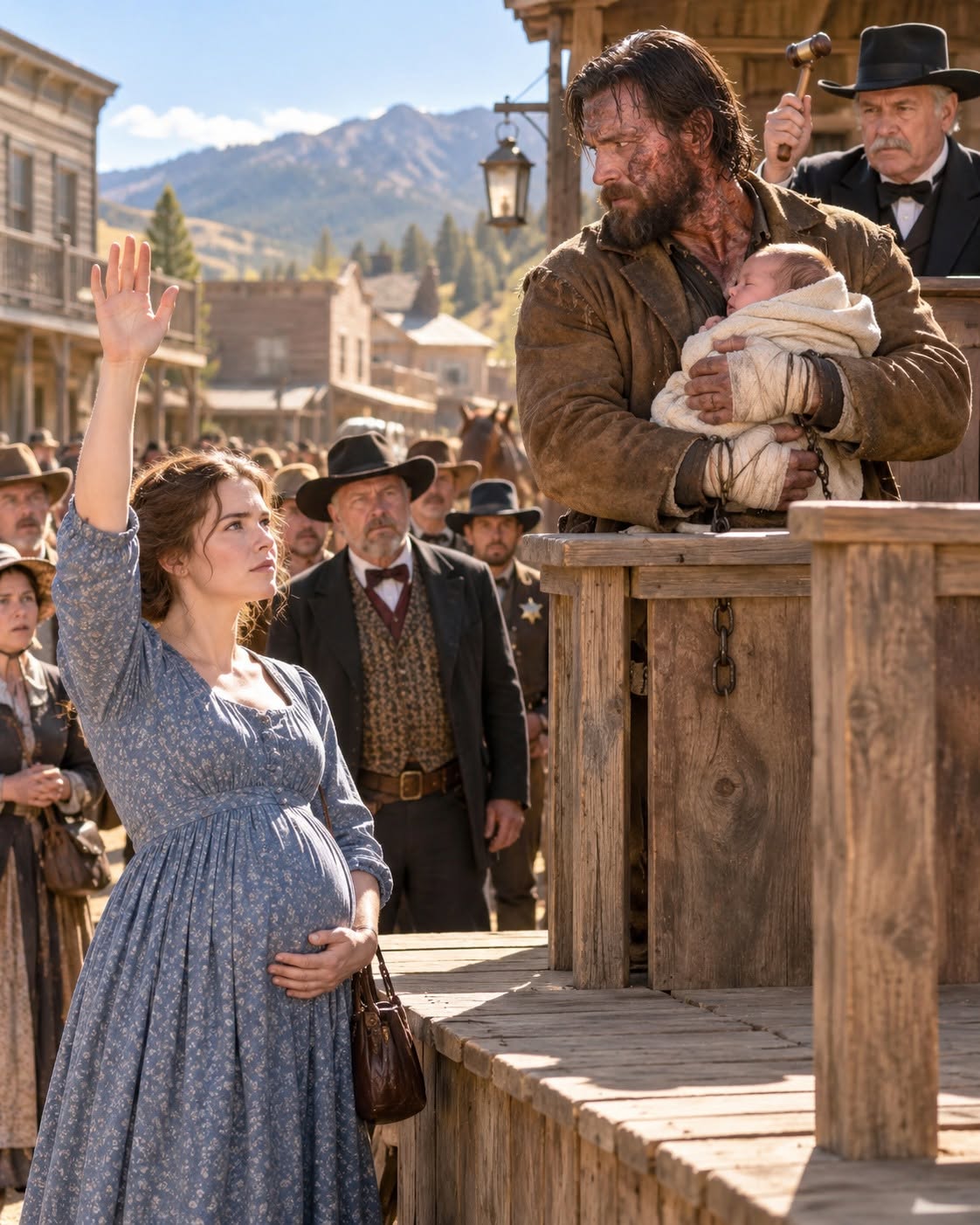
The magistrate stared at Ruth Callahan as though she had just announced she intended to purchase the courthouse itself.
“His daughter stays with him?” Vernon Pike repeated.
“That is what I said.”
“You misunderstand the arrangement, Mrs. Callahan. You are purchasing Boone’s labor contract. You are not adopting his troubles.”
Ruth glanced at the tiny child in Elias’s arms.
“Then perhaps you should explain why a newborn was brought into a public auction.”
A few people in the crowd shifted uncomfortably.
Horace Bell stepped forward, brushing dust from his expensive coat.
“I’ll make it simple,” he said. “One hundred dollars for the contract. The child goes to Helena, and Boone comes to work at my mine on Monday.”
Elias’s arms тιԍнтened around his daughter.
“No,” he said hoarsely.
Bell barely looked at him.
“You’ll do what you’re told.”
Ruth opened her purse.
“One hundred dollars is more than I have. But my eighty-five-dollar offer comes with a condition. If the contract cannot guarantee that the child remains with her father, then the sale is worthless to me.”
Pike tapped his gavel against the table.
“You cannot dictate terms to this court.”
“Then don’t take my money.”
For several seconds, neither spoke.
Ruth knew she was risking everything. Eighty-five dollars was not merely money. It was the roof over her head, the winter flour, the medicine she might need when her baby arrived.
But she also knew what it meant to have the world decide that a grieving person was too inconvenient to keep.
Her husband, Thomas, had died after a fall from their barn roof. Before that, he had been the one who repaired fences, hauled water, and made Ruth believe their little homestead could withstand anything.
Since his death, people had offered advice.
They had not offered much help.
Now a newborn was being treated like an inconvenience because her father had become poor and injured.
Ruth would not watch it happen.
“Eighty-five dollars,” she repeated. “And the child stays.”
Pike looked toward Bell.
The mine owner gave a small, impatient nod.
“Let her have him. He won’t last a month doing farm work with those hands.”
That remark made Elias lift his head.
“I can work,” he said.
His voice was rough, but it carried.
“I can mend fences. Cut timber. Build sheds. I can do anything that doesn’t require a man to pretend he isn’t hurt.”
Bell laughed.
“Look at you. You can barely stand.”
Elias lowered his eyes.
Ruth saw the shame cross his face, and something in her hardened.
“He doesn’t need to prove himself to you.”
Pike finally called the sale.
“Eighty-five dollars from Mrs. Callahan, conditional upon the infant remaining in the father’s care. Do I hear a higher bid?”
Nobody answered.
“Sold.”
 The gavel struck.
Ruth handed over the purse.
Every coin.
Pike counted it twice before sliding a paper across the table.
“Sign here. You are responsible for Boone’s contract, including his lodging, food, and any expenses arising from his employment.”
Ruth read the document carefully.
Five years.
That was what the contract demanded.
Five years of Elias Boone’s labor, unless the debt was repaid or the agreement was legally discharged.
Her stomach тιԍнтened.
“Does this say he belongs to me?”
Pike frowned.
“It says you hold the contract.”
“Then write that he is a worker, not property. And write that no one may separate him from his daughter while he lives under my roof.”
“That is not standard wording.”
“Neither is auctioning a father while threatening to send his baby away.”
The crowd murmured again.
Pike looked annoyed, but he added the condition in the margin and stamped it.
Ruth signed.
And just like that, the last money she owned was gone.
Getting Elias off the platform proved harder than Ruth expected.
His legs trembled when he stood. His burned hands were wrapped in linen, and the effort of holding his daughter seemed to cost him more than he wanted anyone to see.
“Let me carry her for a moment,” Ruth offered.
Elias drew back instinctively.
“She doesn’t like strangers.”
“Then she and I have something in common.”
For the first time, a faint expression crossed his face that might have been a smile.
He looked down at the baby.
“Her name is Grace.”
Ruth nodded.
“That’s a good name.”
“She was born three weeks ago. Her mother named her before…” He stopped.
Ruth did not ask him to finish.
Instead, she adjusted the shawl around the infant, making sure the baby’s face remained uncovered.
“Do you have somewhere to go?”
Elias shook his head.
“My cabin burned.”
“When?”
“Eleven days ago.”
Ruth looked at his scorched clothes.
“Were you inside?”
He nodded.
“The stove pipe collapsed. I got Grace out first. Then I went back for her mother’s blanket and the papers in my desk.”
His voice broke slightly.
“I thought I could save everything.”
Ruth looked at the bandages.
“You saved your daughter.”
Elias stared at her as though he had never considered that answer sufficient.
“Mrs. Callahan, I don’t know how to repay you.”
“You can begin by walking carefully. I have a wagon.”
The journey to Ruth’s homestead took nearly an hour.
Elias sat beside her, holding Grace against his chest while Ruth guided the wagon along the rough road.
He spoke very little.
But when the wagon pᴀssed a broken fence, his eyes followed it.
When they crossed a muddy stretch, he noticed where the wheels sank.
And when Ruth’s horse shied at a fallen branch, Elias quietly suggested a safer route around the creek.
He was injured, exhausted, and carrying more sorrow than Ruth could imagine.
Yet he noticed everything.
At last, the homestead appeared.
It was a small white house with a sagging porch, a leaning barn, and a roof patched with mismatched boards.
Elias looked at it for a long moment.
“This is where you live?”
“It is.”
“Alone?”
“Until today.”
He looked down at Grace.
Ruth stopped the wagon.
“There’s a spare room. It needs cleaning, and the bed isn’t much, but it is warm. You and Grace can have it.”
Elias did not move.
“Why?”
The question was so quiet that Ruth almost missed it.
“Why what?”
“Why spend everything you have on a stranger?”
Ruth considered the question.
Then she looked at the little baby sleeping against his chest.
“Because once, when my husband was alive, he told me that a person’s worth isn’t measured by what they can pay back.”
Elias swallowed.
“And what if I can’t work?”
“Then we’ll figure out what you can do when you’re well enough.”
“And if I never get well?”
“Then we’ll figure that out, too.”
He looked at her for a long time.
No one had promised him anything without attaching a threat to it in years.
That evening, Ruth heated water, prepared a simple supper, and showed Elias the spare room.
She also brought out a small wooden cradle that Thomas had made before his death.
It had never been used.
Ruth had kept it covered in the corner of her bedroom, unable to decide whether looking at it brought comfort or pain.
Now she placed it beside the spare bed.
“It’s not fancy,” she said.
Elias stared at the cradle.
“Your husband made this?”
“Yes.”
“For your baby?”
Ruth nodded.
“He never got to meet our child.”
The room fell silent.
Elias looked down at Grace.
Then, with great care, he placed his daughter in the cradle.
For the first time since the auction, his arms were empty.
He did not know what to do with them.
Ruth noticed his hands hovering above the blanket, as though he still needed to protect the child from an invisible danger.
“You can rest,” she told him.
Elias shook his head.
“I don’t know how.”
“Then you can start by sitting down.”
He obeyed.
Outside, the last light disappeared behind the mountains.
Inside the small house, two grieving strangers listened to a newborn’s soft breathing.
Neither knew what the next morning would bring.
But before Ruth went to bed, she heard Elias whisper something from the spare room.
“Your mother would have liked this place, Grace.”
Then came a pause.
“And I think she would have liked the woman who brought us here.”
Ruth stood in the hallway, one hand resting against her stomach.
She had thought she was saving a father and his child.
She had not yet realized that the two of them might be about to change her life as well.
Because the next morning, someone would arrive at her gate carrying a document that could take everything she had just bought.
And the name written across its top was Horace Bell.