PART 2 — THE TRAIL BOSS HAD A SECRET OF HIS OWN
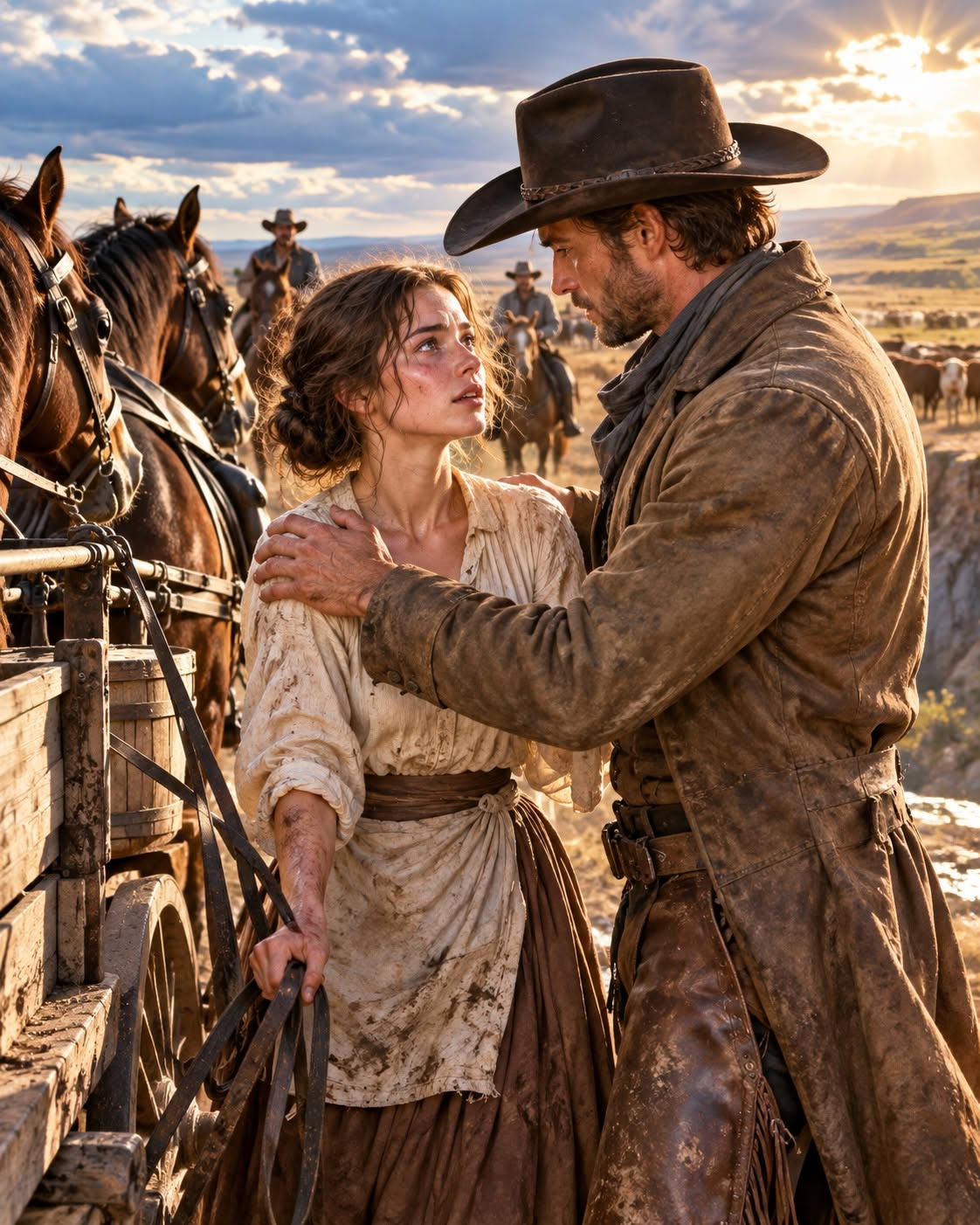
PART 2 — THE TRAIL BOSS HAD A SECRET OF HIS OWN
Ara looked down at the coffee pot.
The fire crackled between them, throwing golden light across Silas Blackwood’s weathered face. Around the camp, the cowboys were settling beneath their blankets, and somewhere beyond the wagons, cattle shifted restlessly in the darkness.
“I buried my husband less than a month ago,” she finally said.
“I know.”
“Then you understand why I cannot simply answer you.”
Silas nodded.
“I didn’t ask you to.”
Ara studied him.
“Why tell me about finding a wife at all?”
“Because I don’t want you thinking I hired you only to cook for my men.”
His voice was steady, but there was something uncertain beneath it.
“I’ve watched you these past weeks. You work harder than anyone I’ve ever hired. But that’s not what matters most.”
“What does?”
“You remember the men who are hurting. You notice when someone hasn’t eaten. And you never make a person feel small for needing help.”
Ara turned away.
Thomas had once told her that kindness was the only inheritance worth leaving behind. Hearing Silas describe those qualities made her feel as though some small part of her husband was still traveling beside her.
“I don’t know how to be anyone’s wife again,” she whispered.
“Then don’t decide tonight.”
Silas stood, placed another piece of wood on the fire, and walked away.
Ara watched him disappear into the darkness.
For the first time, she wondered whether a man could offer a woman a future without demanding that she forget her past.
The following morning, the cattle drive resumed.
But something had changed.
Silas no longer treated Ara’s presence as an ordinary part of the expedition. He asked whether she needed supplies before making the next stop. He arranged for a fresh horse to replace the exhausted wagon team. And when the cook wagon crossed a muddy creek, he rode beside it until the wheels reached firm ground.
The cowboys noticed.
 Eli was the first to comment.
“Boss, you’ve checked that wagon more times than you’ve checked the herd.”
Silas gave him a cold look.
“Then perhaps the herd ought to learn to behave itself.”
The men laughed.
Ara pretended not to hear.
Yet she could not stop thinking about the way Silas had looked at her beside the fire.
Three days later, they reached a small settlement near the trail.
Ara went into the general store for flour, beans, and coffee. She was examining a shelf of canned peaches when a woman in a green traveling dress approached.
“You’re the cook from Blackwood’s drive, aren’t you?”
Ara nodded.
“I’m Mrs. Margaret Voss. My husband owns the Voss ranch east of here.”
The woman looked her over.
“I heard you’re a widow.”
“Yes.”
“And only twenty?”
Ara felt uncomfortable.
“That’s correct.”
Mrs. Voss lowered her voice.
“Then let me offer you some advice. A woman traveling alone with a group of cowboys should be careful about the reputation she leaves behind.”
Ara slowly placed the coffee tin in her basket.
“I’ve done nothing to deserve such a warning.”
“Perhaps not. But people talk.”
Before Ara could answer, another voice interrupted.
“Then perhaps people should find something better to do.”
Silas stood in the doorway.
Mrs. Voss stiffened.
“Mr. Blackwood, I was merely offering friendly advice.”
“Then offer it to someone who asked.”
He picked up the flour sack and carried it toward the counter.
Ara followed him outside.
“You didn’t have to interfere.”
“Yes, I did.”
“I can defend myself.”
“I know.”
Silas stopped beside the wagon.
“But you shouldn’t have to defend yourself against people who mistake your kindness for permission to insult you.”
Ara looked at him.
For a moment, neither spoke.
Then she noticed a folded paper sticking out of his coat pocket.
“What’s that?”
Silas glanced down.
“Something I’ve been meaning to tell you.”
He pulled it out.
It was a letter bearing the seal of a bank in Abilene.
“My land purchase,” he explained. “I put nearly everything I owned into a ranch north of town. There’s a house, a barn, and enough pasture to support a good-sized herd.”
“You’ve worked hard for it.”
“I have.”
He folded the letter again.
“But there’s a problem.”
“What kind?”
Silas hesitated.
“The previous owner sold me the property with a clear тιтle. Now a man named Gideon Pike claims part of the land belongs to his family.”
Ara frowned.
“Does he have papers?”
“He says he does.”
“And what do your papers say?”
“That the entire property was transferred to me legally.”
“Then why are you worried?”
Silas looked toward the distant hills.
“Because Pike has friends in the county office, and he has threatened to challenge the sale when we reach Kansas.”
Ara considered this.
“Have you checked the original survey?”
Silas looked at her.
“Why?”
“My father kept books for a freight company. He taught me how to compare property descriptions and account records. Sometimes a mistake in one line changes the meaning of an entire document.”
Silas studied her with renewed interest.
“You never mentioned that.”
“You hired me to cook.”
“I hired you because I needed someone capable.”
Ara smiled faintly.
“Then perhaps you should stop being surprised when I prove it.”
Silas laughed.
It was becoming a familiar sound.
That evening, Ara examined the papers.
The description was complicated, but she noticed that the eastern boundary appeared to follow a dry creek bed that had changed course years earlier.
She asked Silas for the original survey.
When he brought it, she compared the two documents carefully.
Then she found it.
“Silas, look here.”
He leaned over her shoulder.
“The seller’s deed describes the property as ending at the old creek,” Ara explained. “But this survey shows the creek was moved after the flood of 1874. The land boundary didn’t move with it.”
Silas stared at the papers.
“You’re saying Pike’s claim might be based on the new creek location?”
“I’m saying someone may have used the wrong map.”
Silas studied her.
“Can you prove it?”
“Not yet. But I know where I’d start.”
For the next two hours, Ara worked by lantern light while Silas fetched additional records from his saddlebag.
By midnight, they had found a discrepancy in the surveyor’s notes.
It was not enough to settle the dispute, but it gave Silas something he had not possessed before.
A way to fight back.
He sat opposite her.
“You could have been a bookkeeper.”
“I could have been many things.”
“Why weren’t you?”
Ara’s expression softened.
“Thomas and I were planning to buy a little farm. He wanted to raise horses. I wanted a kitchen with a window facing the garden.”
She paused.
“Then he became ill.”
Silas said nothing.
“He kept telling me we would have time. I think he believed it himself.”
Ara closed the ledger.
“After he died, I couldn’t bear to stay in that house. Every corner reminded me of something we would never finish.”
Silas looked down at his hands.
“I understand more than you think.”
Ara studied him.
“What happened to your wife?”
The question seemed to surprise him.
“I never had one.”
“But you said you were looking for a wife.”
“I was.”
He stared into the fire.
“My younger brother, Samuel, died six years ago. He left behind a wife and a little boy. I promised him I’d look after them.”
“What happened?”
“His wife remarried and moved east. The boy went with her. I wrote for a while, but eventually the letters stopped.”
Silas paused.
“I spent years building a place I thought a family might someday want. But the longer I worked, the more I wondered whether I was building a home or just another empty ranch.”
Ara understood that feeling.
She had spent weeks traveling north because standing still hurt too much.
Perhaps Silas had spent years building something because he did not know what else to do with his loneliness.
Neither spoke again until the fire began to fade.
Then Silas said something she would remember for a long time.
“I don’t want a woman to fill an empty chair, Ara. I want someone whose dreams have a place beside mine.”
She looked at him.
And for the first time, she did not immediately turn away.
But their quiet evening was interrupted by a rider approaching camp at a gallop.
It was Eli.
“Boss! We have trouble!”
Silas stood.
“What happened?”
“Someone went through the wagon supplies. Two sacks of flour are missing, and I found a broken crate near the creek.”
“Who did it?”
Eli looked toward the darkness.
“That’s the strange part. We found a man hiding behind the cattle pens.”
Silas reached for his coat.
“Bring him here.”
A few minutes later, two cowboys escorted a thin, frightened man into the firelight.
Ara recognized him immediately.
He was the store clerk from the settlement.
The young man looked at Silas, then at Ara.
“I didn’t mean to steal anything,” he stammered. “I was looking for something else.”
Silas folded his arms.
“What?”
The clerk swallowed.
“A leather ledger. Someone paid me to find it in your wagon.”
Ara looked at Silas.
“What ledger?”
The clerk’s eyes moved between them.
“The one proving that Mr. Blackwood’s ranch was sold twice.”
Silas went pale.
And the clerk added one more thing.
“The man who hired me said the cook would know exactly where it was hidden.”
Ara felt the blood drain from her face.
She had never seen that ledger before.
So why had someone connected her to it?