PART 2: THE RANCHER’S SECRET — THREE MEN CAME TO TAKE THE WIDOW’S CHILDREN
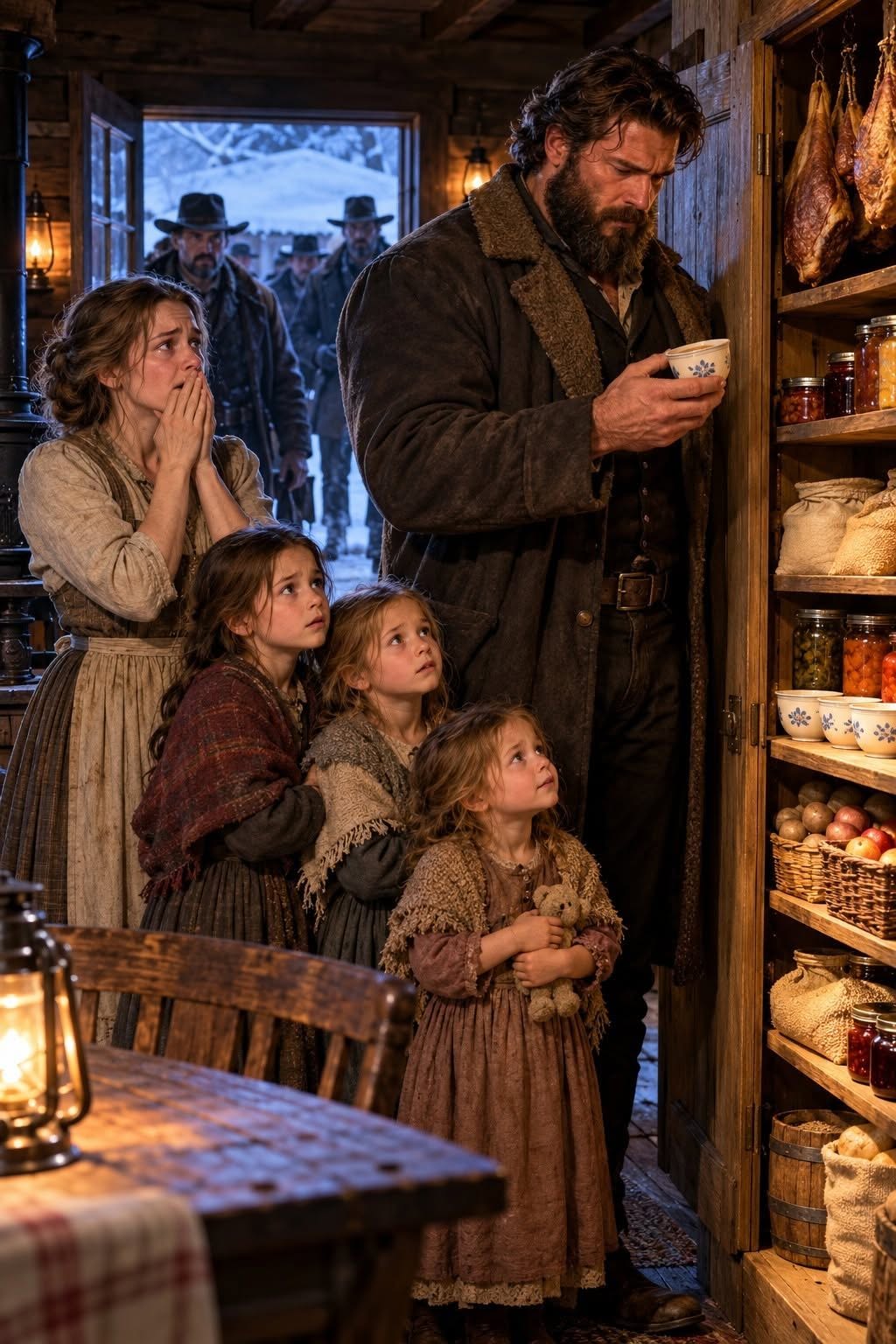
“Gideon Cross!” a man shouted from the porch. “We know you’ve got that widow and her girls in there! Open this door!”
Mabel Harlo went white.
She knew that voice.
Silas Boone, the man who had driven her and her daughters across the frozen prairie that afternoon. The same man who had laughed when he left them at Cross Ranch, telling her she ought to be grateful if the giant rancher let her sleep in his barn.
But now his voice carried a different kind of confidence.
Mabel hurried toward her daughters.
“Ruth, Clara, Annie. Come here, babies.”
Ruth immediately pulled Clara close. Little Annie, still holding Gideon’s enormous hand, looked up at him with frightened eyes.
“Are those bad men coming back for us, Mama?”
Mabel swallowed hard.
“I don’t know, sweetheart.”
Gideon gently released Annie’s hand.
“Take your girls into the kitchen, Mrs. Harlo.”
“But, Mr. Cross—”
“Now.”
His voice wasn’t loud, but something in it made Mabel obey.
She gathered her daughters and hurried them behind the kitchen doorway. Before disappearing, however, she looked back.
Gideon stood in the center of the room, his broad shoulders squared and his hands hanging at his sides.
He no longer looked like a grieving man staring at the ghosts of his past.
He looked like a man who had finally found something worth protecting.
The front door shook beneath another pounding fist.
“Open up!” Silas shouted. “We haven’t got all night!”
Gideon crossed the room and unlatched the door.
Three men stood on the porch.
Silas Boone was in front, wearing a black wool coat and a smug grin. Behind him stood Harlan Pike, a broad-faced ranch hand with a scar across his chin, and Deputy Marshal Everett Cole, whose badge glinted beneath the lantern light.
Silas looked Gideon up and down.
“Evening, Cross.”
Gideon didn’t move aside.
“What do you want?”
Silas chuckled.
“Just collecting what belongs to us.”
“Nothing on this ranch belongs to you.”
“That’s where you’re mistaken.”
Silas glanced past Gideon toward the kitchen.
“We brought the widow here because we heard you needed a housekeeper. But the arrangement has changed.”
Gideon’s eyes narrowed.
“What arrangement?”
“The woman owes money. Her late husband’s debts didn’t disappear just because he died. We found someone willing to take the girls in, and we’re here to make sure the matter gets settled.”
Behind the kitchen doorway, Mabel felt her knees weaken.
She knew what Silas meant.
Three weeks earlier, he had offered to help her settle the remaining debts on her husband’s small farm. He’d promised her work and food in exchange for signing a document she hadn’t fully understood.
When she’d refused to surrender custody of her daughters as collateral, he had threatened to make sure no respectable family in the county would employ her.
Now he’d returned with a badge.
Gideon noticed the change in Mabel’s expression.
He looked back at Silas.
“You said someone was willing to take the girls?”
“An upstanding family in Cheyenne. They’ll raise them properly.”
“And their mother?”
Silas shrugged.
“She can work off what she owes. There’s plenty of laundry to do in town.”
Gideon became very still.
“You intend to separate a mother from her children to settle a debt?”
“Don’t make it sound ugly, Cross. It’s business.”
“No,” Gideon replied. “It’s cruelty dressed up in a clean coat.”
Harlan took a threatening step forward.
“Watch your mouth, old man.”
Gideon turned his head slowly.
“Come inside and repeat that.”
Harlan hesitated.
For all his size, Gideon had a reputation that extended far beyond his own property. He had once dragged a wounded bull away from a trapped ranch hand with nothing but a rope and his bare hands. During the previous winter, he’d ridden through a blizzard to rescue two stranded cowboys.
Men called him a monster because he rarely spoke.
But the men who had worked beside him knew better than to mistake his silence for weakness.
Silas cleared his throat.
“Let’s not turn this into a fight. Deputy Cole is here to ensure everything is done properly.”
The deputy stepped forward.
“Mr. Cross, I’ve received a complaint concerning Mrs. Harlo’s debts and the welfare of her children. I need to speak with her.”
“You may speak with her here,” Gideon said. “You will not take her children anywhere without lawful authority.”
Silas’s grin disappeared.
“Who do you think you are, telling a deputy what he can do?”
Gideon leaned slightly toward him.
“The man standing between you and three frightened little girls.”
For a moment, nobody spoke.
Then a small voice came from the kitchen.
“Mr. Cross?”
It was Annie.
She had slipped away from her sisters and stood at the doorway, clutching her stuffed cloth rabbit.
Gideon turned immediately.
“Go back to your sisters, little one.”
“But the men are shouting.”
“I know.”
“Will they take Mama away?”
Something shifted in his face.
He crouched, bringing himself closer to her height.
“No one is taking your mama away tonight.”
Annie searched his eyes.
“Promise?”
Gideon hesitated only a second.
“I promise I’ll do everything in my power to keep you together.”
She nodded and returned to the kitchen.
When Gideon straightened, the warmth had vanished from his expression.
“Now,” he said to the men, “you can explain why you believe you have the right to remove these children from their mother.”
Silas pulled a folded paper from his coat.
“Because she signed this.”
He thrust it toward the deputy.
“Her husband left debts. She agreed to transfer temporary guardianship of the girls until those debts were settled. It’s all written down.”
Mabel stepped into the doorway.
“No!”
All four men turned.
Her face was pale, but she stood upright.
“I never agreed to give away my daughters. I signed a paper saying I’d work to repay the money my husband owed. Silas told me it was a work agreement!”
Silas laughed.
“You signed your name, woman.”
“Because you told me what it meant!”
“And you should have read it.”
Mabel’s hands trembled.
“I asked you to explain it. You said it was ordinary paperwork.”
Silas shrugged.
“Perhaps you should have learned to read before signing contracts.”
Gideon moved between them.
“Enough.”
His voice cracked through the room like a rifle sH๏τ.
The deputy unfolded the document and examined it beneath the lantern.
His expression grew troubled.
“This is a private agreement,” he said slowly. “It doesn’t automatically give you authority to remove the children.”
Silas’s jaw тιԍнтened.
“You can see her signature!”
“I can see a signature. I also see language concerning guardianship that requires closer examination.”
“You’re a deputy! Do your job!”
“I am doing my job.”
Gideon held out his hand.
“Let me see it.”
Deputy Cole glanced at him, then handed him the paper.
Gideon studied the lines. He wasn’t a lawyer, but he’d managed a large ranch for more than a decade and had signed enough contracts to recognize when someone was hiding a trap inside a paragraph.
He looked at Mabel.
“Did you receive a copy of this agreement?”
“No, sir.”
“Were you told that signing it could be used to claim custody of your children?”
“No!”
Gideon returned the paper to the deputy.
“Then I suggest you investigate why she was denied a copy and whether she was deceived about what she signed.”
Silas’s face reddened.
“You think you’re some kind of hero, Cross? You live out here alone because no woman can stand to look at you. You don’t have a family. You don’t have anyone. Why should you care what happens to hers?”
The words struck a place Gideon had spent six years trying to bury.
For one brief moment, the room seemed to vanish.
He saw three little girls running through a summer meadow.
Sarah, his eldest, with her yellow ribbons.
Beth, who always insisted on carrying her own basket.
And tiny Rose, whose laughter could be heard from one end of the ranch to the other.
He remembered the winter fever that had swept through their home.
He remembered holding Rose against his chest while the doctor worked desperately to save her.
He remembered his wife, Eleanor, whispering through cracked lips, begging him not to let their daughters die alone.
And he remembered the morning he buried all four of them beneath the cottonwood trees.
Six years of silence had not erased a single detail.
Gideon looked at Silas.
“You’re right about one thing,” he said quietly. “I don’t have my family anymore.”
Silas smirked.
“Then stay out of other people’s business.”
Gideon’s eyes hardened.
“But I know what it means to lose someone you love. And I’ll be damned if I stand by while you try to take a mother’s children from her.”
The deputy lowered the paper.
“Mr. Boone, I won’t remove these children tonight. This agreement needs to be reviewed, and Mrs. Harlo must have an opportunity to explain the circumstances under which she signed it.”
Silas stared at him in disbelief.
“You can’t be serious!”
“I am.”
“This woman is a debtor!”
“Debt is not proof that you have lawful custody of her children.”
Harlan stepped toward the door, muttering a curse.
Silas grabbed his sleeve.
“Not yet.”
Then he turned to Gideon with a smile that made Mabel’s stomach twist.
“You’ve made an enemy tonight, Cross.”
Gideon didn’t blink.
“Get off my porch.”
Silas leaned closer.
“You may regret taking in that widow. She has nothing. No money, no land, no respectable family. And now she’s your responsibility.”
Gideon opened the door wider.
“Then I suppose it’s fortunate I never asked your permission.”
The three men stepped into the cold.
But Silas stopped at the bottom of the porch stairs.
He turned and shouted, “You can’t protect them forever!”
Gideon shut the door.
The latch clicked into place.
For several seconds, nobody moved.
Then Mabel’s legs gave way.
Gideon caught her before she hit the floor.
“Easy, Mrs. Harlo.”
She clutched his sleeve, shaking.
“They’ll come back. They’ll keep coming back until they take my girls.”
“Not while I’m standing here.”
“You don’t understand. Silas has friends in town. He knows people who lend money, people who own businesses, people who speak to the sheriff. He can make us disappear without ever laying a hand on us.”
Gideon looked toward the window.
“I understand more than you think.”
Mabel stared at him.
“Why are you helping us?”
He didn’t answer immediately.
Instead, he guided her to a chair near the fire.
“Sit down.”
“Mr. Cross—”
“You and those girls haven’t eaten properly in days. You’re exhausted, frightened, and half-frozen. We’ll deal with Silas after you’ve had supper.”
“But—”
“Mrs. Harlo.”
She fell silent.
Gideon softened his voice.
“For once, let someone else carry the weight.”
Those words broke something inside her.
Mabel bowed her head and began to cry.
Not the quiet tears she’d shed in abandoned barns and beneath church porches, where she had learned to cry without disturbing anyone.
These were the tears of a woman who had been strong for so long that she had forgotten what it felt like to be allowed to fall apart.
Gideon turned away, pretending to examine the stove.
He knew better than to tell a grieving person not to cry.
He had learned that lesson too late.
An hour later, the ranch house smelled of beef stew, fresh bread, and cinnamon.
Gideon had opened every cupboard in the pantry.
Mabel stood at the stove, stirring a pot with a wooden spoon while Ruth arranged bowls on the table. Clara was cutting bread with a small knife under her mother’s supervision, and Annie sat on a folded blanket near the fire.
For the first time in weeks, the girls were warm.
For the first time in months, Mabel wasn’t calculating how many bites of food she could sacrifice so her children might have enough.
Gideon placed a platter of roasted potatoes on the table.
“Come on, girls. Supper’s ready.”
Ruth hesitated.
“Are we allowed to eat all of it?”
Gideon looked at her.
“All of what?”
“The food.”
He slowly set down the platter.
“Ruth, when I invite someone to my table, they eat until they’re satisfied. They don’t have to earn every bite.”
The little girl glanced at her mother.
Mabel nodded, her eyes shining.
“You heard him, sweetheart.”
Ruth sat down.
Clara followed.
Annie hurried toward her chair, nearly tripping over her blanket.
“Is there bread, too?”
Gideon pulled out a chair for her.
“There’s bread, honey. There’s stew, potatoes, apples, and enough food for tomorrow.”
Annie’s eyes widened.
“Tomorrow, too?”
“And the day after that.”
She looked at her sisters.
“Did you hear? We get tomorrow!”
Gideon turned his face away.
Mabel saw him press his lips together.
She understood then that the food in his pantry wasn’t simply stored for winter.
It was a monument to everything he had lost.
The flour, the preserves, the carefully stacked bowls, and the children’s cups had remained untouched because Gideon couldn’t bring himself to change anything.
Perhaps he had been waiting for the day when the house would once again hold the sound of children.
Perhaps he had been waiting for someone who could understand why he had never opened that pantry without feeling as though he were betraying the ᴅᴇᴀᴅ.
Mabel ladled stew into the bowls.
“Mr. Cross, won’t you sit with us?”
“I’ll eat later.”
“No, sir.”
He turned.
She met his gaze with quiet determination.
“You told us to set five places. There are five places at this table. If you don’t sit down, Annie will think you’ve changed your mind.”
Annie immediately looked up.
“Are you leaving, Mr. Gideon?”
The rancher froze.
Nobody had called him that in years.
“Mr. Gideon,” she repeated. “That’s what I’m going to call you because you’re too big to be just Gideon.”
A surprised laugh escaped Clara.
Even Ruth smiled.
Gideon stared at Annie, then at the empty chair.
Finally, he pulled it out.
“All right, little one. I’ll sit.”
Annie beamed.
“Good. You need supper, too.”
For the first time in six years, Gideon Cross sat at a table with children and listened to their chatter.
Ruth told him about the schoolhouse they had attended before their father died.
Clara explained how she had once wanted to become a schoolteacher.
Annie described a rabbit she had seen beside the road and insisted it had been following them because it wanted to come home with them.
Gideon listened to every word.
He didn’t tell them to be quiet.
He didn’t complain when Annie dropped her spoon.
And when Clara accidentally knocked over her cup, he simply reached for a cloth and wiped the table.
Mabel watched him with growing wonder.
The man the county feared was gentle with her daughters.
The man who had lived alone for six years was listening as if their smallest stories mattered.
After supper, Ruth helped clear the table. Clara stacked the plates, and Annie climbed into a chair beside Gideon, fighting sleep.
“Mr. Gideon?”
“Yes?”
“Did your daughters like stories?”
His hand stopped halfway to his cup.
“They did.”
“Did you tell them stories before bed?”
“Every night.”
Annie’s eyelids drooped.
“Will you tell us one?”
Gideon looked at Mabel.
She immediately shook her head.
“Annie, Mr. Cross has done enough for us tonight.”
But Gideon surprised her.
“What kind of story do you like, little one?”
“About a princess who gets lost in the snow and finds a warm house.”
For a moment, he couldn’t speak.
Then he nodded.
“I know one like that.”
He began telling them a story about a young princess who followed a silver fox through a winter forest until she discovered a cabin filled with warm blankets, bread, and a fireplace.
The girls listened, spellbound.
Halfway through the story, Annie fell asleep against his arm.
Gideon didn’t move.
He sat perfectly still, afraid that even the smallest movement might wake her.
Mabel gently lifted her daughter.
“Let me take her upstairs.”
Gideon reluctantly released the child.
As Mabel carried Annie away, she glanced back.
The rancher was staring at the empty chair beside him.
His eyes were wet.
She stopped.
“Mr. Cross?”
He quickly wiped his face.
“It’s nothing.”
“No,” Mabel said softly. “It isn’t.”
He looked at her.
She hesitated before speaking.
“I don’t know what happened to your daughters. And I won’t ask you to tell me before you’re ready. But I want you to know something.”
“What?”
“My girls aren’t here to replace anyone. They never could. But they can be part of your life without taking anything away from the people you’ve lost.”
Gideon lowered his head.
For a long time, he said nothing.
Then he whispered, “I used to believe that if I loved anyone again, I’d be forgetting them.”
Mabel’s heart ached.
“Love doesn’t work that way, Mr. Cross.”
He stared into the fire.
“I haven’t opened that pantry properly in six years. I bought food for the girls even after they were gone. Every winter, I filled those shelves as if they might walk through the door hungry.”
His voice broke.
“I knew they wouldn’t. But I couldn’t stop.”
Mabel sat across from him.
“Perhaps you weren’t buying food for the children who were gone.”
He looked up.
“Perhaps you were keeping a place for the kindness you still had left to give.”
Gideon stared at her as though she had opened a door he had been afraid to touch.
Then, very slowly, he nodded.
The next morning, Mabel awoke to the sound of chopping wood.
She had slept in a small upstairs bedroom with her daughters, in a bed covered with thick quilts that smelled of cedar.
For the first time since her husband’s death, she had slept through the night without waking to check whether her children were still breathing.
When she descended the stairs, she found Gideon outside splitting logs.
Snow covered the ground, and his breath rose in white clouds.
“Good morning,” she called.
He glanced over his shoulder.
“Morning.”
“Why didn’t you wake me? I could have prepared breakfast.”
“There’s food in the kitchen.”
“But I came here to work.”
Gideon drove the axe into a log.
“You came here because you needed shelter. We’ll discuss work after breakfast.”
Mabel folded her arms.
“I don’t want charity.”
He removed the axe and rested it against the chopping block.
“Neither do I want a housekeeper who works until her hands bleed because she’s afraid I’ll throw her children back into the snow.”
Her cheeks flushed.
“That’s not—”
“Mrs. Harlo, I know what fear looks like. I’ve lived with it long enough.”
She lowered her eyes.
Gideon continued.
“You can cook, clean, mend, and help with the household. I’ll pay you fair wages. Your girls can attend school when the roads are safe. And until you decide what comes next, you’ll have a roof over your heads.”
Mabel stared at him.
“You would do all that?”
“Yes.”
“Why?”
He glanced toward the house.
“Because I can.”
She swallowed hard.
“That isn’t a reason.”
“It is for me.”
He picked up another log.
Then he added, almost reluctantly, “And because your daughters deserve to grow up knowing that not every door will close in their faces.”
Mabel covered her mouth.
She had begged dozens of people for work.
She had offered her strength, her time, and every skill she possessed.
Yet the first person to offer her something lasting had been a man who barely knew her name.
“Thank you,” she whispered.
Gideon shook his head.
“Don’t thank me yet. I make terrible biscuits, I don’t know how to braid hair, and the chickens seem to hate me.”
A laugh escaped Mabel before she could stop it.
It was small and rusty, as though she hadn’t used it in years.
Gideon looked at her.
Then, to her astonishment, the corner of his mouth lifted.
It wasn’t quite a smile.
But it was close.
And for a moment, the ranch seemed a little less lonely.
Their fragile peace lasted until noon.
A rider appeared on the road, his horse laboring through the snow.
Gideon recognized him as Thomas Bell, the town’s blacksmith.
Thomas dismounted and hurried toward the porch.
“Cross! I’ve been looking for you.”
Gideon opened the door.
“What happened?”
“Silas Boone is spreading stories in town. He’s telling everyone you stole a debtor’s children and are keeping them against their mother’s will.”
Mabel, standing in the kitchen, felt the blood drain from her face.
Thomas continued.
“He says you’re unstable. Says you haven’t been right since your wife and daughters died. He’s even telling people you might be dangerous around children.”
Gideon’s expression became unreadable.
Mabel stepped forward.
“He’s lying.”
“I know,” Thomas said. “But Silas has been talking to the sheriff. And he’s got two men claiming they saw Gideon threaten you.”
Gideon folded his arms.
“Who are they?”
“Men who owe Boone money. Neither has much of a reputation, but they’ll say whatever he tells them.”
Thomas lowered his voice.
“There’s more. Boone plans to peтιтion the county judge to have your ranch inspected. He’s claiming you can’t care for children because you live alone and have no family.”
Gideon looked toward the kitchen.
Ruth was helping Clara with her reading. Annie sat on the floor, arranging wooden blocks into a crooked little house.
A familiar pain rose in his chest.
Six years ago, he had buried his family.
Now someone was threatening to turn his grief into a weapon against three children who had already lost too much.
“Let him peтιтion,” Gideon said.
Thomas frowned.
“Cross, this could get ugly.”
“Then we’ll deal with it.”
“Boone knows people.”
“So do I.”
Thomas blinked.
Gideon rarely spoke about his past. Most people in the county knew only that he had arrived in Wyoming years earlier with a wife, three daughters, and enough money to buy a substantial ranch.
They knew that after the fever took his family, he had become a recluse.
They didn’t know that before coming west, Gideon had spent years managing a freight company that transported supplies across several territories.
He had dealt with dishonest partners, forged contracts, missing shipments, and men who believed intimidation could replace evidence.
He had learned something important during those years.
The loudest man in a room was rarely the most powerful.
And the person who controlled the truth didn’t need to shout.
Gideon turned to Thomas.
“Would you ride into town and tell the sheriff I expect him to visit the ranch tomorrow? I’d like to discuss the matter in person.”
Thomas nodded.
“I’ll do it.”
“And Thomas?”
“Yes?”
“Tell him to bring anyone who witnessed the agreement Boone claims gives him custody.”
Thomas gave a grim smile.
“Now that sounds like Gideon Cross.”
After the blacksmith rode away, Mabel approached the rancher.
“You don’t have to do this.”
Gideon looked at her.
“Do what?”
“Risk your reputation for us. You have your own life. Your own grief. We could leave before this becomes worse.”
His expression hardened.
“Where would you go?”
She couldn’t answer.
“Back to the road? Another town where Silas can find you? A place where your daughters have to sleep hungry because you’re afraid of accepting help?”
Mabel’s eyes filled with tears.
“I don’t want to bring trouble to your door.”
Gideon glanced toward the kitchen.
“Mrs. Harlo, trouble was already at my door long before you arrived.”
He looked back at her.
“For six years, I’ve eaten alone. I’ve kept three cups on a shelf because I couldn’t bear to put them away. I’ve let the house grow cold because there was no one left to warm it.”
His voice softened.
“Then three little girls walked into my kitchen and asked whether there would be supper.”
Mabel’s lips trembled.
“I can’t promise you an easy life here,” Gideon said. “But I can promise that no one will take those girls from you without a fight.”
She wiped her cheeks.
“Why does that matter so much to you?”
Gideon glanced toward the window.
“Because I know what it feels like when the world takes everything before you can stop it.”
He paused.
“And because yesterday, for the first time in six years, someone sat at my table and asked me to tell a story.”
His eyes met hers.
“I’d forgotten what that felt like.”
That evening, Gideon unlocked the pantry again.
This time, he didn’t stand at the doorway trembling.
He walked inside and began moving the old bowls from their shelf.
Mabel watched from the kitchen.
“Mr. Cross?”
He lifted the smallest cup, the one decorated with faded blue flowers.
“Rose used to drink milk from this one. She insisted the flowers made the milk taste sweeter.”
A faint smile crossed his face.
“Beth always wanted the largest bowl. Sarah complained that I gave the biggest pieces of bread to her sisters.”
Mabel listened quietly.
For the first time, Gideon spoke about his daughters without looking as though every memory would destroy him.
He placed the three cups on a lower shelf, where the girls could reach them.
Then he took a fourth cup from the cupboard.
“What are you doing?” Mabel asked.
“Making room.”
He looked toward the kitchen table.
“There’s no reason these cups should stay locked away forever.”
Mabel felt tears gathering in her eyes.
“Your daughters would be proud of you.”
Gideon’s hands stopped.
For several seconds, he said nothing.
Then he whispered, “I hope so.”
From the doorway came Annie’s sleepy voice.
“Mr. Gideon?”
He turned.
She stood in her nightdress, holding her rabbit.
“Can I have the blue cup tomorrow?”
Gideon knelt before her.
“Yes, sweetheart.”
“Will you put milk in it?”
“I will.”
Annie smiled.
“Then I’ll save you the biggest piece of bread.”
Gideon let out a broken laugh.
He pulled her into his arms, holding her gently against his chest.
And for the first time in six years, the rancher allowed himself to imagine a future that wasn’t merely an endless winter.
But outside, beyond the glow of the windows, a rider watched the house from the ridge.
He had heard the laughter.
He had seen the smoke rising from the chimney.
And he had a message for Silas Boone.
The widow had found shelter.
The giant rancher had taken her side.
And the plan to separate the children from their mother was beginning to fall apart.
The rider turned his horse toward town.
He would reach Boone’s office before midnight.
And when Silas learned what Gideon Cross had promised the widow, he would realize that the man he had dismissed as a lonely old fool was about to become the most dangerous obstacle he had ever faced.
Because Gideon Cross wasn’t merely protecting Mabel Harlo and her three daughters anymore.
He was finally finding the courage to protect something in his own heart.
And the next morning, when the sheriff arrived at Cross Ranch with a warrant and a sealed envelope, the secret inside that envelope would reveal why Silas Boone was so desperate to get his hands on the children.
A secret connected to the winter Gideon lost his family.
A secret someone had spent six years trying to bury.
And a secret that could change everything Mabel believed about the man who had opened his pantry door.