PART 2: THE MEAL THAT SILENCED FIFTEEN COWBOYS
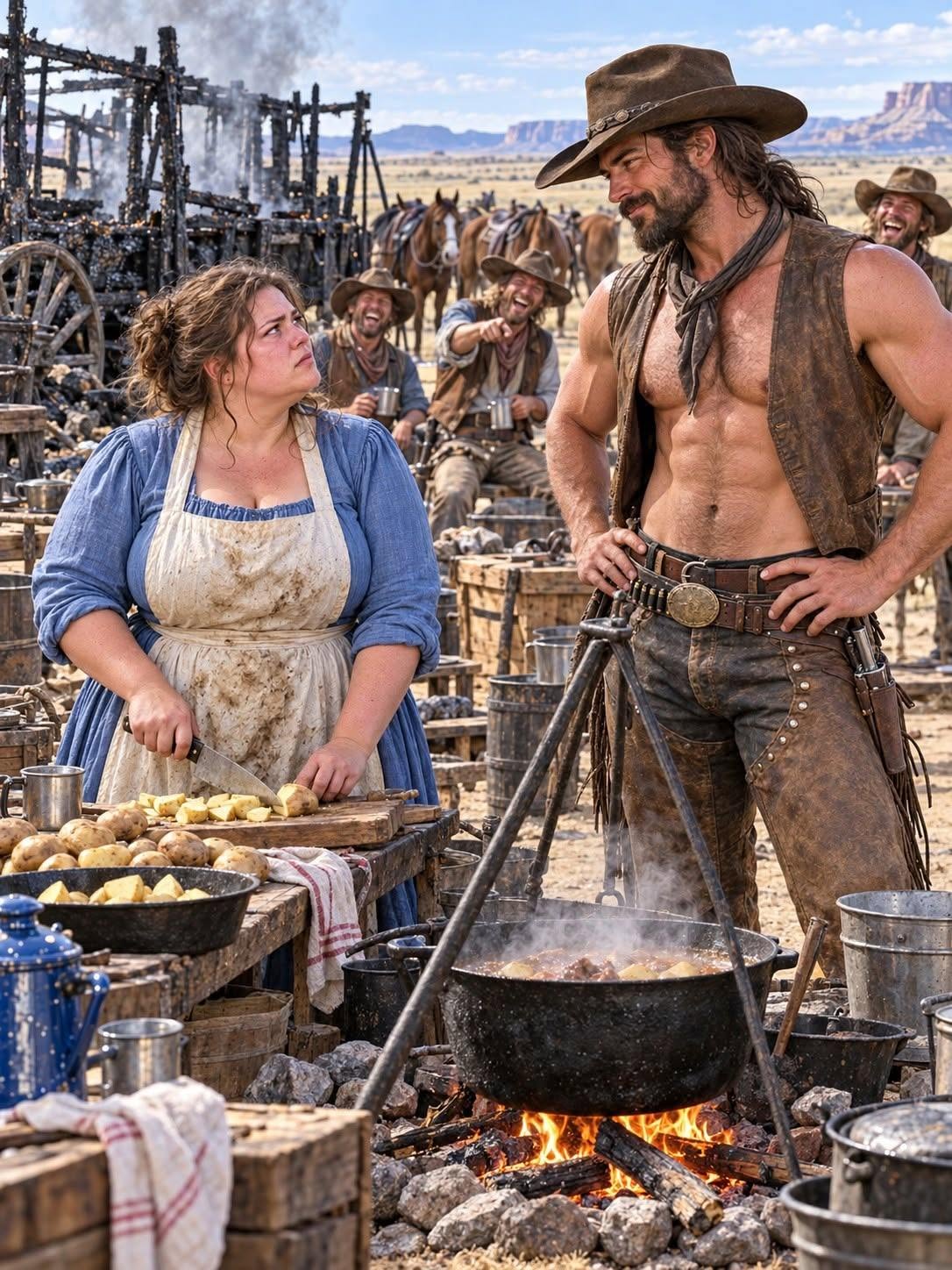
By the time the sun began sinking toward the western horizon, Josie Bartlett had gathered a small pile of things the cowboys would have considered worthless.
A handful of wild onions.
Several prickly pear pads, carefully stripped of their spines.
A bundle of edible greens growing along the dry creek bed.
And, tucked beneath a flat stone, a cluster of wild plums that had survived the summer heat.
She had also found something more valuable than all of them.
A narrow seep of water beneath the creek bank.
It wasn’t much, but it was enough to fill two dented buckets after she dug carefully into the damp earth and waited for the water to gather.
When she returned to camp, her dress was streaked with dust, her shoes were worn through at the edges, and her hands were scratched from gathering the plants.
Hank Tagert was sitting beside the surviving wagon, sharpening his knife.
He glanced at her collection and burst out laughing.
“What’s that supposed to be? Rabbit food?”
Josie set the buckets down.
“Depends. You planning to eat it, or are you planning to keep talking?”
Two cowboys snorted with laughter.
Hank stood, stretching his thin frame.
“Listen, ma’am. I’ve eaten chuck wagon food from Texas to Montana. I’ve swallowed beans that could strip paint off a barn. I’ve eaten beef so tough I had to soak it in whiskey before I could chew it.”
He gestured at her pile of greens.
“But that? That’s what a starving rabbit leaves behind.”
Josie picked up the Dutch oven.
“Then I suppose you’ll have to trust a rabbit to save your supper.”
Hank’s grin faded.
“You think you’re clever?”
“No,” she replied. “I think I’m hungry, you’re hungry, and we’re wasting daylight.”
She turned away.
Behind her, the laughter resumed.
But Caleb Montgomery wasn’t laughing.
He had returned from checking the herd and was watching Josie sort the wild onions from the greens.
He noticed how she examined every leaf, discarding those she couldn’t identify with certainty. He noticed how she rationed the water before washing the vegetables and how she saved the cleanest pieces of cloth for straining the muddy water.
Most importantly, he noticed that she wasn’t panicking.
Every other person in camp had spent the afternoon complaining about what they’d lost.
Josie was working with what remained.
“Miss Bartlett,” Caleb called.
She looked up.
“Yes, sir?”
“What exactly are you planning to feed fifteen men with?”
Josie wiped her hands on her apron.
“Something warm, filling, and better than the hardtack you boys will be chewing tomorrow if I fail.”
Caleb folded his arms.
“And if it tastes like boiled weeds?”
“Then you can dismiss me after supper.”
She returned to her work.
Caleb watched her for another moment.
Then he did something that surprised the entire camp.
He walked to the wagon, picked up an axe, and began splitting wood.
Hank stared at him.
“Boss, what are you doing?”
“Getting the fire ready.”
“For her?”
Caleb brought the axe down hard.
“For supper.”
Hank muttered something under his breath, but he didn’t argue again.
Not with Caleb.
Not when the trail boss had that look in his eyes.
The Secret of the Dutch Oven
Josie began by cutting the dried beef into thin strips.
It was an unpleasant job. The meat was so tough that her knife barely pᴀssed through it, and several pieces were almost black along the edges.
She studied it carefully.
Then she soaked the strips in warm water with a little salt, allowing them to soften while she prepared the rest of the ingredients.
She chopped the wild onions and prickly pear pads into small pieces. She crushed the wild plums in a tin cup, releasing their sharp, sweet juice, and added the edible greens only after checking them once more.
She had no flour worth using for a proper loaf.
But the half sack contained enough to work with.
Josie sifted the flour through a piece of clean muslin, removing the worst of the grit and weevils. She mixed it with water and salt until it formed a thick dough, then shaped it into small, flat rounds.
They weren’t pretty.
They weren’t meant to be.
She placed the softened beef in the Dutch oven with the onions and enough water to cover the bottom. The pot went over a bed of low coals, where the meat could cook slowly rather than burn.
As the mixture began to simmer, Josie stirred in the prickly pear and a small amount of crushed plum.
The fruit wasn’t there to make the stew sweet. It was there to soften the harshness of the dried meat and balance its salt.
She placed the dough rounds along the edge of the pot, where they could cook against the warm iron.
Then she waited.
And stirred.
And waited some more.
Cooking for hungry men on a cattle drive wasn’t about creating something fancy. It was about understanding what a body needed after hours in the saddle.
Warmth.
Salt.
Water.
Enough food to keep a man standing.
And something that tasted like a meal instead of a punishment.
By the time the sun touched the horizon, a rich, savory smell drifted across the camp.
The cowboys noticed it almost immediately.
One man lifted his head from the saddle he was repairing.
Another sniffed the air.
Hank stopped sharpening his knife.
“What in blazes is that smell?”
Caleb looked toward the fire.
“That’s supper.”
“But it smells—”
“Like supper,” Caleb repeated.
Hank’s mouth тιԍнтened.
The smell was making him hungry enough to forget his own objections.
Josie lifted the lid.
Steam rose into the evening air.
The stew had thickened. The beef had softened, the onions had melted into the broth, and the prickly pear had given it body. The little dough rounds had puffed slightly, their surfaces golden where they touched the H๏τ iron.
Josie tasted a spoonful.
Then she added a pinch of salt.
She stirred once more and set the lid aside.
For the first time that day, she smiled.
Not because she had proved the cowboys wrong.
Because she had made something good from almost nothing.
“Every Man Sits Down.”
At sundown, the riders returned to camp.
Their horses were tired, their faces streaked with dust, and their tempers were short.
They gathered around the fire expecting another argument.
Instead, they found a table made from two wooden crates, a row of tin plates, and a Dutch oven bubbling gently above the coals.
Hank dismounted and approached the pot.
He peered inside.
“What is that?”
“Supper,” Josie said.
“I can see that. What’s in it?”
“Beef, onions, prickly pear, wild greens, and a little plum.”
Hank recoiled.
“Plum? You put fruit in beef?”
“I did.”
“That’s not cooking. That’s an experiment.”
Josie set down the ladle.
“Then you don’t have to eat it.”
Hank looked around at the other men, expecting their support.
But the smell had already betrayed them.
One cowboy named Eli Harper was practically leaning over the table.
“Smells better than the last three meals Pete cooked.”
A few men laughed.
Hank glared at him.
“You want to eat weeds, go ahead.”
Eli shrugged.
“I want to eat something that isn’t saddle leather.”
Caleb stepped forward.
“Enough.”
The camp fell silent.
He looked at every man in turn.
“I hired Miss Bartlett to feed this outfit for a week. She has spent the afternoon gathering ingredients, hauling water, and cooking while the rest of you stood around telling her she couldn’t do the job.”
His gaze settled on Hank.
“You judged her before she ever put a pot on the fire.”
Hank opened his mouth.
Caleb raised a hand.
“I’m not finished.”
The rancher pointed toward the table.
“Every man sits down. Every man gets a plate. And every man tastes what she made before he decides whether he has anything worth saying.”
The cowboys stared at him.
Caleb’s voice grew harder.
“Then, if you discover you’ve been wrong, you’ll apologize.”
Nobody moved.
Caleb planted both hands on the table.
“Did I stutter?”
Fifteen men scrambled for seats.
Even Hank sat down, though he did so with the expression of a man attending his own funeral.
Josie ladled stew into the first plate.
Caleb held it out.
“May I?”
She nodded.
He took a spoonful.
For a moment, his face revealed nothing.
He chewed slowly, swallowed, and took another bite.
Then he looked at Josie.
“Miss Bartlett.”
“Yes, sir?”
“How soon can you make more?”
The camp erupted.
Eli laughed so hard he nearly dropped his spoon.
One of the younger riders slapped the table.
Another shouted, “Give me another bowl!”
Caleb ignored the commotion and held out his empty plate.
“I asked how soon you can make more.”
Josie folded her arms.
“That depends. How many men are planning to insult my cooking before asking for seconds?”
The laughter grew louder.
Even Caleb smiled.
“Fair question.”
He turned toward the crew.
“Eat first. Apologize afterward.”
The Cowboy Who Couldn’t Swallow His Pride
Hank was the last man to taste the stew.
He stared into his plate as though the food had personally offended him.
Then he lifted a spoonful to his mouth.
He chewed.
His expression shifted.
He took another bite, this time with less reluctance.
The beef was tender enough to cut with a spoon. The onions gave the broth a deep, savory flavor, while the slight tartness of the plum kept it from tasting flat. The dough rounds were warm and filling, perfect for soaking up the broth.
Hank took a third spoonful.
Then a fourth.
Josie stood across the table, waiting.
He finally looked up.
“Well?”
Hank swallowed.
“It’s… decent.”
Eli slapped the table.
“Decent? You just ate half the pot!”
“Shut your mouth, Harper.”
Caleb leaned against the wagon.
“That’s not an apology, Hank.”
The older cowboy’s ears reddened.
He set down his spoon and looked at Josie.
For the first time since she had arrived, he seemed uncertain what to do with himself.
“Miss Bartlett,” he began.
She waited.
“I was wrong to judge you before you cooked anything.”
“Yes,” Josie replied.
Hank blinked.
He had probably expected her to make it easy for him.
She didn’t.
He cleared his throat.
“I was wrong to make remarks about your size, too. It had nothing to do with whether you could do the job.”
The camp grew quiet.
Josie studied him.
“You’re right. It didn’t.”
Hank nodded stiffly.
“I’m sorry.”
She accepted the apology with a small nod.
“Thank you.”
Then she turned toward the Dutch oven.
“Now, if you’re finished making speeches, the rest of you can stack your plates. I’ve got another batch of dough to prepare.”
The men burst out laughing.
This time, the laughter wasn’t aimed at her.
It was the sound of fifteen cowboys discovering that the woman they’d dismissed had just fed them better than their former cook ever had.
What the Rancher Saw
Later that night, after the men had eaten their fill, Caleb found Josie washing the Dutch oven near the water barrel.
The fire had burned low. The cattle were quiet in the distance, and a blanket of stars stretched across the Texas sky.
“You did a fine job tonight,” he said.
Josie continued scrubbing.
“Thank you.”
“I mean it. That was better than anything I’ve eaten on this trail.”
“Then you should hire better cooks.”
He laughed.
“Fair enough.”
She rinsed the pot and set it upside down to dry.
Caleb hesitated.
“Can I ask you something?”
“You can ask.”
“Why take the job? You knew the conditions. You knew these men could be difficult. You knew there wasn’t much food left.”
Josie wiped her hands.
“Because I need work.”
He waited.
She looked out across the dark prairie.
“My father died last winter. The washing I used to do in Fort Worth barely kept me fed. I had a room, but the landlord raised the rent, and I couldn’t afford it anymore.”
Her voice remained steady, but her fingers тιԍнтened around the cloth.
“I heard your supply wagon had burned. I thought a man with fifteen hungry cowboys might need someone who knew how to make a little food stretch.”
Caleb looked at her carefully.
“And you thought you could manage the trail?”
“I can walk. I can cook. I can work until my hands ache. I don’t need to ride a horse to feed men who do.”
She turned toward him.
“But I won’t spend my life begging people to overlook my body long enough to see what I can do.”
Caleb’s expression changed.
For the first time, he understood that the argument around the fire had not been an isolated insult.
It was a wound she had carried for years.
He removed his hat.
“Miss Bartlett, I’m not going to pretend I know what you’ve had to endure. But I know this much: I hired you because you offered to do a job. You did that job, and you did it well.”
He paused.
“Tomorrow, I’ll pay you the first week’s wages in advance. You’ll receive the agreed rate, and if you keep this outfit fed, we’ll discuss a longer contract when we reach Dodge City.”
Josie stared at him.
“You’re paying me in advance?”
“Yes.”
“Why?”
“Because I don’t expect a woman to work for a week without knowing she can buy herself a decent pair of boots.”
She looked down at her worn shoes.
For a moment, she couldn’t speak.
Then she lifted her chin.
“I’ll earn every cent.”
“I expect you to.”
Caleb put his hat back on.
“And Miss Bartlett?”
She looked up.
“Yes?”
“If anyone on this outfit makes another remark about your body instead of your work, you tell me.”
Josie studied his face.
“And what will you do?”
Caleb’s mouth curved.
“Make him peel potatoes until his fingers fall off.”
A laugh escaped her.
“That’s a terrible punishment.”
“Not if I make him do it for fifteen men.”
She shook her head, smiling.
For the first time since arriving at the camp, Josie felt the тιԍнтness in her chest ease.
Not because a powerful man had defended her.
But because she had earned her place before anyone offered her protection.
And she intended to keep it.
The Morning After
At dawn, Josie woke before the camp.
She made coffee from the small supply that hadn’t been ruined by the fire, then prepared a thick breakfast porridge with the remaining flour and a few dried ingredients she had found in the secondary wagon.
By the time the cowboys emerged from their bedrolls, the coffee was ready.
Eli approached the fire, holding his tin cup.
“Morning, Miss Bartlett.”
“Morning.”
He glanced toward the pot.
“What’s for breakfast?”
“Something warm.”
He grinned.
“I knew there was a reason I got out of bed.”
One by one, the men approached her with their cups and plates.
Even Hank removed his hat when he pᴀssed.
“Morning, ma’am.”
Josie looked at him.
“Morning, Hank.”
He hesitated.
“About yesterday—”
“We’ve already discussed yesterday.”
“Yes, ma’am.”
He cleared his throat.
“Still, I wanted to say I’m sorry again. I spoke like a fool.”
Josie handed him a bowl.
“Then don’t speak like one today.”
Hank accepted it.
“Yes, ma’am.”
He walked away, and Eli immediately leaned toward him.
“Careful, Tagert. At this rate, you’ll be a gentleman by the time we reach Kansas.”
“Eat your breakfast, Harper.”
The men laughed.
Josie shook her head and returned to the stove.
Caleb watched from beside his horse.
He had seen men fight through blizzards, cross swollen rivers, and ride for hours to save a single steer.
But he had rarely seen a person command a camp without raising her voice.
Josie did it by working.
By refusing to be humiliated into silence.
By making something useful out of what everyone else had dismissed.
When she finished serving breakfast, Caleb approached her.
“We ride in twenty minutes. You’ll have the wagon and a horse available if you want one.”
Josie glanced toward the horses.
“I’ll walk beside the wagon for now.”
“All right.”
He didn’t question her.
Then he added, “But when your feet get tired, you tell me.”
She looked at him.
“I will.”
The wagon rolled out as the sun climbed over the prairie.
Josie walked beside it, her skirts stirring in the wind, the Dutch oven secured among the supplies.
Behind her, fifteen cowboys followed a trail boss who had learned a valuable lesson.
A person’s worth could not be measured by the shape of their body, the sound of their voice, or the ᴀssumptions strangers made when they first saw them.
Sometimes, the person everyone underestimated was the very person who could carry them through the hardest part of the journey.
And sometimes, the finest thing a person could cook was not a meal.
It was a second chance.
THE END