PART 2 — THE MOUNTAIN MAN’S UNEXPECTED CHOICE
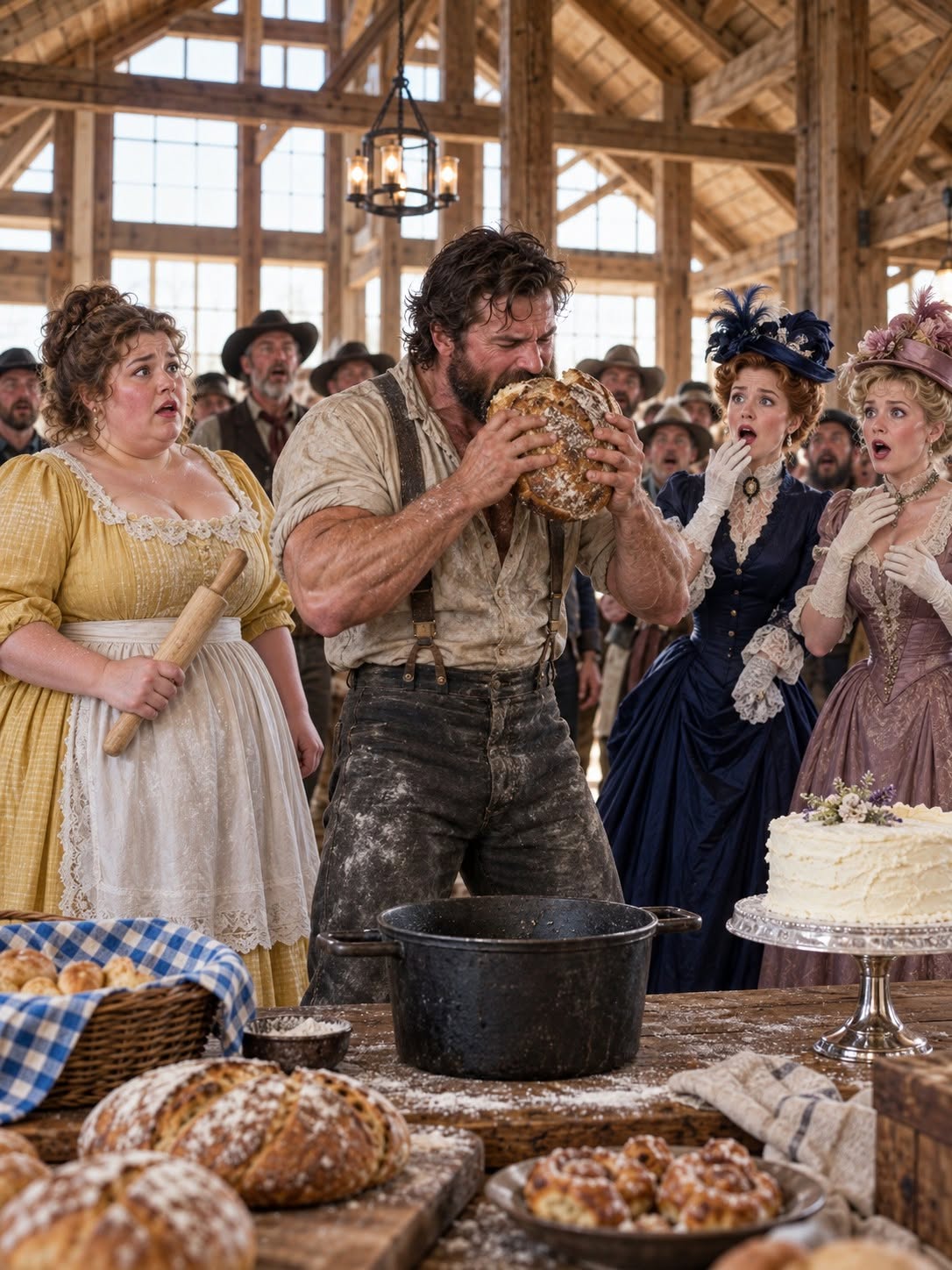
THE WOMEN AT THE FRONTIER MARKET LAUGHED AT HER HOMEMADE BREAD AND CALLED HER A HOPELESS NOBODY—UNTIL THE RUGGED MOUNTAIN MAN TOOK ONE BITE, TURNED TOWARD THE ENTIRE CROWD, AND DECLARED, “THAT’S THE ONE I’M TAKING HOME.”
PART 2 — THE MOUNTAIN MAN’S UNEXPECTED CHOICE
Harlan Jessup did not look at Pearl.
He reached into his coat, pulled out a small hunting knife, and cut a thick slice from the sourdough loaf.
The crust cracked beneath the blade.
A deep, warm fragrance rose from the bread—roasted oats, honey, and the faint tang of wild yeast.
Harlan examined the slice.
Then he took a bite.
He chewed slowly.
The entire room watched him.
He took another bite.
Then he closed his eyes.
For a moment, the hard lines around his mouth softened.
“Where’d you get this?” he asked.
Pearl laughed nervously.
“She made it herself, Mr. Jessup. That’s the trouble.”
Harlan turned his head.
“I wasn’t asking you.”
Pearl’s smile vanished.
His eyes moved across the room until they found Harriet sitting beside the stove.
“You made this?”
Harriet stood so quickly that her knee struck the bench.
“Yes, sir.”
“What’s in it?”
“Rye flour, oats, a little honey, salt, and my starter.”
“Your starter?”
“My father began it when I was a girl. I’ve kept it alive ever since.”
Harlan looked down at the bread again.
“How old?”
“Twenty-three years.”
He took another bite.
“Good bread.”
The words were simple.
But Harriet felt them settle somewhere deep inside her chest.
“Thank you, Mr. Jessup.”
He lifted the loaf with both hands, as if it were something valuable.
Then he turned toward the crowd.
“That’s the one I’m taking home.”
Silence.
The mayor blinked.
“Beg pardon?”
“The bread. I’ll take it.”
Josephine gave a thin laugh.
“Well, of course, Mr. Jessup. But surely you mean you’ll buy the loaf. The box social rules say the winning bidder gets the company of the lady who prepared the food.”
“I heard the rules.”
The mayor cleared his throat.
“Then we’ll begin the bidding.”
Harlan reached into his pocket and placed a gold coin on the table.
“Five dollars.”
A murmur swept through the hall.
Five dollars was more than anyone had paid for a box that evening.
The mayor stared at the coin.
“Five dollars! Do I hear six?”
Nobody spoke.
Harlan looked at the crowd.
“Ten.”
Josephine’s mouth fell open.
“Ten dollars for that ugly old loaf?”
Harlan turned toward her.
“That loaf will feed a working man for three days. Your cake might keep a parlor pretty for an hour.”
A few men coughed to hide their laughter.
Pearl flushed.
Harlan laid another coin on the table.
“Twenty dollars.”
The mayor nearly dropped his gavel.
“Sold!”
The room erupted into whispers.
But Harlan wasn’t finished.
He turned toward Harriet.
“Now, ma’am, I believe the rules say I get your company for the evening.”
Harriet looked at him in disbelief.
“Yes, sir. But—”
“Would you care to have supper with me?”
She glanced at the women near the table.
Josephine’s face was rigid with disbelief. Pearl looked as though someone had stolen the air from her lungs.
Harriet swallowed.
“I don’t believe I have anything suitable to wear.”
Harlan studied her faded dress, her flour-marked apron, and her rough hands.
“You’re wearing clothes. That’s suitable enough.”
The room went quiet again.
Then Harriet surprised herself.
She smiled.
“All right, Mr. Jessup. I’ll have supper with you.”
They left the hall together shortly after the auction ended.
The cold night air bit at Harriet’s cheeks. Harlan had brought his horse and a small sled to carry his purchases.
He noticed her rubbing her hands.
“Cold?”
“A little.”
He removed his thick fur-lined gloves and handed them to her.
“What about you?”
“I’ve got another pair.”
He did not.
Harriet noticed.
“Mr. Jessup, I can’t take your only gloves.”
“You can if I tell you to.”
She looked at him.
“Do you always give orders?”
“Only when I’m worried.”
The answer came so naturally that Harriet almost missed it.
She climbed onto the sled, and Harlan wrapped a heavy blanket around her knees.
As they traveled up the mountain road, the town lights gradually disappeared behind them.
For a while, neither spoke.
Then Harlan asked, “How long have you been running the boarding house?”
“Since my father died. Three winters.”
“Hard work.”
“It keeps the roof over my head.”
“How many boarders?”
“Usually six. Sometimes eight when the mill is busy.”
“And you do all the cooking?”
“And the cleaning. Laundry. Repairs when I can manage them.”
He glanced back at her.
“That’s a lot for one person.”
Harriet shrugged.
“Someone has to do it.”
The sled climbed through a stand of pine trees.
After a moment, Harlan spoke again.
“Your father must have taught you well.”
Harriet looked down at her hands.
“He taught me everything.”
“What was his name?”
“Thomas Bell.”
Harlan’s expression changed.
“Thomas Bell?”
She nodded.
“You knew him?”
Harlan stared at the road.
“I knew a man by that name once. Worked in the old timber camp?”
“Yes. Before he became too sick to work.”
Harlan said nothing more.
But Harriet noticed his jaw тιԍнтen.
When they reached his cabin, she understood why people called him a mountain hermit.
The place stood in a clearing surrounded by towering pines. Smoke curled from the chimney. A woodpile stood beneath a covered lean-to, and a pair of snowshoes hung beside the door.
Inside, the cabin was simple but clean.
There was a stone fireplace, a broad table, two chairs, a narrow bed, and shelves lined with jars.
Harlan placed the loaf on the table.
“Make yourself comfortable.”
Harriet removed her gloves.
“Do you live here alone?”
“Yes.”
“Have you always?”
“Long enough.”
She didn’t ask more.
He heated stew over the fire and set two bowls on the table.
Harriet tasted it.
“That’s good.”
“Elk.”
“Your own?”
“SH๏τ it last month.”
 She looked around the cabin.
“You must be very self-sufficient.”
“Have to be.”
They ate quietly.
After supper, Harlan poured coffee and placed a small plate of bread between them.
He took another bite.
Then he looked at her.
“Would you consider making bread for me regularly?”
Harriet blinked.
“Regularly?”
“I spend half my winter eating hard biscuits and dried meat. Good bread would be worth paying for.”
She smiled faintly.
“I could bake twice a week.”
“How much?”
“Whatever you think is fair.”
“No. You tell me what your work is worth.”
Harriet had no answer.
Nobody had ever asked her that.
Finally, she said, “One dollar per loaf.”
Harlan nodded.
“Two.”
“Mr. Jessup—”
“Your bread is worth two.”
She looked down at the table.
For a moment, she couldn’t speak.
Then Harlan leaned back.
“There’s something else.”
Her smile faded.
“What?”
He stared into the fire.
“I didn’t come to that social just because I needed bread.”
Harriet waited.
“I came because I heard someone in town was selling the old Bell boarding house.”
Her heart jumped.
“Who told you that?”
“The bank clerk.”
“That house isn’t for sale.”
“According to him, it will be if the overdue loan isn’t paid by the end of the month.”
Harriet’s hands went cold.
Her father had borrowed money for medical treatment during his final winter. The debt had been small at first, but interest had grown like weeds.
She had been making payments whenever she could.
“I’ve been paying it,” she whispered.
“Not enough, apparently.”
“I know.”
Harlan looked at her.
“How much do you owe?”
She hesitated.
“One hundred and eighty dollars.”
He nodded slowly.
“That’s why you brought bread to the social.”
Harriet stared at him.
“How did you know?”
“Because a woman who works as hard as you do doesn’t carry a pot that heavy just for entertainment.”
She looked away.
“I thought if people liked my bread, perhaps I could earn enough to keep the house.”
Harlan was quiet for a long time.
Then he said, “I have a proposition.”
Harriet stiffened.
“What sort of proposition?”
“I need someone to cook at my cabin. Not just bread. Meals. Someone to help me keep the place in order through winter. I can pay you a proper wage.”
She studied him.
“Why me?”
“Because your bread is good.”
“That’s all?”
He hesitated.
“No.”
The fire popped.
Harlan looked at her with an expression she couldn’t quite read.
“Because when you walked into that hall tonight, everyone looked at your size, your dress, and your old iron pot. I looked at what your hands had made.”
Harriet felt her throat тιԍнтen.
“And what did you see?”
“A woman who knows how to keep something alive.”
For a moment, she couldn’t look at him.
Then he stood and walked to the shelf.
He brought down a small wooden box and placed it on the table.
Inside was a stack of old letters.
“There’s something I should tell you about your father.”
Harriet looked up.
“What about him?”
Harlan pulled out a folded document.
“Thomas Bell and I worked together twenty years ago. He saved my life during a timber accident. Before he died, he wrote to me.”
Harriet’s fingers trembled.
“Why didn’t you ever come to see him?”
Harlan looked toward the window.
“Because I received his letter too late.”
He placed it in front of her.
The envelope bore her father’s handwriting.
And across the front, in faded ink, were four words:
For my daughter, Harriet.
She opened it carefully.
The first line made her gasp.
If you’re reading this, then Harlan Jessup has finally found you.
She looked up.
Harlan’s face had gone pale.
Because neither of them had expected the letter to contain what came next.
There is something about the boarding house you must know. It was never meant to belong to the bank.
And beneath that sentence was a name.
JOSEPHINE WHITCOMB.