The Little Boy Whose Leg Could Not Grow Normally
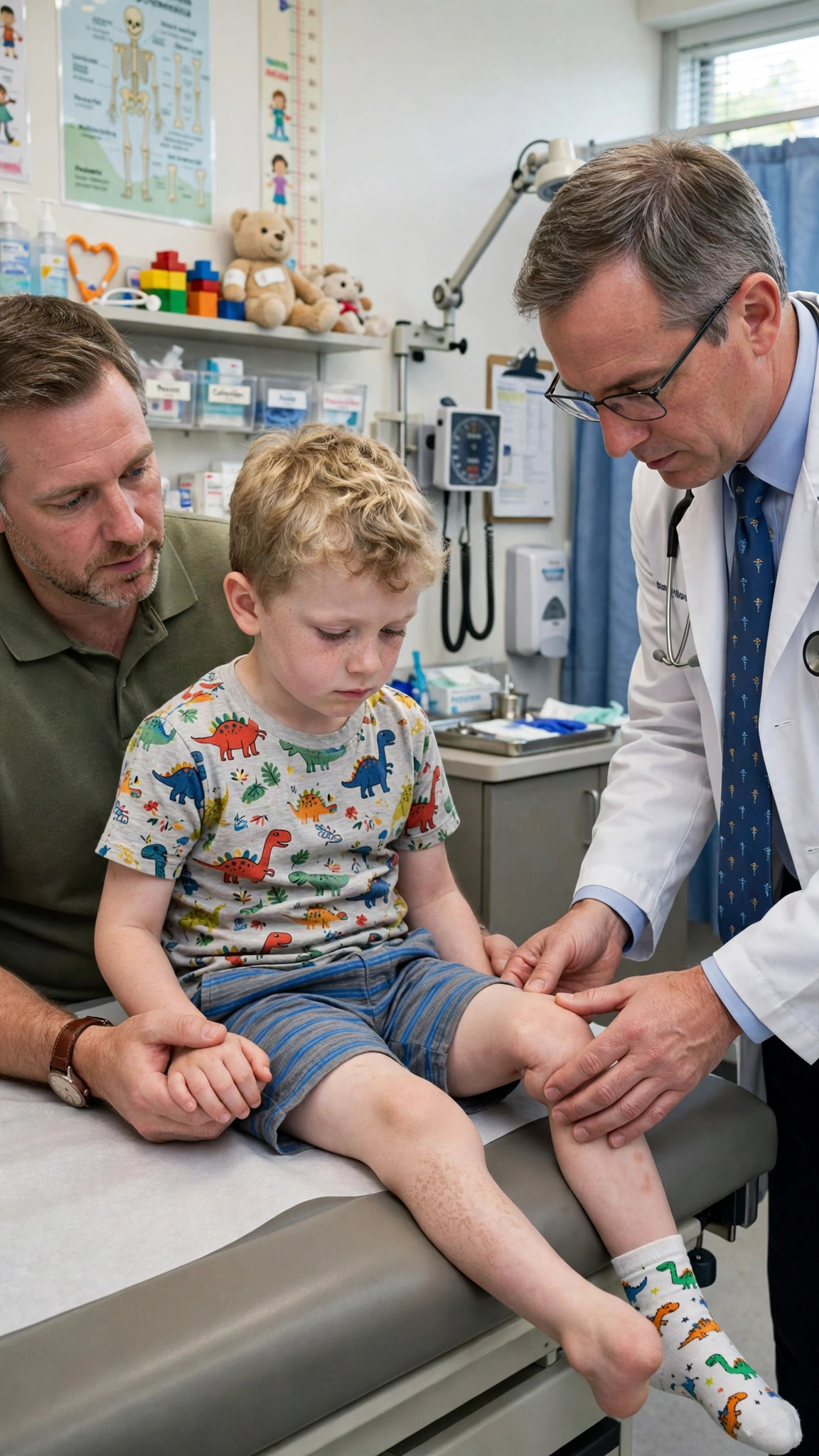
Living With Congenital Tibial Pseudarthrosis: Ethan’s Journey Through a Rare Bone Condition
When little Ethan was born, nothing immediately suggested that he would face an unusual medical challenge during childhood.
However, as he began growing, his parents gradually noticed something different about one of his legs.
His left lower leg appeared slightly curved, particularly around the shin. At first, the difference was not very obvious. His parents thought it might simply be a temporary variation in the way his bones were developing.
They hoped that as Ethan grew older and became more physically active, the appearance of his leg might change naturally.
But the unusual shape did not disappear.
Instead, the curvature gradually became more noticeable. His lower leg appeared increasingly bent forward, and his parents began observing differences in the way he moved and supported his body.
When Ethan started trying to stand and take his first steps, the situation became more concerning. He sometimes appeared uncomfortable when placing weight on the affected leg, and maintaining balance seemed more difficult than expected.
His parents realized that this was not something they should continue to ignore.
They decided to seek specialized medical advice to understand why their little boy’s leg was developing differently.
The Medical Examinations That Revealed the Condition
At the hospital, doctors began with a detailed physical examination.
They evaluated the shape of Ethan’s lower leg, examined his joints, observed his movement, and ᴀssessed how comfortably he could stand and place weight on his feet.
To understand the structure of the affected bone, doctors recommended X-ray imaging.
The images allowed the orthopedic specialists to examine the tibia, which is the larger of the two bones in the lower leg and plays an important role in supporting body weight.
After reviewing the examination results and considering Ethan’s clinical history, doctors diagnosed him with a rare condition known as Congenital Tibial Pseudarthrosis, commonly abbreviated as CPT.
For Ethan’s parents, receiving this diagnosis was an emotional moment.
They had noticed that something was different for quite some time, but they had not expected their child to have such an uncommon bone disorder.
They now needed to understand what the condition meant, how it could affect Ethan’s development, and what medical options might help protect his leg.
What Is Congenital Tibial Pseudarthrosis?
Congenital tibial pseudarthrosis is a rare condition that affects the normal development and structural strength of the tibia.
The condition is often ᴀssociated with an abnormal area of bone formation, usually involving the middle or lower portion of the tibia.
The affected section of bone may become unusually weak, allowing the leg to develop an abnormal curvature.
In some children, the weakened bone can fracture spontaneously or after relatively minor trauma.
One of the most challenging complications occurs when a fracture fails to heal normally. Instead of joining together into a stable bone, the broken ends may remain separated and develop a false joint, known medically as a pseudarthrosis.
This can result in an unstable area within the lower leg.
The affected bone may become progressively deformed, and the leg may not provide sufficient support for normal standing and walking.
The severity of congenital tibial pseudarthrosis varies considerably between children. Some develop significant bone deformity early in life, while others experience fractures and increasing difficulties as they grow.
In certain cases, the condition is ᴀssociated with neurofibromatosis type 1, although it can also occur without that diagnosis.
Because every child’s situation is different, careful evaluation by an experienced pediatric orthopedic team is essential.
How the Condition Affects Ethan’s Everyday Life
For Ethan, the condition has introduced challenges into activities that many children experience naturally.
Standing, walking, and playing may require additional effort and support.
His parents have noticed that he sometimes needs more time to move around and that he cannot always participate in physical activities in the same way as other children.
The visible curvature of his lower leg is also something he is gradually becoming aware of.
As he grows older, he may begin asking questions about why his leg looks different or why he needs to attend so many hospital appointments.
These moments can be emotionally difficult for a young child.
His family tries to make sure that he understands that his condition is not his fault and that he should never feel embarrᴀssed about asking for help.
They encourage him to participate in activities that are comfortable and appropriate for his physical abilities.
Rather than allowing his medical condition to define his childhood, they focus on creating opportunities for him to learn, play, and develop confidence.
The Importance of Long-Term Orthopedic Care
Congenital tibial pseudarthrosis is a complex condition that often requires long-term medical monitoring.
Doctors regularly evaluate the shape, strength, and development of the affected bone.
They may use follow-up X-rays to determine whether the curvature is changing, whether a fracture has occurred, and how the bone is responding to previous treatment.
Treatment depends on several factors, including the child’s age, the severity of the deformity, the presence of a fracture, and the condition of the surrounding bone and soft tissue.
Some children may benefit from specialized protective braces to support the leg and reduce the risk of further injury.
When the bone is fractured or unstable, surgery may be necessary.
Surgical approaches can include removing abnormal tissue, stabilizing the bone with internal or external fixation devices, and using bone grafts to encourage healing.
Certain specialized techniques may also be considered for difficult cases.
Even after successful treatment, continued monitoring is important because the affected bone can remain vulnerable as the child grows.
For Ethan, each medical appointment is part of a longer journey toward protecting his mobility and supporting his development.
His doctors carefully discuss the available options with his family, explaining the potential benefits, limitations, and risks of different approaches.
A Family Learning to Face Each Challenge
The diagnosis has changed many aspects of family life.
Hospital visits, medical discussions, and concerns about Ethan’s future have become part of their routine.
His parents must balance their hopes for his recovery with the reality that his condition may require ongoing treatment.
His father often spends quiet moments with him, holding his hand and listening to the questions that naturally come with growing up.
Sometimes Ethan watches children running outside and wishes he could move just as freely.
His father understands that these moments can be difficult.
He reminds his son that every child develops differently and that having a medical condition does not make him any less valuable.
His mother also works hard to maintain a sense of normality at home.
She encourages Ethan to enjoy the activities he loves, whether that means drawing pictures, building imaginary roads with his toy cars, or listening to stories before bedtime.
The family celebrates his progress without comparing him to other children.
A new skill, a happy afternoon, or the confidence to try something unfamiliar can become a meaningful achievement.
A Childhood Filled With Hope and Possibilities
Although Ethan’s medical journey may involve difficult decisions and periods of recovery, his life is not defined by the condition affecting his leg.
He is still a little boy who enjoys discovering new things, asking questions, laughing with his parents, and imagining what he might become when he grows up.
His parents know that there may be challenges ahead.
They also understand that medical treatment cannot always provide immediate or permanent solutions, particularly in a condition as complicated as congenital tibial pseudarthrosis.
Nevertheless, they remain committed to working with his doctors and following the care plan designed for his individual needs.
Their greatest hope is that Ethan will continue developing his confidence, maintaining as much mobility as possible, and enjoying the experiences that make childhood special.
Ethan Is More Than His Diagnosis
Congenital tibial pseudarthrosis is a rare bone disorder that can affect a child’s physical development, mobility, and quality of life.
But behind every medical diagnosis is a child with feelings, interests, dreams, and a future that deserves to be protected.
Ethan’s curved little leg may make certain parts of his journey more difficult, but it does not determine his intelligence, personality, or ability to experience happiness.
He deserves to play, learn, make friends, and dream about the future just like every other child.
For his parents, the most important thing is not whether Ethan can run as fast as other children.
It is seeing him grow up feeling loved, supported, and confident in who he is.
And sometimes, the most meaningful progress begins with something as simple as a little boy smiling and knowing that he is never facing the journey alone.