PART 2 — THE MEN WHO CAME LOOKING FOR THE LEDGER
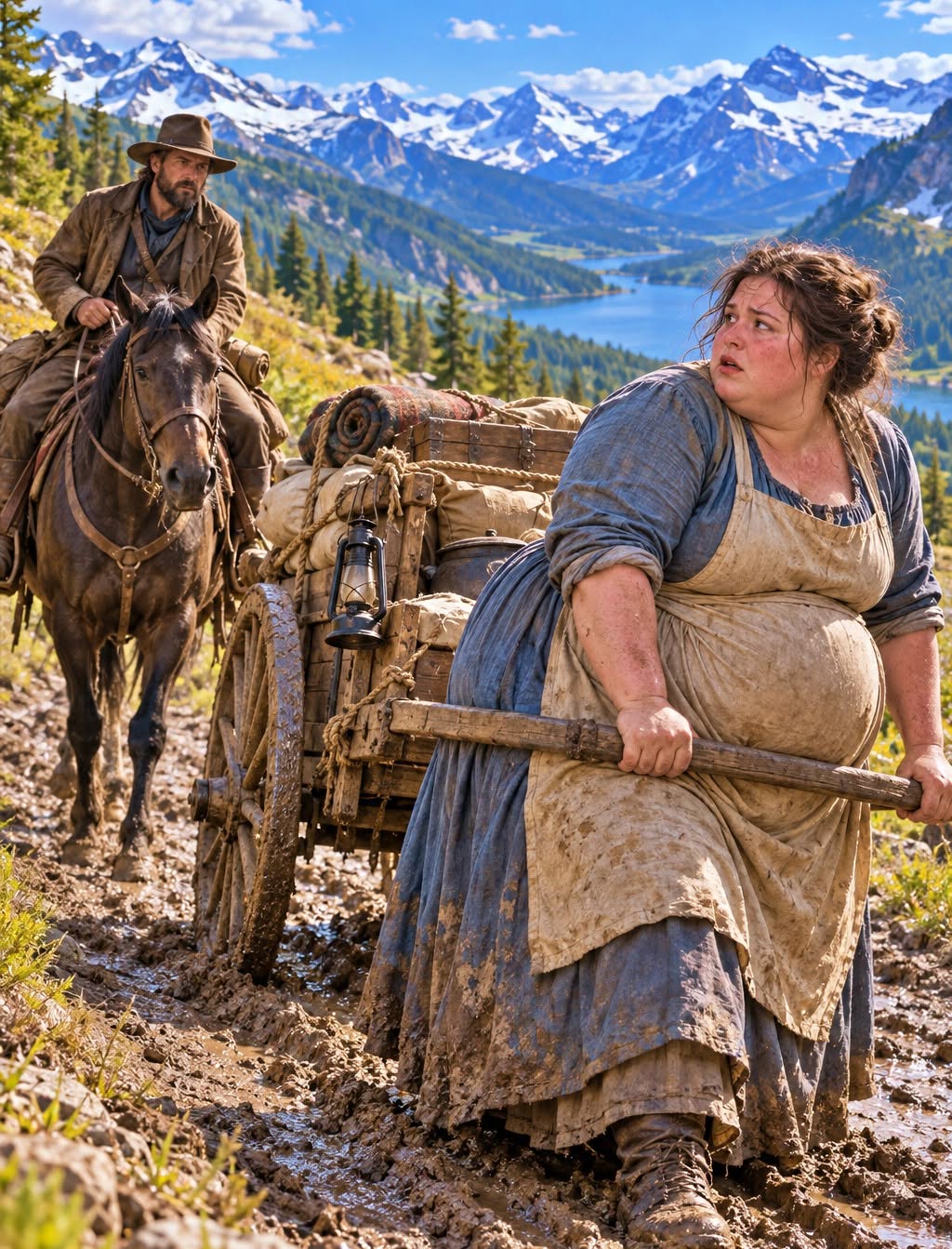
PART 2 — THE MEN WHO CAME LOOKING FOR THE LEDGER
The four riders disappeared beyond the ridge, but Holt Brennan did not relax.
He stood beside the cart, watching the trail long after the last horse had vanished.
Tabitha noticed that his right hand remained close to the rifle.
“They’ll come back,” she said.
“Probably.”
“With more men?”
“Possibly.”
She looked toward the road leading to Dunmore Crossing.
“Then we should keep moving.”
Holt turned toward her.
“You’re eight months pregnant, Mrs. Gorse. You’ve been pulling that cart for three days. You don’t need to prove anything else today.”
“I’m not trying to prove anything.”
“Then what are you trying to do?”
“Keep the promise I made to my husband.”
Something in Holt’s expression changed.
He nodded once, then checked the towline.
“All right. We’ll reach the settlement before dark.”
But he did not explain why he had suddenly become more watchful.
For the next hour, he kept looking behind them.
Dunmore Crossing appeared just as the evening light began fading.
It was a small settlement of timber buildings, a blacksmith’s shop, a general store, a church, and a boarding house with a painted sign swinging above the entrance.
MRS. VICKERS — ROOMS AND MEALS.
Tabitha felt relief wash over her.
For the first time in three days, she could see a proper bed in her imagination.
Holt stopped the cart outside the boarding house.
A woman in her late fifties came hurrying down the steps.
“Mrs. Gorse?”
“Yes. I’m Tabitha.”
“Oh, thank goodness. I’ve been expecting you.”
Mrs. Vickers looked at Tabitha’s swollen belly, then at the cart.
“Come inside, dear. You look exhausted.”
Tabitha climbed down carefully.
Holt helped her, then began unloading the supplies.
Mrs. Vickers noticed him.
 “And who might this be?”
“Holt Brennan.”
The woman’s welcoming expression suddenly became cautious.
“Brennan?”
“That’s right.”
She glanced toward the street.
“Well, I suppose you should come inside too.”
Holt shook his head.
“I have business at the livery.”
“Mr. Brennan,” Mrs. Vickers said quietly, “I wouldn’t go wandering around town just yet.”
He studied her face.
“Why?”
“Because Crispin Ford’s men arrived an hour ago.”
Tabitha felt the ledger against her ribs.
“They’re already here?”
Mrs. Vickers nodded.
“Four of them. They’ve been asking about a surveyor named Edmund Gorse.”
Holt’s expression became unreadable.
“Where are they now?”
“At the H๏τel. With Mr. Ford himself.”
For a moment, nobody spoke.
Then Holt looked at Tabitha.
“Get inside. Don’t open the door for anyone unless you hear my voice.”
Tabitha frowned.
“I’m not a child.”
“I know.”
“Then don’t speak to me like one.”
He considered that.
“Fair enough. But stay somewhere safe.”
He turned to leave.
Before he reached the street, Tabitha called after him.
“Mr. Brennan?”
He stopped.
“Thank you for helping me.”
He gave a small nod.
“Get some rest, Mrs. Gorse.”
Then he disappeared into the gathering dusk.
Mrs. Vickers gave Tabitha a small upstairs room overlooking the main street.
There was a narrow bed, a washstand, and a little iron stove.
It was more comfort than Tabitha had known in weeks.
She washed the road dust from her face, changed her dress, and placed Edmund’s ledger inside the locked wooden trunk.
She was just beginning to feel human again when someone knocked.
Three sharp taps.
“Mrs. Gorse?”
It was Mrs. Vickers.
Tabitha opened the door.
The older woman looked troubled.
“There’s a gentleman downstairs asking to speak with you.”
“Who?”
“He says he’s Mr. Ford’s attorney.”
Tabitha’s stomach тιԍнтened.
“Tell him I’m resting.”
“I did. He says the matter is urgent.”
“Then he can come back tomorrow.”
Mrs. Vickers hesitated.
“He has brought a doctor.”
Tabitha stared at her.
“A doctor?”
“He says Mr. Ford is concerned about your condition and wants to make certain you’re receiving proper care.”
Tabitha understood immediately.
Crispin Ford had not sent a doctor out of kindness.
He wanted to see what she knew.
“Tell them I already have a doctor.”
Mrs. Vickers looked confused.
“Do you?”
“No. But I will.”
The older woman almost smiled.
“I’ll send them away.”
She started down the stairs.
Then a man’s voice rose from below.
“Mrs. Gorse! I know you’re in there.”
Tabitha stepped back.
“Open the door,” he continued. “This will be much easier if you cooperate.”
She closed her bedroom door and turned the key.
A moment later, she heard Mrs. Vickers speaking firmly.
“She is not receiving visitors.”
“Then perhaps you can explain why she’s carrying government property.”
Tabitha went still.
The attorney knew about the ledger.
And he knew exactly why Edmund had entrusted it to her.
Downstairs, Mrs. Vickers stood between the attorney and the staircase.
“She’s a widow who needs rest. You can conduct your business tomorrow.”
The attorney smiled.
“Mrs. Vickers, I would advise you not to interfere in matters that don’t concern you.”
“I would advise you to leave my boarding house.”
His smile disappeared.
He reached into his coat and produced a folded document.
“This is an order authorizing the recovery of stolen government survey records.”
Mrs. Vickers glanced at the paper.
Then she looked toward the front window.
A familiar figure was crossing the street.
Holt Brennan.
He entered without knocking.
“Put that paper away,” he said.
The attorney turned.
“Mr. Brennan. I was wondering when you’d appear.”
“Then your wondering is finished.”
The two men stared at one another.
The attorney folded the document.
“You’re making a mistake involving yourself in this.”
Holt removed his hat.
“That’s possible.”
“Ford won’t appreciate it.”
“I’ve never been particularly concerned about what Ford appreciates.”
The attorney moved toward the door.
But before leaving, he looked toward the staircase.
“Tell Mrs. Gorse that her husband’s records are government property. If she doesn’t surrender them, she’ll be considered an accomplice.”
Holt stepped aside.
“Get out.”
The attorney left.
Mrs. Vickers locked the door behind him.
“Who is that man?” she whispered.
“Someone who knows less than he thinks,” Holt replied.
He looked up toward Tabitha’s room.
“Is she all right?”
“She’s frightened, but she won’t admit it.”
Holt nodded.
“That sounds like her.”
The following morning, Tabitha went to see Sheriff Monroe.
Holt accompanied her, though he remained several steps behind.
The sheriff was a broad-shouldered man with tired eyes and a silver mustache.
When Tabitha introduced herself, he immediately stood.
“Mrs. Gorse. I’ve been expecting you.”
She reached inside her coat.
“Edmund asked me to bring you this.”
She placed the ledger on his desk.
Sheriff Monroe didn’t open it immediately.
Instead, he locked the office door.
Then he closed the curtains.
“Did anyone see you carrying it?”
“Mr. Ford’s men know I have it.”
The sheriff swore under his breath.
“Then we’re already in trouble.”
Tabitha sat down.
“What does the ledger contain?”
Monroe opened it.
He turned several pages, reading Edmund’s neat handwriting.
His expression grew increasingly serious.
“Good Lord.”
Holt moved closer.
“What is it?”
The sheriff looked up.
“Ford has been acquiring land through fraudulent survey adjustments. Water rights, timber boundaries, mining claims. He’s been moving property lines by changing the original measurements.”
Tabitha leaned forward.
“Edmund discovered it?”
“He didn’t merely discover it. He documented everything.”
Monroe turned another page.
“Here are the original measurements. Here are the altered records. And here are the names of the men who approved the changes.”
He stopped.
One name appeared repeatedly.
“Commissioner Alistair Bell.”
Holt’s face тιԍнтened.
“Bell?”
The sheriff nodded.
“He’s the man responsible for reviewing land claims in this district.”
Tabitha looked between them.
“Why would a government commissioner help Ford?”
Monroe closed the ledger.
“Because Ford has made certain people very wealthy.”
He walked to the window and looked out.
“Edmund was going to testify. He had enough evidence to bring down the entire operation.”
Tabitha swallowed.
“Was that why he died?”
The sheriff turned slowly.
“I can’t prove that.”
“But you suspect it.”
Monroe didn’t answer.
He didn’t need to.
For several moments, Tabitha couldn’t speak.
She remembered Edmund’s last days, his fever, his exhausted hands, and the way he had pressed the ledger against her palms.
Recorded facts are the only honest currency.
She had thought he was asking her to protect a book.
Now she understood he had been asking her to protect the truth.
That afternoon, Holt returned to the boarding house with a serious expression.
“We need to move you.”
Tabitha looked up from the account book Mrs. Vickers had given her.
“Where?”
“Somewhere Ford won’t think to look.”
“I’m not leaving.”
“Tabitha—”
It was the first time he had used her given name.
She noticed.
“Edmund trusted me with that ledger. I’m not going to run from the men who killed him.”
Holt was silent.
Then he pulled out a chair.
“There’s something you should know.”
He looked down at his hands.
“Five years ago, I worked for Crispin Ford.”
Tabitha stared at him.
“What?”
“I hauled supplies to his camps. Took messages. Helped move equipment. I didn’t know what he was doing with the land records.”
“How long?”
“Almost two years.”
“Why did you leave?”
Holt looked toward the window.
“Because a man named Samuel Reed questioned one of Ford’s surveyors. Two days later, Reed disappeared.”
Tabitha’s expression hardened.
“And you did nothing?”
“I left.”
“That’s not the same as doing nothing.”
“No,” Holt said quietly. “It isn’t.”
He looked at her.
“I’ve spent five years wondering whether leaving was enough.”
Tabitha studied him.
For the first time, she understood that his quietness wasn’t simply a personality.
It was something he had built around himself.
“Mr. Brennan,” she said, “I don’t need a perfect man helping me. I need an honest one.”
Holt met her eyes.
“Then I’ll tell you everything I know.”
Before he could continue, a loud crash sounded from the street.
They rushed to the window.
A horse had bolted outside the blacksmith’s shop.
Behind it, a man was shouting.
And beside the boarding house door stood a young boy holding a small package.
The boy looked directly at Tabitha.
“Mrs. Gorse?”
“Yes?”
He held out the package.
“My mother told me to give you this.”
“Who is your mother?”
The boy swallowed.
“Mrs. Reed.”
Holt went completely still.
Tabitha looked at him.
“Do you know her?”
Holt’s face had lost all color.
“Samuel Reed’s wife.”
The boy nodded.
“She said you should read it before Mr. Ford finds out she’s still alive.”
He pushed the package into Tabitha’s hands and ran.
Inside was a folded letter and a small brᴀss compᴀss.
Tabitha opened the letter.
The handwriting was shaky, but the words were clear.
Mrs. Gorse,
My husband did not disappear. He was taken because he discovered what Crispin Ford had done.
Edmund Gorse helped him hide the original survey records. I know where Samuel was last seen, and I know who gave the order.
But there is something Edmund never told you.
The land Ford wants is not simply valuable because of its timber or water.
Beneath the northern ridge lies the original boundary marker for a much larger territory—land that was never legally transferred.
And the person whose name appears on the original deed is not Crispin Ford.
Tabitha read the final line.
Her hands began to tremble.
It is Holt Brennan.
She slowly raised her eyes.
Holt was staring at the letter.
Outside, a carriage had stopped in front of the boarding house.
A man stepped down.
Crispin Ford himself.
And he was carrying a document with Holt’s signature on it.
To be continued in Part 3…