Part 2 — Seven Steps Behind
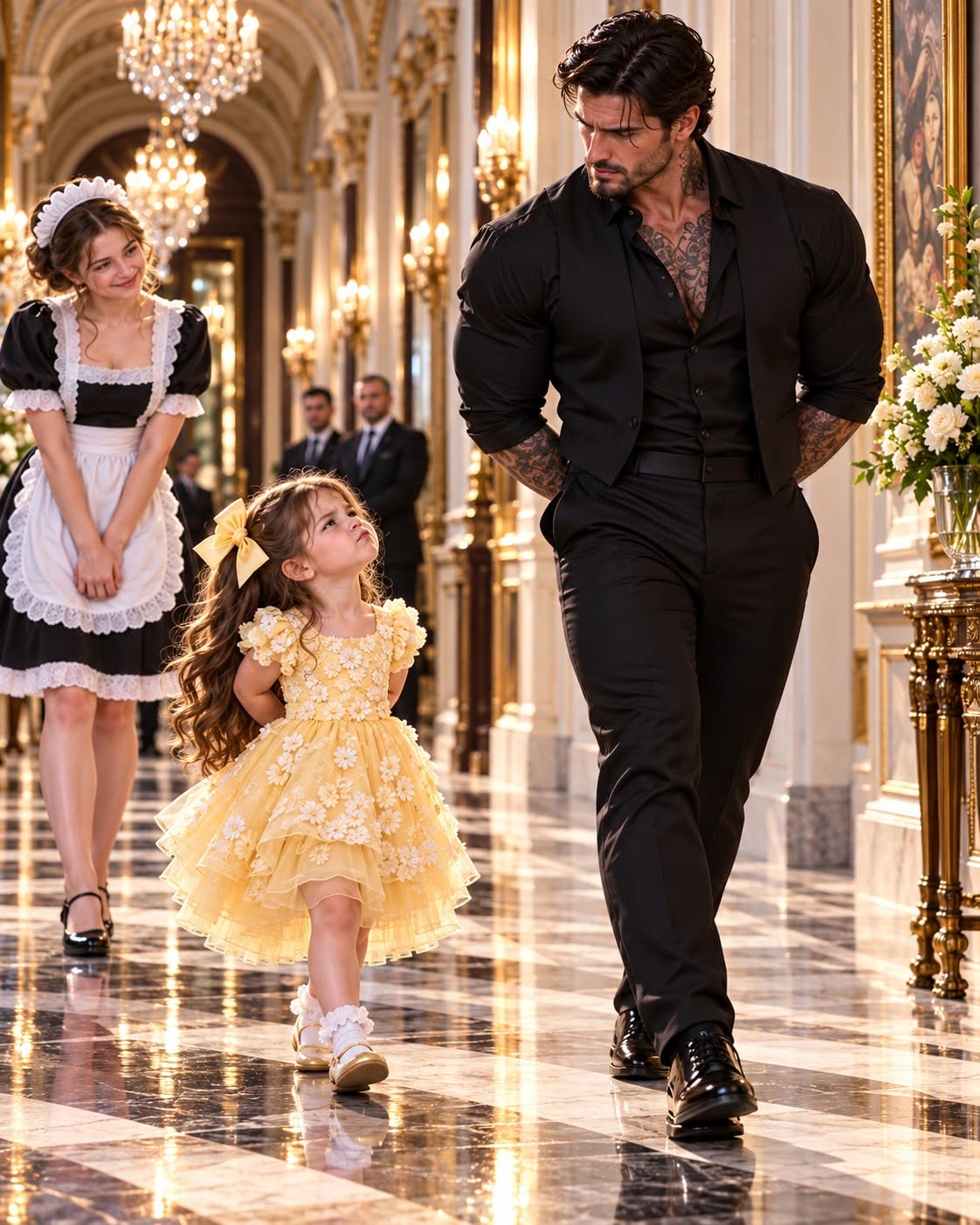
The Door That Answered
“What did you say?”
The cold was gone from his voice. What remained was worse: attention. Sophia patted his cheek once, proprietary.
“The pretty lady. She sits by the window when you walk. She doesn’t like the lock.”
A guard shifted. Rosa heard it like a cocked thing. Dante’s eyes stayed on the child.
“No one sits in that room.”
 “She does when the house gets quiet.” Sophia glanced at Rosa, then back, lowering the secret as if volume were the problem. “She said your name the long way. And she said don’t be mad at Mama.”
Rosa’s mouth was dry. She had never had a key. She had never stood at that door longer than it took to pᴀss it. “Mr. Falcone, she’s three. She invents—”
“Open it.”
The order was not for her. A guard produced a ring Rosa had never seen on a belt. The lock turned harder than it should have, as if the mechanism had learned to resist. The door gave. Dust and a closed-up sweetness came out — perfume gone stale in fabric, not a body, not rot. Afternoon light lay on a chair by the window. Empty. A shawl folded over the arm. On the sill, a single crayon drawing that had not been there at the funeral: a tall black shape, a small yellow one, seven clumsy steps between them.
Dante did not enter. His hand found the frame.
“Who put that there?”
No one answered. Sophia walked in under his arm before Rosa could catch her, and pointed at the glᴀss.
“She watches the garden. She said the man with the silver pin took her chair once, but she made him put it back.”
Silver pin. Rosa knew it. Vincent Hale — not family, not quite staff. Carmela’s cousin on paper, the estate’s fixer in practice. He had been the one to announce the time of death. He had been the one to suggest the room stay locked “until Mr. Falcone was ready.”
Dante turned his head a fraction. “Find Hale.”
“He’s in the city,” the guard said.
“Then he can come back from the city.”
Sophia climbed onto the chair. Her shoes left prints in the dust on the cushion. She looked suddenly uncertain, the performance gone. “She cried when I copied your face. She said that was how you looked the day the car stopped.”
The ambush had not been a car stopping. It had been a driveway, four o’clock, Dante already at the door and Carmela between him and the street. Rosa watched the calculation move behind his eyes and hated that she could see it.
From the corridor, a phone buzzed. The guard answered, listened, and went the color of the marble.
“Hale’s car is at the south gate,” he said. “He isn’t in it. Trunk was popped from inside. There’s a woman’s coat in the back. Carmela’s. The one that went missing from this room.”
Dante’s hand left the frame. For the first time since Rosa had known him, he looked afraid of a hallway in his own house.
Sophia held up her arms again, smaller now.
“She said if you open the door, she can stop walking.”
Somewhere below them, in the service stair, a door that should have been bolted struck the wall — once, hard — and a man’s voice, not Hale’s, called Dante’s name the way you call it when the story you buried has just stood up.